

Selected Comparisons
The following comparisons to the iBasso Nunchaku were completed using a mix of the Vision Ears VE10, the Empire Ears ESR MKII, and the PMG Audio Apx, all in balanced mode. The Nunchaku was connected to a Samsung S23 Ultra via USB-OTG.
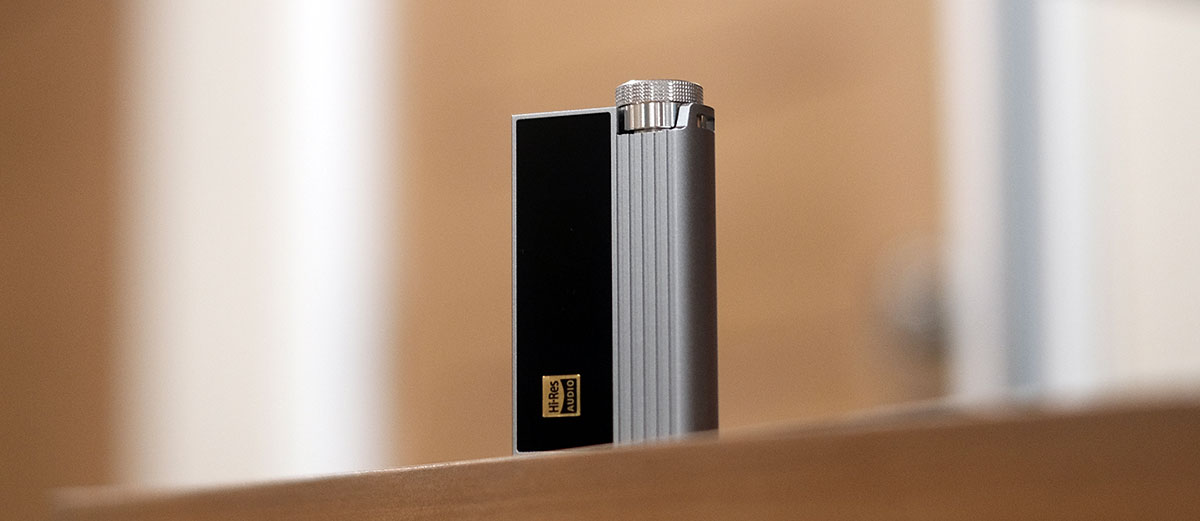
iBasso DC-Elite
The iBasso DC-Elite was launched in 2024, with my review published in July of the same year. It also won our Top Gear 2024 Award for the best Dongle DAC.
Technical
Despite the matching form factors, the innards of these two dongles are very different. The DC-Elite uses a single but more premium ROHM BD34301EKV DAC rather than the dual CS43198 design inside the Nunchaku.
However, decoding is much the same at a maximum of PCM 32BIT/768kHz and DSD512 natively via USB. Both dongles can also output via coaxial with a maximum decoding rate of PCM 32BIT/768kHz.
The DC-Elite is all solid-state, there are no tube modes inside it, and curiously, its power output is also a bit lower at a maximum of 280mW of balanced output power and 120mW single-ended into a 32Ω load.
The Nunchaku can output up to 525mW into 32Ω via its tube mode and 450mW into the same load on solid-state due to a slightly reduced Vrms output. That is considerably more power than the DC-Elite, making the Nunchaku more amenable to driving demanding headphones.
One thing to note is that the DC-Elite uses a rather expensive true 24-stepped attenuator for volume control, which should produce a tighter dB channel tolerance compared to the Nunchaku.
The only issue I have is that granular volume levels are difficult to achieve without the UAC app fine-tuning it for sensitive IEMs. That is not the case with the Nunchaku’s cheaper multifunction rotary dial.
Design
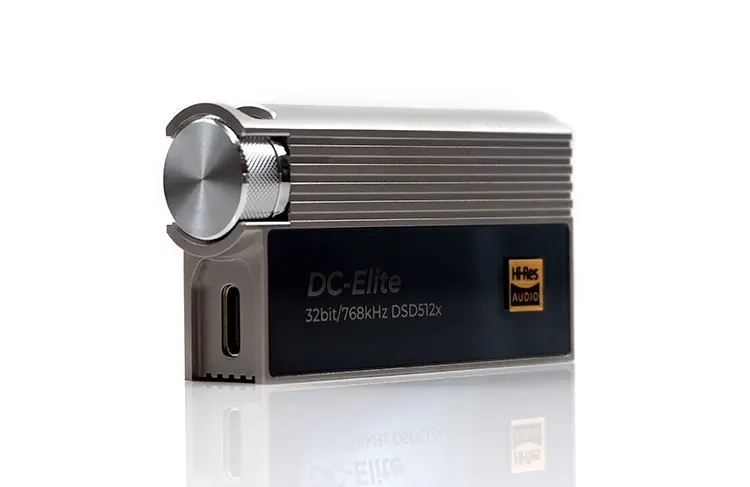
As discussed in detail on page 1 of this review, the form factor and design language of these two dongle DACs are the same. The differences are more nuanced than overt, at least when the Nunchaku LCD screen and tubes are not activated.
The one chassis design change is the lowering of the volume guard on the Nunchaku. Functionality-wise, that makes sense since it’s a press-down multipurpose dial.
However, the guard was a little too high on the DC-Elite to make easy volume changes, so I would like to think the Nunchaku version is also due to feedback.
Both dongle ports and connections are positioned and work in the same manner, so if you are coming from the DC-Elite to the Nunchaku or vice versa, the handling and stacking with phones and DAPs will have a familiar feel.
The more obvious change is the introduction of the LCD screen on the Nunchaku, combined with the rear panel tube illumination port when the tube mode is activated.
I prefer the LCD screen over the UAC/physical control system of the DC-Elite. I do not have to rely on UAC for visual cues as much with the Nunchaku.
Accessories and leather cases are much the same; both offer good quality IC cables for OTG, and the leather cases are a nice fit, albeit in different colors.
Performance
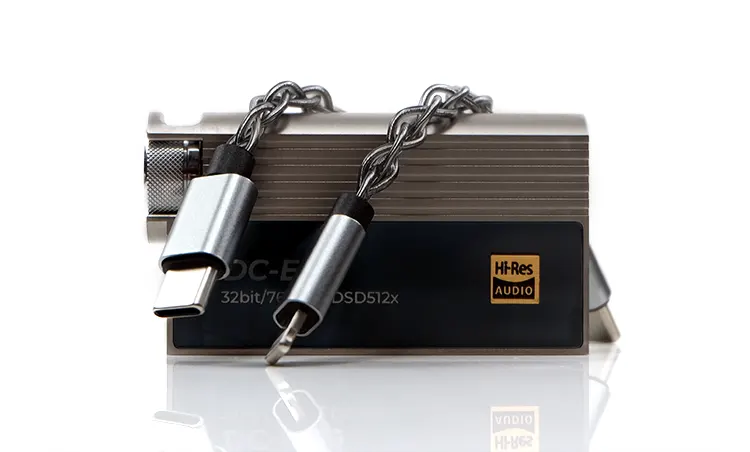
I tested with three IEMs switching between Class AB and tube mode, and in all instances, the DC-Elite sounded more dynamic and resolving. I can see why it is the flagship dongle in the range.
The DC-Elite tuning is much more upfront and vivid with a blacker background, so it’s more about the timbre match and personal preference.
And yes, the tone is a little bit drier, and might not be the best match for brighter IEMs where you want to keep a lid on treble overtones.
However, the precision, layering, and channel separation are superior to the Nunchaku. So, if you have a large staging IEM, such as the PMG Audio Apx, or a warmer, bassier alternative, like the VE10, then you will hear the DC-Elite’s strengths in an optimal environment.
I think if you are looking for more contrast between it and the DC-Elite, the tube mode is where things get very different. It’s a richer, smoother sound, slightly slower-paced with more bass bloom but much more agreeable over the highs with brighter IEMs.
Where the Nunchaku excels is bringing a macro soundstage and a smoother tone to the presentation. Slightly reduced in dynamic range and detail, but with a spacious imaging experience and a more relaxed vocal positioning.
And it is on vocals where the Nunchaku would get my vote. It’s a very natural analog type of tone from the tube mode, tuned for emotive connection and easy listening rather than absolute precision.
Cayin RU7
The Cayin RU7 was launched in 2023, replacing the RU6 as the company’s flagship pure dongle. It also won our Top Gear 2023 Award for best Dongle DAC.
Technical
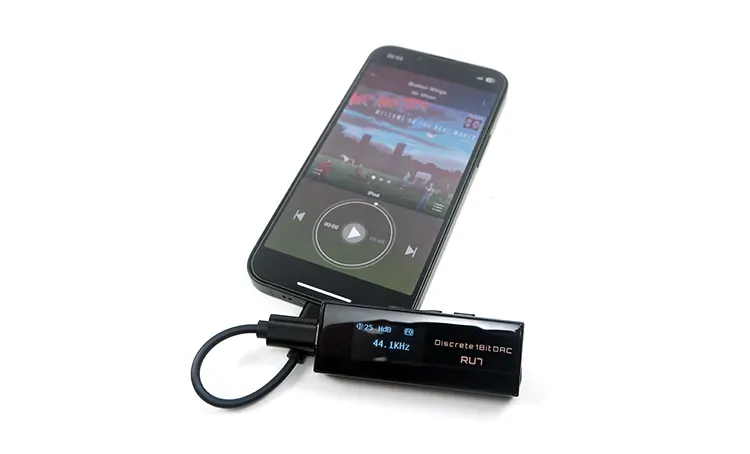
The RU7 is quite a different proposition from the Nunchaku internally. Instead of a delta-sigma DAC, it uses a discrete 1-bit DAC with an “all-to-DSD” digital signal processing approach.
That means both PCM and DSD get processed or upsampled to DSD before being sent to the DAC, which can then be user-controlled in terms of sampling levels from within the RU7 settings menu.
There are some limitations to this setup. Compared to the Nunchaku’s decoding limit of DSD512 and 32-bit/768 kHz, the decoding ceiling on the RU7 is lower at DSD256 natively and PCM 32-bit/384 kHz.
The RU7 is solid-state only; there are no tubes in its amplification, but output power is competitive at 160mW (3.5mm) and 400mW (4.4mm) into a 32Ω load
Though not quite as strong as the Nunchaku’s 525mW balanced output in tube mode, the solid-state 450mW rating is closer to the RU7 performance.
Although the RU7 can offer a lineout function, it does not have the Nunchaku’s ability to operate in S/PDIF mode, meaning it cannot connect and bypass the signal to a 3rd Party DAC.
Design
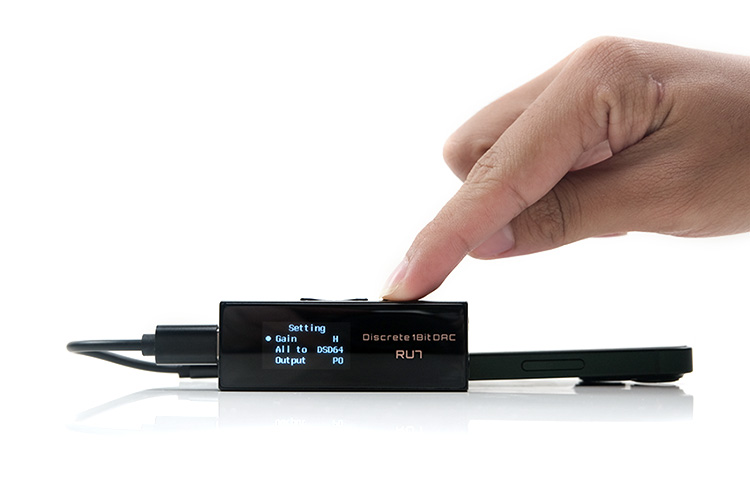
The Nunchaku has the superior build quality and materials, but the lighter and smaller RU7 might be more user-friendly for potential owners.
The Titanium alloy of the Nunchaku is a confidence builder, and I dare say it would better survive a drop over the RU7’s comparatively blander CNC aluminum build quality.
That being said, both come with some nice leather cases, so this is more of a moot point once slipped onto the dongle.
Both have onboard LCDs and UI menu-based control systems, with the Nunchaku going one step further with its Android UAC app integration, allowing easy access to the controls via a smartphone.
I prefer the control and granular volume control of the multifunction rotary dial on the Nunchaku over the RU7 rocker. The RU7 volume rocker is functional, but nothing beats the experience of a manual dial on an audio device.
Both are SE and balanced with USB-C for OTG and USB-DAC duties. However, another differentiator is a RU7’s dual balanced and SE lineout compared to the switchable 3.5mm coaxial output on the Nunchaku.
Owners of a 1BIT iBasso D16 can technically connect their unit with the Nunchaku coaxial output if they so wish.
Performance
The most appropriate comparison between these two is with the Nunchaku in the tube mode, but there are some common aspects in both modalities when compared to the RU7.
Differences include a denser sub-bass presence from the RU7 and a firmer note quality with a stronger fundamental throughout the mids.
The Nunchaku is a little more polished-sounding as you would expect from a delta-sigma DAC, with the Class AB exhibiting less texture and detail than the 1-bit DAC.
It doesn’t quite have the body and punch of the RU7, but one could argue it has a little more presence in the highs and slightly more sparkling upper-midrange overtones.
In tube mode, you get a much clearer perspective of their strengths. Both are expensive-sounding, with the RU7 showing some excellent depth and width, and the Nunchaku aiming more for width and height with a spacious set of mids.
Tonally, the RU7 is ‘uber’ analog, textured, and denser sounding, with the Nunchaku tube mode sounding a bit warmer. The tube mode is also slightly lighter in note weight, and sweeter in tone with more sparkle and upper-mids bloom.
The Nunchaku leans off the sub-bass a bit more with enhanced mid-bass bloom, which, in turn, creates a nice warm glow through the midrange combined with more liquid-sounding highs.
I have always considered staging to be a strength of the RU7, but compared to the Nunchaku tube mode, I find it a little more intimate in the mids and not quite as open-sounding with my tested IEMs.
I would pick the RU7 if you need sub-bass density and a stronger note fundamental. Go with the Nunchaku (tube mode) if you want a more spacious, sweeter-sounding set of mids and highs.
HiBy FC6
Like the RU7, the HiBy FC6 was launched in 2023, and at the time, it was the company’s flagship dongle DAC. It seems to be discontinued at this point, but it is still available at some dealers and retail websites.
Technical
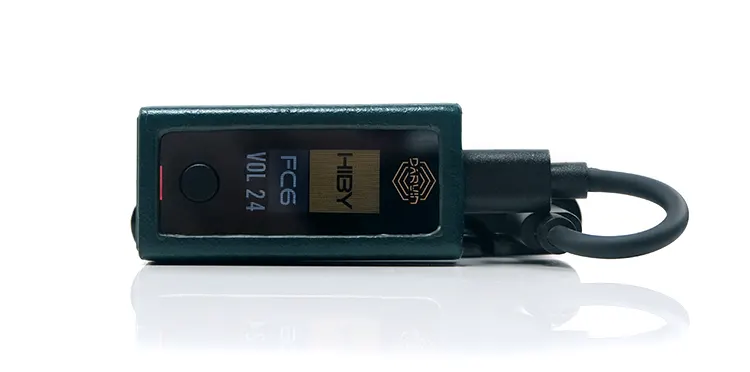
Another different DAC design from the dual delta-sigma inside the Nunchaku. This time, we have an R-2R DAC inside the FC6 outputting to a single-ended amplification topology as opposed to balanced.
The key focus inside the FC6 is more than R-2R, as the architecture is a trickle-down of their high-end DAP Darwin Architecture.
It represents a holistic approach to digital signal management, including digital-to-analog decoding and any associated sampling and filtering techniques to acquire the desired sound signature.
The FC6 uses a discrete-designed 24BIT R2R DAC with two rails of 48 matched resistors (0.1% tolerance) per rail/channel, making it a total of 96 resistors with supporting technology for linear compensation.
Decoding is competitive with both dongles capable of DSD512 native and up to PCM 32-bit/768 kHz. The FC6 will also handle MQA up to 8X, but this is irrelevant these days unless you have a ton of local MQA files.
The FC6 is a single-ended amplification circuit with no balanced output, so if you are looking for a 4.4mm output and some power differences along with it, then the Nunchaku is the go-to choice here.
It’s rated at 100mW on a 32Ω load, which is reasonable when compared to the Nunchaku’s 125mW SE solid-state rating under the same load.
The competitiveness falls away once you go balanced with the Nunchaku at 450mW solid-state and 525mW in tube mode on a 32Ω load.
Design
The FC6 looks tiny when sitting beside the chunky Nunchaku. No question which of the two is the lighter, it’s the FC6 all day long.
Do not get me wrong, though, smaller is not always better. I can say the Nunchaku looks more premium with its Titanium alloy finish and that beautifully knurled multi-functional rotary dial.
However, the diminutive low-profile finish of the FC6 will appeal greatly to HiBy R3 II or Shanling M0 Pro owners who want to use their DAPs as transports into an equally small but better-performing dongle.
There is no accompanying app similar to the iBasso’s UAC, but iPhone users have no access to that app, so if you need onboard visuals as an iPhone user, you will have to rely on the onboard display from each dongle.
Staying on that point, there is more depth in the onboard menu options for the Nunchaku, but I enjoy the styling of the FC6 colorful display; it’s very easy to read.
Just a 3.5mm TRS port on the FC6 and no balanced 4.4mm option. You will need an adapter for your balanced terminated cables to use the FC6.
There are no LO or coaxial options either on the FC6, meaning the Nunchaku can be used as a system device rather than just a dongle DAC.
Performance
Regardless of timbre mode, the Nunchaku has more dynamic range and resolution in its presentation compared to the more one-dimensional FC6.
Granted, the FC6 is SE only, so channel separation is never going to be as strong as the balanced output of the Nunchaku. But even so, the note texture and complexity of the staging depth of the FC6 is not as convincing, save for the vocal performances, which I quite like in NOS mode.
In both solid-state and tube mode, the Nunchaku shows off its technical capability, casting a wider, deeper, and more complex dimension to the recordings, and rendering a more compressed quality to the equivalent FC6 performance.
One thing the FC6 has is tremendous coloration on the bass, more so than the Nunchaku solid-state equivalent. It’s one of the more enjoyable aspects of the FC6, especially with bass-heavy IEMs such as the Odin.
The Nunchaku doesn’t quite match the weight of the FC6 sub-bass, but in tube mode, it does sound livelier on the lows and more fulsome through the mid-bass and beyond.
Combined with the more open and refined mids and sparkling highs, it’s much more immersive sounding than the FC6 with all but the most bass-heavy IEMs in my collection.
My Verdict
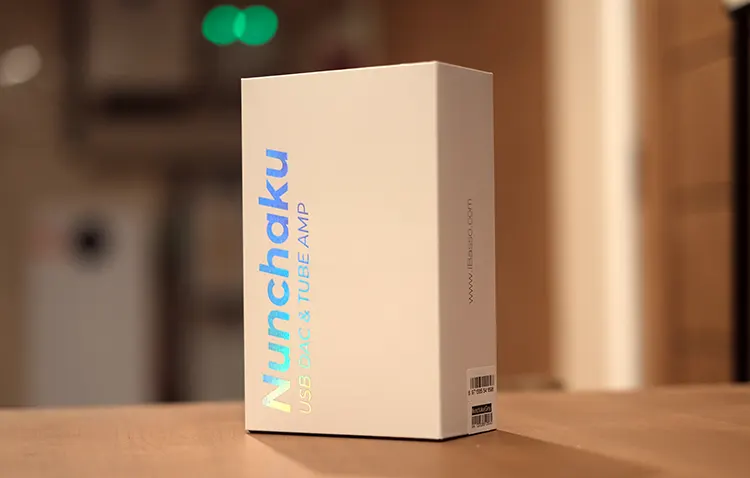
The iBasso Nunchaku is a classy-looking, albeit large dongle DAC with improved controls over the flagship DC-Elite. Its dual-timbre sound system marks it out as the most unique out of all of the company’s dongle lineup.
In tube mode, the Nunchaku is at its most impressive. It’s a deliciously smooth and sparkling performance with excellent macro staging qualities, creating a very immersive and enjoyable presentation.
Consider the alternative solid-state Class AB mode as an able deputy, a choice, albeit a nicely detailed and more linear option.
I would buy the Nunchaku for the tube mode alone and keep it in that mode for 99% of everything I attach it to and most of the music I listen to. The additional power and dynamics also create a wonderful analog contrast to the high-energy precision of the flagship DC-Elite.
iBasso Nunchaku Technical Specifications
- DAC: Dual Cirrus Logic CS43198
- PCM: Up to 32bit/768kHz
- DSD: Native DSD 512x
- Weight: 1.7 oz
- Dimensions: 2.6″ x 1.4″ x 0.6″
4.4mm BAL Output (AB Mode)
- THD+N: -119 dB (0.00011%) @1kHz 200kΩ
- Output Voltage: 2.8Vrms(Low Gain), 4.1Vrms(High Gain)
- Output Power: 450mW@32Ω
- S/N: 130 dB
- Dynamic Range: 130 dB
- Crosstalk: 145 dB
- Frequency Response: 15Hz-40kHz ±0.5 dB
4.4mm BAL Output (TUBE Mode)
- Output Voltage: 2.3Vrms(Low Gain), 4.5Vrms(High Gain)
- Output Power: 525mW@32Ω
- S/N: 107 dB
- Dynamic Range: 110 dB
- Crosstalk: 82 dB
- Frequency Response: 15Hz-40kHz ±1 dB
3.5mm SE Output (AB Mode)
- THD+N: -115 dB (0.00017%) @1kHz 600kΩ
- Output Voltage:1.4Vrms(Low Gain), 2Vrms(High Gain)
- Output Power: 125mW@32Ω
- S/N: 125 dB
- Dynamic Range: 125 dB
- Crosstalk: 116 dB
- Frequency Response: 15Hz-40kHz ±0.5 dB
3.5mm SE Output (TUBE Mode)
- Output Voltage:1.15Vrms(Low Gain), 2.25Vrms(High Gain)
- Output Power: 150mW@32Ω
- S/N: 112dB
- Dynamic Range: 112 dB
- Crosstalk: 82 dB
- Frequency Response: 15Hz-40kHz ±1 dB
