

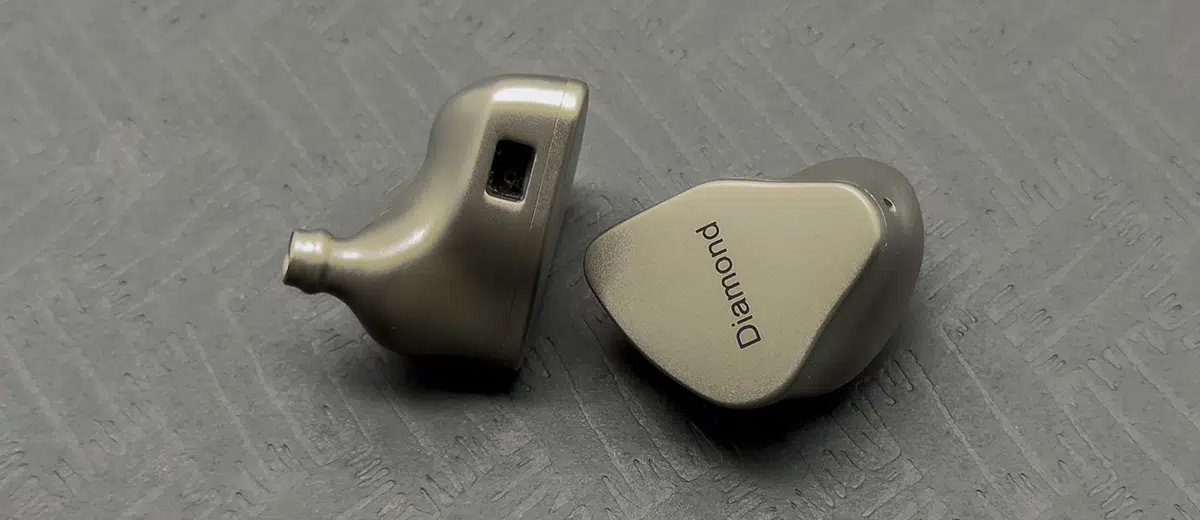
Nihal reviews the TXN Diamond, a new flagship high-end single true diamond diaphragm dynamic driver enclosed in a titanium shell. It is currently priced at $1999.00.
Disclaimer: I received this sample in exchange for my honest opinion. Headfonics is an independent website with no affiliate links or status. I thank TXN Sound for this opportunity.
Click here to read more about the dynamic driver IEMs previously reviewed on Headfonics.
This article follows our current scoring guidelines, which you can read in more detail here.
I have known TXN Sound for the past few years, with some positive impressions floating around about their ‘unobtanium’ IEMs, Dest and Dest Ti, which do not seem to be in production anymore.
I believe the brand is quite visible in the local Vietnamese audio circle. Outside the local circle, they are just mentioned occasionally but do not have much presence.
This time, they have released a single dynamic driver IEM called Diamond. These past few months, we have seen some notable releases in the flagship dynamic driver space, such as the Faith Audio E1000 and the DITA Audio Ventura.
At $1999, the Diamond is also hitting a premium price range, but is relatively cheaper. For an IEM with a relatively simple driver configuration, it sometimes becomes easier to impress due to the coherence and textures it offers.
Can Diamond impress and earn its place among those coveted single dynamic driver IEMs? We will find out very shortly.
In this review, we will take an in-depth look at what TXN Sound has to offer, and I will also be comparing it with E1000, Campfire’s new Andromeda 10, and the THIEAUDIO Valhalla. Stay with me!
Features
Diamond features a dome-shaped single dynamic driver – that’s the core of it. An IEM with just a single driver feels quite intriguing to me, as I always wonder what sort of engineering goes on behind the scenes to achieve a full-range sound, and to top it off, a flagship-level sound.
This driver is crafted from pure diamond through high-temperature crystal deposition, which demands utmost accuracy. TXN Sound claims this is the most advanced dynamic driver available out there.
What’s special about this diamond driver, you might ask? Well, there are some practical benefits.
The first is the extreme rigidity it offers. It is more rigid than the usual beryllium, titanium, aluminum, and PET diaphragm drivers that we commonly come across. This helps in achieving a high level of acoustic precision, which in turn aids better clarity and dynamics.
Also, the diaphragm here has a higher speed and faster transients. The other benefits of the diamond diaphragm are its distortion-free highs and effective heat management, which are critical for performance and longevity.
Now, all that sounds quite geeky; the real test is how it all translates to sound, and that will be out shortly in our sound impression section.
Design
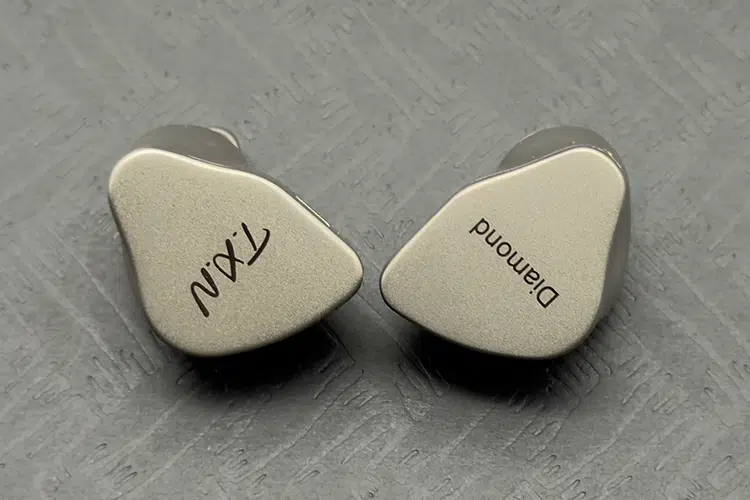
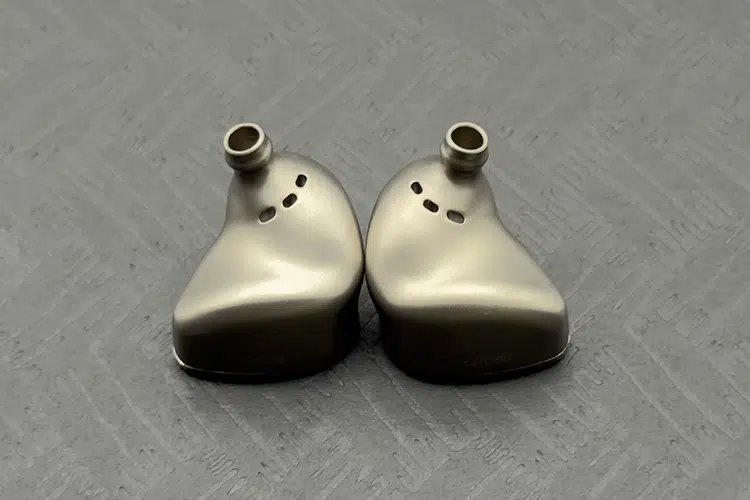
TXN Sound Diamond has a truly gorgeous design. The shells are built from aerospace-grade titanium, sculpted from a single solid block using advanced 5-axis CNC machining, so you can expect the robustness and durability it carries.
Thankfully, the titanium shells have a matte finish, so you’ll be saved from the easy scratches the mirror-polished ones get.
To be honest, these shells are one of a kind. What sets it apart from other titanium shells is how curvaceous the inner part of it is.
It’s as if the makers went deep into machining it, giving it some great angles and smooth curves. That’s what makes it stand out from the crowd. Diamond follows a flat design, and the faceplate is totally flat.
The interesting part of the shell is the three vents on the front chamber below the nozzles. As per TXN Sound, they had to spend a lot of time designing these vents for the kind of sound they were aiming for.
These vents seem large, and I am not sure whether they have enough protection from dirt, as it can easily get inside. I am sure these do not expose the inner drivers in any way. There is another tiny vent on the other side, which is protected by a mesh.
The nozzle is an open one, and it does not have a metal grille, but you do get small foams that you can insert to protect against dirt and debris getting inside.
You get a pair of tweezers inside the package to do that, so that’s convenient. These little foams can help you play around with tuning as well.
Comfort & Isolation
Diamond’s size is not large. It is on the average side and offers a very decent fit. The shell is ergonomically carved out, so the curves are smooth and do not put any pressure on the ears. There are no hotspots either.
Due to its flat design, it does not have those swollen-up shells where the inner ears feel tortured.
I always have this fear of single dynamic driver IEMs running very small in size, such as the Meze Audio ASTRU and Faith Audio Labs E1000, where I did have a decent struggle with the fit. But not here.
Diamond is extremely comfortable and does not demand any extra struggle. You just pop it in with one of your favorite ear tips and get started.
The nozzle is slightly longer and has a narrow shape. Most ear tips fit easily. The shells sit deep inside, so you get decent isolation as well.
However, Diamond is built to deliver an open sound, which is what the front chamber vents are for, so do not expect a very high level of isolation.
During my time with Diamond, I did not encounter any driver flex or any pressure building up inside. All this makes Diamond a very ideal IEM for long sessions.
Ear Tips
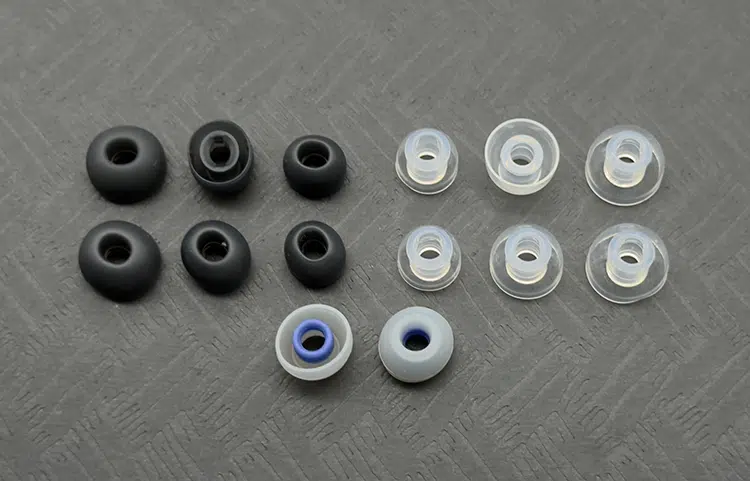
Diamond is shipped with two sets of ear tips, both made of silicone and available in three sizes: small, medium, and large. One is the Ultra Clear ear tip, and the other is a simpler and pliable silicone tip with a wider bore and relaxed fit.
The sizes are marked on the ear tips: S, M, and L. A very small thing, but I am not sure why I found it interesting. And there is a third one, which the IEMs come mounted with, but that is just one of its kind with no other sizes.
This one is quite good, actually, and fits me really well. I used these the most on Diamond. TXN Sound should include these in three sizes.
I am sure a lot of folks would find it more useful than the other two sets. The Ultra Clear ear tips feel very sticky to me, so I do not really enjoy them much.
With a very sorted nozzle design, Diamond is not fussy about ear tips. You can put any of your favorite tips on it, and it would pair well. The wider bore ear tips do not work for me because of how they grip on these narrow nozzles.
Also, you need to check if the stem is gripping properly or not, as it may slip out while inserting or removing the IEMs from your ears.
Among the aftermarket ear tips, SpinFit W and Nostalgia XWB ear tips also go well. None of the frequency ranges feel boosted on Diamond, so I did not need to pair it with ones that tame the bass or treble frequencies.
I would suggest playing with a few ear tips with Diamond to see how the tuning changes and what suits your preference best.
Stock Cable
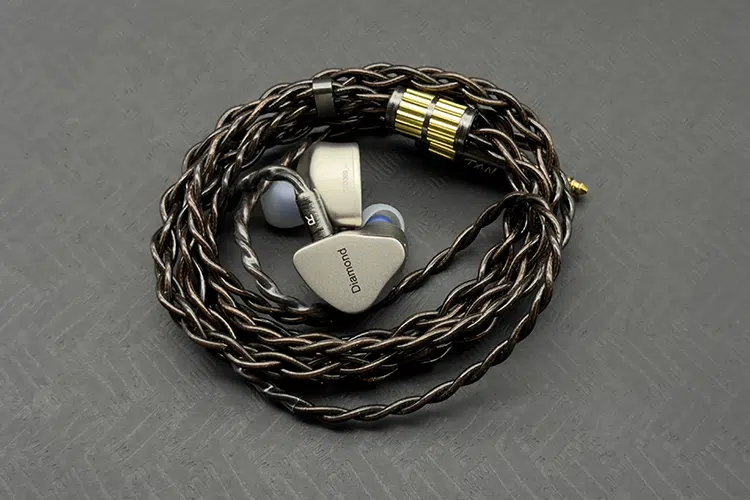
Diamond is stocked with the Aegis cable, a special 4-wire cable TXN Sound built for Diamond. At the core of Aegis lies 7N OCC copper sourced from Taiwan. Each of the conductors is individually shielded to preserve signal integrity.
The 4.4 mm OFC balanced plug and 0.78 mm two-pin connectors are manufactured in Japan. They seem quite well built, so for a stock cable, Aegis gets full marks.
I like the slightly transparent brown sleeve on the cable. The y-split and 4.4 mm plug have a gold-accented slotted finish, which gives them a rich look. However, I think they will attract scratches with long-term usage. That said, they do feel quite sturdy in build.
The cable overall has a slightly beefy look but is lightweight. It does not tangle during usage or while coiled for storage, so handling is quite easy with this cable.
Overall, I find this cable good enough to be paired with Diamond. It does its job and does not immediately ask for a cable switch.
However, given how transparent Diamond sounds, it will be quite interesting to pair it with different cables and see how the sound is affected.
Packaging & Accessories
Diamond arrives in an average-sized box – nothing flashy or fancy. It is built minimally, with a black color scheme throughout and subtle silver accents in the branding. The box opens from the top.
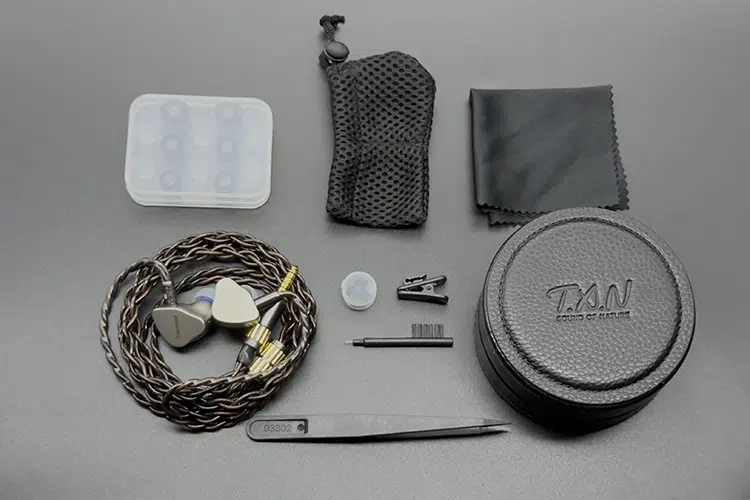
Inside, the IEMs and the carry case are tucked into foam cutouts, while the attached cable is coiled and placed beneath the carry case.
The carry case holds the remaining accessories: a cleaning tool and cloth, a mesh pouch, a pack of foam filters, and a tweezer for inserting and removing the foams from the nozzle.
Diamond is packed with most of the accessories one would look for. It is good to see a mesh pouch included, as metal-shelled IEMs, especially titanium ones, are prone to scratches, so you definitely need to protect them.
A slight nitpick with the packaging is that the foams are a little flimsy and lack rigidity, so once you unpack everything, it can be tricky to pack them back in.
Overall, TXN Sound’s packaging does not really miss anything, but it falls a little short of creating that full wow or boutique-like impression.
Carry Case
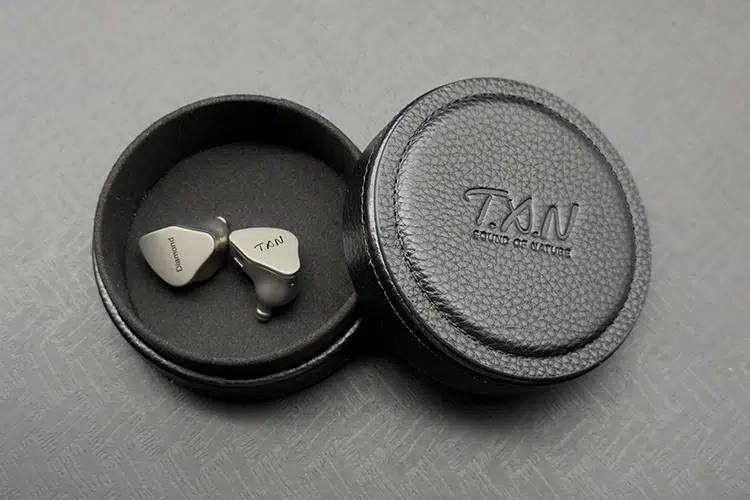
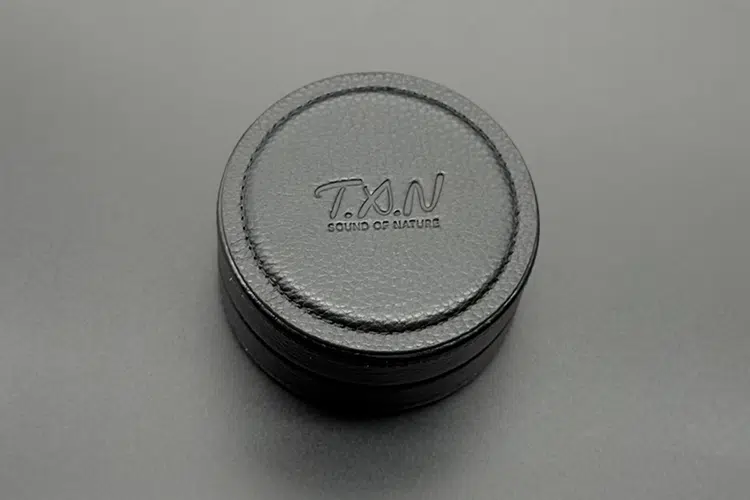
The carry case here is a puck-style one. This all-black case is built from leather with a textured appearance. You can see thin stitches all around it. The brand’s name is embossed on the top. Overall, it feels well-built and, more importantly, is lightweight too.
This case is slightly too large to fit in your pockets, but you can easily toss it in a bag while on the move. It won’t pick up scratches.
The other good thing is that this case runs slightly larger than the usual puck-style cases you find with many other IEMs. That’s a real relief; otherwise, the IEMs with the cable would be hard to fit in.
However, if you put the IEMs in the mesh pouch, there is a very tight space, so that’s one problem area here. For this reason, I really cannot use it, and I have put the Diamond in a different case.
Click on page 2 below for my sound impressions and recommended pairings.
