

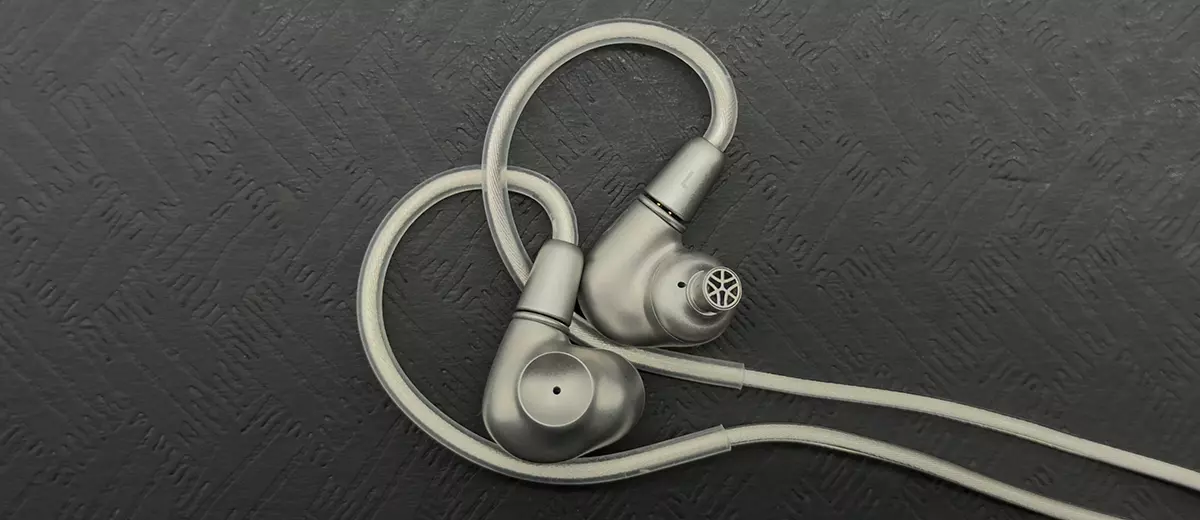
Nihal reviews the Meze Audio ASTRU, the company’s new flagship 10mm dynamic driver titanium-shelled in-ear monitor, currently priced at $899.00.
Disclaimer: This sample was sent to me in exchange for my honest opinion. Headfonics is an independent website with no affiliate links or status. I thank Meze Audio for their support.
You can click here to learn more about Meze Audio products previously reviewed on Headfonics.
This article follows our current scoring guidelines, which you can read in more detail here.

Meze Audio built its name on headphones. Their IEM line has always been more of a side project. But now and then, they drop something solid, and when they do, they focus on the whole package: a tuning that clicks and something that feels polished when you pick it up.
Over the last few years, they have very slowly built their IEM catalog. Back in the day, Meze’s Rai Penta received a lot of appreciation. ADVAR came in as their premium single dynamic driver IEM, with a detailed presentation that many people found good.
Then came ALBA, a more accessible release that still carried the same Meze sense of style and easy-listening appeal. Different price points, different goals, but both felt very much like Meze products.
Now they are back with $899 ASTRU. A new high-end single dynamic driver IEM, and in some ways, it feels like a continuation of that journey.
Meze already showed with ADVAR that they know how to make a dynamic driver-based IEM with character. ALBA showed they could also bring some of that charm to a lower tier. So ASTRU steps in with a bit of expectation already around it.
In this review, I am going to take a closer look at what ASTRU brings to the table and how it compares with competing IEMs, such as the Dita Audio MECHA and Campfire Audio’s Alien Brain.
Features
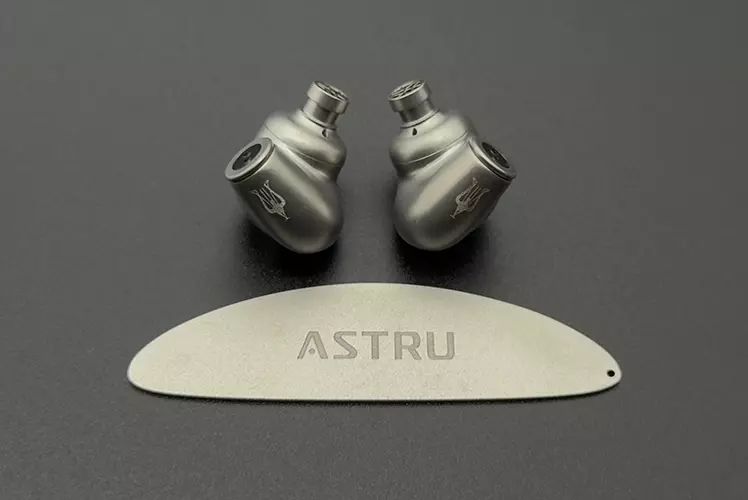
At the heart of the ASTRU sits a single 10mm dynamic driver. On paper, that might sound simple, but the interesting part here is not the number of drivers. It is what Meze has done with this single unit.
The diaphragm itself has an intricate structure. The driver dome is built using a titanium layer coated with more than 80 extremely thin gold layers.
These layers are applied through a controlled manufacturing process called physical vacuum DC magnetron sputtering, which runs for close to forty-eight hours.
In simple terms, this process allows the gold to bond extremely evenly with the titanium surface at a microscopic level. This gives the diaphragm firmness when it needs to, but still allows it to react quickly to small signal changes.
This dome structure is then mounted on a PEEK base, which stands for Polyether Ether Ketone. It is a high-performance polymer that is often used in engineering applications. Here, the PEEK base helps maintain structural stability while still allowing the diaphragm to move freely.
These elements together give the driver the rigidity needed for controlled movement while remaining responsive enough to capture quick transients in the music. We will see how much these translate into listening very soon.
Design
The design follows the familiar Meze language that we have already seen on models like ADVAR and ALBA.
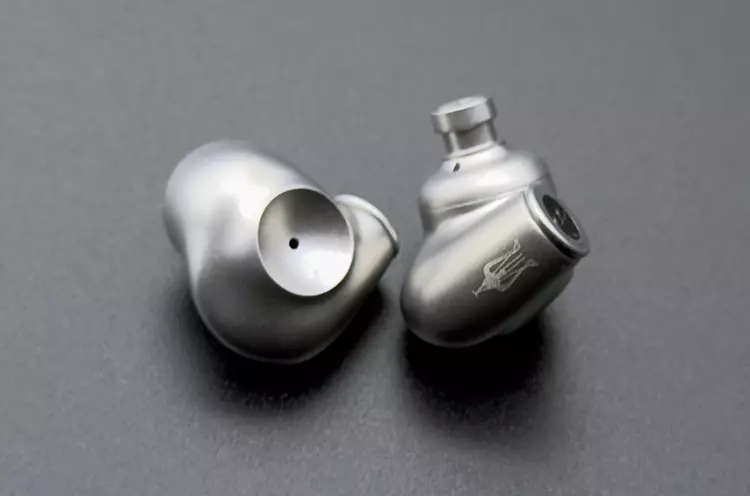
At first glance, it carries that same organic, sculpted look, but once you pick it up, you realize how compact these shells really are. They are tiny, much smaller than most IEMs in this category.
Each shell is CNC-machined from a single block of pure titanium. The density is immediately apparent, and there’s real heft here.
The shells go through additional procedures to achieve their smooth matte surface. The finish has a soft, smooth feel while retaining a faint metallic glow beneath. It does not have a very gaudy shine under direct light. Nothing about it reads flashy.
There is no paint layer here, unlike the ALBA. That means there is no risk of paint chipping over time, which some users experienced with ALBA during long-term use.
The center of the shell carries that classic Meze concave groove. This time, though, it is left completely clean with no branding around the circle. Right at the center of that structure sits a tiny vent hole.
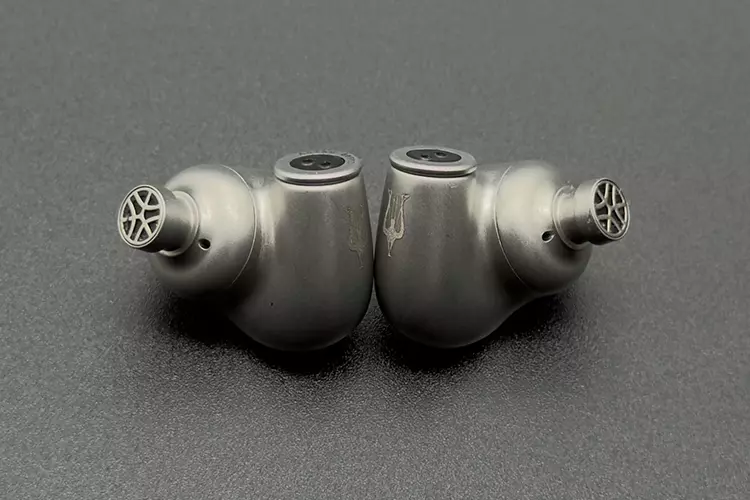
The 2-pin socket sits inside a small, round disc-like structure that protrudes slightly from the shell. It looks sturdy and well integrated. The connector fit feels stable and secure. The nozzles are quite compact and narrow.
Overall, these shells feel like premium little pieces that you will probably end up babying a bit. They are small, elegant, and unmistakably Meze in their design language.
Comfort & Isolation
Comfort with tiny IEM shells is always a bit of a double-edged situation. If you have smaller ears, these kinds of shells can feel like a gift.
They sit effortlessly in the ear; there is hardly any fuss during insertion, and most of the time, you can grab one of your usual ear tips, plug it in, and start listening without thinking twice.
For my ears, which sit somewhere in the average range, things were a little different. Tiny shells like these can sometimes be a bit tricky. They irk you a bit with a poor fit, and getting a proper seal can take some patience.
I usually end up going through my box of ear tips, trying one after another, quietly hoping that the next one will be the magic tip that finally settles everything into place.
Once that little battle is won, though, the comfort really shines. After finding the right tip and seal, these become the kind of IEMs that disappear in the ear. Hours pass without you noticing.
There are no pressure points, nothing digging into the ear, and thankfully, no thick nozzle situation that can sometimes make things uncomfortable. The shells are small, smooth, and shaped to rest naturally.
Throughout my time with the ASTRU, I also never noticed any pressure buildup inside the ear. The venting seems to be doing its job well. Driver flex is another thing that never showed up during insertion or removal, which is always nice to see.
Isolation is surprisingly strong for such a small design. Once you get a proper seal, the outside world fades away quite nicely. It blocks a good amount of ambient noise and makes the ASTRU perfectly usable even in noisy surroundings.
Ear Tips
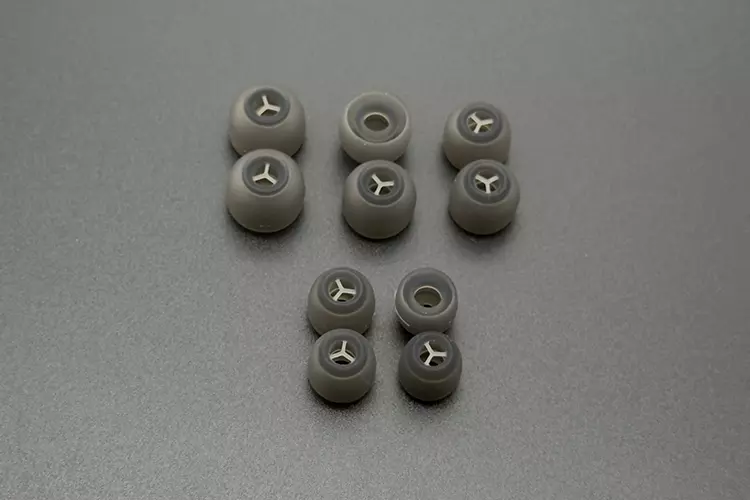
We get five pairs of silicone ear tips, all the same type, covering pretty much every ear size. The stems are quite small, and I think they suit IEMs with tiny nozzles like these quite well.
Inside, there is a three-spoke, almost Y-shaped support structure. So, the nozzle opening is not fully open like a plain hollow bore. It looks a bit obstructed. Still, I do not think it changes the tuning in any noticeable way.
I am glad these stock tips worked well for me. I did not have to spend time hunting for third-party options right away. I went with the largest size from the pack.
Given how small these IEMs are, and my not-so-great history with tiny shells, I honestly was not sure if the stock tips would work for me at all. But the fit turned out pretty good.
I also found that some ear tips improve the bass body and depth, so it’s worth experimenting a bit. I also suggest trying ear tips with small stems and slightly wider bores; they really work well for me.
Other than the stock set, I also tried the IEMs with COREIR Brass ear tips. The large size fit me nicely there as well. Those brass tips do seem to add a tiny bit more air up top, so overall I found that to be a positive change.
Stock Cable
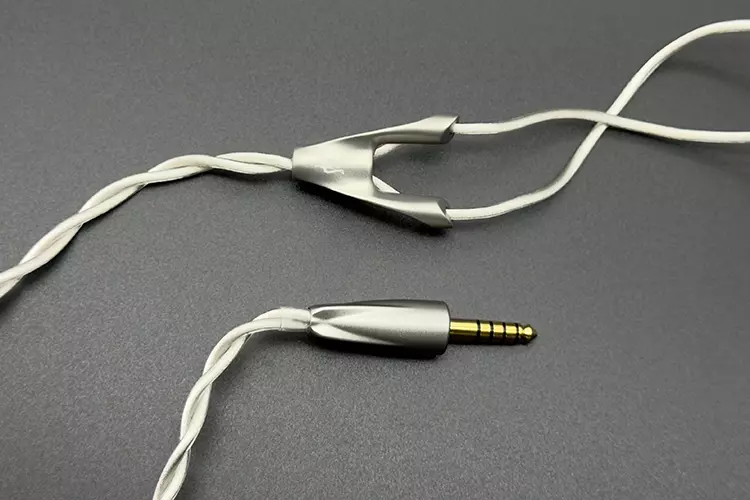
Meze has gone with a high-quality 4.4 mm balanced cable here, and it does not feel like some throwaway extra.
It uses silver-plated LC-OFC conductors, with 161 conductors per strand, SoftFlex PVC insulation, and CNC-anodized aluminum hardware. The plug is a gold-plated 4.4 mm balanced termination.
This cable is soft and easy-going. It’s very easy to handle. It bends without fighting back, and that makes day-to-day use a lot more pleasant.
It also does not take up much space when stored. Since it coils up quite easily, it fits into the case without much fuss. I also did not find it tangling much, which is always a good thing. Just a very comfortable cable to live with.
The cable itself has a pearly silver-white look, and that matches well with the rest of ASTRU’s aesthetic. The braid is simple and tidy: not too thick, not too flashy, and just enough to look premium while staying practical.
Even the ear hooks look gentle and well-behaved. They do not seem too stiff or overly aggressive in shape.
The hardware has that same understated Meze styling: clean, smooth, and a little sculpted. The plug housing has a rounded, tapered shape with a satin metallic finish.
The Y-split is probably the standout bit. It is large but quite lightweight. It has an open, fork-like design that gives it a bit more character than the usual plain metal barrel you see on many stock cables.
It keeps the whole cable looking clean and a little more special. The Meze logo on it is also a nice touch.
Packaging & Accessories
The unboxing feels premium, but not in a loud or overdone way. Meze Audio has kept it clean and tasteful.
The outer sleeve is finished in a grey shade and carries this nice spiral artwork in gold across the front. It almost looks like expanding rings or sound waves, with the Meze logo in the middle.
Once you slide that sleeve, the actual box underneath opens from the middle. The two sides pull apart like little doors, which makes the presentation feel a bit more special.
Inside, everything is stacked in tiers. The top section has the IEMs and the cable placed alongside them in its own slots. The presentation here is quite nice because nothing feels thrown in. Your eyes go straight to the earpieces first, which is exactly how it should be.
At the second tier, you are greeted by the carry case and ear tips. The carry case sits nicely in place and looks every bit like part of the same design language. The ear tips are arranged below in a neat layout, easy to see and easy to pick from.
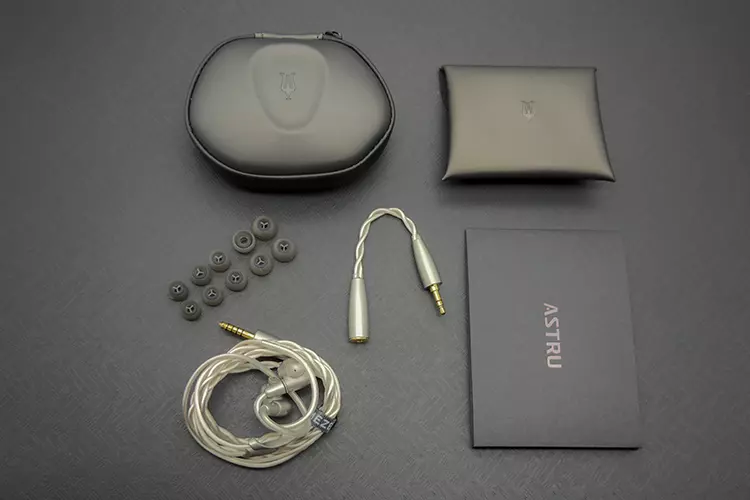
The final layer is where Meze has placed the smaller extras, including a 4.4 mm female to 3.5 mm adapter and a small pouch. That pouch is a handy addition for storing spare tips, adapters, or any other little bits.
The packaging does not waste space. It is done smartly, fitting everything in a compact box without needing a lot of empty air or excessive foam.
This unboxing is very much in line with what you would expect from a release like ASTRU and a brand like Meze Audio. It feels well thought out and gives you all the important accessories without making the whole thing feel bloated.
Carry Case
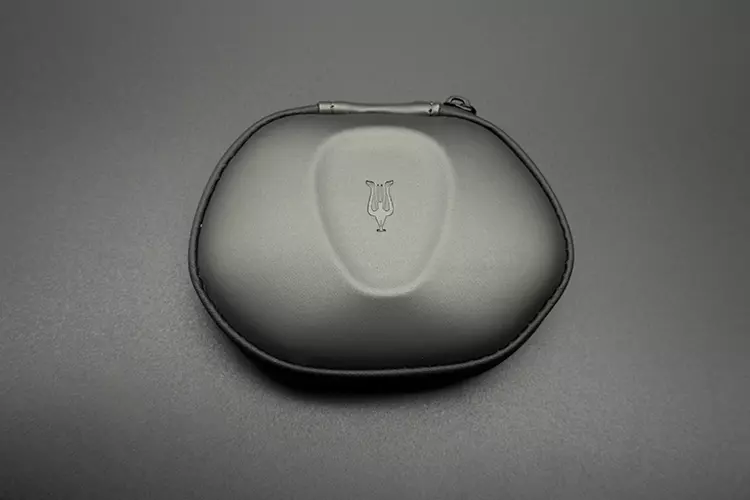
We get a PU leather case with ASTRU, but to be honest, I was hoping for a slightly better carry case here. I do like the design, though. The color scheme is also nice.
There’s enough room inside to store the IEMs with the cable attached. The shells are tiny, so they don’t eat up much space anyway.
The case comes in dark brown with a smooth finish, with Meze’s logo embossed on top. Inside, a soft fabric lining adds a bit of extra protection for whatever you stash in there.
There is also a mesh pocket on the inner side of the top lid. You can use that to store a few ear tips or some small extras.
The case itself is not very rigid, but it should still be protective enough for normal use and light pressure. Still, I really wish Meze had gone with a slightly better-built case here.
You also get an extra leather pouch for storing the smaller accessories, like ear tips or the 3.5 mm adapter. It is a nice little extra, but the pouch itself is quite small, so it needs to be stored inside some other case.
That is why I feel the main carry case could have been just a little bigger, enough to fit this pouch too.
This is a bit of a nitpick, I know. But at this price, expectations naturally get a little higher. That said, many people may not care much about these extras and would rather get straight to the sound.
Click on page 2 below for my sound impressions and recommended pairings.
