

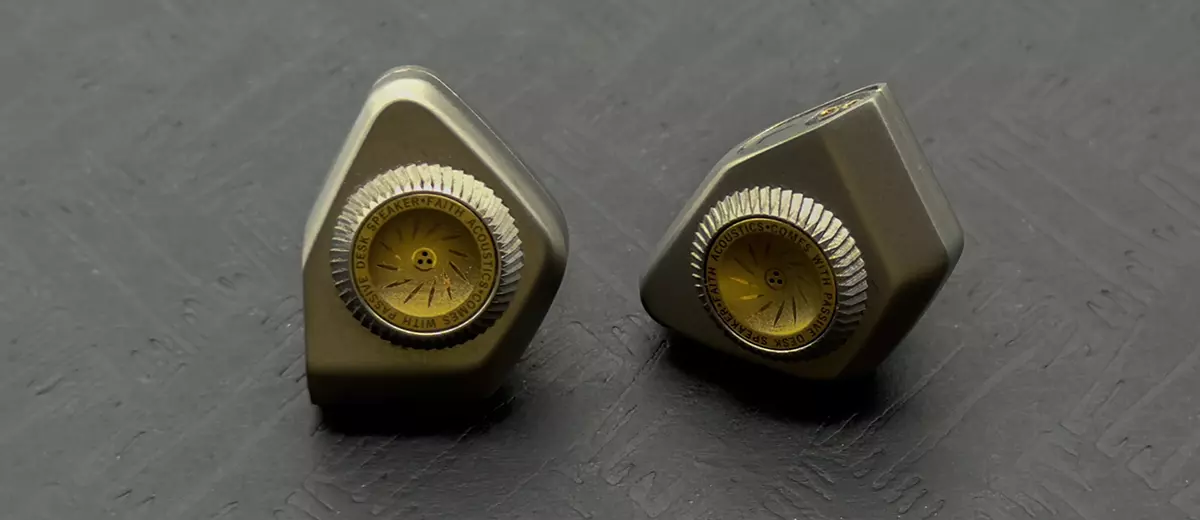
Nihal reviews the Faith Audio Labs E1000, a new high-end single 10.2mm dynamic driver universal in-ear monitor, currently priced at $3799.00.
Disclaimer: I received this sample in exchange for my honest opinion. Headfonics is an independent website with no affiliate links or services. I want to thank Faith Audio Labs for their support.
You can click here to learn more about the IEMs previously reviewed on Headfonics.
This post follows our current scoring guidelines, which you can read in more detail here.
A couple of months ago, most of the audiophile crowd did not even have Faith Audio Labs on their radar. It is a young boutique brand out of China, and it has come in swinging straight at the summit-fi end of the IEM market.
Faith Audio Labs does not present itself like a typical earphone company. The branding leans more toward an engineering-led atelier, with a lot of emphasis on materials, machining, and execution rather than chasing whatever configuration is trending that month.
Instead of high driver count headlines, the brand has focused on premium single dynamic-driver designs thus far.
Right now, their lineup is small and very pointed. The E1000 sits as the entry flagship, and the U1000 exists as a more premium limited-edition model.
At such prices, these IEMs are aimed at serious enthusiasts, and that alone tells you what Faith is trying to do here: earn credibility at the top tier from day one.
In this review of the E1000, I will break down how the tuning and technical performance stack up and whether this flagship hits hard.
I will also put it up against a few flagship IEMs, such as Softears Enigma, PLUSSOUND SONORA SE, and iBasso Audio EPITOME, to see how it compares.
Features
Inside the E1000, Faith Audio Labs keeps the driver count simple, but the engineering is anything but.
The main engine is a single 10.2mm full-range dynamic driver that handles the whole sound. That driver is driven by a dual-neodymium magnetic circuit rated at around 9000 Gauss. In plain terms, it is a very strong magnet system.
The driver’s diaphragm is coated with titanium using a sputtering process. The coating has more than 80 ultra-thin layers. The goal here is to keep the diaphragm light but also make it stiffer and more stable.
Alongside the main driver, there is an auxiliary passive radiator. That’s like a helper element that is not powered directly but moves in response to air pressure inside the shell.
Overall, it is a simple layout on paper: one main driver plus a passive radiator. But the strong magnet system, the titanium-coated diaphragm, and that bass control element are what make the E1000 feel like a flagship single-driver design rather than just a basic single dynamic driver build.
Design
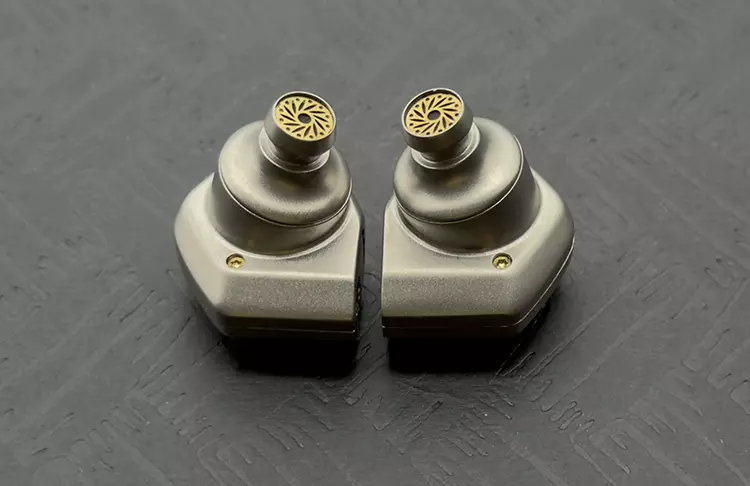
The E1000 shells are way smaller than you’d think. Photos make them look almost toy-sized, but holding them, they feel solid, like a tiny metal tool.
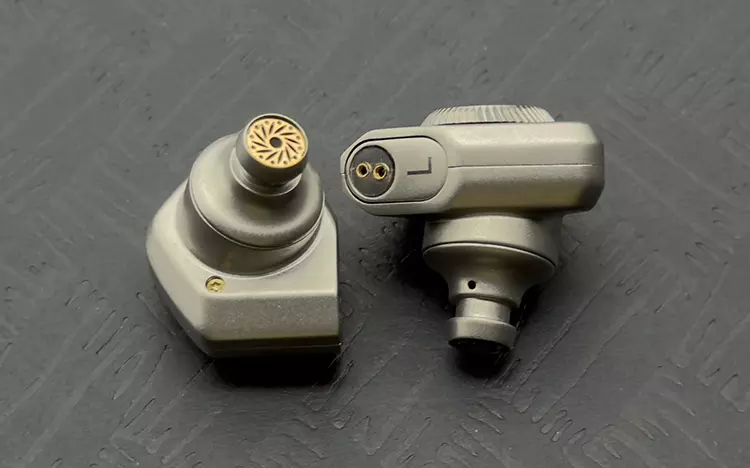
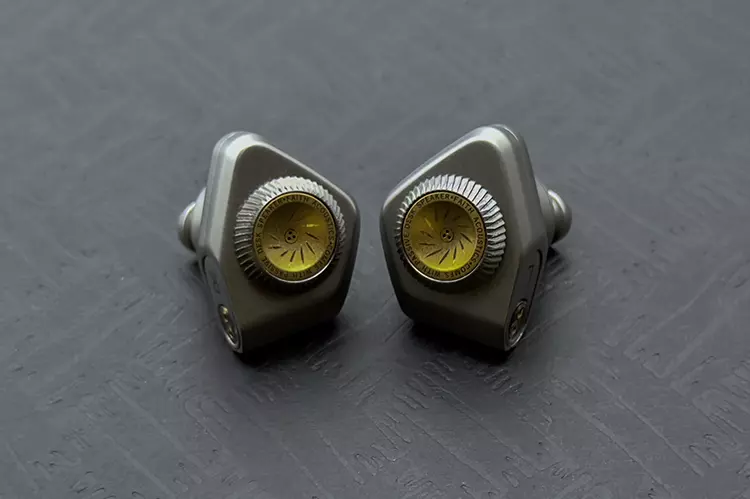
The shell has the shape of an irregular pentagon with angular curves and clean edges. It feels very “machined.” It is small, but it gives off a rugged, almost industrial feel.
I like that it’s not trying to be flashy. Quiet vibe, but still feels expensive somehow with a slight jewelry-like finish.
It’s CNC-milled from solid titanium alloy. The matte finish is a lifesaver, as there is no fingerprint nightmare like those glossy mirror finishes that need constant wiping.
Faceplate is pretty stripped back. There’s this concave copper-gold piece dead center that looks like a mechanical dial. Around it, you’ve got these stereo-cut guilloché patterns and a knurled ring that catches light in a way that reminds me of a watch.
The etched text around the ring is barely there. No loud branding, just a “precision object” feeling. It’s elegant but restrained and still feels like a premium tool.
From the front, the nozzle section stays compact. The nozzle is small with a gold grille at the tip. The gold accent on the shell gives a nice contrast. The cable connects using a 2-pin socket on the top edge.
Overall, the E1000 has a subtle design that feels premium and classy but also carries a slightly rugged and serious look. A tiny titanium shell that feels engineered, not just pretty.
Comfort & Isolation
Comfort on the E1000 is a bit of a two-part story, and it mostly comes down to the fact that these shells are genuinely tiny.
With small shells, there is always a disclaimer. For some people, it is instant comfort; for others, it is a small wrestling match before things finally click.
I fall somewhere in the middle. The first couple of hours usually involve a bit of trial and error to get the seal right. The good part is we are spoiled with ear tips these days, so you can almost always find something that works.
If you have smaller ears, this should be an easy win. The shells disappear quickly, and once they settle in, they stay out of your way.
The weight is low enough that you do not feel them pulling or shifting. No hotspots, no weird pressing against the outer ear, and no “take a break” moments.
Isolation is where the E1000 can be a bit more demanding. These do not block outside noise as strongly as some deeper-sealing shells, so the seal becomes even more important.
If the fit is slightly off, you will notice it right away. It is one of those IEMs where you want to make sure everything is seated properly before you hit play, because the whole experience depends on that seal being right.
In my time with the E1000, I did not run into any driver flex. Insertion feels clean, and there is no crinkling or pressure weirdness when you put them on.
So overall, comfort is a strong point here, but only after you do the small bit of work up front. Get the right tips, get the seal, and the E1000 becomes a very easy IEM to wear for hours.
Ear Tips
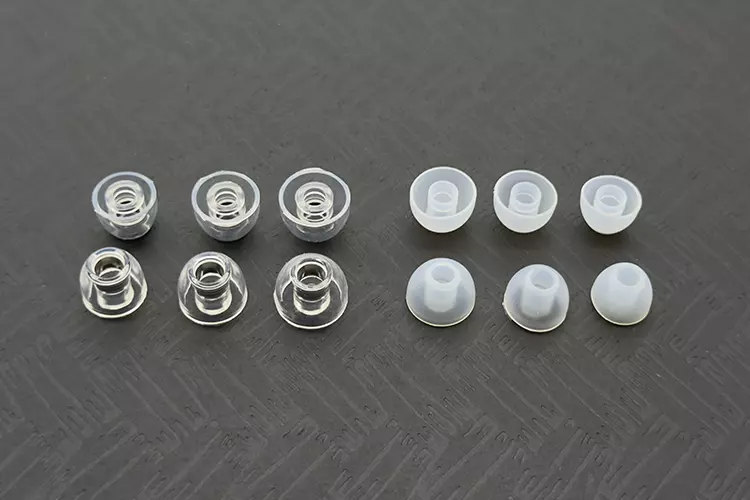
The E1000 arrives with two sets of silicone tips. One of the sets is the more premium style, the kind with a metal core. It reminds me of tips like Coreir Brass or Softears UT Titanium, though I do not know what metal is being used here.
What I can say is that this type of tip usually has a certain effect on the sound. If you want to lift the top end a bit and bring more openness, these metal-core tips can work well.
The second set is a more basic silicone tip. It feels like the standard “included for completeness” kind.
Nothing wrong with it, but it does not feel as special in hand, and it does not bring any particular advantage other than being a simple backup option.
Now the real issue is not the quality of the tips; it is the fit. The E1000’s shell is tiny, and the nozzle is small, and that combination can be tricky.
Both included tip sets gave me trouble, mainly with getting a stable seal and decent isolation. They would fit, but not in the locked-in way I wanted.
After trying a bunch of options, I ended up settling on Divinus Velvet tips in size L. It held the tiny shells more securely and made the fit feel more stable, like the IEM finally had something to anchor itself properly in my ear.
If you have smaller ears, I can see this being much less of a struggle. The tiny shells should sit more naturally, and the included tips might work fine. But if you are like me and you often need a more confident seal, be ready to experiment.
Stock Cable
The stock cable on the E1000 keeps things simple and functional, and that is honestly the best compliment I can give it.
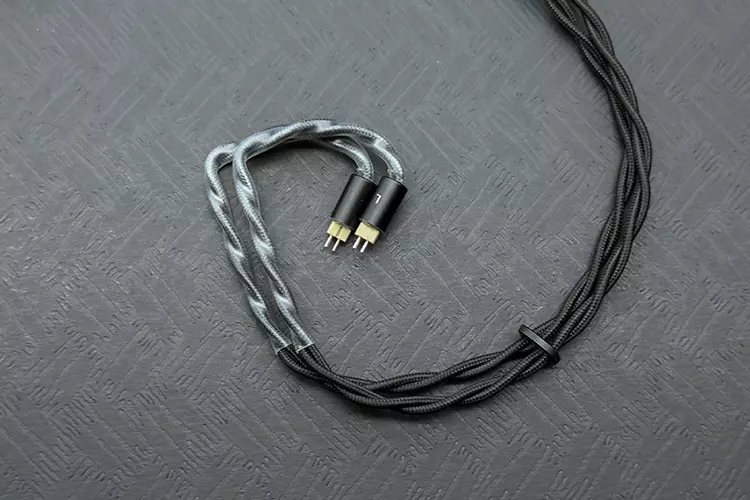
It is a 4-core high-purity OFC cable terminated in 4.4mm balanced, so you are not forced into adapters or upgrades just to use it with a proper source.
It has a black braided fabric covering that gives it a slightly rugged look. More importantly, it makes the cable easy to live with.
It stays lightweight and supple. Even after being stuffed into the carry case, it comes out without major tangles. In daily use, it drapes well and does not feel stiff or springy.
Hardware is equally no-nonsense – plain and simple. The 2-pin connectors and the Y-split are housed in matte black metal barrels that look clean and understated.
No loud branding, no stamping, no unnecessary design flex. It matches the overall vibe of the IEM: practical, minimal, and a bit industrial.
Microphonics are also kept in check, which is a big deal for fabric-sheathed cables because some of them can be noisy the moment they rub against your shirt.
Here, it behaves well. You still know it is there, but it does not ruin the experience, and it is usable for walking around without constantly hearing cable noise.
Sonically, it does not give you a reason to complain. It sounds clean and does its job. More importantly, I never felt the itch to cable roll to “fix” something. The E1000 already performs the way it should on this cable.
Packaging & Accessories
The E1000 shows up in a rather small box for a flagship-priced IEM. This packaging does not try to impress you with layers of foam and oversized presentation. It’s compact and tidy.
The outer box is a simple cardboard one with the brand and product information on it.
Once you open that up, a wooden box sits snugly, and it instantly feels like a step up from the usual all-cardboard unboxing. The wood finish has a classy, boutique feel. The front side has the Faith Audio Labs subtle emblem carved into it.
The wooden box layout is the interesting part. It is built like a small two-level setup. The top section is dedicated to the IEMs, and the lower section has the cable and ear tips.
You lift the top wooden cover, and the E1000 sits there, held tightly in a dense black foam cutout. It looks neat and secure. There is no clutter around them, and the black foam against the silver shells and gold accents looks sharp.
That said, once the initial “nice wooden box” moment passes, the unboxing starts to feel a little incomplete for the price.
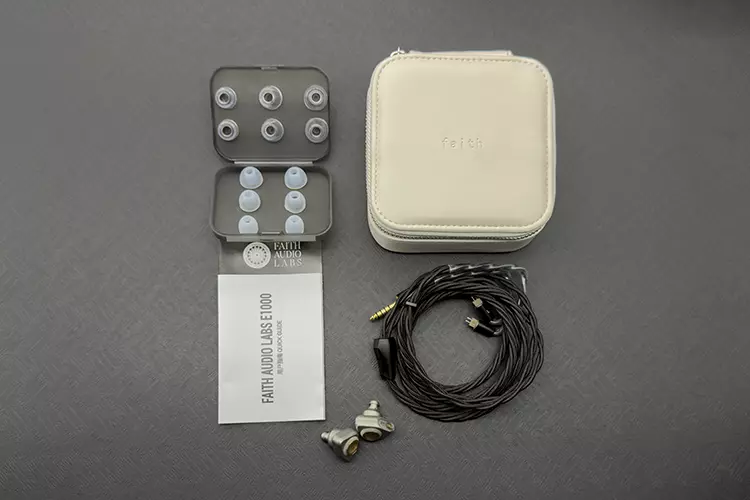
You do not get the extra little premium touches that often come with summit-fi sets, like a mesh pouch, a cleaning cloth, or small utility bits that make it feel like a full kit.
The bigger oddity is the carry case. It is kept outside the main wooden box, and I understand it was probably done to save space.
Overall, the wooden box is a strong move, and it looks a lot more premium than what most IEMs come with. It is tasteful and minimal, but it stops just short of feeling fully complete.
Carry Case
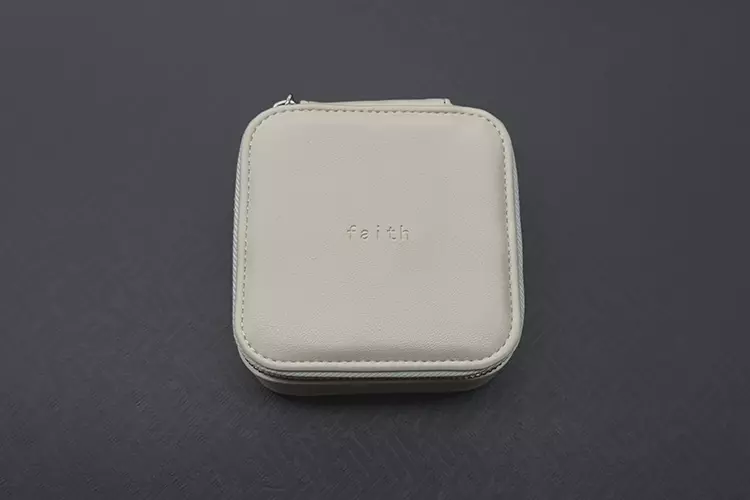
The carry case is easily the weak link in the whole package for me. With an IEM like this, and especially with the whole “precision titanium object” vibe it carries, I was expecting something that feels more premium and more thoughtfully made.
What you get instead is a very basic case that does the job but does not really add anything to the experience.
The case is built in faux leather with a smooth all-white finish. The brand name is embossed on top, but you can barely see it. Hard edges give it some structure, so it’ll do the job in your bag without getting crushed.
That all-white look is clean out of the box, but it can pick up dirt quickly. Really feels like one of those standard throw-in accessories rather than something you’d consider a premium inclusion.
On the inside, there is soft and cushioned lining. There is also a mesh pocket on the inner top flap, which one can use for storing extra tips or small accessories.
You get enough space inside. You can store the cable and the IEMs without fighting for room, and you do not have to wrap everything in an overly careful way just to make it fit.
My main complaint is simply the missed opportunity. The price of the IEM demands a better-built case, or one made with a more premium material.
In short, the carry case feels too basic to match the rest of the product’s premium intent.
Click on page 2 below for my sound impressions and recommended pairings.
