

Kurt reviews the CVJ MYTHERA, a 7-driver universal IEM featuring a single 9.5mm dynamic, 5 custom BA, and a micro planar driver configuration. It is currently priced at $368.00.
Disclaimer: This sample was sent to me in exchange for my honest opinion. Headfonics is an independent website with no affiliate links or services. I thank the teams at Linsoul and CVJ for giving me this opportunity.
Click here to read more about the Linsoul audio products we have previously reviewed on Headfonics.
Note that this article follows our latest scoring guidelines, which you can read in more detail here.
CVJ has been building its reputation in the chi-fi space with affordable models like the CS8 and Aria. Their focus has steadily shifted toward more ambitious configurations, inching closer toward flagship territory with each new release.
Now comes the CVJ MYTHERA, priced at $368, bringing a seven-driver tribrid setup per side that combines a 9.5mm DLC dynamic driver, four custom balanced armatures, one Knowles balanced armature, and a micro-planar unit.
With this level of hardware, can the MYTHERA deliver the complete flagship experience it’s aiming for? And how does it compare to competitors such as the ZiiGaat Luna and the InAwaken Twilight-DS? I found out in my full review below.
Features
The CVJ MYTHERA runs a seven-driver tribrid configuration per side, combining a dynamic driver, balanced armatures, and a micro-planar unit in a single shell.
A four-way crossover manages the array, using both an electronic circuit and physical acoustic tubing with damping filters to keep each driver operating in its own window.
At the core of the low end sits a 9.5mm custom dynamic driver with a Diamond-Like Carbon diaphragm, combining stiffness and internal damping to resist driver flex without introducing resonance.
CVJ also cites a golden-ratio routing approach for the acoustic tubing paths, aimed at improving phase coherence between drivers.
Four custom balanced armatures handle the midrange, arranged in two pairs, with a dedicated balanced armature sitting above them for the upper range.
A custom micro-planar unit sits at the top of the stack, described by CVJ as a BA-type design that stays compact and easier to drive than full-sized planar implementations.
A dual-damping scheme with pressure-relief venting is also built into the configuration to stabilize diaphragm motion and keep background noise in check.
CVJ does not disclose the manufacturer or model numbers for any of the drivers used in the MYTHERA.
Design
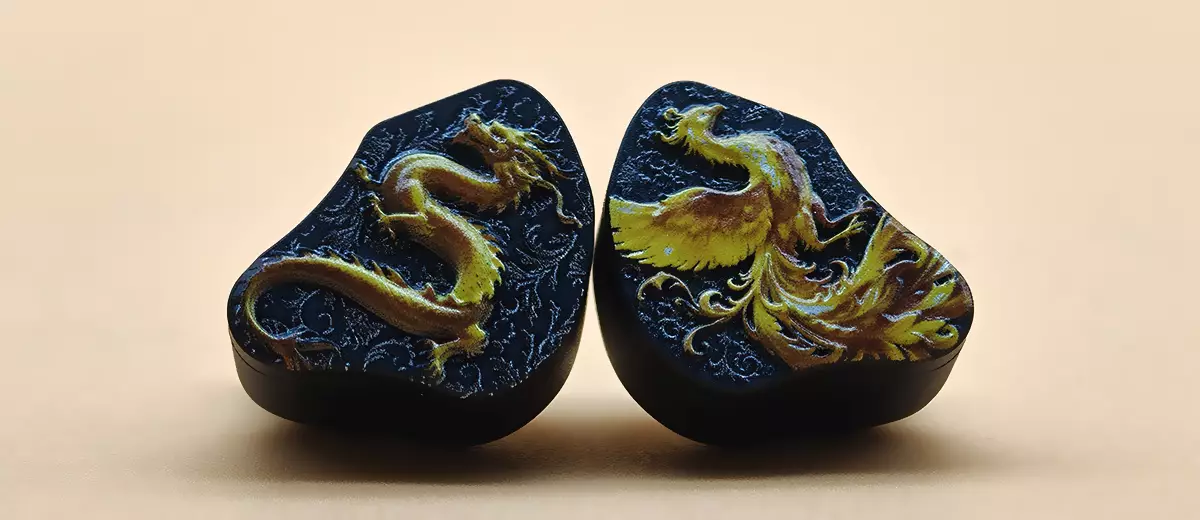
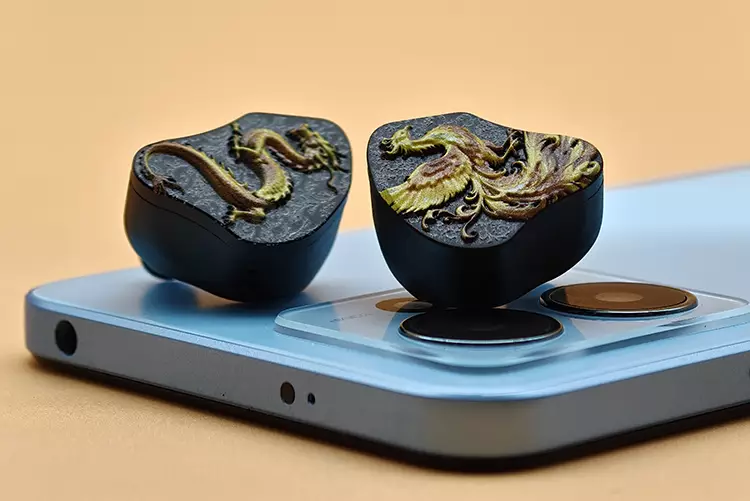
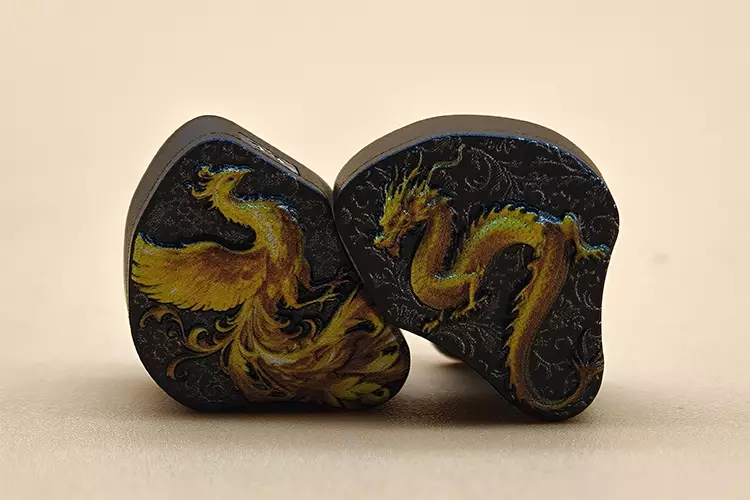
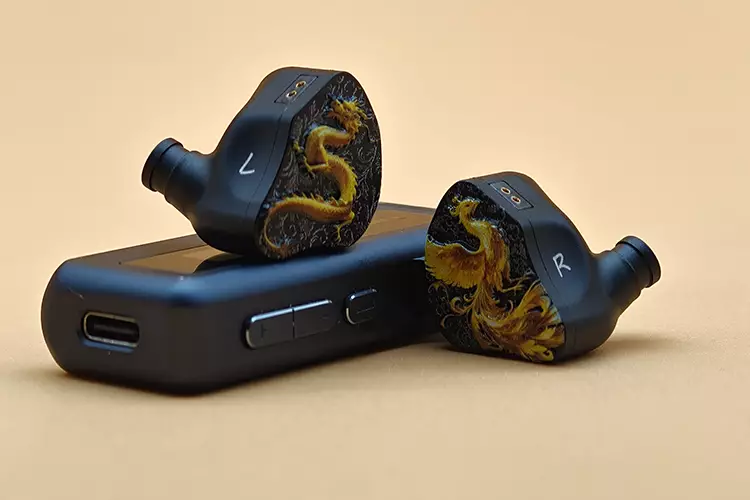
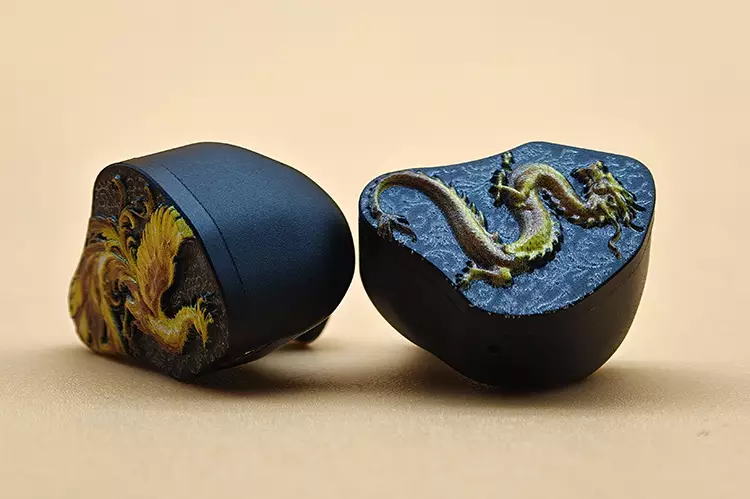
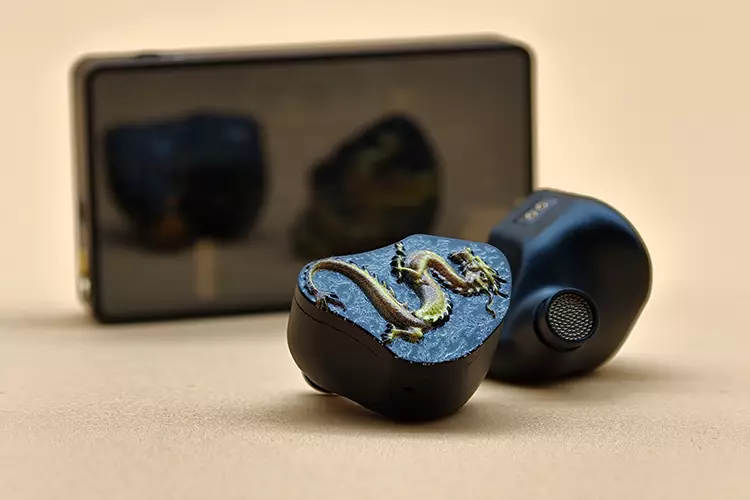
Each faceplate on the MYTHERA tells half of a story, with the left side carrying a coiled dragon and the right side featuring a phoenix in full spread, both rendered in deep gold and amber tones against a dark textured background of scrolling floral patterns.
The artwork is applied through CVJ’s color micro-engraving process, giving each figure a layered, almost relief-like depth that catches light differently depending on the angle.
The Gilded edition swaps the dark background for a pale cream base with scattered gold flake, putting both figures in matching gold relief for a more uniform and ornate look.
The unit being reviewed here is the Obsidian edition, where the dark background gives the dragon and phoenix considerably more contrast and visual weight.
The shell is CNC-machined aluminum alloy with a matte black finish, and it feels solid and unmistakably metal in hand.
Its shape is wide and rounded, shaped through 3D ear modeling, with the faceplate sitting as a distinct panel separated from the main body by a visible seam running along the edge.
Channel identification is straightforward once you know the key, as the dragon always sits on the left and the phoenix on the right.
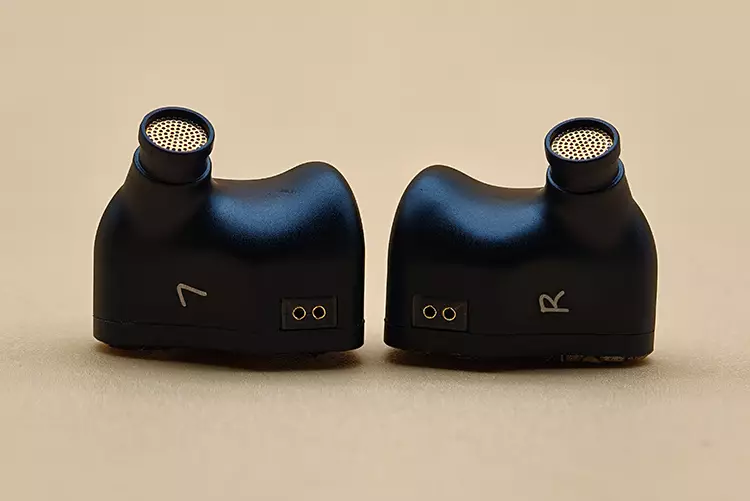
Beyond that, L and R markings are also printed in white on the inner face of each shell, sitting alongside the 0.78mm 2-pin connectors, which are housed in a small raised rectangular port near the top of the inner face.
A single vent hole sits on the opposite side of the shell from the connectors, handling pressure relief for the dynamic driver inside.
The nozzle is short and angled with a proper lip at the tip to keep ear tips locked in place, finished with a gold mesh filter pressed into its opening.
Comfort & Isolation
The CVJ MYTHERA sits surprisingly small in the ear given its seven-driver-per-side configuration, landing closer to medium-small in actual size once worn.
It sits flush against the ear and covers most of the opening, which translates directly into strong passive isolation that blocks out a good amount of ambient noise.
The fit goes deep without any fuss, locking in with a secure and comfortable seal that doesn’t shift or slip out during normal movement.
Pressure is well managed too, staying light enough that lying down with them in remains a practical option rather than an uncomfortable one.
Weight is a non-issue here, as the aluminum shell keeps things noticeably light on the ear despite the metal construction.
That lightness also makes the MYTHERA a practical travel companion, even if the eye-catching faceplate makes it anything but discreet.
It ranks as one of the most comfortable dynamic driver hybrids I’ve worn, hitting a balance between a secure fit and effortless wearability that most IEMs at this size and driver count don’t manage.
The combination of its compact shell, deep fit, and light weight makes long sessions feel completely natural.
Ear Tips
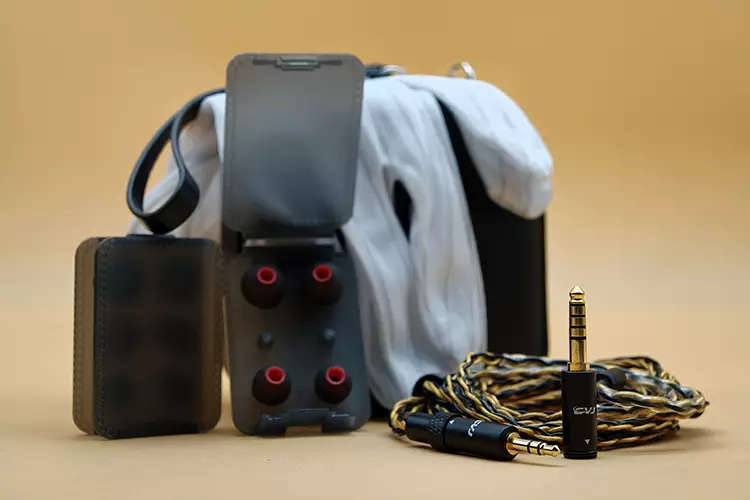
Two sets of silicone tips are included with the CVJ MYTHERA: a wide-bore set with a black stem and a balanced-bore set with a red stem.
Neither set stands out as exceptional, but they each behave differently enough that the choice between them matters more for comfort than for sound.
The wide bore tips are on the shorter side, which works against MYTHERA’s already short nozzle rather than complementing it.
The material is also very thin and soft, collapsing easily under light pressure and leaving the nozzle feeling like it’s pressing directly into the ear rather than the tip doing its job.
The balanced bore tips are a better fit, sitting at a medium height that gives the MYTHERA just enough extension to land comfortably in the ear canal.
The material feels like standard silicone but with a stiffer construction, which keeps its shape better and makes it the more usable of the two options.
Neither set makes a meaningful difference to the sound, with comfort being the more noticeable variable between them.
The balanced bore tips are the clear choice here, and most will likely find them sufficient without needing to reach for aftermarket alternatives.
Stock Cable
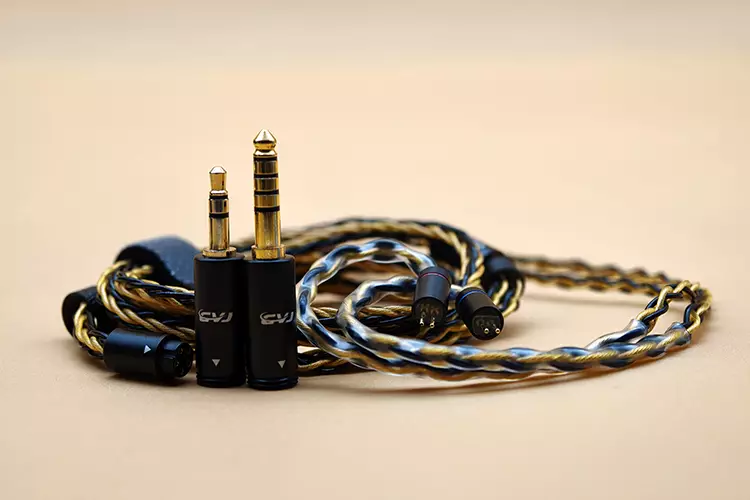
A 1000-core Furukawa copper cable ships with the CVJ MYTHERA, built from eight strands with 125 individually woven cores each, a construction CVJ credits for keeping resistance low and signal transmission clean.
It’s a genuinely premium material choice for a stock cable, and Furukawa copper is not something you typically see included at this level without paying extra for it separately.
Visually, the braid is a mix of gold and dark blue strands twisted together, giving it a distinct and eye-catching look that complements the Obsidian edition well.
The braiding is executed nicely, staying tangle-free and draping naturally without the stiffness or memory that plagues a lot of stock cables.
Despite its construction, the cable stays impressively lightweight on the ear, adding no noticeable drag or pull during wear.
The hardware throughout is matte black with the CVJ logo printed on the plug housings, keeping the branding subtle without disappearing entirely.
Modularity is handled through a screw-lock system for attaching the included 3.5mm and 4.4mm plugs, locking each one firmly in place and removing any concern about accidental disconnection during swaps.
The 0.78mm 2-pin connectors are finished in a matching dark blue, tying the cable’s color scheme together from end to end.

Packaging & Accessories
Arriving in a large, weighty box finished with a tone-on-tone blind embossed floral pattern across its surface, the MYTHERA’s packaging immediately signals that CVJ is treating this like something more than a typical IEM release.
The flowers are pressed into the black cardstock using the same black, making the design visible through texture and shadow rather than color, and the linen-like background gives the whole surface a fabric feel that sits closer to luxury goods than audio packaging.
A separate outer cardboard sleeve wraps the box, carrying the dragon motif in gold on the front with the CVJ logo, MYTHERA name, and technical specifications spread across the remaining sides.
Sliding that sleeve off reveals the main box beneath, which opens through a magnetically secured flap that swings out cleanly.
Opening the flap exposes a pull-tab compartment taking up roughly half the box depth, with the IEMs seated in foam cutouts at the top and a labeled Wire Box section below them housing the cable.
Both sections sit snug and well-protected, keeping everything organized without any loose movement inside.
The pull-tab compartment houses a large hard-sided leather carrying case embossed with the CVJ logo, which holds the ear tips inside a separate flip-open plastic case.
The Wire Box contains the cable, a cleaning cloth, and a pair of gloves, which is a first in my experience with any IEM packaging.
Those gloves have a lightly hatched texture that feels comfortable on the hands. CVJ is clearly framing the MYTHERA as something like jewelry to a degree, and the gloves make that statement more directly than anything else in the box.
Sound Impressions
The following sound impressions of the CVJ MYTHERA were completed using a mix of the Heartfield R1 and the Colorfly CDA-M2 dongle DACs.
Bass
The low end on the CVJ MYTHERA is heavy, wide, and all-consuming, pushing firmly into basshead territory with a presence that makes itself felt on nearly every track regardless of genre.
It doesn’t sit quietly in the background; it covers the mix with a sense of energy that some will find exciting and others will find overbearing.
Deep and physically weighty, the sub-bass delivers a strong rumble that gives each track considerable momentum and drive.
It isn’t the cleanest presentation, though, feeling loose and uncontrolled at times, carrying that chaotic and unrestrained quality that dedicated bassheads tend to gravitate toward.
That same energy carries into the mid-bass, which hits with a ‘groovy and slammy’ approach that keeps things feeling lively and rhythmically always driven.
The issue is that it doesn’t know when to step back, and on tracks with minimal bass content, the low end still asserts itself, pulling focus away from vocals and other elements that deserve the spotlight.
Despite the excess, the texture remains surprisingly articulate, and the dynamic range within the bass itself is properly communicated, with quieter and stronger notes landing with the right difference in weight. It shows that control exists within the low end when the tuning allows for it.
Drums don’t benefit from any of that control, though, sounding blunted and tonally off with an artificial quality that strips them of the realistic body and snap they should carry.
Bass guitars follow a similar path, falling short of sounding natural, though the differences between individual string plucks do come through with enough distinction to remain followable.
Mids
Vocal forwardness is an understatement for the midrange here, as vocals and instruments push right to the front of the mix in a way that’s immediately noticeable.
Bass bleed from the heavy low-end seeps into the lower midrange, though, adding unwanted warmth and thickness that muddies the presentation and makes the mids feel less defined than they should be.
What that bleed costs most is male vocal performance, which lands flat and lifeless despite the forward positioning, lacking the body and weight needed to sound convincing.
They’re present in the mix but carry a dull quality, as if the foundation they need to stand on has been swallowed by the bass below them.
Female vocals push even further forward and carry strong brightness, but the sheer amount of bass coverage takes some of the edge off, preventing them from becoming as sharp as they might otherwise be.
Timbre sits in an uncomfortable middle ground, with bass bleed dulling the natural tone while a mild BA coloration adds a slight artificiality that becomes more noticeable on instruments.
Clarity is the midrange’s biggest casualty here, as the bass masks a significant amount of detail and nuance that simply doesn’t surface on its own. Those finer elements are technically recoverable if you listen for them deliberately, but that defeats the purpose entirely.
Treble
The treble on the MYTHERA struggles to deliver a great performance, sharp, bright, and ultimately underwhelming is how I’d describe it.
Even with detail retrieval, that should be a strength given the micro-planar unit at the top of the stack, the overwhelming bass presence buries so much of the mix that making a fair assessment becomes genuinely difficult.
Surprisingly, sibilance is not the main concern here despite everything else going against it. There is sharpness present, and the treble carries an aggressive edge, but it stops short of being consistently sibilant, which is arguably the one thing working in its favor up top.
Airiness is where expectations fall hardest, as the top end feels closed in and narrow despite the dedicated planar tweeter in the configuration.
Cymbals and hi-hats share the same blunted and artificial quality found throughout the rest of the presentation, sounding tonally off rather than accurate and metallic.
Fortunately, fatigue is oddly kept at bay, not because the treble is well-behaved, but because the bass coverage absorbs enough of the sharpness that the top end never fully becomes grating or unbearable on its own.
Staging & Dynamics
The soundstage of the CVJ MYTHERA offers nothing but a narrow and closed-in experience across width, depth, or height.
Moving from it to anything with even modest staging makes the contrast immediately apparent, as everything stays pulled tight and intimately centered rather than spreading outward.
Imaging holds up to a functional degree, placing sounds with acceptable precision, but it never rises above average or makes positional cues feel particularly convincing.
Separation keeps sounds reasonably distinct under normal conditions, though busy mixes start pushing it past its limits as layering breaks down when too many elements compete for the same space at once.
Dynamics are present but heavily one-sided, with scaling benefiting the bass almost exclusively rather than lifting the overall presentation.
The low end responds to more power with added weight and physicality, but the rest of the frequency response gains little from it, leaving MYTHERA’s dynamic ceiling feeling as narrow as its stage.
Click on page 2 below for my recommended pairings and selected comparisons.
