

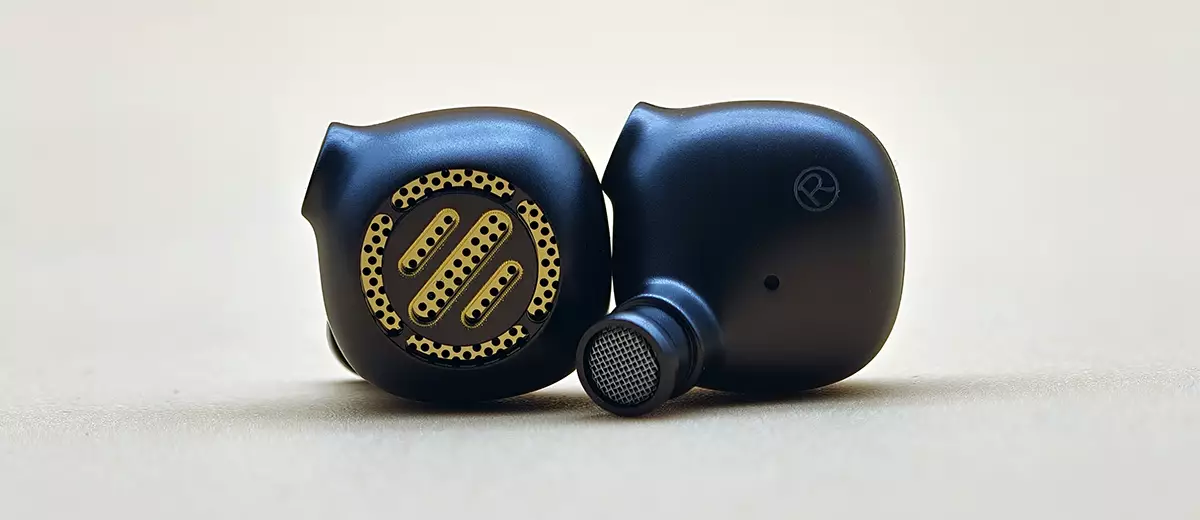
Synergy
Efficiency
The Shanling MG200 is rated at 16Ω with 112 dB ±3dB/mW sensitivity, making it very easy to drive from balanced portable sources.
It reaches proper listening volume without strain, so dongles, DAPs, and compact DAC-amps can run it without needing much power.
Out of the box, the stock cable pushes the MG200 toward 4.4mm balanced use because that is the included plug.
Direct phone 3.5mm use requires a different cable or another compatible plug, since the included modular system does not come with a 3.5mm termination.
At lower volumes, the bass remains present but loses some of its physical punch and body. The midrange stays forward and clear, while the airy top end keeps enough openness to prevent the presentation from collapsing inward.
Raising the volume benefits the bass the most, giving the low end stronger body and a more convincing hit.
The treble also becomes more revealing, though sibilance on poor recordings becomes easier to notice when the volume climbs.
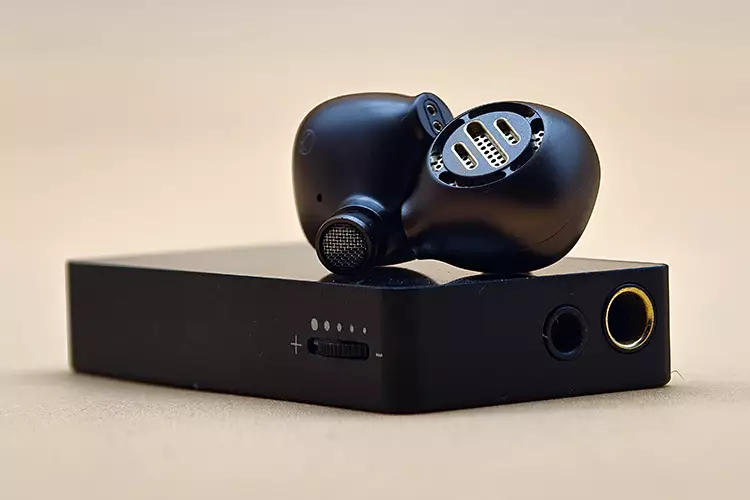
Pairings
Using a phone’s 3.5mm jack required swapping to a separate 3.5mm cable, since the stock cable only includes a 4.4mm plug.
The Shanling MG200 still reached usable volume easily, though the bass felt softer and the wide staging lost some precision compared to better sources.
With the FiiO JA11, I again used a separate 3.5mm cable to make the pairing possible. It pushed vocals more forward and tightened the bass slightly, but it also emphasized the MG200’s vocal sharpness and made sibilance on rough recordings easier to notice.
Through the Colorfly CDA-M2, the MG200 leaned further into its strengths by sharpening imaging and improving separation across the stage. The wider and more analytical presentation suited its open-back design well, though badly mixed tracks exposed stronger sibilance through this pairing.
Pairing with the Heartfield R1 gave the MG200 a warmer and fuller delivery, adding more mid-bass body while smoothing some of the vocal sharpness. This was the easier long-session pairing, trading a bit of crisp separation for a thicker and more relaxed presentation.
Selected Comparisons
MOONDROP Kadenz
Technical
The MOONDROP Kadenz uses a single 10mm dynamic driver, keeping it in the same one-driver category as the Shanling MG200. MOONDROP calls this driver the ULT Gen-2 super-linear dynamic driver, built with a revised irregular magnetic circuit.
Its diaphragm uses a TAC diamond-coated dome composite structure over an LCP base. The diamond-coated layer is designed to increase rigidity, improve treble behavior, and reduce distortion within the single dynamic driver system.
Design
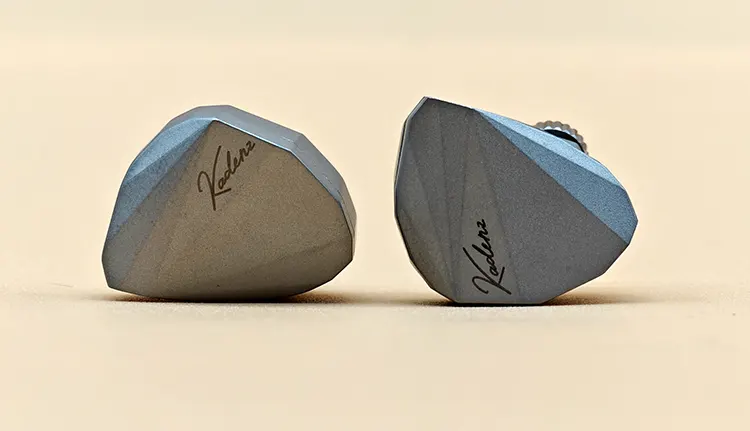
The Kadenz follows the design direction of the older KATO, but it adds sharper edges and a more angular metal shell.
Its matte finish removes the shinier look of the KATO, giving the body a smoother and more subdued appearance.
A cursive Kadenz marking sits on the outer shell like a signature, adding a decorative touch to the otherwise restrained metal body.
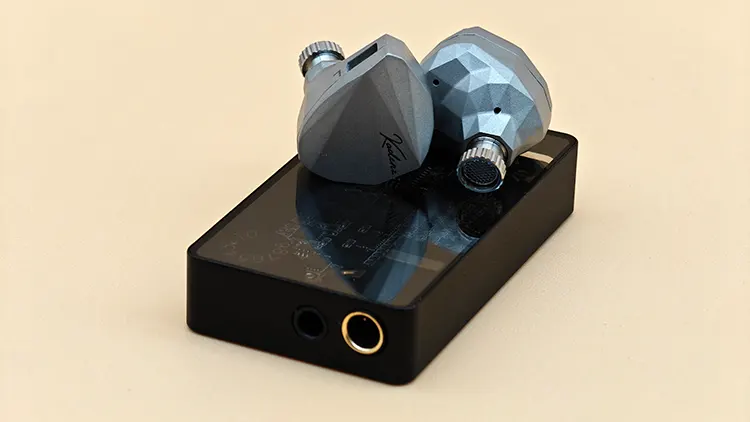
The inner shell includes a pressure relief vent, while the replaceable nozzle system gives it three nozzle options for tuning and maintenance.
Performance
The Shanling MG200 takes the win in bass, delivering stronger subbass rumble and more tactile mid-bass punch than the MOONDROP Kadenz. The Kadenz keeps its bass clean and detailed, but it sounds lighter and less physically satisfying beside the MG200.
Vocals give the Kadenz its clearest advantage, as it presents the midrange with smoother timbre and better refinement. The MG200 has stronger forwardness and excellent clarity, but its vocal sharpness and grain make it less polished in direct comparison.
Air and openness favor the MG200, which stretches the treble wider and makes the presentation feel less closed in. The Kadenz has better sibilance control and a safer top end, but it cannot match the MG200’s sense of space.
The MG200 also wins in staging, especially when tracking left-right panning and the placement of sounds across the sides. The Kadenz has better depth and a more structured stage, but the MG200 feels more immersive because of its wider spread.
For dynamics, it belongs to the MG200, with drum hits, guitar plucks, and bass impact showing clearer differences in strength. The Kadenz stays even and controlled, but the MG200 communicates those changes with more accuracy and energy.
SIMGOT SuperMix 5
Technical
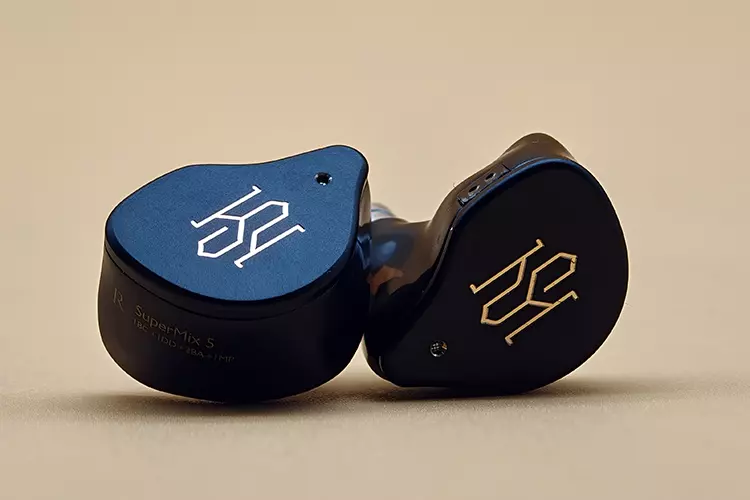
The SIMGOT SuperMix 5 uses a five-driver quad-brid configuration made up of one custom coil bone conduction driver, one dynamic driver, two balanced armatures, and one micro-planar driver.
These drivers are managed by a precision RC four-way crossover, with each driver placed in its own 3D-printed acoustic duct to reduce interference.
Its 8mm DLC dynamic driver handles the bass, while the 10mm bone conduction driver works from 200Hz to 7kHz to add texture and physicality.
Two large-volume balanced armatures cover the midrange, while the micro-planar driver sits closest to the nozzle for the treble.
Design
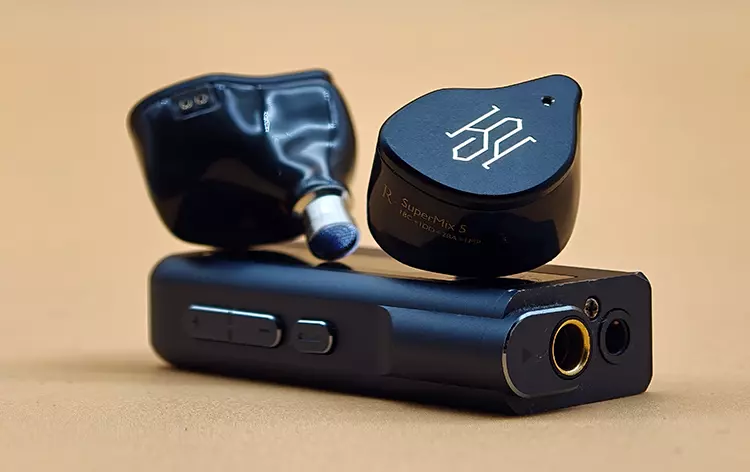
The SuperMix 5 uses a CNC-machined metal faceplate with a satin finish, carrying a white laser-etched SIMGOT logo against a deep gray surface.
Its shell is made through high-precision resin 3D printing, with a slightly translucent dark finish that faintly reveals the internals under light.
Gold lettering marks the model name, driver configuration, and channel indicators along the inner edge of each shell.
The 0.78mm 2-pin connectors sit flush on the lower inner face, while one vent sits near the top of the faceplate with additional pressure relief holes near the connector area.
Performance
The Shanling MG200 hits with stronger sub-bass rumble, but the SuperMix 5 offers better bass due to its quicker and more tactile mid-bass punch.
The MG200 gives bass notes more spread and bloom, while the SuperMix 5 turns kick drums and bass hits into cleaner physical strikes.
Vocals create the most interesting split, with the MG200 sounding more forward and emotionally direct.
In comparison, the SuperMix 5 creates a more laid-back vocal presentation, sounding less emotional but overall wins the midrange as it avoids the MG200’s vocal grain and sharpness.
That refinement difference becomes clearer with instruments, where the SuperMix 5 sounds smoother and more controlled.
The MG200 gives stringed instruments more presence and clarity, but the SuperMix 5 handles the same textures with less roughness around the edges.
Treble control favors the SuperMix 5, which keeps sibilance low and avoids the MG200’s tendency to become fatiguing in longer sessions.
Despite the MG200 sounding much airier and properly immersive, the SuperMix 5’s safer and more polished treble is the better choice in the long run.
Fortunately, the one thing the SuperMix 5 can’t follow through on is the standout staging of the MG200, as its open-back design creates wider movement and more convincing left-right panning.
The SuperMix 5 separates sounds cleanly, but the MG200 places them with better direction and a stronger sense of space.
Dynamics also favor the MG200, especially when listening to drums, guitar plucks, and bass hits shifting in strength. The SuperMix 5 stays tidy and even, but the MG200 makes loudness changes feel more expressive and alive.
My Verdict
The Shanling MG200 stands out as one of the more interesting single dynamic driver IEMs I have heard, proving that an open-back system can work inside an in-ear format.
Its airy treble, wide staging, excellent imaging, and surprisingly capable bass make its internal design feel purposeful rather than experimental.
The forward midrange can show vocal grain and sharpness, while isolation is naturally weaker because of the open-back structure.
Despite this, the MG200 succeeds as a unique and engaging single dynamic driver IEM that gives Shanling’s open-back approach a proper spot in the market.
Shanling MG200 Technical Specifications
- Driver Type: One (1x) dynamic driver with polymer composite diaphragm
- Plug: modular 0.78mm 2-pin with 4.4mm balanced termination
- Frequency Response: 20Hz – 40kHz
- Impedance: 16Ω
- Sensitivity: 112 dB ±3dB
