

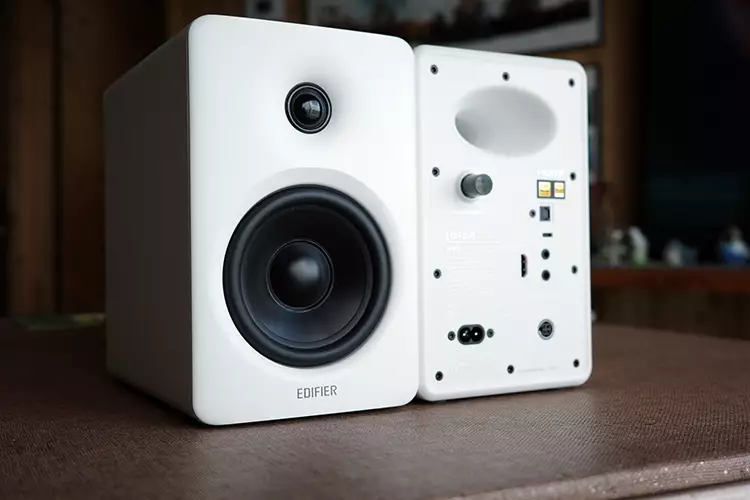
Lynn reviews the Edifier M90, a compact set of active desktop speakers with 100W RMS total output power, wireless, and HDMI eARC capability. It is currently priced at $369.99.
Disclaimer: This is a sample sent in exchange for my honest opinion. Headfonics is an independent website with no affiliate links or services. I thank the team at Edifier for giving us this opportunity.
To read more about the Edifier audio gear previously reviewed on Headfonics, click here.
This review follows our current scoring guidelines, which you can read in more detail here.
While Headfonics has not reviewed many Edifier products over the years, I have. Ranging from their headphones such as the Spirit S3 to speakers such as the S2000Pro, I can appreciate the cost/benefit ratio of many of the wares I have tested.
The $369.99 Edifier M90 is the company’s latest powered wireless speaker, which can also be connected to your TV via an HDMI cable (not included).
This is a slight departure for the company, but if you have followed Edifier over the last 30 years, they have always seemed to bring about products not only promptly, but also with functionality that fits the spot.
The HDMI connectivity, while not novel, makes for another option in this highly versatile speaker. Equally at home on your desktop in a near-field situation or within your television experience, the Edifier M90 proves itself in multiple situations, adding to its versatility.
How does it perform and compare to competitors such as the FiiO SP5 and SA1 or even Edifier’s own MR5? I found out in my full review below.
Features
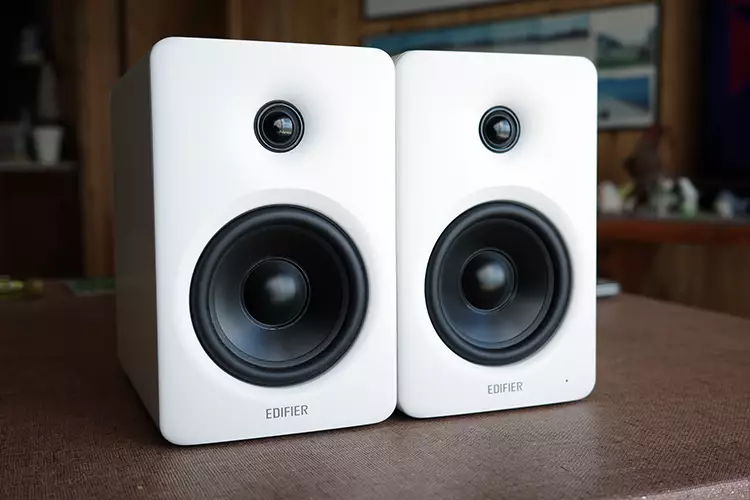
The Edifier M90 comes with a 4” long-throw aluminum “mid-bass” driver and a 1” silk dome tweeter. It has dual Class-D bi-amplification delivering up to 100W total power.
Each mid-bass driver pushes 35W, and each silk dome tweeter pushes 15W, plenty for most of your needs, to be honest.
Having HDMI eARC makes the Edifier M90 a plug-and-play option for your television, and you do not even need to worry about powering on when turning the television on and off; it is automatic.
When connected to HMDI, you can utilize the TV remote for not only power, but also mute and volume. The remote also includes three stock EQ settings (Classic, Dynamic, Monitor) and a custom one when designed on the app.
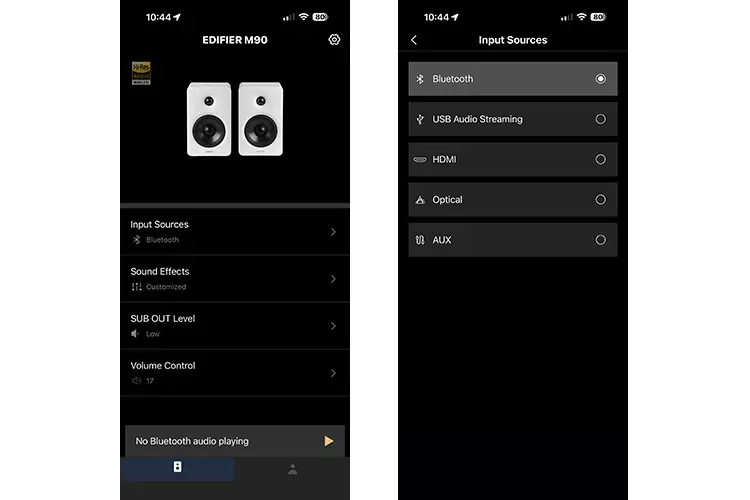
The M90 also runs Bluetooth 6.0 with up to LDAC decoding, and offers wired optical input, USB-C, and an AUX input as source options. For more bass, a sub-out connection is also included.
Using the companion app on your smartphone, you can create custom EQ curves or utilize the existing ones. Bluetooth is multi-connectivity when enabled via the app, adding to the versatility.
A frequency response of 50Hz – 40kHz makes the Edifier M90 reach fairly low (performance was better than that, actually). A Signal-to-Noise Ratio of ≥ 85dB (A-weighted) means it is somewhat hard to drive, but that isn’t unexpected for such a diminutive speaker.
Design
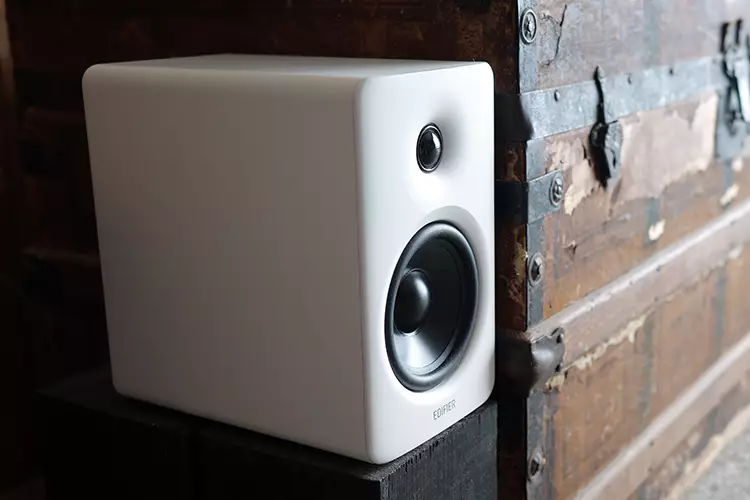
Since the Edifier M90 is marketed as a desktop speaker that can also be used in a television system, it is fairly diminutive in size, but not in heft.
Each speaker is stocky and solid, adding to the reputation Edifier has for including quality options and good functionality.
With sizes of 133mm × 212mm × 225mm for the active speaker, and 133mm × 212mm × 210mm for the passive speaker, the 6.05kg (13.31lbs) indeed promotes heft in that smaller size. Of course, that smaller size makes for more opportunities in placement.
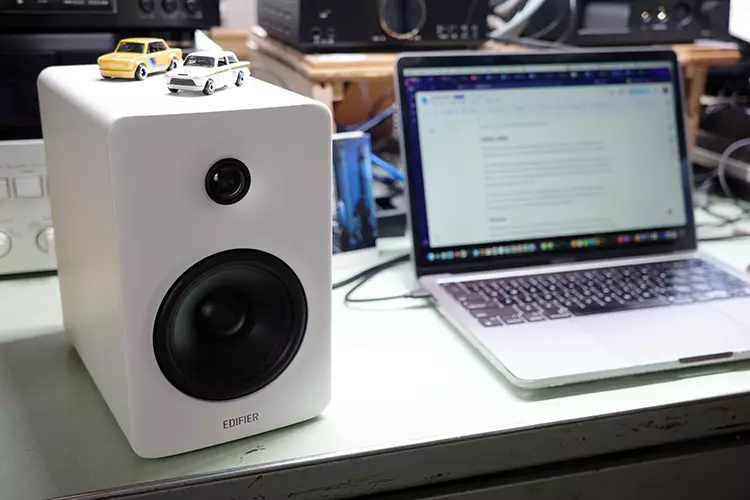
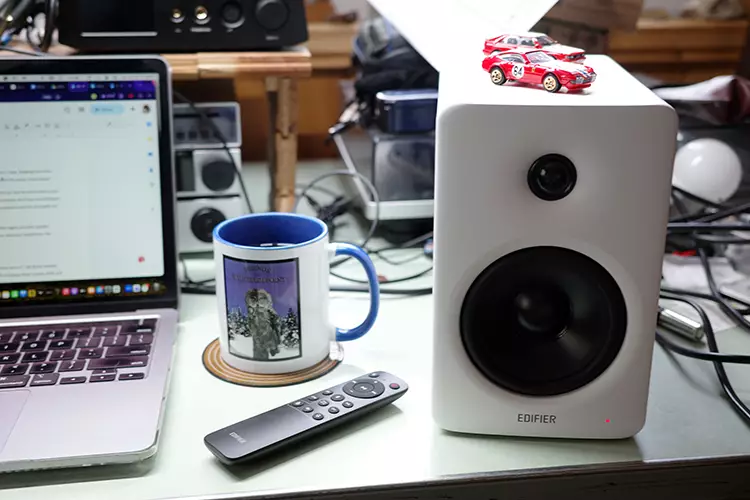
The cabinet comes in either black or white. My sample came in white, and to be honest, it was a nice change from the blacks and browns of other speakers I have reviewed. This is a color I did not mind showing off.
The same can mostly be said about the construction. Two pieces of heavy plastic form the housing, with a front piece and a back.
The back also has an oval port opposite the tweeter, and the seam of the two port halves can be seen. But once placed, you would not see that aspect.
Fitment was average at best, falling short of Edifier’s typically stellar fit-and-finish. That, of course, does not diminish the sound.
The back of the active speaker has the connections for source options clearly laid out, and here is where the black-on-white lettering showed better, to me. I would still rate the build and fit quality up there, and quite acceptable.
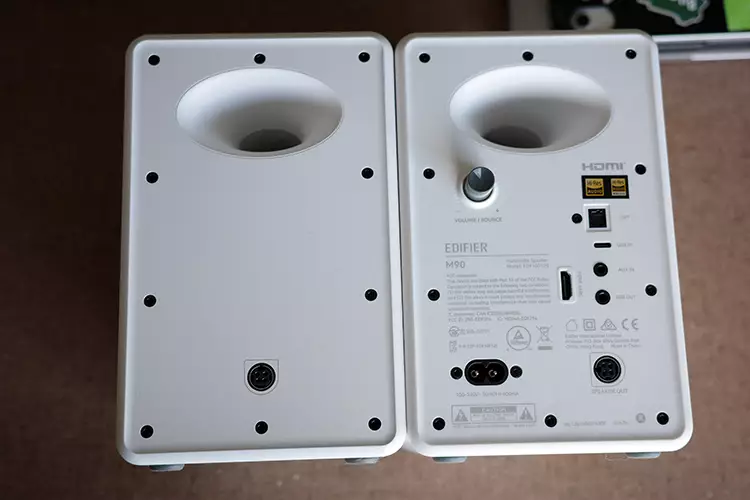
I/O
The Edifier M90 comes chock-full of options for connectivity, including HDMI eARC. A simple plug-and-play, and you are off listening to your favorite footy match or British drama.
Besides the HDMI, the M90 also has optical, which can be connected to the television or a media player such as a CD player. Bluetooth 6.0 allows for connectivity with any number of Bluetooth devices, from a smartphone to a DAP to a CD player I have in for review.
USB-C and AUX allow for connection to DAPs or your laptop, should you desire. The option for multiple sources connected at once makes quick changes as easy as pushing the appropriate button on the remote and hitting play on the source.
When using Bluetooth or HDMI, the Edifier M90 detects the incoming signal and returns to active playback very quickly, something you would expect from a speaker you use throughout the day.
When in optical, USB-C, or AUX, though, the Edifier M90 powers down after idling for a while, and requires a manual wake from either the remote or the app before it will play again. This does add a layer if hooked to your laptop, but something to be aware of in use.
To me, though, the star is the inclusion of HDMI, especially at this price.
Controls
All controls are on the back of the active speaker, including a rotating volume knob and power switch.
But once activated, the remote (2.4GHz omnidirectional) is all you need, so I understand why the controls were located on the back. This also helps keep the design of the speaker clean.
The remote controls power, volume, input source switching, and mute, and it provides dedicated buttons for switching between the three onboard EQ preset buttons (Classic, Dynamic, Monitor) and the custom option button.
Testing of the differences was not made until the unit reached 50 hours.
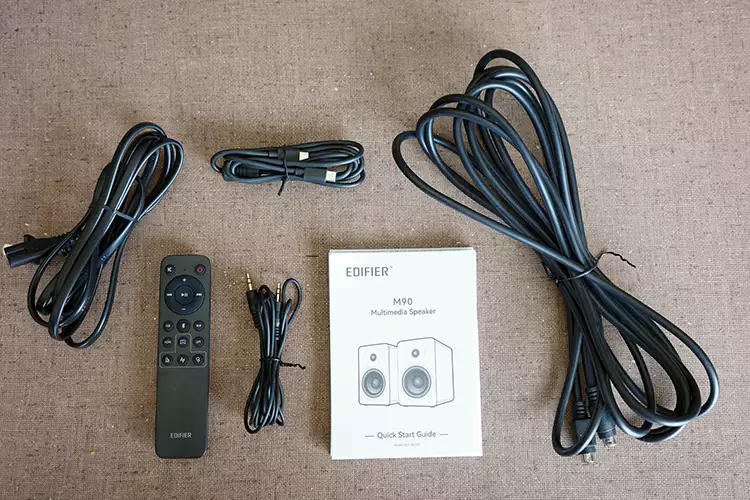
A nice inclusion is a pair of AAA batteries, too. Often of late, these are not included in many devices (some companies more than others…), and the user must purchase more.
Edifier ConneX App
The Edifier ConneX app connects to the Edifier M90 in Bluetooth mode and provides access to the full set of features. Input selection, EQ presets, custom EQ editing, Bluetooth multipoint management, and firmware updates are all controlled within the app.
The home screen is clear, providing an overview of the current operational state. Navigation is fast and logically laid out, too.
The EQ section is very customizable, beyond the three presets. It can be configured and saved independently in either flat, custom, or a third option of your choosing, with each accessible on the remote hardware buttons.
The custom EQ screen provides a 9-band interface ranging from 62Hz to 16kHz, with enough plus-minus dB range to make audible tone changes across the board.
The only thing lacking for me is a full PEQ, which the FiiO SP5 and SA1 have. That said, the three included EQ settings and custom should suffice. Especially since using custom allows for tailoring the M90 to the room situation.
Packaging & Accessories
The Edifier M90 comes double-boxed, with the inner box as the product packaging. Inside, Edifier thankfully uses recycled cardboard-like forms, protecting the contents.
Two accessory boxes are set into the top protective board, and contain the power cable, connection cables, manuals, and the remote control in one, and the speaker interconnect in the other.
Under that, the speakers are protected in taped plastic bags surrounding the soft, thin, pliable foam used to protect the speakers. Efficient and all-inclusive, except for an HDMI cable.
Sound Impressions
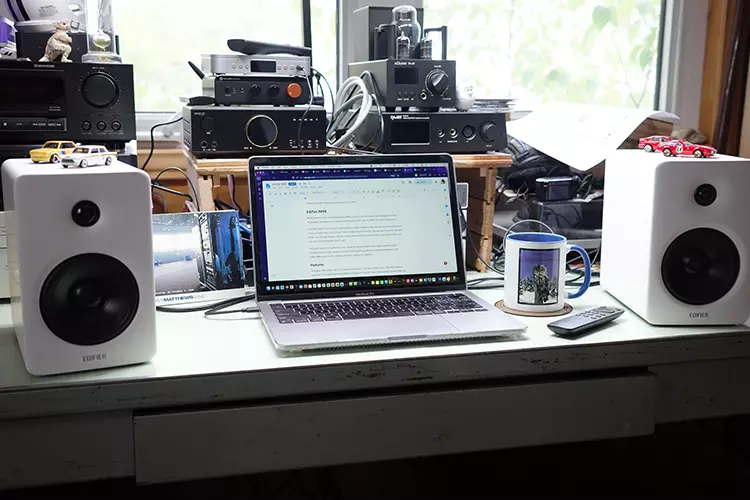
The Edifier M90 was played for 50+ hours before critical listening. I used the M90 across the sources listed above, spending time almost equally as a nearfield unit (with various input sources ranging from an upcoming CD player and my MacBook Pro) and HDMI to our Samsung TV.
Summary
Edifier speakers are seemingly ready out of the box. The M90 proves no different, with a good, controlled thump down low, especially through HDMI. Extension up top is limited by source input and the diminutive tweeter, but I was never left wanting more reach.
The top-end promoted a smooth quality that also showed a slight analytical side. Seemingly dichotomous in nature, the smooth extension promoted an organic naturalness to the top end without losing quality.
The analytical character of the top-end gave the Edifier M90 a punctuation mark, keeping the sound signature “honest.”
By that, I mean even with the potential for artificial extension or character, the smoothness combined with the analytic to keep the signature well-rounded, organic, and versatile.
The midrange sits a bit further back than I would prefer, but it did not get lost when called upon, like in Jazz or with good vocal characters.
The overall signature promoted excellent depth, aided by the midrange, while width was limited only by placement. In the television setup, the soundstage was wide and deep.
In nearfield, the depth and height showed through with excellent quality, while the width was limited by the desktop setup.
Bass
The bass is limited by the size of the woofer, yes, but when the source material reaches low, so does the Edifier M90.
On bass-heavy content through HDMI (eARC) and our Samsung TV (which has horrible speakers), I was quite surprised when low-end explosive material played through almost on par with the normal soundbar and subwoofer setup we utilize.
Tight control kept the lows taut without becoming thin or analytical. The attack was quick and decisive, and the decay slowed a smidge, giving the lows the added weight necessary to promote the low-end somewhat well into the sub-bass region.
In nearfield experience, the source proved the limiting factor, although I did not have a chance to place the Edifier M90s close enough to a wall to discern if that helped.
The vent placement helped with the low-end extension while also adding to the depth mentioned in the soundstage. Angling the speakers focused the low-end more directly behind your workspace, while keeping the speakers flat, expanding the width of the lows (and all else) as expected.
I did find that keeping the speakers slightly angled ended up giving a bit better definition to the lows, but I appreciated the expansion when perpendicular to my sitting workspace, so I left the pair in this manner.
Mids
The midrange might be called the panacea of the Edifier M90, but the tuning serves its purpose by staying somewhat out of the way and giving the excellent depth of which I have spoken. While not the most defined part of the sound signature, the midrange does not offend, either.
Sometimes speakers push the midrange so far out front that they become too shouty, or too dominant within the signature. The Edifier M90 sets a stance, allowing the parts, which blend into the mids, to pull what is needed out of the rest.
The retreating of those midrange notes might be construed as not giving any character to the signature. Even with the withdrawn nature, the level of detail promotes excellent note weight and the ability to tease out the best of what is presented.
Music, which might normally be more frontal in attack, is still present, but not showy or forceful, instead supporting the overall character of sound. And, there is still good clarity present.
This works especially well with genres such as jazz, where the underlying cast of characters supports the show. Vitally important for support, the Edifier M90 comes across with alacrity, but distinction in presentation, especially through HDMI or optical.
Treble
The treble extension is neither too much of a reach nor too rounded. Rather, the extension fits the size of the tweeter while giving a smooth quality character to the top-end that soothes rather than punctuates.
But, when called upon, the treble notes show forth with excellent clarity and detail, almost belying the size and expectations.
The upper midrange pushes top-end notes forward, giving an almost false sense of extension. Instead, that push upward is what helps to give the Edifier M90 its rich, smooth quality with excellent note weight.
I do wish for a bit more extension, but not at the expense of thinning note quality or separation of the parts.
The upper reaches of the treble suffer a bit from the smoother overall character, but I was never left wanting more extension in that top.
I found that what was presented represented the source material quite adequately, especially when using the Hi-Res inputs such as optical or HDMI. For lacking in XLR connectivity, the Edifier M90 does a very good job of representing the source material.
The lack of true extension does hinder detail retrieval, though. What you hear is the melding of the whole top-end, instead of the individual instruments, which does hurt a bit in clarity.
Staging & Imaging
The soundstage might be the highlight of the sound signature. The Edifier M90 is truly impressive, using the variety of input options.
When using HDMI (eARC) or optical, the depth extends well beyond what you would expect from such a small representation of desktop speakers.
The depth when using nearfield also extends upward, increasing the height to well above my head.
This is even with the speaker set below ear level. In fact, when I set the speakers at ear level, I feel subjectively that the height diminished, as did the depth. Silk dome tweeters are known for radiating sound in a near-180-degree field, and the Edifier M90 proved this.
The treble note plays especially nicely within the soundstage, adding to the smoothness and extension, without losing note girth.
The placement of instruments did not diminish across sources, either. Hooked to the television, the Edifier M90 presented a wide, deep soundstage that extended high to accommodate whatever the source presented.
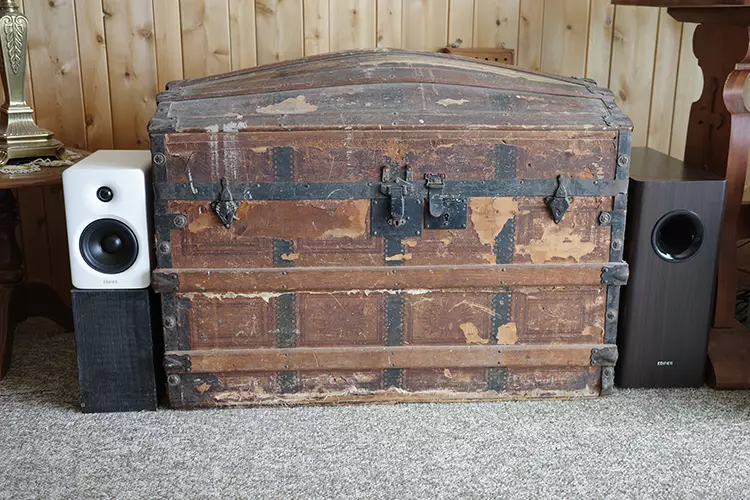
There really was no need for a subwoofer, but when used together, the subwoofer added that extra bit of floor, enhancing sound in all three dimensions. This also afforded the benefit of accurate placement, which is especially important when used in a television/video setup.
Given that the width and depth were already present in copious amounts, the extension using a subwoofer only enhanced the accurate placement of scene material.
Click on page 2 below for my recommended pairings and selected comparisons.
