

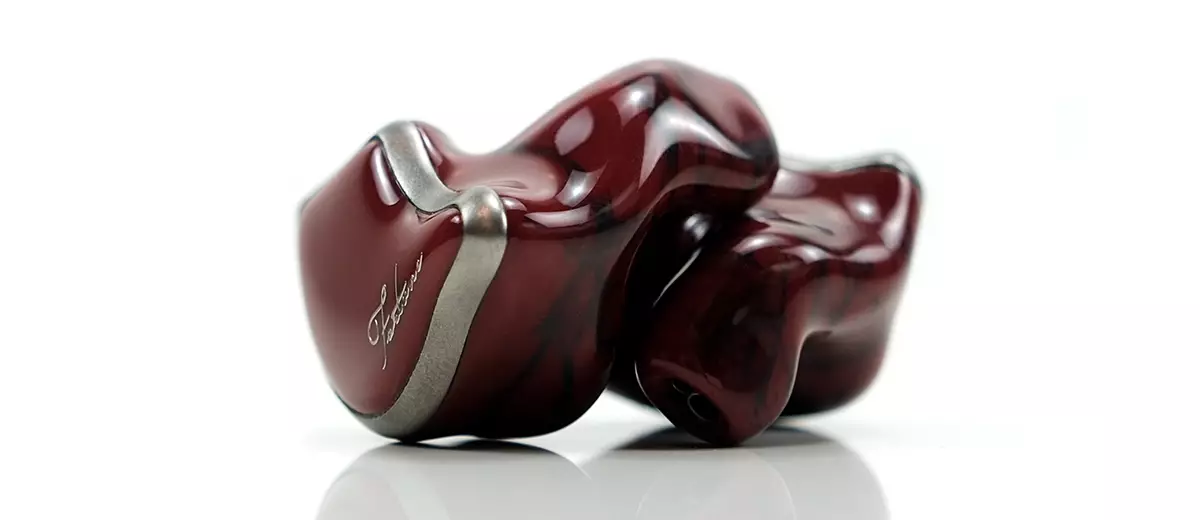
Marcus reviews the Unique Melody MEST Fortune, a limited-run 10-driver custom IEM with dynamic, BA, EST, and bone conduction drivers. It is currently priced at $2699.00.
Disclaimer: This sample was sent to me in exchange for my honest opinion. Headfonics is an independent website with no affiliate links or partnerships. I thank the team at Unique Melody for their support.
Click here to read more about the Unique Melody products previously reviewed on Headfonics.
This assessment follows our current scoring guidelines, which you can read in more detail here.
UM’s MEST series is probably one of the company’s longest-running monitor lineups, with the original MEST and MEST MK II coming out in 2020 and 2021.
The MEST MK II, in particular, captured a lot of audiophiles’ attention, such was the value-to-performance proposition at the time. There have been several subsequent MESTs in the lineup, with the most recent being the Jet Black last year.
The new MEST Fortune is a follow-on from the 2021 MEST Indigo, a special “North American release” and one of the few UM monitors I have not yet reviewed.
Priced at $2699 (Universal edition) and launched as a special 2026 Lunar year model, with 200 units released, the multi-driver UM MEST Fortune has a more refined sound than previous models, with a natural level of depth, warmth, and sparkle, creating a very balanced and likeable tuning.
As always with UM IEMs, this is a review of the custom version rather than the universal format. My sound impressions might differ slightly due to the nature of custom IEMs’ acoustics, given they do not use ear tips.
To balance that out, I will be comparing the MEST Fortune’s performance with some of UM’s other custom-designed monitors, the MEST Jet Black, Maven II Crescent, and the Maven Pro in my full review below.
Features
The Unique Melody MEST Fortune is a multi-driver hybrid in-ear monitor. It comes in universal and custom formats, though if you want to go custom, you need to send UM an email requesting it.
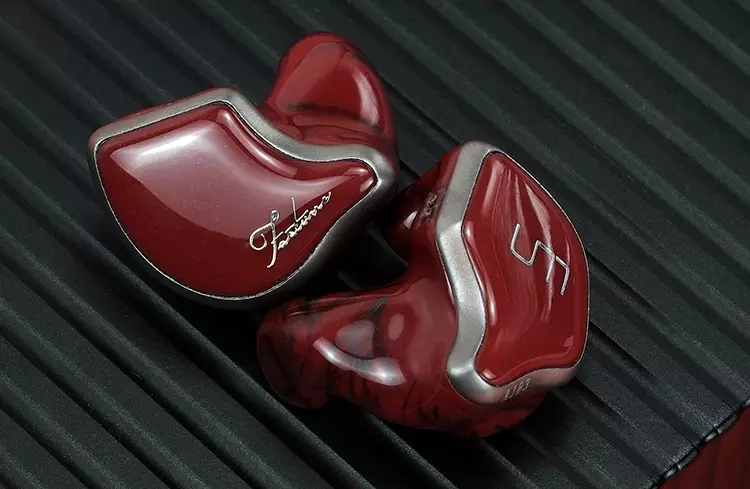
Inside, it has a 10-driver setup similar to the MEST Jet Black, with a single dynamic driver for the lows (presumably 10mm), 2 BAs for the mids, 2 BAs for the highs, and 2 ESTs for the ultra-highs.
It also uses a full-frequency bone conduction system with 3 bone conduction drivers of two types: composite BA and piezoelectric.
Their primary focus is on enhancing the spatial properties of the MEST Fortunes soundstage and enhancing the tactile response of the low-end frequencies.
The MEST Fortune is rated at 10Ω and 107 dB/mW @1kHz, so not super sensitive, but perhaps a little more so than the Jet Black, and easy enough to drive with good quality DAPs and dongles.
Design
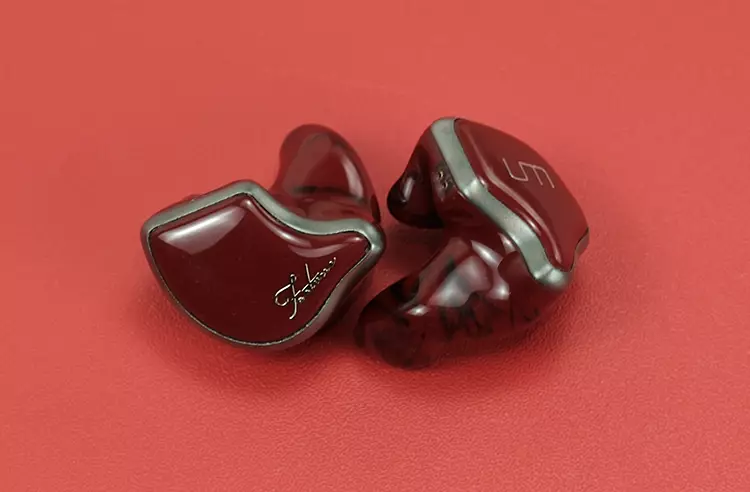
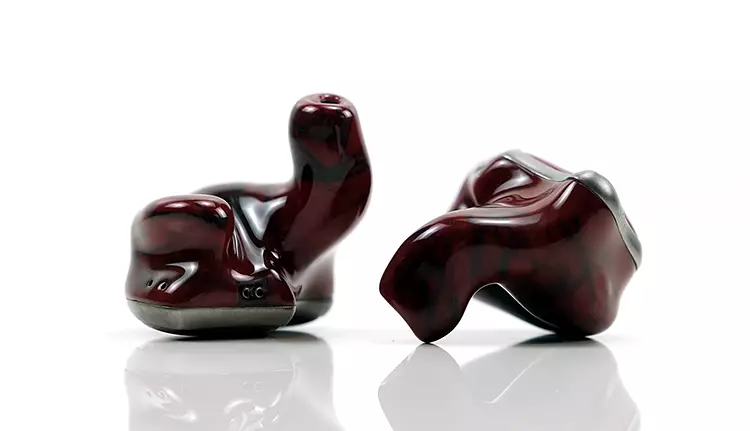
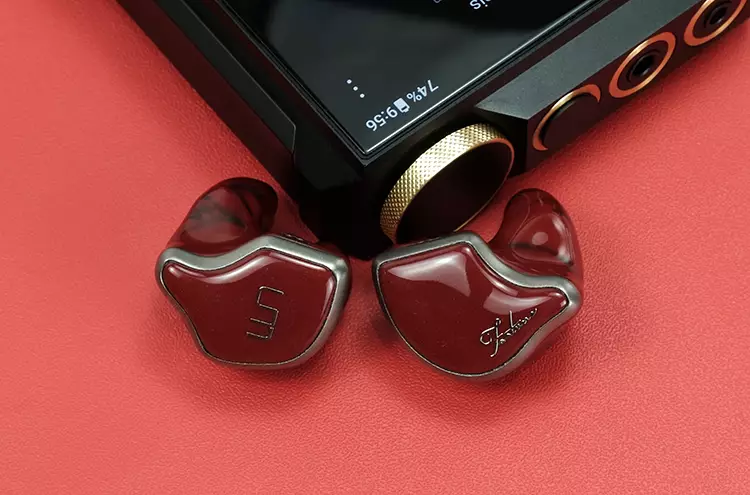
Whilst custom designs can provide limitless options depending on what UM can provide, this particular MEST Fortune sample came in stock red, with the alternative being purple. Both versions are available for the universal variant.
Now, I have seen a very similar aesthetic to this before with my MEST MKIII CF version, but it’s not quite the same.
This sample uses a shell with a solid red and patterned black brushstrokes finish as opposed to my MEST MKII CF’s translucent equivalent.
The plates are are a glossy single tone red with the signature Fortune moniker on the side as opposed to the continuous red and black strokes finish of the MKIII with gunmetal fenders as opposed to gold.
It’s not as ‘spicy’ in its visual pop as the MKIII CF, but I do like the harmonious use of red throughout rather than going two-tone, and gunmetal is more of a “western-flavor” than gold is.
As always with customs, the shell is going to be slightly bigger than the universal version, given the nature of how molds translate to form-fitting shells for your ears.
However, for owners of the MEST Jet Black, the MEST Fortune shells are almost the same size, and definitely smaller and lighter than the titanium Maven Pro and Maven II Crescent models.
Comfort & Isolation
Much of the level of isolation from a custom IEM comes down to how accurate your 3D ear scans are and how well the company translates them into the final shell.
UM has always done a fantastic job translating my digital scan files to resin shells, but credit to the scanning company, which nailed the scanning accuracy in the first place.
Bear in mind, this is a hybrid model, so there is venting via two microscopic holes to the back of the shells that can often diminish performance compared to non-Vented BA alternatives.
That said, I hardly noticed as the passive isolation from the MEST Fortune is excellent and slightly superior to the MEST Jet Black’s Petal vent design, which tended to pick up some wind noise.
I would place its passive isolation performance on par with the MEST MKII CF and marginally better than the more rigid metal shells of the MAVEN II Crescent.
Also, since the MEST Fortune shells are resin rather than metal, they are lighter and more comfortable in the ear with an excellent pressure-to-seal balance in the inner ear canal.
The nozzles are not overly long and not quite as long as my Maven II Crescent shells (shorter, maybe by 1mm), which can enhance comfort for some ear canal shapes by providing a more relaxed fitting compared to a tighter stage musician alternative.
Stock Cable
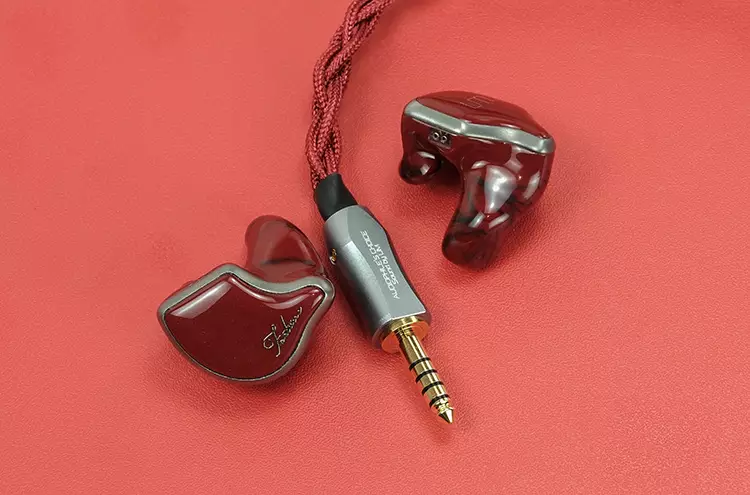
The MEST Fortune stock cable is called the JoyFort Line and comes in a delicious, matching red nylon braided jacket finish, complementing the custom red shells beautifully.
If you opt for the purple custom version, the cable is finished in black, which, for me, is not quite as stunning as the red combo.
The Joyfort cable is a 4-wire 26AWG Pure copper creation with PVC insulation wrapped inside the braided outer red nylon jacket and finished with UM’s trademark thick pinched barrels in the same matching light gunmetal finish as the faceplate frame of the MEST Fortune shells.
The stock plug is 4.4mm balanced, though if you want 3.5mm or an alternative, you can email UM and find out if it’s available. The connectors are 0.78mm 2-pin with a good size tolerance, meaning they did not feel overly tight or loose when connected to the main shell sockets.
Memory retention is nil, with a provided matching chin cinch that is loose enough not to bother and stays in place when adjusting its position.
The cable has a sliver of springy PVC coating near the connectors to steady the cable around the ear, but not so much that it ends up denigrating its visual appeal.
For a nylon-jacketed cable, the microphonics or physical noise from touching or moving the cable is low below the splitter and slightly higher above the splitter when adjusting the chin cinch or adjusting your head.
It’s not something that would bother me too much, as it’s only noticeable during dead silent moments, but just something to be aware of if you have a beard or high collar that can brush against it.
Packaging & Accessories
You get everything provided in the universal MEST Fortune accessory line-up, save for the ear tips, which are not required for a custom IEM.
As with most UM packages, it’s a small, compact, and sturdy black box with a jewelry-type drawer design presenting the custom shells and carry case on top and the accessories neatly tucked away on a slide-out lower tray.
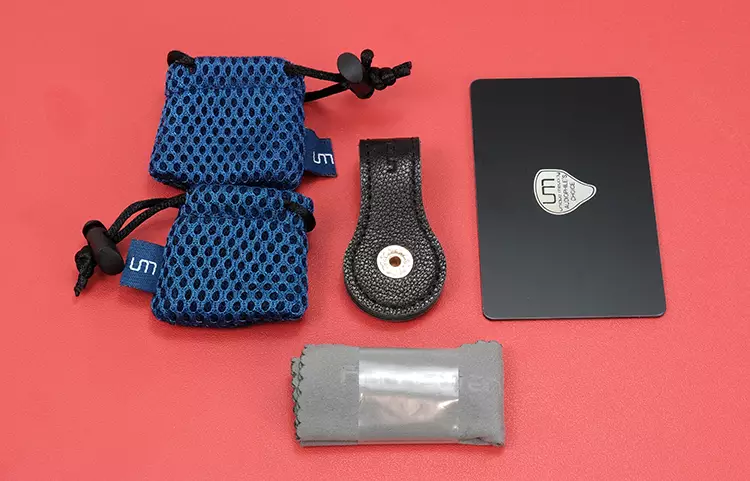
The carry case is UM’s classic compact blue leather zipper case with the MEST Fortune shells inside protective blue mesh pouches and attached to the Joyfort stock cable.
It provides good protection with some compartmentalization and is about the right size for sticking in a small bag, though slightly too big to sit comfortably in average-sized pockets.
Aside from that, you get an IEM organizer strap, a cleaning cloth, and your numbered warranty card.
Sound Impressions
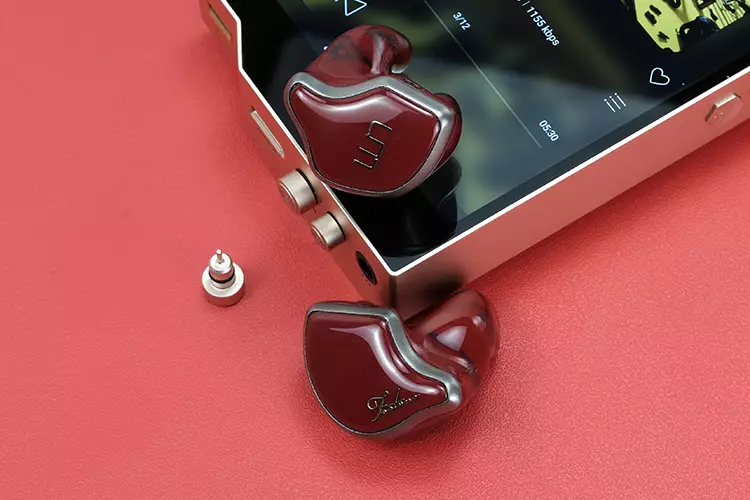
The following sound impressions of the Unique Melody MEST Fortune were completed using the HiBy RS8 II, FiiO’s M27, and the Cayin N6iii/R202 combo.
Summary
The custom version of the MEST Fortune is a weighty, fulsome tuning, with an even-harmonic, almost euphonic, timbre throughout.
Nothing about this tuning is shrill, bright, or lean-sounding. It’s effortlessly smooth throughout with a saturated coloration that is very unlikely to ‘breakup’ with sibilant or brighter recordings.
Everything up to 1-2k is north of neutral, so it carries a good deal of warmth and power. Instruments deliver a pleasing fundamental frequency that will delight thrash metal, modern pop, and R’n’B rhythm section fans.
Vocals and percussion are more neutral in their imaging. It’s not as forward-sounding as the MEST Jet Black in the mids, nor does it have the same levels of note contrast as the Maven II Crescent or the older Maven Pro.
Instead, it generates a subjective feeling of relaxation. This is more of an easy-going sound with a slightly looser ‘phatter’ bass delivery. Combined with a treble lift shifted more to the upper than lower FR, it creates a gentle sheen on notes rather than a drier, hard-hitting impact.
If there is one Achilles heel, it’s the MEST Fortune’s vocal presence when the bass is energetic. It can sound a little rounded in its delivery and not quite as well separated as the MEST Jet Black.
I tend to pair the MEST Fortune with airier or mid-forward sources such as the iBasso D17 or N6iii/R202. In the case of the HiBy RS8 II, I use PEQ with additional dB around 4k if I need more vocal intimacy, which it responds very well to, so it is a flexible performer.
With soulful recordings and more ambient music, the staging size of the MEST Fortune is very good, sounding wider and deeper than the older Maven Pro or Maven II models.
Frequency Response
The custom version of the MEST Fortune delivers a fairly pointed 20-50Hz sub-bass lift combined with a slow slide that never dips below neutral right up to the mids around 1-2k.
It’s a long bass shelf, though I must point out it’s not a bloated, bloomy sound either. There is just enough of a dip around 200-500Hz to retain some much-needed space, but not to the same level as the MEST Jet Black, so the mids retain more warmth and do not sound quite as neutral.
From 2-4k there is a mild bump, but it remains south of neutral for me with a bigger dip around 4-5k.
Imaging resonates well with sparse mixes; the vocal comes across as beautifully textured with liquid-like leading edges and slower decays, but it can also lack a little presence and contrast when up against some of the older MEST and Maven models.
Conversely, the perceived space from the listener’s position to the singer feels more abundant, creating a more atmospheric or bigger soundstage quality from the MEST Fortune’s presentation than, for example, the more intimate and narrower Maven II Crescent.
From 6k to 10k, the treble presence rises somewhere around neutral. It’s not an aggressive tuning, but necessary to prevent the MEST Fortune from switching from relaxed to dark.
The lack of heavy pinna gain means the treble doesn’t upset the MEST Fortune’s otherwise lush harmonic balance. Instead, you get a gentle sheen that can often create a slightly sweet and agreeable quality to upper-register vocals and percussion notes.
Click on page 2 below for my recommended pairings and selected comparisons.
