

Selected Comparisons
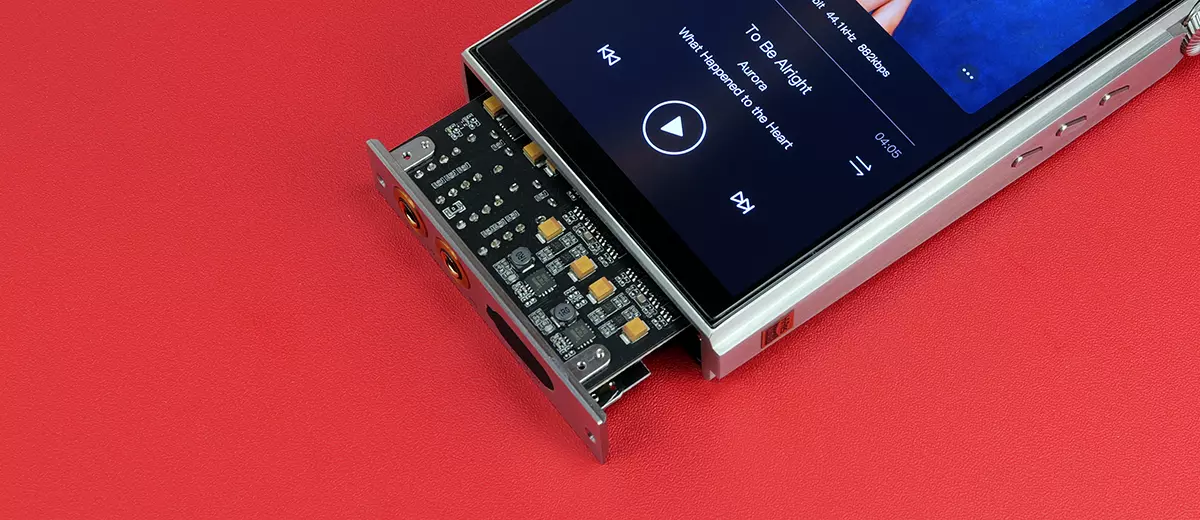
The following selected comparisons to the AMP18 were completed using the DX340 with a mix of the Vision Ears VE ZEN, PMG Audio Apx, and the ZMF Headphones Tessidera.
iBasso AMP17
The iBasso AMP17 is the 3rd card in iBasso’s next-gen series of amplification cards and one that we reviewed at the start of this year.
Technical
Like the AMP15 and the AMP18, the AMP17 is a solid-state-based card. Both it and AMP18 are discrete-engineered balanced output-only amplifiers.
However, instead of AMP18’s dense 80-transistor matrix topology, AMP17 uses a gallium nitride (GaN) semiconductor material rather than traditional portable transistor-based or MOFSET silicon amplification topologies.
This is a more efficient, low-heat design producing a higher PWM frequency that results in excellent square wave output performance from faster switching nodes than traditional MOFSET alternatives.
Note, because it is more efficient than AMP18’s transistor matrix, it is a little easier on battery life by 1-2 hours’ worth, though both have 12V DC input to bypass the battery for extended playback capability should you require it.
Rated output power is balanced-only; neither of these cards has single-ended output capability, though both offer LO and PO options in 4.4mm formats.
The AMP17 seems to do better on paper with DC input at 1.9W compared to 1740mW (32Ω load) from AMP18, but that switches around on battery power, with AMP18 having a small edge at 1170mW compared to 1030mW on the same load.
Both require firmware upgrades for compatibility with the DX340 (and by default the DX300/DX320)
Performance
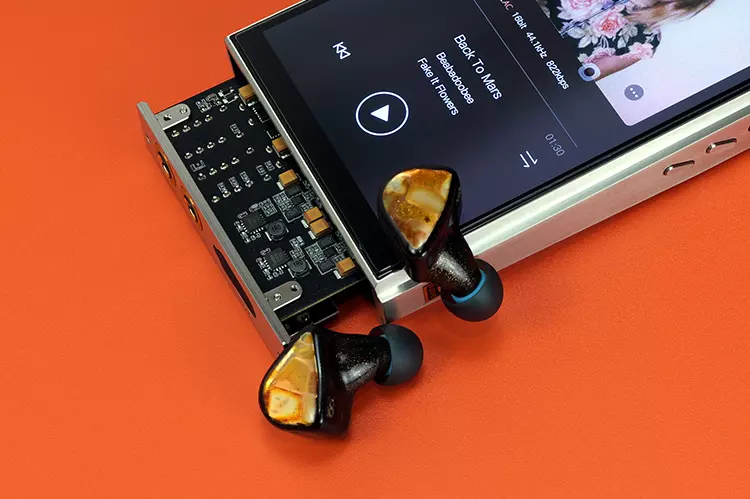
In a nutshell, if you have a brighter mid-forward monitor, pick AMP18; if you have a smoother, heavier-sounding alternative, I would go with AMP17.
AMP18 is the more polished, tranquil performer, excellent for taking the edge off the treble energetic IEMs such as the PMG Audio Apx (V1) and creating a very balanced, even-harmonic sound that works wonderfully well with clean vocal tuning.
AMP17 is more upfront, the brasher sibling if you will, with an uptick in energy and a more vocal-forward sound. It also has a higher default gain level, by the sounds of it, forcing me to drop the volume by 6-7 steps to match volumes.
It also has a cooler coloration and shorter note decay compared to AMP18. It also has more upper-harmonic presence, creating a little more top-end focus, heightened timbral contrast in the mids, and a tighter, more chilled bass response.
With warmer monitors such as the VE ZEN, the AMP17 sounds livelier with more zip in the lows and impact in vocal presence. There is less harmonic dissonance in the vocal timbre compared to the Apx pairing, which, to be frank, I found relatively distracting compared to the softer embrace of AMP18.
Technically, AMP18 might amplify some upper-register detail with more gusto than the softer delivery of AMP18.
There may be a perception of ‘more detail’ as a result, but at the same time, the longer listening sessions felt more at home with AMP18’s fuller, smoother sound and more forgiving upper mids and highs.
iBasso AMP16
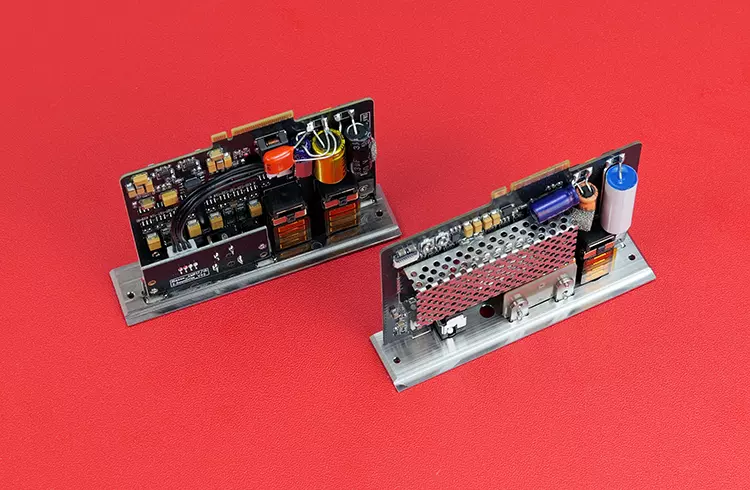
The iBasso AMP16 was launched in early 2025, not long after the AMP15 /DX340 were released.
Technical
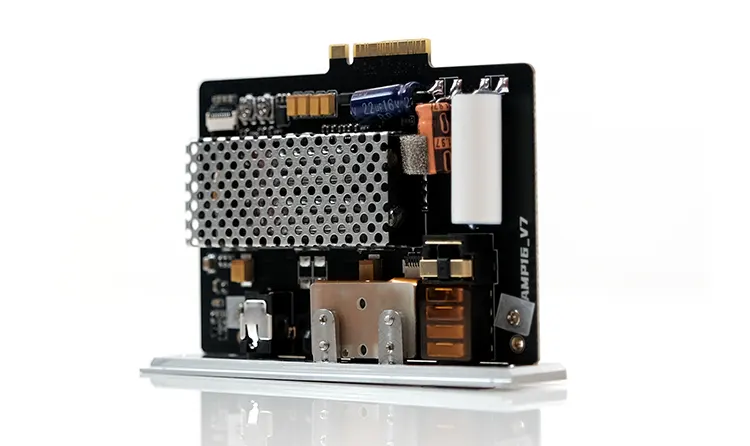
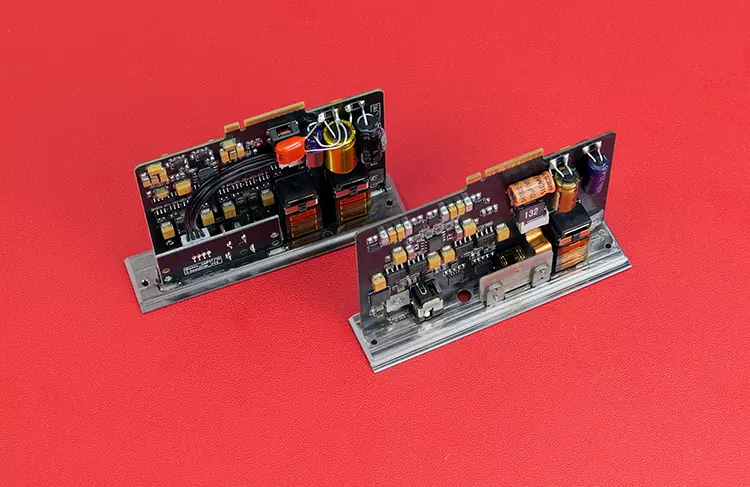
AMP16 is currently the outlier in this group as it is a balanced and SE-capable hybrid tube and transistor amp card. It consists of a dual Raytheon JAN6418 tube with a 22.5V anode power supply on the tube side, 4 TI dual opamps, and 4 BUF634A on the transistor side.
The hybrid setup also means the user can choose between two modes via the DX340’s GUI: Tube and Class AB mode (transistor).
Each mode will deliver a different output power level, with Tube mode capable of up to 660mW balanced on a 32Ω load from the DX340’s battery. Class AB mode will provide up to 1W on the same load and battery.
Like AMP18, AMP16 has the same DC12V input, which will enhance the voltage performance and output headroom from 1W to 2W in Class AB mode and up to 1.5W in Tube mode.
The numbers vary a little on DC input mode, but on battery mode alone, the AMP18 balanced output performance is more current-biased, with almost double the output power compared to AMP16’s tube mode. Things even up a bit in terms of power when AMP16 is in solid-state Class AB mode.
AMP16 also offers a single-ended output, but on a much lower output power rating of 150mW into a 32Ω load in tube mode and 260mW in Class AB mode using the battery. It also lacks the AMP18’s lineout option.
Battery life is slightly better from AMP16 Class AB mode at around 8-9 hours, but Tube mode is lower, around a similar mark to AMP18 at 7-8 hours, depending on usage.
Performance
The most succinct way I can put this comparison is that AMP18 is fulfilling the goal of AMP16’s tube mode better than AMP16.
This comparison reminds me a little of the quality Class A versus a decent tube amplifier debate. Both are smooth-sounding amplification cards, but the AMP16 is still a little rawer and brighter, courtesy of its dual Raytheon JAN6418 miniature tubes.
I have always found these tubes to sound analog, with good body but not overly lush or as polished-sounding as the more expensive NuTube variants.
AMP18’s tuning is definitely more polished-sounding, but with the solid-state advantage of a better underlying sense of drive in the lows compared to AMP16’s less distinct bass response.
You can add more energy and push from AMP16’s Class AB mode, but it introduces a sharper upper-harmonic order and a drier sound at the same time.
I would pick AB for harder-hitting dance and EDM, but the more liquid-sounding tube mode is really where most people want to be with AMP16, given it’s the only tube card iBasso offers in this range.
The layering is also to AMP18’s advantage. It has a deeper, more enveloping staging quality with superior detail retrieval.
AMP16 is more vocal-forward in tube mode and more spacious-sounding than in its Class AB alternative. However, it will sound narrower than AMP18 with slightly less dynamic range, giving it a more centered presentation quality.
iBasso AMP15
The iBasso AMP15 is the DX340‘s stock amp card, launched in early 2025. The DX340 also won our 2025 Top Gear Award for Best DAP.
Technical
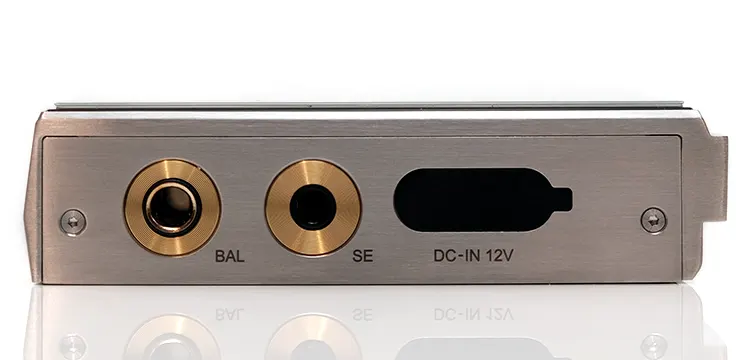
AMP15 is a balanced amplification card, but unlike AMP18, it can output single-ended with a dual LO/PO 3.5mm output. Unlike AMP18, AMP15 has no dedicated 4.4mm balanced line-out. Its 4.4mm socket is also dual-functional for PO and LO.
Inside the AMP15 are 8 TI BUF634 op-amps, delivering up to 1200mW balanced and 312mW single-ended into a 32 Ω load, using the DX340’s dedicated amplification battery power supply.
Like the AMP18 card, AMP15 has a DC 12V input socket that will increase the voltage headroom.
AMP15 has more headroom than AMP18, with a maximum output power rating of 2150mW balanced on a 32Ω load compared to AMP18’s 1170 mW (battery) and 1740 mW (DC-powered) on the same 32Ω load.
Of the two, AMP18 will offer better current capacity or headroom, making it more suited to driving low-impedance, inefficient planar headphones.
Performance
The AMP15 is the less aggressive, less dynamic cousin of AMP17; thus, in some ways, the observations between AMP18 and AMP17 also apply here.
AMP15 has a more linear, more neutral tuning than AMP18 with the paired IEMs I tested it with. I find it spacious and ethereal with a nice weight and punch in the lows, but it’s missing the body and smoothness of AMP18, and consequently a bit of depth in its staging.
To be fair to AMP15, I have always liked its wide and tall staging quality and used it more than AMP16 before AMP17 and AMP18 were released. However, compared to those two cards, it sounds a bit too safe, a little too compressed in the mid-layering, and lacking the bass weight of AMP18.
Tonally, AMP15 is also drier, with a little more upper-harmonic order bias, so treble-happy IEM users will find it slightly harsher sounding, though vocal presence is quite good.
AMP18 is analog in tone, with a warmer lilt and a fuller sound. Vocals are imaging is marginally further back, but with longer decay and a more liquid-sounding attack, making it is generally more agreeable with the Apx’s stronger upper-mids tuning. Vocals have a fantastic harmonic balance compared to AMP15’s treatment.
The warmer tuning of the VE ZEN is better suited to AMP15 than the Apx. However, I still prefer the better bass presence and deeper staging quality from AMP18.
Staging width is always where AMP15 excels, and at times it can sound wider than AMP18 with the right matchups.

My Verdict
The iBasso AMP18 is the perfect tonic for DX340 owners (and DX320/DX300) whose IEM and headphone lineup craves a little smoothness in their sound signature, something that will ease off on brash upper-mids and a spicy treble delivery.
It delivers a refined, analog, and slightly warm sound signature, with excellent depth, creating a performance that is easy on the ear and has enough power and delicacy for IEMs and planar headphones alike.
It won’t replace AMP17. If you need something more dynamic, punchier, and with more overt sparkle, AMP17 is a better choice, and for gear that is already very relaxed-sounding, it adds a bit more urgency than AMP18. It is also a bit more battery-intensive than the more efficient AMP17.
That being said, AMP18 is a beautiful pairing with neutral-sounding gear and, out of all the available cards in this series, it delivers the smoothest, most agreeable sound.
iBasso AMP18 Technical Specifications
- 4.4mm Balanced Phone Out
- THD+N: -114dB (No load), -105dB (300 ohms load), -93dB (32 ohms load)
- Dynamic Range: 123dB
- Signal-to-Noise Ratio: 122dB
- Max Output Power
- 1740mW+1740mW @ 32Ω (12V DC power supply)
- 1170mW+1170mW @ 32Ω (Battery Power)
- Crosstalk: 122dB
- Frequency Response: 10Hz-40kHz ±0.9dB
- Output Impedance: 1.2Ω
- 4.4mm Balanced Line Out
- THD+N: -110dB (No load)
Dynamic Range: 123dB
Signal-to-Noise Ratio: 123dB
Crosstalk: 114dB
- THD+N: -110dB (No load)
