

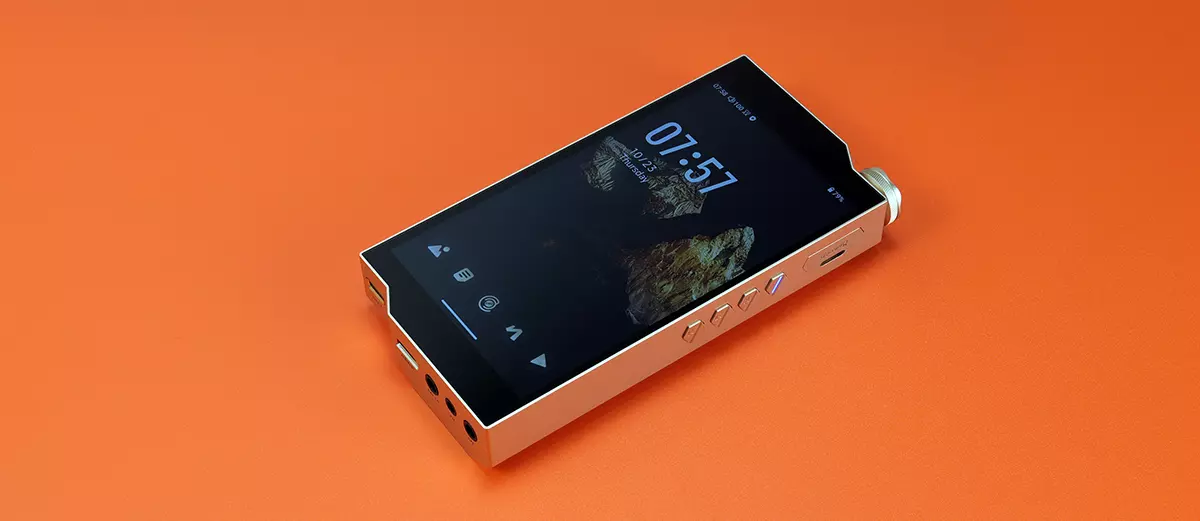
Marcus reviews the HiBy RS8 II, a groundbreaking flagship 16GB Android DAP with adaptive amplification and AI-enabled tone controls. It is currently priced at $3899.00.
Disclaimer: This unit sent to me was purchased for this review. Headfonics is an independent website with no affiliate links. I thank HiBy for their support.
You can click here to read more about the HiBy products we have previously featured on our website.
This article follows our latest scoring guidelines, which you can read in more detail here.

Upgraded DACs and refined or more powerful amplification have typically been key selling points of new DAPs. If it is an Android DAP, there is also an emphasis on the enhanced CPU, RAM, or a new Android software version, such as 12 or 13.
These are all really tangible, time-honored improvements that the audiophile community traditionally looks for when making their buying choices.
However, with the launch of the new flagship $3899 RS8 II, HiBy has opted for a different route, one that is grounded in their legacy expertise, software, and what it can add to the listening experience beyond the aforementioned basics.
As a result, the RS8 II is less of an iterative flagship upgrade on the RS8 and more of an evolved, modern way of thinking on how to customize sound to fit your needs in a portable audio player.
Will it be the most powerful player out there? I doubt it, but its smooth and natural sound, smartphone-level speed, and deep, ever-evolving Darwin Architecture certainly make it the most innovative DAP in today’s market.
Features
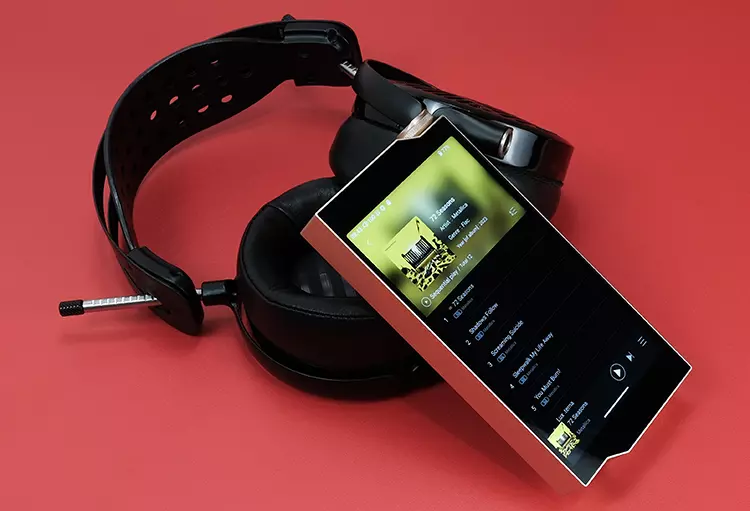
The HiBy RS8 II is a new flagship open Android 13 digital audio player. It is primarily pitched as a wired and wireless portable player for headphone and IEM/TWS users.
However, the RS8 II can also slip seamlessly into desktop and HiFi systems, operating as a USB 3.2-capable DAC or transport with SPDIF, I²S, and USB-DAC capabilities.
As with all high-end HiBy DAPs, the RS8 II is wireless-capable, featuring Wi-Fi 7 MIMO and bidirectional Bluetooth 5.3, which allows you to maximize the Android connectivity experience.
Inside is a Qualcomm Snapdragon 8 Gen 2 processor (QCS8550) and a massive 16GB of RAM, paired with 512GB of internal storage.
There is not a single DAP on the market today with that amount of processing power. Despite Android 13 showing its age a bit with most new smartphones on 15 or 16, the 16GB of RAM and upgraded processor will make a palpable difference in how you perceive the speed of the RS8 II’s UI.
The RS8 II also comes with DARWIN III, an audio processing architecture combining FPGA and R2R, which debuted in the RS6, and includes a 2nd-gen delta-sigma version inside the R8 II.
And it is in DARWIN III that we see possibly the first use of AI in a DAP with significant computational power within its FPGA algorithm to enhance each R2R individual resistor’s performance in real time, as opposed to pre-defined abstracts. The ideal result is lower distortion and greater accuracy than previous generations of DARWIN.
Decoding
As with the RS8, the RS8 II utilizes a discrete R2R network array within its DARWIN II architecture for decoding, with its AI-powered FPGA providing digital signal processing for its oversampling harmonic controls.
The new CPU and FPGA setup is also the foundation for the RS8 II’s new Sankofa AI platform, which provides the user with an ever-expanding set of tone controls designed to mimic the sound of older gear such as mini-disc and cassette players.
Decoding rates are up to an impressive DSD1024 and PCM 32-bit/1536kHz, and if so interested, the RS8 II can unfold MQA natively at up to 16X.
Bear in mind that the original R8 had the same high-level decoding specs, so this is not something new. Rather, it’s the quality of performance within the new DARWIN III architecture and suite of tone controls that is of more interest.
The RS8 II is also wireless-capable with BT5.3, with transmission support for LDAC, aptX Lossless-equipped devices, and LDAC/ACC/SBC support as a receiver.
Amplification Topology
The RS8 II is designed to run either single-ended or dedicated balanced PO/LO, and in Class A or Class AB mode, much like the RS8. However, the way in which power is generated has changed significantly.
HiBy calls their new topology ‘Adaptive Amplification,’ whereby the operational mode activated will be picked by the DARWIN III FPGA based on the preceding type and complexity of the recording signal it sends to the amplifier.
In short, this is a real-time operation, one that can happen many times during one song, and is designed to give you the strengths of Class A or Class AB when you need it.
You can also control the degree of adaptive bias towards Class A or Class B within the RS8 II audio settings, effectively allowing you to block out one class over another or blend them, depending on your needs.
As mentioned in the introduction, pure grunt is not what the RS8 II is all about. If you want maximum swing voltage and PO output power, then the 3W FiiO M17 and the new 5W-capable M27 DAPs are better choices.
In balanced output mode, the RS8 II is listed as having a maximum of 812mW (5.08Vrms) into a 32Ω load down to 210mW single-ended on the same load.
The RS8 II still uses the Turbo Power option from the RS8, which enhances Vrms output, so I am guessing that the above statistics are weighted with Turbo Power on, which is my preferred setting.
Design
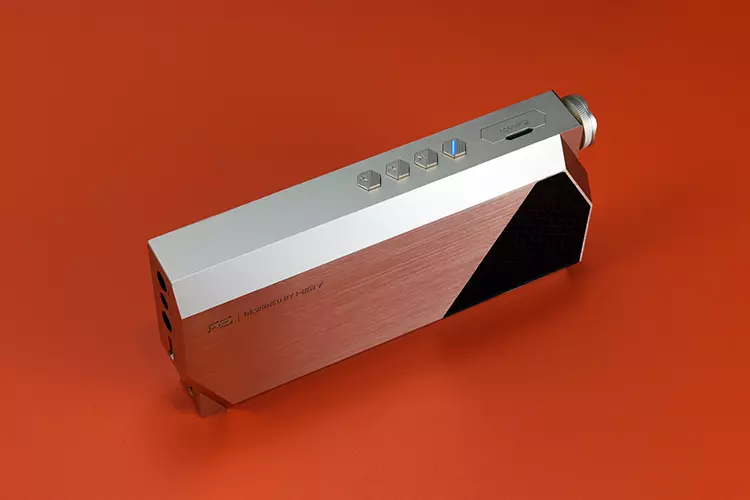
The design language of the RS8 II is more refined and complex when compared to the more conventional form factor of the RS8 and even the newer R8 II, despite its splendid red Alcantara finish.
I am guessing some of the innovative design approaches on their lower-tier models, such as the R4 and R6 Pro, have reverse-trickled because the RS8 II looks nothing like the company’s previous premium DAP lineup, with a sleeker, chiseled, and more angular profile.
The sample I have here is the 411g Starlight Golden edition, but you can get it in Classic Black. I much prefer the gold edition. Something about a brighter classic HiFi color and the way it shows off the aluminum machining appeals to me more than staid black. YMMV.
It’s not a continuous uniblock of ‘gold’ on the outside, though. The glass-finished rear panel has an etched RS logo and moniker, and at the sides, there is some elongated chamfering.
The rear panel is then finished with a tasteful “Darwin-branded” black glossy wedge on the top corner, complete with honeycomb prints.
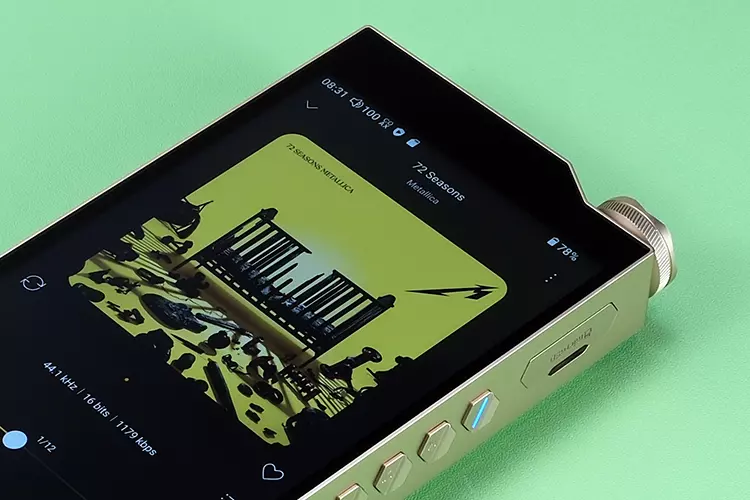
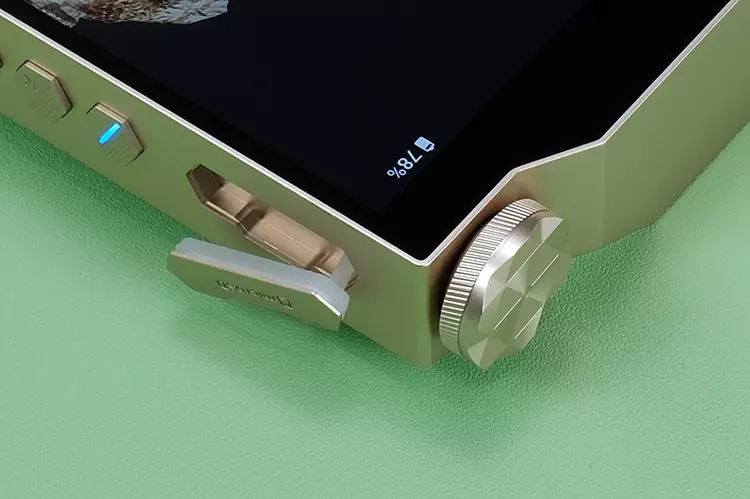
The angular design ethos is continued with hexagonal physical control buttons and a gorgeous 3D geometric-cut cap with fine knurling around the volume dial on the top panel.
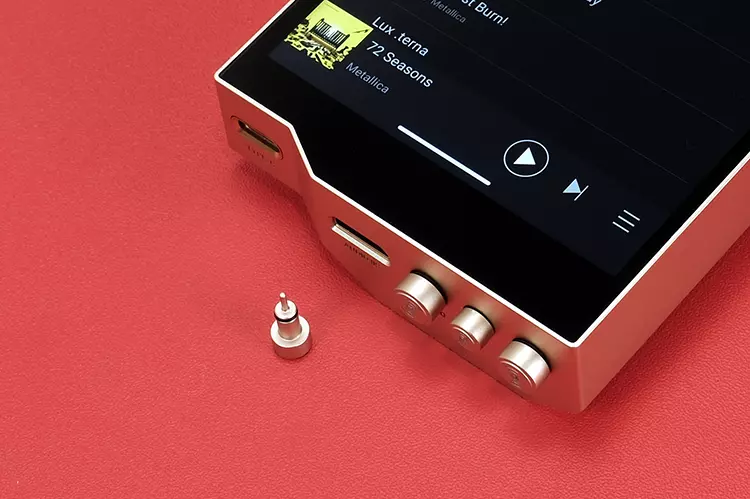
One design aspect that I greatly appreciate is the simpler external memory card slot on the RS8 II. HiBy has done away with the pin tray system (finally) that the majority of DAPs have used for years and instead brought in a simpler rubbery flap with a matching aluminum top.
It might seem a little less durable to some, but from my perspective, it’s about time we moved away from having to bring a pin with you when you want to change memory cards.
I/O
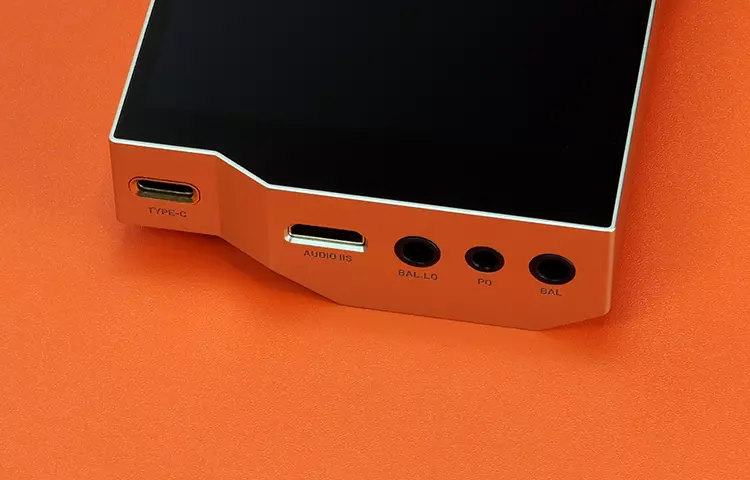
There are several significant changes to the RS8 II I/O, at least when compared to the RS8’s base panel lineup.
The most important (to me) of which is the addition of an I²S output port, which is compatible (configuration 1) with the Topping DX9 Discrete DAC/Amp.
Loyal readers may have noted my disappointment that Topping changed the pin configuration of their new DX9 Discrete amplifier I²S input socket, rendering my Cayin N7/N8ii DAPs incompatible via I²S.
This is not the case with the RS8 II. It has 3 user-selectable I²S pin configuration modes, providing compatibility with a wide range of DACs (see my Synergy section on page 3 for more details).
The addition of I²S does come at the cost of the RS8 II losing the RS8’s dedicated 3.5mm lineout port, which I know might disappoint some users. It now doubles up as a single-ended 3.5mm LO/PO port. Thankfully, the 4.4mm balanced output remains the same, i.e., dedicated outputs for PO and LO.
The RS8 II’s USB port has also been upgraded to 3.2 over the older 3.1 used by the older RS8, increasing the theoretical data transfer speed from 5 Gbps to 10 Gbps.
For those who wish to use the RS8 II’s SPDIF functionality, you will still need a specialized cable or adapter to convert the signal from the device’s Type-C port to a coaxial or optical output.
HiBy used to supply just such a cable in their previous R8 and RS8 flagship DAPs, but that is not the case with the RS8 II, so you will have to buy or use your existing one.
Controls
The control suite for the RS8 is largely unchanged, save for the new physical button and volume dial designs. I much prefer the rotary dial over the volume rocker on the R8 II. It feels more immediate to the touch with faster granular control.
The knurling on the side of the dial, combined with easier access courtesy of the dipped top panel, also makes it more manageable with a couple of fingers compared to the RS8’s guarded alternative.
Do not underestimate the impact of the upgraded CPU and RAM inside the RS8 II. The touchscreen controls feel far more responsive than before, making it a joy to navigate and control the RS8 II via the screen.
The RS8 II screen is largely unchanged from the RS8 version, which means a 5.5″ multitouch 1080P IPS panel with a very minimal bezel enclosure at the base and sides. The top bezel margins are much bigger on the RS8II to account for the dipping top aluminum panel design, but it feels right visually.
Overall, the screen is a little below the likes of the iBasso DX320’s 1080×2160 6″ AMOLED display, but the processing power makes it a much nicer prospect for scrolling and touch response.
Battery Upgrades
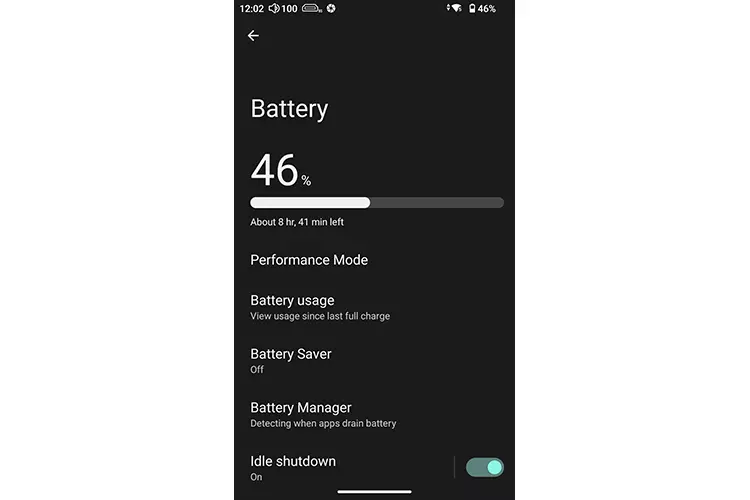
HiBy has dispensed with the RS8’s massive 12000mAh Li-Poly battery and replaced it with a higher-voltage 46.8Wh 6000mAh version.
I am personally glad they have done that because my RS8 battery now needs a lot of coaxing to wake up after a prolonged absence of use, unlike other DAPs.
It seems a sizeable reduction in capacity, but the paper numbers suggest the battery performance of the RS8 II has improved in certain areas over the previous generation, with up to 20 hours in Class AB down to 15 hours in Class A, and adaptive amping right in the middle at just over 17 hours.
The older RS8 battery will give you 1-3 hours more in Class A mode, but the RS8 II is the better choice for Class AB, with up to 5 hours more battery life in balanced output mode.
Bear in mind, the HiBy official numbers are without turbo mode, and the screen is turned off with 44.1kHz WAV files, so if you plan on doing a lot more, and we normally do, then expect those numbers to reduce even more.
There is some good news on the charging side with this new battery. The recharging voltage rating is now 12A, meaning you can connect the RS8 II to an 80W-capable PD3.0 charger for a much faster charge compared to the RS8’s 20W PD2.0 capability.
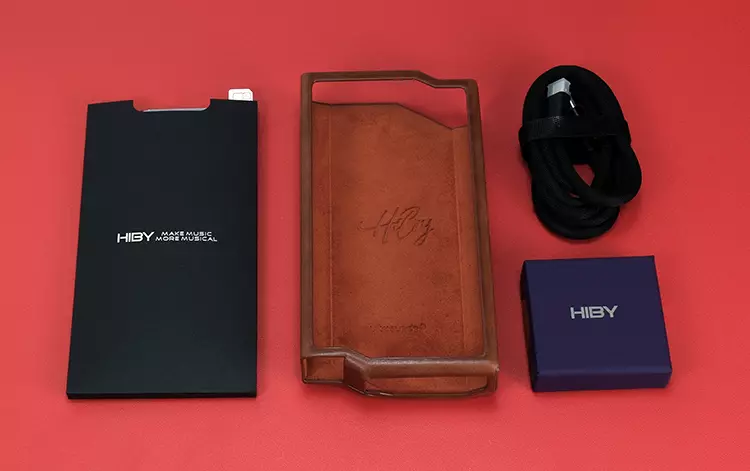
Packaging & Accessories
The HiBy RS8 II packaging is a case of less is more. They have cut down on the grandeur of the original R8 and even the more compact RS8 retail packaging. Now we only have a few items, but ones that I consider genuinely useful.
So, what are the useful things, and what could have been added? Well, I do wish they included the USB-C-to-coaxial adapter, but the leather case is probably the highest quality DAP case I have ever used.
It fits the RS8 II like a glove, feels really soft to the touch, and even has a specially textured Alcantara finish over the buttons, providing a more tactile feel when operating the DAP.
And then there is a small blue box that holds 4 aluminum dust plugs that perfectly match the Starlight Gold finish of the RS8 II sample I have here.
They look superb when inserted, though I suspect they can easily be lost over time. Thankfully, HiBy has provided one spare in the box should that happen, but do note, the spare is for the larger ports, not the 3.5mm port.
The rest of the accessory lineup consists of a USB-C to USB-A cable for charging and data transfer, some screen protectors (not pre-applied, surprisingly), and the usual assortment of warranty and user guide pamphlets stuck in a black envelope.
Click on page 2 below for my software impressions.
Click on page 3 below for my sound impressions and recommended pairings.
