

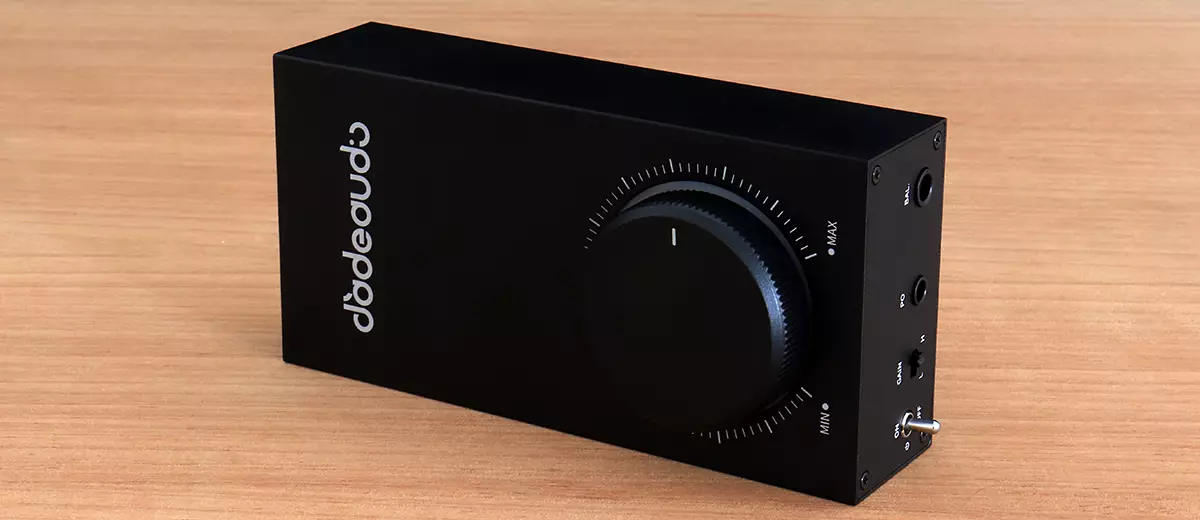
Louis reviews the FiiO JadeAudio GIGAS 1, a compact and ultra-affordable 4.6W desktop headphone amplifier for audiophiles and gamers. It is currently priced at $49.99.
Disclaimer: I received this sample in exchange for my honest opinion. Headfonics is an independent website with no affiliate links or services. I want to thank FiiO for their support.
Click here to learn more about the FiiO audio products previously reviewed on Headfonics.
This post follows our current scoring guidelines, which you can read in more detail here.
We recently reviewed the affordable FiiO JadeAudio Level 1, aimed at HiFi enthusiasts; now we have a new competitively priced compact desktop amplifier from the same sub-brand. This time for headphone owners, called the GIGAS 1.
The GIGAS 1 is aimed at gamers and audiophiles who need more driving power from their desktop rig or another line source, but don’t want to invest in a dedicated DAC just yet and are content driving the amp with their current integrated solution.
Small amplifiers like these are a rare breed, and at a retail price of $49.99, it is even more of a bargain.
The GIGAS 1 concept is all about bang for the buck. It’s a “where else can you get so much power for so little cash” concept with many positives.
So, let’s see how it performs and compares to other affordable compact amps, including the Topping NX7 and the iFi audio ZEN Air DAC 2 in my full review below.
Features
The GIGAS 1 has a couple of features that are hidden away within its boxy frame.
One of them is the ability to upscale with a voltage increase, and you can use a 5V or 12V power source, your choice. The benefit of using a 12V power source is that it will massively increase power output.
The FiiO JT7 planar magnetic headphone is cited as the inspiration behind the GIGAS 1, according to FiiO and JadeAudio. But I think the GIGAS 1 is a closer match with the new FG3 gaming headphone, which has a 4-pole 3.5mm cable and a microphone. I’ll explain later.
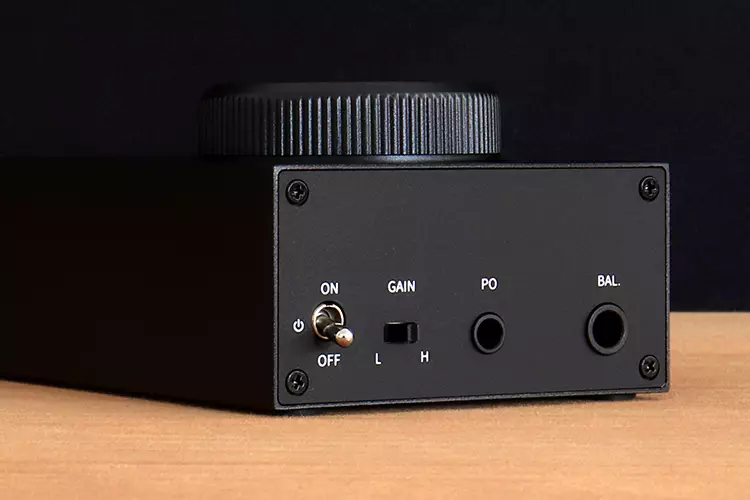
The 4.4mm Pentaconn connection next to the 3.5mm connection appeals to those who want maximum power with low noise. It appeals to the audiophile in us. Dual connectivity is the norm nowadays.
One of the other hidden features lies within the 3.5mm microphone-capable plug itself. If you use a 4-pole 3.5mm plug on the input and output ends, the microphone will work, as long as the receiving gear has a compatible 4-pin TRRS audio port.
You can always buy a separate Y-cable that separates the audio and the microphone connections.
So, the GIGAS 1 is not just an amp with a top-mounted volume knob. It has some tricks up its sleeve. But at its core, it’s a straightforward line-driven desktop amplifier.
Amplification
The GIGAS 1 uses a discrete class AB transistor current amplifier design with two adjustable gain settings. It combines OPAMPs plus current transistors in the same circuitry section.
The novelty aspect, again, is that the power input determines the output power. For example, if you use a 5-volt power source, the power output will be 790mW tops. But if you use a 12V power source, then the output side will increase considerably to 4600mW per side max.
JadeAudio used some Onsemi MJE243G in combination with some MJE253G silicon transistors that are capable of 15 watts at 100 volts for this result.
With that specification in mind, JadeAudio designed this amplifier in a way that’s not pushing these transistors anywhere near their top output capability and gave them plenty of operating headroom.
Perhaps that’s why the GIGAS 1 sounds so effortless and clean.
Design
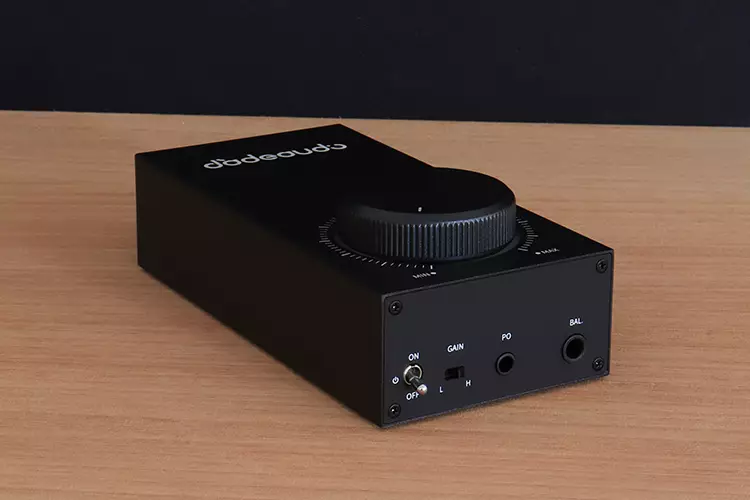
The design is pretty rough but not too bad. It has a kit box appearance. The overall outer shell has some sharp corners and sharp edges, with some rough edges around the edges. It’s not a refined design or construction, but it is robust, nonetheless.
The overall construction material is aluminum with a black anodized finish. The GIGAS 1 comes in three colors, by the way. I got the black one, but there are also silver and green models you can choose from to suit your taste.
The black one retains fingerprint marks, which I bet happens at a minimum on the silver model. I’m not sure about how that fares on the green variant.
The most novel part about the GIGAS 1 is the large, top-mounted volume knob. It’s a smooth-operating knob with no indents, but as I spun mine, I could tell it had a certain eccentricity.
But if you’re not super picky like me, and don’t measure things with a micrometer, you probably won’t notice that.
The volume knob at its base has white volume position indicators, with 60 positions, and a power LED ring around the volume knob. My only hope is that those painted-on indicators last and don’t wear off.
I/O
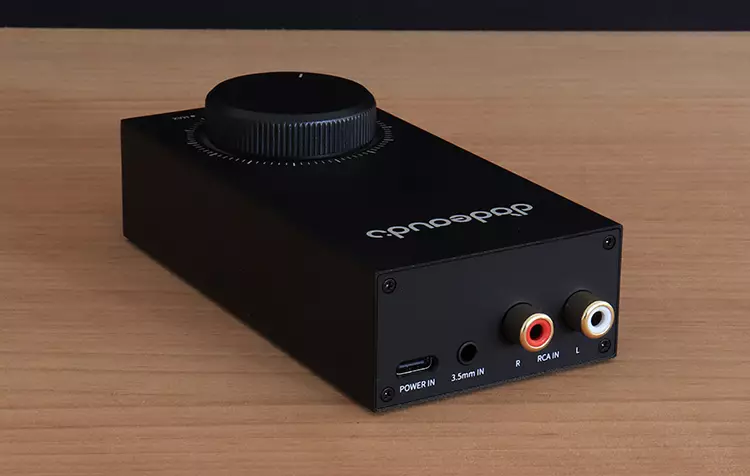
The IO has a neat feature, and something I’ve been asking for from FiiO and other manufacturers.
When you use 3.5mm connectivity exclusively, you can use a headset with TRRS connectivity with a microphone and use the microphone via the GIGAS 1.
Of course, the receiving gear must have TRRS connectivity, plus you’ll have to outsource a TRRS cable assembly for the output end, since there is none included in the box.
This is what JadeAudio should have included to stand out further. That functionality usable out of the box would truly be a step above the rest.
I would have gladly paid extra bucks for that cable if they had included a JadeAudio branded cable. The rest of the IO is standard fare.
Controls
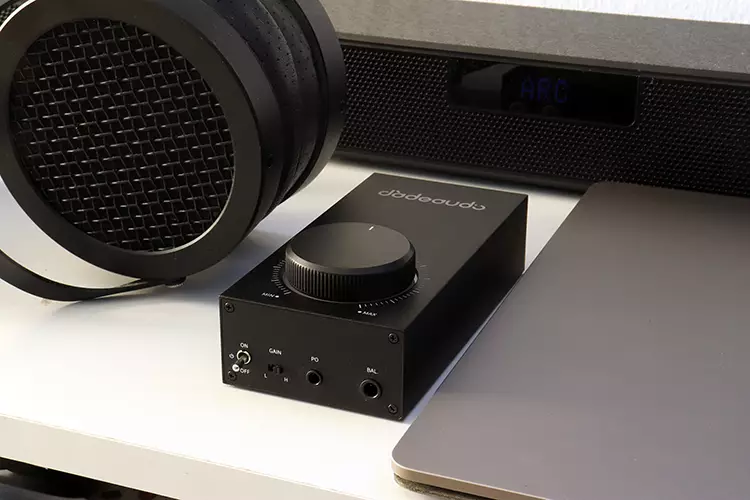
The volume knob, the power switch, and the 2-position gain switch are the only controls on the JadeAudio GIGAS 1, and they’re all upfront. Imagine that? This small amplifier comes with a front-mounted power switch where it belongs.
I do like metal toggles, and that’s what’s used on the GIGAS 1 for the power on and off function.
The only problem is that the stiffness of the switch forces you to use two hands to power on the GIGAS 1 via that switch. But honestly, I prefer rugged over delicate any day.
To elaborate on the volume knob, it’s an obvious analog implementation that doesn’t have much of the dreaded channel imbalance at the lowest volume setting that some others do.
It’s also quiet to operate, and I did not detect any static noise during operation or other similar anomalies.
Packaging & Accessories
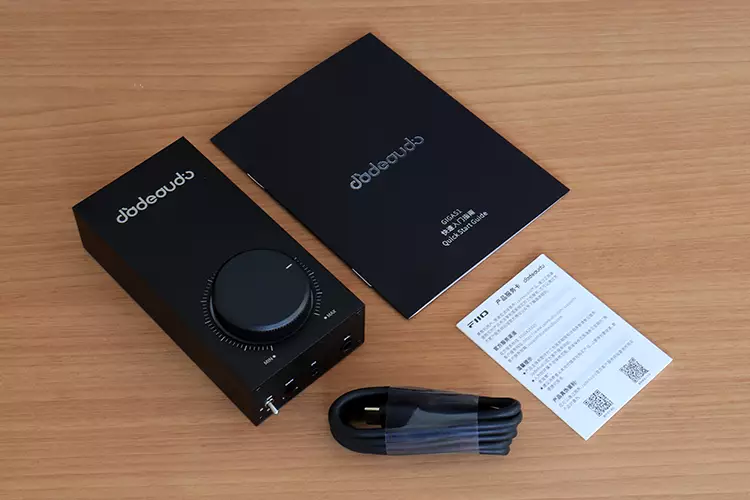
The JadeAudio GIGAS 1 comes with only a few extras. It comes with a USB Type-C power cable, but no power adapter, as always. It also comes with a quick start guide and a warranty card.
I already mentioned the lack of any connectivity, and again, this model should have come with a dual-tip TRRS cable so that you can connect many of the gaming headsets out there, or IEMs, with a TRRS 3.5mm connection and a microphone.
Sound Impressions
Since the GIGAS 1 was designed with the idea of driving headphones like the FiiO JT7, I had to use a substitute and similar headphones, since I do not have the JT7.
So, I pulled out my HIFIMAN Sundara, which are somewhat similar in tech origin, with a 2 dB difference in efficiency. This combo gives me a good gauge of how much power is available.
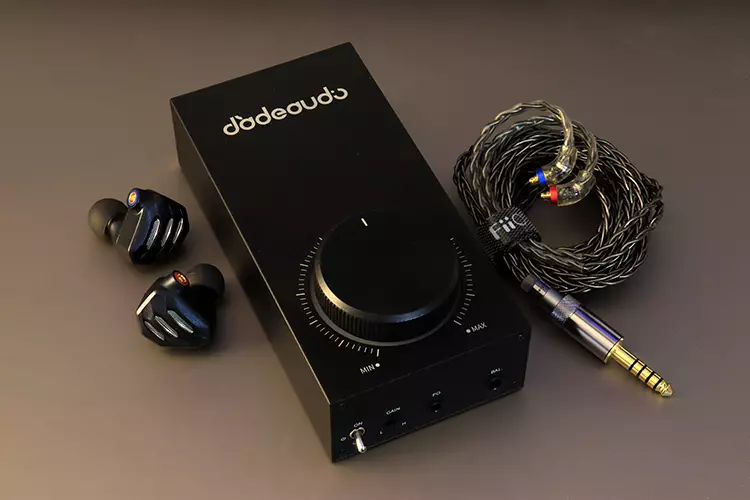
I used other headphones like the Sennheiser HD 490 PRO Plus, and IEMs like the FiiO FX17 and the FH7S to see how well-behaved the GIGAS 1 is with sensitive IEMs.
Summary
While using my well-broken-in HIFIMAN Sundara and on a 5V power source, the bass response was somewhat dispassionate. But when you run the GIGAS 1 off a 12V source, the 4.4mm port comes alive with harder-to-drive headphones.
The overall sound signature is neutral and effortless with a slightly smooth character and a hint of bite as well. It’s fairly transparent and can produce audio with no coloration on its part.
One of the strong points of the GIGAS 1 is that it sounds punchy and dynamic with headroom to spare.
Most of the time, the volume position remained lower than halfway on the volume knob while supplying an ample amount of loudness using planar magnetic headphones.
Being that it is an amplifier with such a high amount of power output, it tends to sound controlled and well-behaved at medium levels of volume, and even at high volumes. It’s also very quiet with low levels of distortion and noise, if any at all.
The GIGAS 1 doesn’t add anything to the overall tonality; it just amplifies the input signal, and it gives the potential buyer a method of amplifying any audio source and the ability to drastically gain volume and driving power over all else, and it does it well.
Timbre
The GIGAS 1 timbre is what I call truthful, while some call it natural. It doesn’t attempt to fix the input. It just amplifies, retains the source’s timbre, and stays out of the way.
The overall frequency curve can come across as neutral with a lean timbre that produces sonics cleanly and crisply. Nothing comes across as sounding too chiseled or too searing.
It does produce weight at the bottom octave, with a fast attack and quick recovery, probably due to a decent damping factor. The bass itself is not boosted at all, and there are no features to do so.
The midrange is neutral and clean with a natural timbre. It’s a midrange that doesn’t push forward, but it has an open aspect about it.
The treble is produced with a refined character. It has a detailed, airy personality that doesn’t feel too bright or too strained. The GIGAS 1 even works with dirty sources.
It mostly displays the source. Use a warm DAC from iFi, and you will immediately detect the warmth. Use the DAC section from the Questyle Sigma, and you’ll notice the linearity of its AKM DAC. It is also a revealing amp, but it doesn’t re-cast the audio in any way.
Staging & Dynamics
Amplifiers are not the determining factor as far as soundstage is concerned, but some small characteristics can be attributed to the amplifier, such as the ample width produced by the GIGAS 1.
The JadeAudio GIGAS 1 portrays a natural soundstage dictated by the source, but it doesn’t degrade the panoramic view, as I call it. Elements remain distinct.
The GIGAS 1 remained in control of the output at all times, even at high volume levels, and never smeared the soundstage or caused sound to become congested. The sound remained focused, well layered, and imaging in general retained what the source was feeding it.
Click on page 2 below for my recommended pairings and selected comparisons.
