

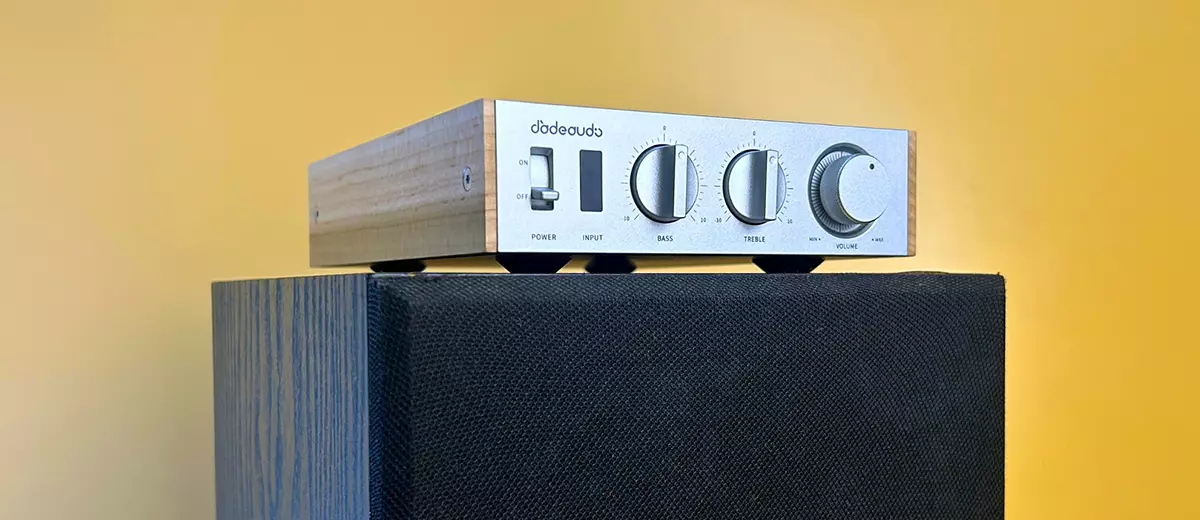
Meldrick reviews the FiiO Jade Audio Level 1, an affordable, solid-state desktop 2 x 300W power amplifier with Bluetooth 6.0 wireless support. It is currently priced at $139.99.
Disclaimer: I received this sample in exchange for my honest opinion. Headfonics is an independent website with no affiliate links or services. I want to thank FiiO and Jade Audio for their support.
Click here to learn more about the FiiO audio products previously reviewed on Headfonics.
This post follows our current scoring guidelines, which you can read in more detail here.
Most audio enthusiasts are already aware of FiiO and Jade Audio, which is FiiO’s sub-brand, known for portable audio gear that offers solid value, such as the JH13 IEM and KA1 DAC dongle.
The Level 1, however, marks a significant step as Jade Audio’s first desktop power amplifier, entering a segment already occupied by well-regarded units from Fosi Audio, Aiyima, and SMSL. At $139.99, it cannot rest on brand recognition alone.
Built around the Texas Instruments TPA3255 chip with an onboard DAC, LDAC Bluetooth 6.0 connectivity, and a full parametric EQ accessible via the FiiO Control app, this feature set is absent on most TPA3255-equipped competitors at this price.
So, how does the Level 1 perform against peers such as the SMSL DA-1 in this segment? I found out over extended listening below.
Features
The headline feature of the Level 1 is the integration of a full parametric EQ accessible via the FiiO Control app on iOS and Android.
This is not just a basic bass and treble shelf; the PEQ exposes full band editing, including frequency, filter type, and Q value, alongside three custom preset slots.
Connectivity is one of Level 1’s other strong suits. Alongside the RCA analogue input, you get a USB-C input (up to 24-bit/96kHz), a coaxial RCA input (up to 24-bit/192kHz), and Bluetooth 6.0 with LDAC support up to 990 kbps via the BT8961 chip. An RCA preamp/subwoofer output rounds out the rear panel.
The Level 1 is powered by the TI TPA3255, a platform that has earned significant respect within the budget-conscious audiophile community in amplifiers like the Fosi Audio ZA3.
The TPA3255 makes the Level 1 capable of outputting up to 2 x 300 W of power when paired with a more powerful 600W power supply.
Design
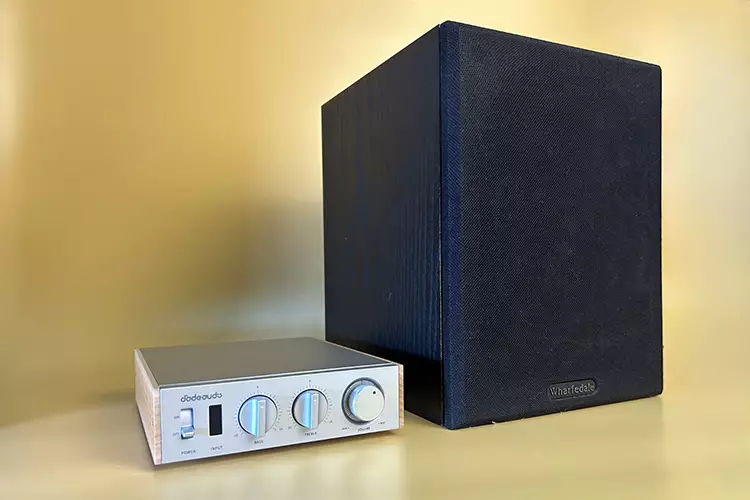
The Level 1 is surprisingly compact for an amplifier of its class, coming in at just 181 × 133 × 36mm, making its footprint closer to some of FiiO’s headphone DAC/AMPs instead of a traditional power amplifier.
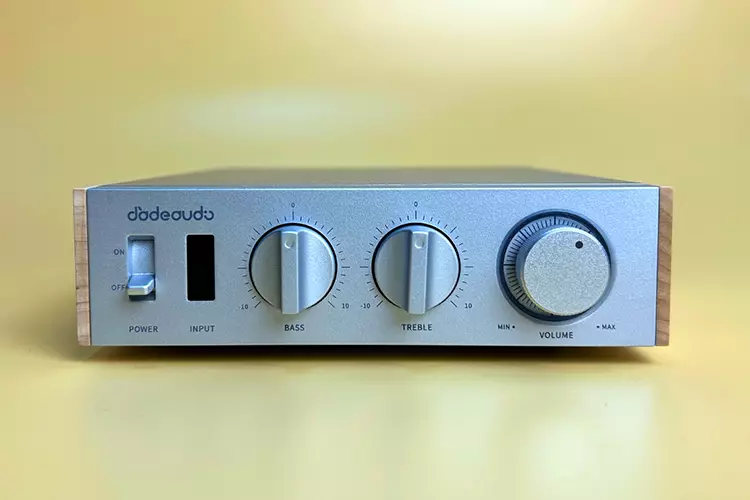
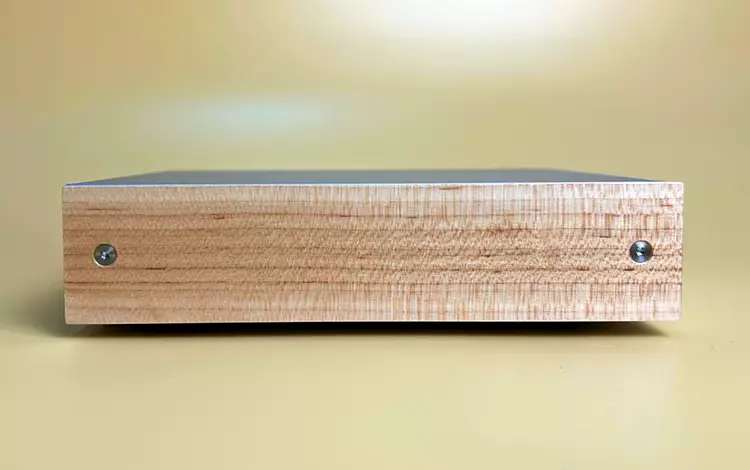
What immediately separates it from the black-box aesthetic that dominates this segment is the chassis itself: an aluminum alloy shell paired with genuine wood side panels. My silver review unit featured maple side panels, while a black variant with walnut panels is also available.
The build communicates a sense of premium intention that the price does not readily suggest. The aluminum finish is consistent throughout, panel gaps are tight, and the wood grain comes off as genuinely refined rather than decorative-only.
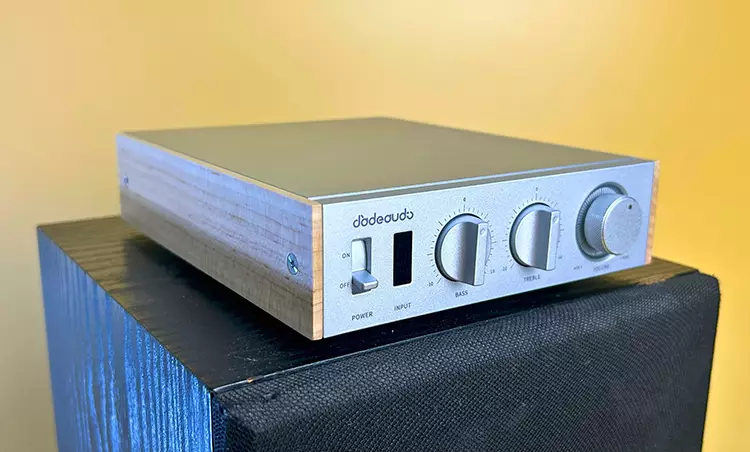
The front panel is logically arranged: a power toggle and input mode indicator sit on the left, followed by bass and treble knobs of appropriate size, and a large machined-aluminum volume knob on the right.
All knobs have smooth action without any loose play. An RGB LED indicator on the front panel doubles as an input and Bluetooth codec status light, subtle enough to be informative without being distracting.
I/O
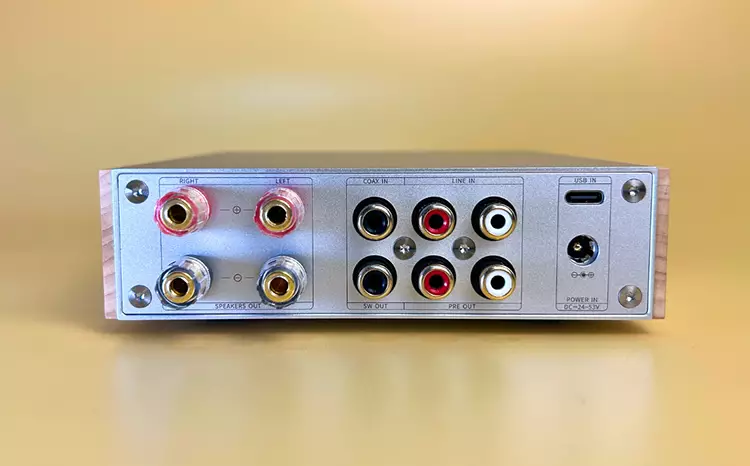
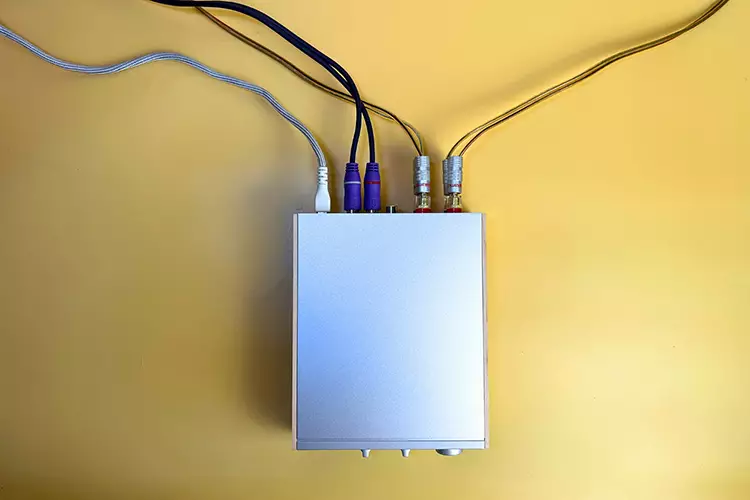
The rear panel best highlights the Level 1’s bang-for-buck case. Gold-plated banana plug-compatible speaker binding posts occupy the center.
To the left, you get an RCA analogue line input, a coaxial RCA input, and a USB-C input. A dedicated RCA preamp/subwoofer line output is present as well, enabling a 2.1 setup without an external crossover or preamp. The DC power socket sits at the far end.
The practical scope of this I/O suite is meaningful. At any one time, I had the Level 1 running a laptop via USB-C as a direct DAC input, a smartphone over LDAC Bluetooth, and an external CD transport via coaxial.
Quick source switching between these required nothing more than clicking the front knob of the unit. For a desktop system where several source types naturally coexist, this integration is a real convenience.
One important nuance: the PEQ features of the FiiO Control app only apply to digital inputs (USB-C, coaxial, and Bluetooth).
With the analogue RCA input selected, the signal bypasses Level 1’s DAC and DSP entirely and feeds straight into the amplifier stage.
This is technically sensible, but it means that users who intend to run the Level 1 purely as a power amplifier behind an external preamp will lose access to one of the features that most sets this unit apart.
Controls
Volume tracking on the Level 1 is well-managed across the full sweep of the knob. I encountered no channel imbalance at low volume positions, and the gradual taper felt intuitive rather than demanding the care that some Class D amplifiers require at the lower end of the range.
The bass and treble knobs allow for ±10dB of adjustment and have a center detent at the neutral position. Most of my listening was done with both controls set flat, letting the PEQ do any curve-shaping work instead.
Pressing in the volume knob cycles through analogue, coaxial, USB-C, and Bluetooth with a single press, and the indicator panel on the left shows the active input.
One area where the Level 1’s otherwise thoughtful feature set falls short is the absence of a hardware remote. For a desktop amplifier used at close range, the FiiO Control app largely covers this; volume, input selection, and even EQ adjustments are all available from a phone.
But for across-the-room use and a TV 2.1 Channel set up, this is less than ideal, especially when the Level 1’s competitors include this as standard.
FiiO Control App
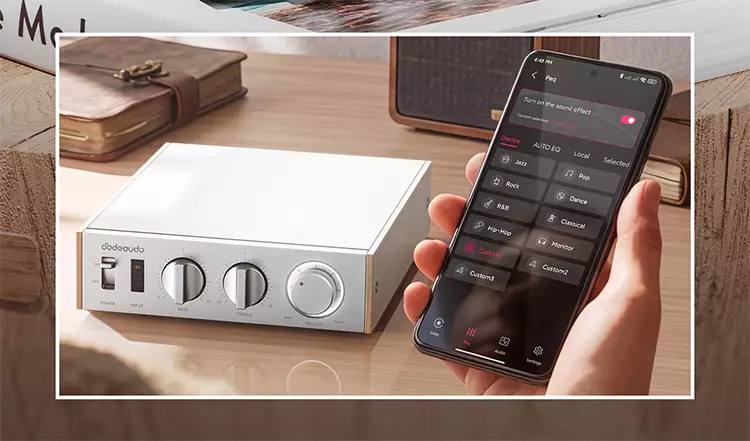
The FiiO Control app is Level 1’s defining feature, and it functions cleanly on both Android and iOS. The home screen presents the Level 1 alongside any other FiiO gear registered to the device, making it accessible within a familiar interface for existing FiiO users.
The Audio page handles output volume and left/right channel balance. The PEQ section exposes full band editing, frequency, filter type, Q, and gain sliders, alongside built-in device presets and three custom slots.
Beyond EQ, the app also serves as the product manual. Front and rear panel labels, indicator light documentation, and operating instructions are all accessible within the app itself, which is genuinely useful given how much behavioral information the RGB LED encoder provides.
Packaging & Accessories
The Level 1 arrives in Jade Audio’s kraft-style outer box, with the Jade Audio brand name embossed on the top face and Hi-Res Audio certification stamps printed beneath.
The interior is organized: the amplifier sits in shaped foam, and a secondary cardboard tray below holds the accessories in a tidy, well-protected arrangement.
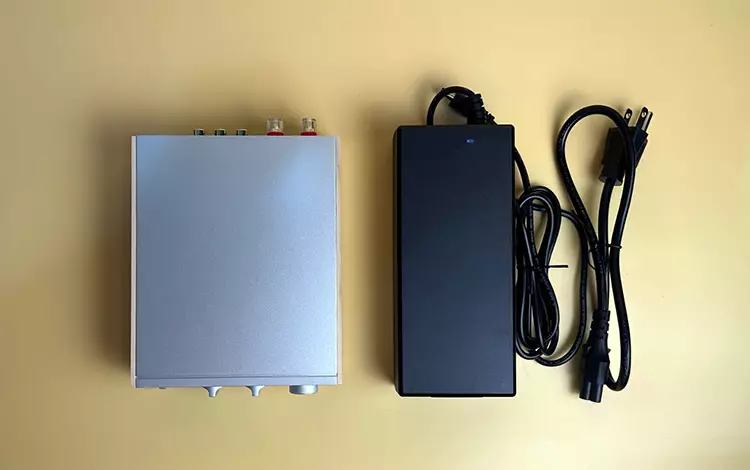
Included in the box are the amplifier, the 48V/5A/240W Merryking power supply, and a power chord.
Sound Impressions
The following impressions were formed using a pair of vintage Wharfedale Diamond III bookshelf speakers, driven directly from the Level 1 via banana plugs.
I also did some tests with a powered subwoofer connected to the Level 1. Sources included a macOS via USB-C, a CD transport via coaxial, a Technics SL Q303 turntable connected to an SMSL PH-1 phono pre-amp, and a smartphone via LDAC Bluetooth. Both flat and PEQ-corrected listening sessions were conducted.
Summary
The Jade Audio Level 1 presents a fundamentally transparent and controlled sound, with a tight low end and an overall tonality that reveals any track’s sonic character with little to no coloration.
Micro-detail retrieval is decent, in line with what you would expect from a well-implemented Class D amplifier at this price.
It is not the last word in resolution, but more than capable of conveying the essential character of a recording without imposing unnecessary editorialization.
The PEQ is where things get genuinely interesting, as it elevates what is otherwise a competent but familiar Class D presentation into something tailored and deliberate.
The top end is clean and free from the edge or etch that occasionally surfaces in less refined Class D implementations.
Bass performance is confident and controlled, with no sense of overhang on well-recorded material. Dynamics are handled cleanly at all volume levels I pushed the Level 1 to, with no compression or hardening as levels climb.
Timbre
The source used plays an appreciable role in what you ultimately hear from the Level 1, particularly since the unit’s neutral disposition means it does little to impose a character of its own.
With the laptop via USB-C and the stock PEQ settings, the presentation through the Wharfedale Diamond III was warm and velvety, reflecting those monitors’ vintage character faithfully.
Some might characterize the Level 1 as clinical in this transparency, but I would frame it as being source-honest, and any perceived warmth or energy is a function of what you feed it or the nature of the speakers themselves.
The PEQ’s availability means this transparency is a feature rather than a limitation; you can shape the response without the amplifier working against you from the outset.
At higher volume levels, the Level 1 remained composed. No peaking of the treble, no bloom in the bass; it tracked the source consistently from desk-level nearfield to a level that would fill a small room without complaint.
Staging & Dynamics
The Level 1 presents a stable, well-proportioned soundstage that neither exaggerates width nor manufactures depth where the source does not provide it. Height and width remain coherent with the Wharfedale Diamond III.
It has accurate imaging and positioning that places the instruments and vocal locations precisely in the space. There is no sense of vagueness, and individual instruments can be easily isolated.
Dynamic behavior followed the source closely. With high-bitrate Bluetooth via LDAC, the presentation was lively and well-resolved, retaining the vitality of the source rather than compressing it into a more homogeneous presentation.
Moving over to my turntable connected via RCA had a warmer sound signature; however, this is more likely a result of the source and not the amplifier itself.
Swapping to USB-C with the same content restored the sharper dynamic edges. The Level 1 stayed out of the way, letting the source define the room.
Click on page 2 below for my recommended pairings and selected comparisons.
