

Synergy
Headphone Pairings
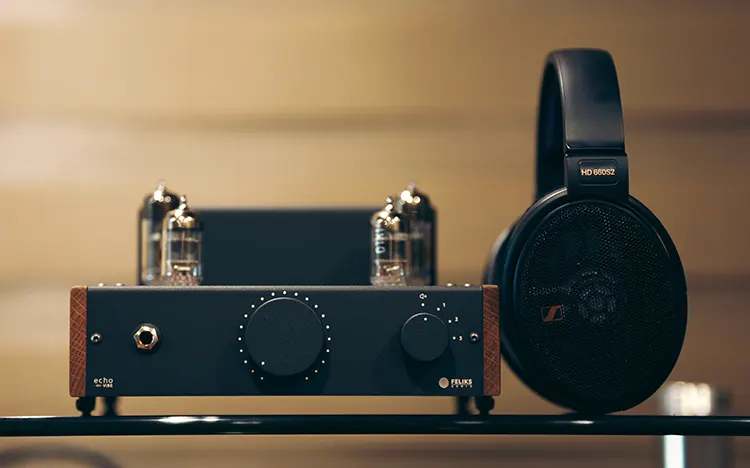
I tested 5 headphones of various loads and driver types. This included the ZMF Headphones BOKEH Open, BOKEH Closed, the Focal Utopia 2022, Sennheiser’s HD 660S2, and the Dan Clark Audio NOIRE XO.
Overall, and at least when compared to solid-state amplifiers, the Echo Vibe will do wonders with sharper-sounding headphones or with recordings where heavy sibilance and treble overtones are a concern.
A good example is the HD 660S2, which delivered a fulsome, smooth sound signature with nice sub-bass weight and extension and not too much emphasis on percussion attack or nasty treble overtones.
Even solid-state amps that I normally describe as smooth, such as the Alto, picked up more treble overtones, creating a sharper attack in the HD 660S2’s upper mids and highs.
That theme continued with the two BOKEH headphones, both of which offer excellent sub-bass responses with rich vocal performances when paired with the Echo Vibe.
A tone that was not replicated with solid-state alternatives, which tended to emphasize the highs more, creating a sharper sound.
Nothing really changed my mind with the Utopia 2022, though in this instance, I would pair these headphones with a more open and detailed-sounding tube amplifier such as the Headonia 300B.
The Focal is resolving but intimate, so it needs good control and a natural timbre. The Echo Vibe offers the latter, but it’s a little dark with the stock tubes and not as resolving as I would like it to be.
The NOIRE XO collapsed like a deck of cards as expected. It’s a current-demanding planar, inefficient, and needs more than 350mW to get off the ground. The distortion here was terrible.
DAC Pairings
I honestly did not establish a pattern of preference for DAC pairings with the Echo Vibe aside from noticing an improvement in dynamic range and scale with desktop lineouts over some weaker portable alternatives. In fact, some of the better pairings were not what I was expecting.
A good example was the humble SMSL PL100 CD Player. Technically a 5V USB-powered desktop device, but one I usually run from my power bank, giving it some transportability.
It sounded fantastic with the Echo Vibe paired with the ZMF Headphones BOKEH Open with a very dynamic and punchy low-end, combined with a strong vocal presence.
The smoother tuning of the Echo Vibe, enhanced by the natural sound signature of the BOKEH Open, sounded deep and energetic, albeit not as detailed as some higher-end DAC outputs such as the iBasso DX320 MAX Ti lineout.
Shanling’s EC Mini alternative was more laid back but delivered a deeper, more resonant sub-bass reach than the PL100 with the same setup. It brought a calming synergy to the Echo Vibe and felt more suited to classical, jazz, and acoustics.
Going full desktop but staying compact, the Gustard X18 DAC produced a very linear sound with almost no additional coloration added to the Echo Vibe. Nothing exaggerated from the BOKEH Open pairing, save for some enjoyable upticks in dynamic range, especially in the BOKEH Open’s low-end.
Portable DAP lineouts did produce a slight preference with the Cayin N7 pre-out over the DX320 MAX Ti’s SE lineout. The N7’s smooth, spacious sound and dense low-end sounded the right pairing, producing a beautiful analog overtone with the Echo Vibe and BOKEH Open.
The iBasso was more resolving but perhaps more clinical-sounding with the Echo Vibe/BOKEH Open pairing.
Selected Comparisons
The following selected comparisons to the Feliks Audio Echo Vibe were completed using a mix of the Gustard X18 DAC and the Cayin N7 pre-out for the sources.
Headphone pairings included the ZMF Headphones BOKEH Open and the Sennheiser HD 660S2.
Cayin HA-2A
The Cayin HA-2A was launched in 2024 and was pitched as Cayin’s entry-level desktop tube amplifier for headphone enthusiasts.
Technical
The HA-2A is a desktop Ultralinear tube amplifier, and uses an output transformer, whereas the OTL Echo Vibe does not.
The Cayin design is a point-to-point welded pure Class A transformer-coupled single-ended design with no pre-out or pre-amping capability. The Echo Vibe is also single-ended but offers a line output so you can use it as a pre-amp.
Despite being a single-ended design, the HA-2A is balanced-driven through Cayin’s in-house designed output transformer.
This means it will accept a 3-pin XLR balanced input and output to headphones via 4.4mm and 4-pin XLR as well as 6.35mm. The Echo Vibe is in single-ended mode for input and output.
The HA-2A also has impedance management, whereas the Echo Vibe aims to cover a range between 80Ω and 600Ω. The HA-2A can dip a little lower with a dedicated impedance value setting from low to 64Ω.
The HA2A uses a hybrid pentode/triode Amperex ECF82 (6U8 NOS) for the driver, Amperex 17BF11 NOS tubes for the output, and an RCA 17AX4GT NOS tube for the rectifier.
The Echo Vibe is equipped with two NOS (New Old Stock) 6N6P Russian double triode power tubes and two NOS 6N1P miniature 9-pin medium-gain double triode driver tubes.
Neither of these amplifiers will set the world on fire for power, but if you need flexibility for planar and earphones, then the HA-2A is better suited.
The HA-2A ranges from 300mW SE to 800mW balanced, with a peak continuous of 750mW SE and 1W balanced. Its 4.4mm output is lower to cater to sensitive gear users at 200mW (low) to 270mW (high).
The Echo Vibe has a fixed 350mW of output power with 20 dB of gain. I would pair this amplifier with headphones with impedance values of 80Ω upwards, given its 70Ω output impedance rating.
Design
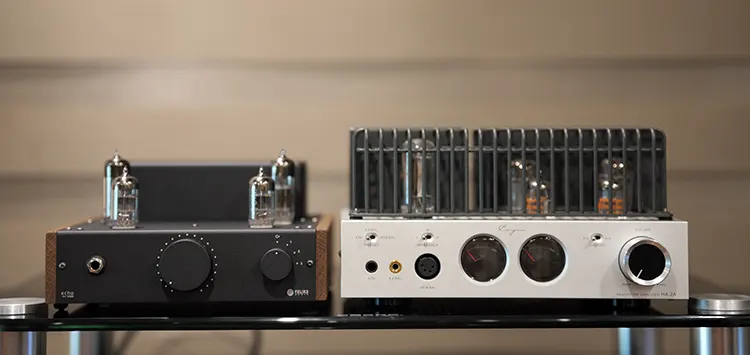
You can tell right away which is the boutique company and which has a major company backing.
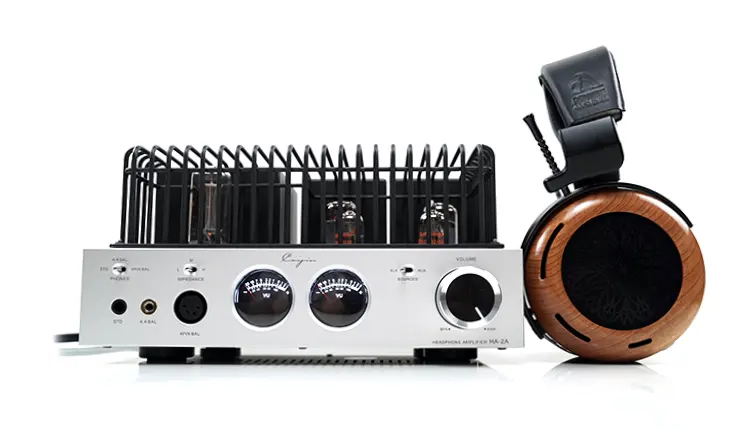
The HA-2A benefits from a significant amount of trickle-down engineering from its higher-end models, such as the HA-6A and the HA-300MK2, featuring dual VU meters, LED lighting, tube cages, and numerous mechanical switches.
Whilst the Echo Vibe is in keeping with the design language of its higher-end models in some respects, there is a significant amount of simplification here to keep the project within budget.
It’s a stripped-down affair, lighter and far more compact, but it does offer some elegance courtesy of those solid oak panels on the side.
Whereas the HA-2A’s silvery finishing and molecular protective film on the housing are more in keeping with the finishing on their new 888+1 solid-state series stackable desktop units, such as the iHA-8.
The big advantage of the Echo Vibe is its wider range of connectivity, including 3 input options as opposed to two on the HA-2A, and a line out that enables HiFi integration with pre-amping capability.
The HA-2A is focused on headphones (and IEMs) with better plug compatibility and more granular impedance load management at lower levels than the Echo Vibe.
Performance
Both of these tube amplifiers sound excellent with medium impedance headphones, so it will come down to tonal preferences and the type of gear you want to pair with.
At a high level, the HA-2A has more of a modern Ultralinear sound (no surprise here) with a slightly flatter but punchier bass delivery and a more neutral coloration and height in the mids and highs.
Instrumental and vocal timbre have more contrast in their timbre and dynamics, with a more attack-oriented focus and slightly more dynamics. The performance with the BOKEH Open and Closed sounds ‘taut’ and energetic with the HA-2A.
I also have to point out that the HA-2A sounds better in a low impedance setting, where both headphones delivered a more balanced presentation. Once I moved to the medium setting and beyond, the 1-4k range of both headphones sounded much too forward and shouty.
Not so with the Echo Vibe. It delivered a fleshier, richer sound, with more sub-bass extension, albeit at a slower, denser pace than the HA-2A and with a bit more lingering decay.
Vocals were also fuller, with less treble overtones or contrast, and not quite as forward-sounding as the HA-2A presentation.
The Echo Vibe has a more relaxing sound with the BOKEH headphones, perhaps also slightly more open in the mids, with a little more lower-mids presence than what the HA-2A offered with the ZMF Headphones.
Overall, I would pick the HA-2A if you need a bit more speed and punch with a more neutral delivery in the mids and highs. Go with the Echo Vibe if you want a more Classic tube sound with excellent depth and smoother timbre, but more relaxed vocal imaging.
Monoprice Monolith Liquid Platinum Amplifier
The Monoprice Monolith Liquid Platinum was launched in 2018 at $799.99 and is a collaboration with Alex Cavalli, owner of the now-closed Cavalli Audio.
Technical
The Liquid Platinum is an embedded tube/hybrid amplifier (DC coupled in to out, no coupling caps) as opposed to the Echo Vibe’s OTL topology. The Platinum uses a dual Electro Harmonix 6922 tube pre-amp section and a balanced/SE solid-state output section.
Generally, hybrids also means a low output impedance value by default. Whereas classic vacuum OTL designs output at a much higher level (70Ω for the Echo Vibe as opposed to under 1Ω for the Liquid Platinum).
The Liquid Platinum has a few more connectivity options for headphones, including a 4-pin XLR PO balanced output. It also has more raw power than the Echo Vibe of up to 6.62 watts into a 32Ω load, dropping to 0.91 watts for 300Ω loads in its balanced output mode.
The Cavalli design SE output power curve peaks a little higher at 4.21 watts into 56Ω as opposed to 1.78 watts at 32Ω, but drops down to 230mW at 300Ω, where the Echo Vibe has a distinct advantage.
If you are looking for power for planar pairings, the Liquid Platinum is more suited. However, once you start using high-impedance dynamic driver headphones, the Echo Vibe’s 350mW rating will provide a more consistent performance.
Design
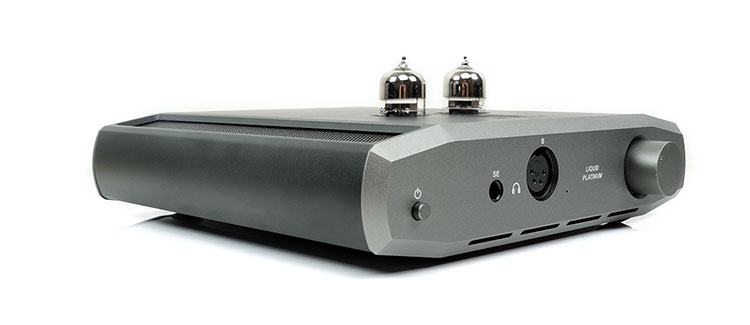
The Liquid Platinum is smaller and lighter than the Echo Vibe, but its design language is quite utilitarian.
It does not have a boutique vibe quite like the Feliks Audio creation. Instead, it’s almost futuristic with its heavy chamfering and aggressive venting down the sides.
It looks great when stacked with the similarly designed Liquid Platinum DAC, but on its own, it lacks the analog spirit of the more classic tube amplifier form factor of the Echo Vibe.
To be fair, the Liquid Platinum amplifier is robustly built. It will take a fair old drop to put this out of action, with joints or panel fits that are fairly seamless.
This is a pure headphone amplifier; it does not have the Echo Vibe’s pre-amp line output. However, its balanced topology means that it can accept 3-pin XLR input and 4-pin XLR PO output alongside 6.35mm balanced, giving it more flexibility for planar and low impedance IEMs.
The PSU is not in the main housing; instead, it’s an external switch-mode DC 36V 1.5A power supply (SMPS), which some may or may not be in favor of depending on your individual setup. It’s not as tidy as the Echo Vibe’s internalized PSU nor as refined as its custom-designed toroidal transformer.
Performance
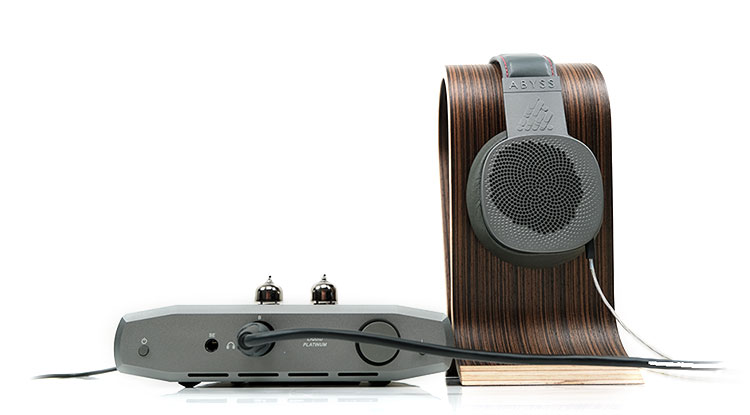
Much like the HA-2A, the Liquid Platinum will move closer to natural to neutral rather than the Echo Vibe’s rich and velvety tone. You can pick up on the hybrid sound qualities with away with the Monoprice pairing.
Testing with the Sennheiser HD 600S2, the Cavalli amp sounded far more neutral in tone with a flatter, punchier bass response. Though I find it coherent and fairly balanced sounding, nothing really stands out, with decent contrast, and a slightly mid-centric sound with airy highs.
That is in stark contrast to the Echo Vibe, which delivers a ‘bigger sound’, with mode depth, sub-bass presence, and a richer, fuller set of mids.
Arguably, it’s a little darker, with noticeably longer decay, but the separation and pointed bass and vocal emphasis provide a lot more character to the HD 660S2 performance, making it a more immersive listening experience.
The choice of gear here is also very critical, as to which amplifier you should choose. Whilst there are some tonal variations picked up in dynamic driver headphones suited to both, once you switch to planar, and in this case, the DCA NOIRE XO, the Platinum becomes the only game in town.
The Platinum drove the NOIRE XO without a hitch, whilst the Echo Vibe collapsed with distortion everywhere, with just a small amount of volume. It cannot handle current-intensive headphones.
Auris Audio HA-2SE+
The Auris Audio HA-2SE+ is the 3rd generation of the company’s desktop headphone tube amplifier series and was launched in 2023. However, it has seen price drops with many stores offering an end-of-run price of $1299 recently.
Technical
The HA-2SE+ is a single-ended Class A SETA tube amplifier as opposed to a single-ended OTL. Like the Echo Vibe, the HA-2SE+ also has pre-amp capability but is powered by a manually wound transformer on a double C core power supply.
Though both are NOS tube designs, the precise tube configuration is quite different. Auris has selected four 7-pin EI EL95 or PL95 pentode power NOS tubes and a single medium-gain double triode ECC81 input tube.
Since you can use either the EL or PL versions of these pentode power NOS tubes, there is a switch at the back allowing you to change modes accordingly.
Both have continuous amplification output for PO, though the HA-2SE+ has a higher 1W rating compared to the Echo Vibe’s more modest 350mW.
Both amplifiers have excellent connectivity options on their rear panel, with room for 3 input source connections and a pre-out (line out in the case of the Echo Vibe).
Perhaps due to the advantage of size, the HA-2SE+ has converted one of those inputs to a 3-pin XLR input with a corresponding 4-pin XLR PO output, though the signal is still single-ended.
The HA-2SE+ also has an impedance management system, something which the Echo Vibe does not offer. It has 4 values from 50Ω up to 600Ω, which you can play around with to get the desired performance from your headphones.
Design
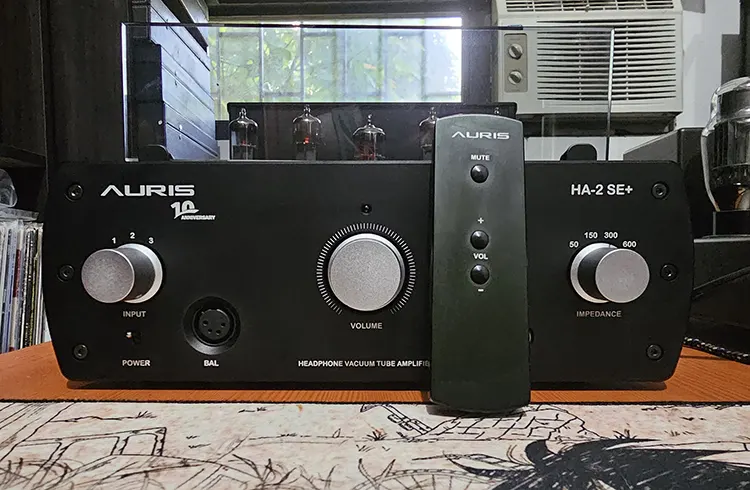
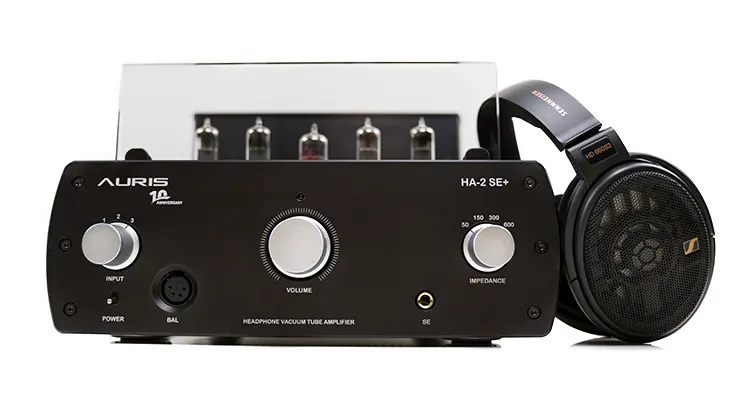
The HA-2SE+ is massive compared to the Echo Vibe and far heavier at 10kg compared to a tidy 3.5kg. It needs a lot of space, especially with its tall transformer boxes on the rear of the unit, whereas the Echo Vibe can be tucked into tighter spaces or small desktops.
The design language of the HA-2SE+ is controversial as it marked a departure from Auris Audio’s attractive wood designs. Which is ironic considering the Echo Vibe has embraced wood with its solid oak panels.
The HA-2SE+ black aluminum is solid, very robust, with clean lines and very legible labeling. However, it lacks a bit of soul in its visual appeal. It does not quite fit the vibe of a tube amplifier in my eyes, with the older HA-2SF and original HA-2SE’s leather and wood finish far more alluring.
That being said, it’s highly functional with its wide range of inputs and outputs, the inclusion of a remote control option, and a lack of heat transfer to the dials that the Echo Vibe suffers from.
Performance
The HA-2SE+ differentiates itself from the Echo Vibe with a performance that I would define as more energetic and symbolic of a ‘modern tube’ tuning.
Paired with the BOKEH Open and HD 660S2, the HA-2SE+ offers a slightly shorter note decay and a stronger perception of clarity and speed, but with a little less sub-bass presence and a stronger mid-bass punch.
The Echo Vibe is a more relaxed tuning with fuller sub-bass presence delivered in a more languid style, combined with a richer midrange instrumental and a more liquid-like vocal tuning.
The HA-2SE+ is fairly smooth and sweet-sounding, but it is not as velvety as the Echo Vibe. It has a busier-sounding mid-centric tuning combined with additional mid-bass punch and energy.
Both pair exceptionally well with BOKEH Open and HD 660S2, but of the two, the Echo Vibe’s fleshier tone and additional low-end presence fill out the BOKEH Open soundstage a bit more.
Like the HA-2A, impedance management will adjust the flavor with the 50Ω sounding quite calm and serene compared to the more mid-bass and vocal-emphasized 150Ω setting. Neither setting will tease out the same sub-bass response level as the Echo Vibe.
The HA-2SE+ performs better than the Echo Vibe with planars. However, even though it doesn’t dissolve into a puddle of distortion, demanding headphones such as the Dan Clark Audio Stealth lack a little bass solidity and tightness, giving it a slightly bright and shallow performance.
My Verdict
The Feliks Audio Echo Vibe is a cracking little OTL tube amplifier with a smooth, surprisingly deep, and emotive sound signature. It works wonderfully well with high-impedance headphones, as you might expect with the open-back BOKEH from ZMF Headphones, a standout pick.
Being OTL, single-ended, and with a maximum of 350mW, I would avoid most IEMs and planar headphones. This is not the amp to drive that type of gear without heavy distortion. Stick with dynamic driver alternatives.
Considering the Echo Vibe’s compact and attractive boutique design and its surprisingly wide range of connection options that allow it to mesh with headphones and HiFi systems, I would consider this a very good introduction to OTL tube amplification.
Feliks Audio Echo Vibe Technical Specifications
- Impedance: 100 k ohm
- Frequency response: 15 Hz – 45 kHz +/- 3 dB
- Power output: 350mW
- Amplification level: 20dB
- THD: 0.4 % (300Ω, 20 mW)
- Optimal headphones impedance: 80 – 600Ω
- Headphones output: SE 6.35mm
