

Wireless Connectivity
Bluetooth
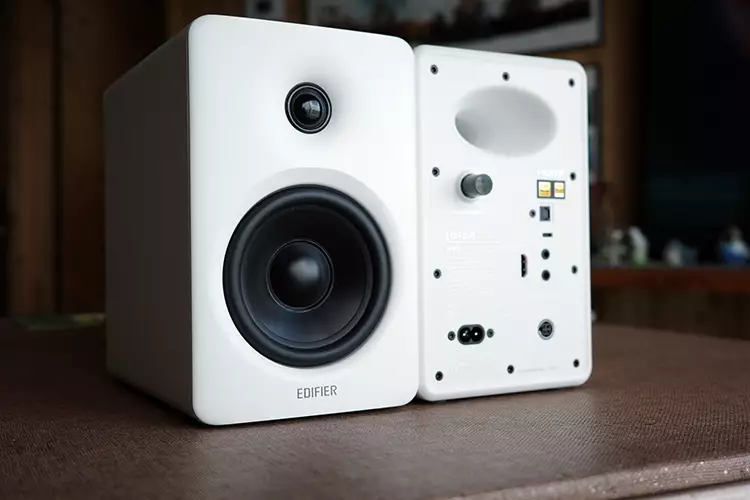
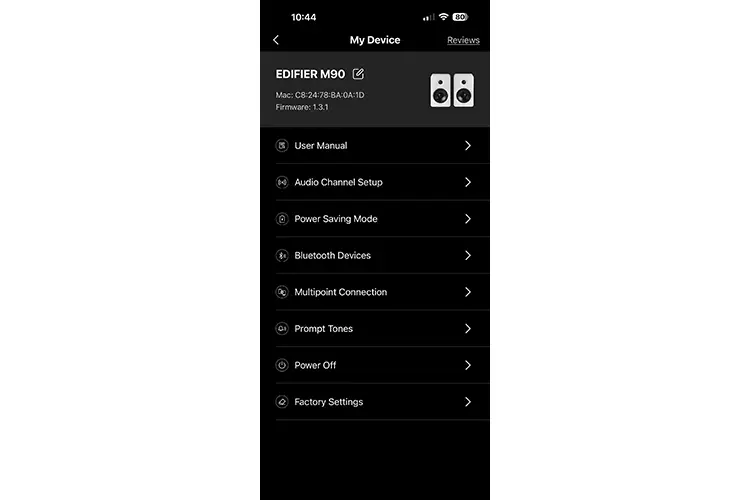
Connection to the Edifier M90 was quick and easy from the Edifier ConneX app, and once connected, you could utilize the Bluetooth multipoint connections.
You can also control via the customized EQ settings, which can then be used from the remote, even when connected to HDMI.
Watching videos on either my iPhone 16 Pro Max or MacBook Pro laptop, latency was non-existent.
Wired Connectivity
HDMI eARC
Connection was easy when tethered to our Samsung smart TV. Listening was quite an improvement over the existing, very subpar speakers within the TV. We normally have a Yamaha soundbar and subwoofer connected, but the Edifier M90 replaced this for the test.
Bass response was quite good using this connection, and I was impressed, even without the Edifier T5s connected as a subwoofer.
USB-C
I connected my MacBook Pro and the HiBy R4 to the Edifier M90 through the USB-C and played music on both and watched a movie through my laptop.
AUX
I also connected both of the above through the 3.5mm AUX connection, finding some difference in sound. I did prefer the USB-C connection. This worked especially well with a CD player I have in for review. But not quite as well as optical.
Optical
I connected the Edifier M90 to an upcoming CD player as well, to gauge performance. Using the included cable, the connection was quick, giving me the ability to stay connected to an external media player like many users might.
Synergy
The versatility of a desktop/nearfield speaker can be beneficial or limiting. Beneficial when the use enhances the user’s listening.
Limiting, if there are “too many” options for use, diminishing each to keep the unit at a certain point. The Edifier M90 melds all of its listening options nicely to promote a most beneficial response.
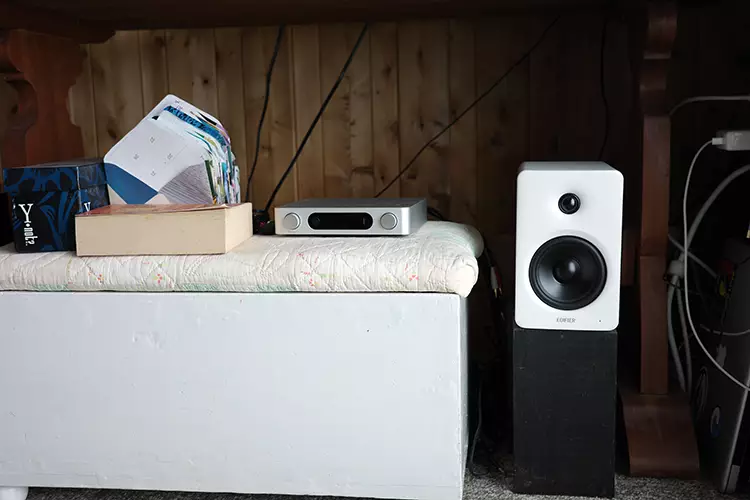
When used as a substitute for our soundbar/subwoofer on our Samsung smart TV, the Edifier M90 proved beneficial across the board. The HDMI (eARC) connection presented excellent sonic characteristics with very good levels of detail retrieval and clarity.
When explosive sound presented itself, the combination provided the necessary grunt down low to convey the massiveness of sound needed.
Only in softer sound sessions did the pair suffer, and this could be as much about the extraneous noise coming from our Aussie when she wanted to play as anything. The Edifier M90 paired with the Edifier T5s could very well supplant our existing soundbar/subwoofer. It is better.
Paired through optical and the AUX with an upcoming CD player review unit, I really appreciated the clarity of the all-digital interface.
I mentioned that only having an XLR option might increase the “value” of sound, but the optical nullified that nicely. I could just as easily see the Edifier M90 in my nearfield desktop setup with the CD player.
Concurrent to that setup, I paired the Edifier M90 with my MacBook Pro through the USB-C for streaming purposes. The pairing gave more props to the versatility, and I could happily keep both hooked together for quick options.
I also paired the Edifier T5s subwoofer here, making videos on my laptop almost like watching a personal movie screen; such were the results.
Selected Comparisons
FiiO SA1
Features
The desktop FiiO SA1 features a 3.5” wood fiber woofer (using the same material as the FiiO FT1 headphone), which allows for a rapid acoustic response. The Edifier M90s 4” woofer bests the low-end of the SA1.
An aluminum-magnesium alloy tweeter using monitor-grade material measuring 0.75” allows for quick, crisp sound response, complementing the woofer. The silk 1” tweeter promotes a smooth character over the metalloid one found in the FiiO.
The Texas Instruments TPA3118 Class-D amplifiers can provide up to 20W x 2 for the woofers and 5W x 2 for the tweeters.
Not earth-shattering, but sufficient for desktop needs and potentially bookshelf usage in smaller spaces. The Edifier bests the FiiO in power, too, with 35W x 2 and 15W x 2 for the woofer & tweeter.
The FiiO app can provide a 31-band lossless PEQ when using a Smart device as a source, which is quite flexible. The app can be used in conjunction with the PEQ to tailor the sound, fitting your space. The Edifier M90 does not have a PEQ.
With a multitude of inputs, including BT 5.4, the SA1 supports LDAC when applicable, as well as AAC & SBC. The Edifier has optical, but no phono pre-amplification options. You can, of course, Bluetooth a capable turntable, though.
Both can be used in conjunction with a powered subwoofer.
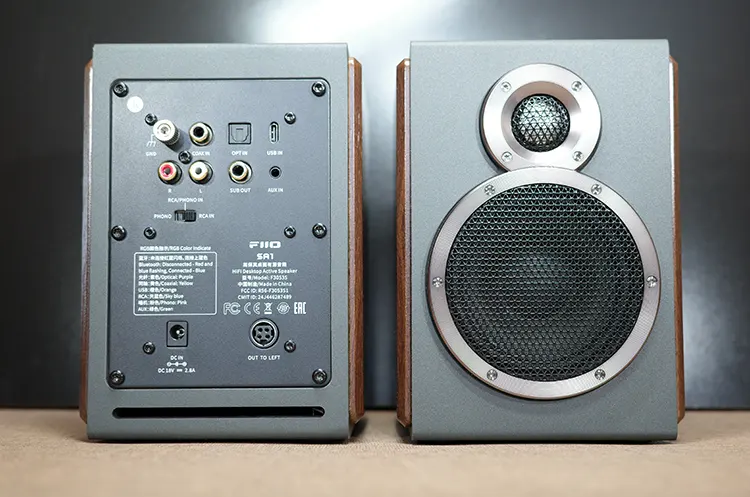
Design
The SA1 uses high-density MDF material up to 12mm thick for the cabinet. The top and sides use 9mm solid wood veneer to reduce resonance, purportedly for a more natural sound.
Its diminutive size of just under 8” tall and 5” wide, the 5.5” fits easily upon my desk and other locations. The Edifier M90 is not only larger but also made of a poly-type material, which gives excellent tactility to the feel.
A lower “slot” out the back, combined with two internal shelves of unequal length, acts as a bass port. The Edifier M90 has its bass port directly behind the tweeter.
Both allow for the low-end to come through without issue. A bass knob allows for added bass on the FiiO, but I found there was not much change to the low-end.
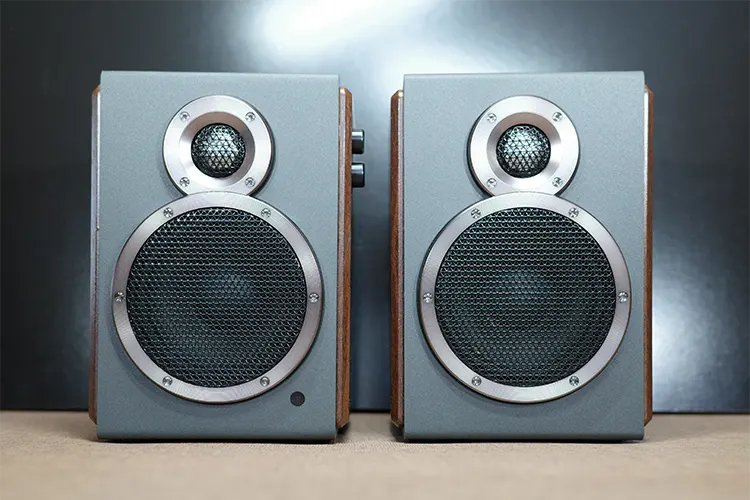
The cabinet is a good-looking unit with a dark gray faux-burnished aluminum look on the top, bottom, front, and back, which combines nicely with the walnut color of the veneer.
I did appreciate the white color of the Edifier M90 as a nice change to the faux wood speakers or all-black color of many I have.
The dark metal smoked-chrome rings surrounding the woofer and tweeter look like a two-globe snowman, adding to the appeal. The Edifier M90, on the other hand, might be a snowman in a storm with a black hat and belly.
Both sets use the right speaker for the “business parts,” ranging from controls to inputs and volume options.
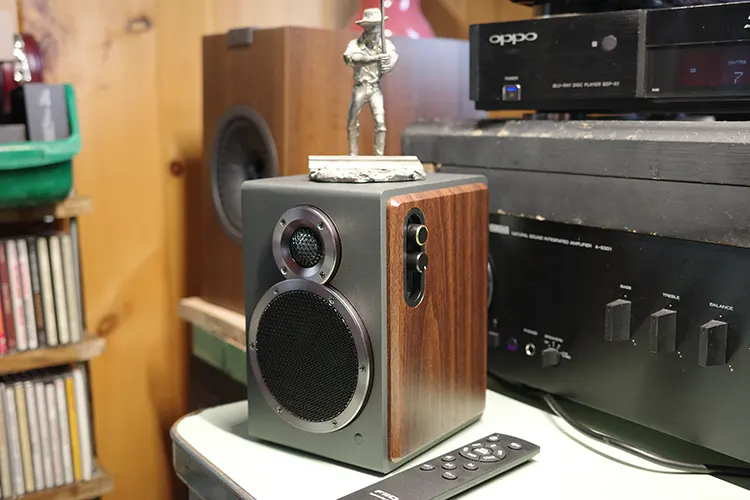
Performance
Proper placement of these ‘Lilliputian’ speakers changes the sound drastically. This is known across two-channel systems. Differences will be noted below, but suffice it to say that even when placed on a desktop, below ear level, the sound qualities were quite adequate.
The Edifier M90 is much more forgiving, especially with its excellent soundstage, but proper placement should still be a frontal thought instead of an afterthought.
Set initially as a nearfield speaker on my desktop, the SA1s promoted a spherical response to each source, with excellent depth to the sound.
The depth in presentation coming forth from the Edifier M90 cannot be matched by the SA-1, even with its excellent sound characteristics.
Even with those limitations, imaging was excellent, and placement came across as expansive without becoming thin in both speakers.
Bass is lacking, but when hooked to my older Paradigm PW-2200, a faithful 20-year companion, using the included RCA to 3.5mm AUX cable, the bass expanded greatly.
Details come through with aplomb and a distinctiveness defying the small speaker’s diminutive size. The Edifier M90 worked equally well with its branded T5s or the Paradigm.
The top end does suffer a bit as well, falling into an almost polite manner, but with good articulation of notes, lending to a nice extension. Size limitations are most likely the culprit in the SA-1.
The midrange comes across as defined and vibrant, but without punctuating any one set of instruments or vocals present here. A work of cohesion instead of showmanship, if you will. It does sit a bit more forward than the Edifier M90.
Placing the SA1s at ear level gives a bit more transparency along with a clearer midrange. Even when placed at the desktop level, the midrange performed quite nicely. This made no difference for the Edifier M90.
FiiO SP5
Features
The SP5 follows the same exterior design as the SP3 and features an aluminum die-cast cabinet from Genelec.
Equipped with an independent 4-channel amplifier delivering 60W to the 5.25-inch Rohacell-cone bass driver and 20W to the 1-inch composite silk dome tweeter, this represents an increase over the SA1 and Edifier M90.
The SP5 is suitable not only for near-field desktop music listening but also as bookshelf speakers for medium-sized rooms or dedicated listening rooms. It is significantly larger, making nearfield placement somewhat of a concern.
Users can control the speakers with the FiiO Control App, which is available for both iOS and Android devices. The app features 10-band PEQ tuning and complete speaker configuration, all from a phone, tablet, or laptop. The same can be said of the Edifier M90, save the PEQ.
Upon first use, I was greeted with a message to kindly update to V1.0.0, which took about four minutes before use.
Both sets of speakers have built-in trigger input support so they can be powered up in sync with other audio gear, making both suitable for integrating with home or studio setups. When turned on, it will automatically remember the previous source and volume.
The SP5 speakers come with two Furukawa oxygen-free copper power cables for clean power delivery, as well as robust connecting cables between each speaker and the connectivity options.
They are heavy-duty. These are probably the nicest stock cables I have encountered in speakers I have reviewed.
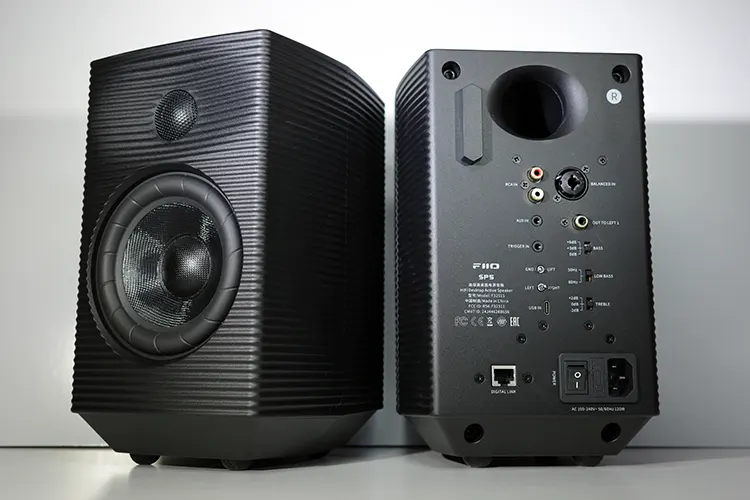
Design
The FiiO SP5 comes in either black or white. I received the black version and immediately noted that it collects smudges and prints somewhat readily.
Once connected, though, you should have minimal contact with the speaker. I could see the white staying cleaner, plus to me it looks quite regal. Not that I mind the subdued black color, which allows the speaker to fade into the background.
Made of two-piece die-cast aluminum, the ridged texture has a rough feel for better grip when you need to move the speaker. Fit and finish are top-notch, though I did note a small mismatch with the melding of the two edges on both speakers.
At 11” high, 6.75” wide, and 7.25” deep (280x170x185mm), the SP5 will fit into most spaces with ease. These are probably ⅓ again the size of the Edifier M90, which is something to consider for desktop situations.
The speakers are robust, coming in at roughly 3.85lbs each (about 1750 g), which is also heftier than the Edifier M90.
The rubber woofer surrounds have an articulated pattern to them, reminiscent of a mechanical blower fan, as you might find in a pellet stove. In terms of pure design aspect, both show good variety, but the FiiO stretches the boundaries a good bit more.
Both the woofer and tweeter are recessed a bit, with the tweeter mounted slightly behind the front face as a result. The woofer sits flush once the curved area surrounding it moves back on the left and right sides.
The XLR input is a plus for the FiiO SP5, while the optical input for the Edifier M90 is something the FiiO does not have.
The robust nature of the SP5 means it should be placed with care, whereas the Edifier M90 is much easier to place.
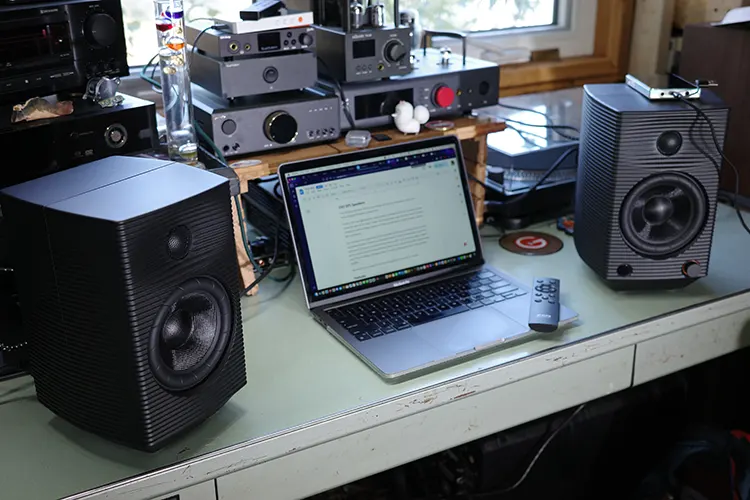
Performance
Using the SP5s as a near-field speaker first, I was surprised that they did not overwhelm the space. The speakers are quite large for such a setting, but they functioned with excellent sonic characteristics, much like the smaller Edifier M90.
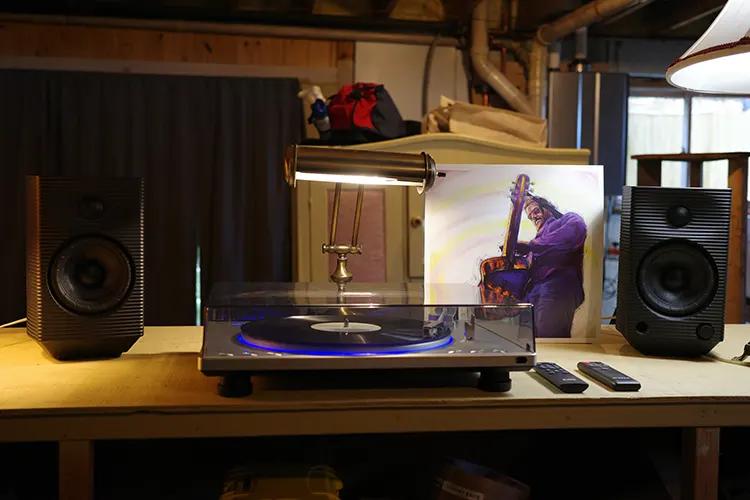
Spacing the SP5 out when using the TA32 or Bluetooth turntables did not hinder the quality, and with the ability to fine-tune the spacing and vertical placement, I could zero in on an excellent setup.
The Edifier M90 did show better soundstage depth when spaced further apart. An interesting twist between the pair.
The ability to tailor bass, treble, and low-bass reach helps with the setup for multiple situations. Suffice to say, as a near-field, +3 dB for bass added just the right amount of low-end grunt. To do this on the Edifier M90, you need to use the app and customize the EQ settings.
Using the desktop spacing, the sound focused around a holographic center, but with good 3D expansion. The depth of the Edifier M90 is still to be commended, even against the FiiO SP5.
Raising the speakers a bit helps with treble extension, but even without this adjustment, the treble sounded vibrant and accurate. There is no need to raise the Edifier M90; it does not benefit the sound in my testing.
Edifier MR5
Features
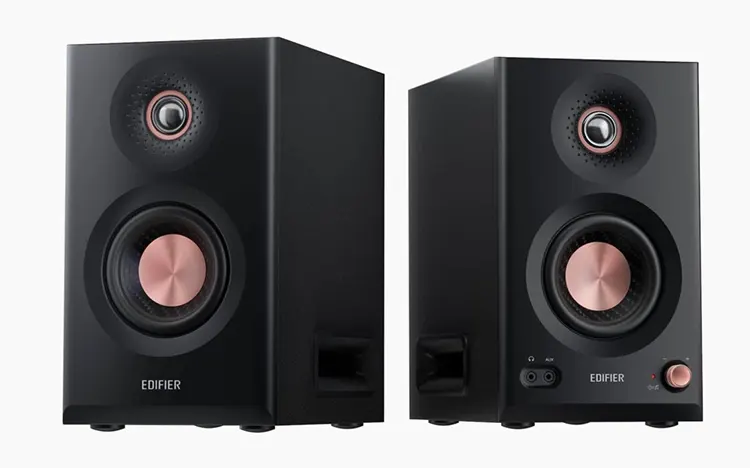
The Edifier MR5 uses an active/passive configuration, where the active speaker (left) receives all input signals and sends them to the passive unit (right).
It supports RCA, TRS, and XLR inputs. This could be considered the sibling or twin of the Edifier M90. Both fall in line pricewise, but function quite differently.
Filters to adjust bass and treble levels are included, much like the SP5, but on a rotating basis, instead of a dedicated switch. The Edifier M90 does not have controls such as that.
With 110W RMS total output power and SPL up to 101dB (@ 1 meter), the MR5s put out a comparable amount of power compared to the 100W of the Edifier M90.
The downward-firing 5″ woofers, along with the frontal 3.75″ mid-range drivers and 1″ silk dome tweeters, make for an active/passive three-way speaker compared to the two-way of the M90, which also has smaller drivers.
You can fine-tune both bass and treble on the MR5 +/-6 dB right on the speaker, while the M90 must use the EQ within the app.
Additionally, the MR5 also uses the volume knob as a sound-changing option (effect option). The user can fine-tune the sound using one of three preset options, tailoring the sound. The M90 does not have that function, presenting a simpler, straightforward control setup.
Balanced XLR, balanced TRS, RCA, and AUX inputs, with a headphone output jack, highlight the input/output options.
The SP5 does lack a headphone port, but it does have a USB-C input and a remote. The Edifier M90 has optical and HDMI (eARC) instead of the XLR and balanced TRS options.
Bluetooth V6.0 audio receiver supporting multipoint connection, much like the 5.4 of the sibling.
Design
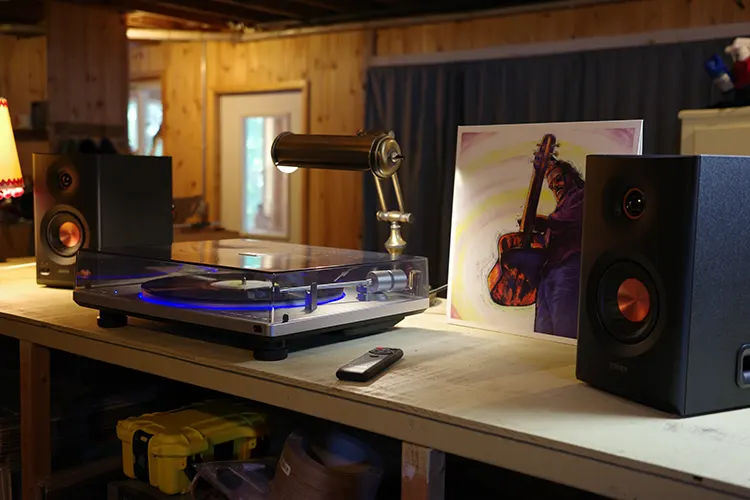
The tweeter–midrange driver is exposed on the front panel, while a downward-facing 5-inch woofer is hidden inside, with side slots acting as ports in the more traditional-looking bookshelf speaker.
This is a novel setup, whereas the Edifier M90 presents a more traditional design with a bass port out the back.
The all-black look, with copper accents on the woofer, tweeter, and volume knob, is reminiscent of The Sixes compared above.
If for only a look, the Edifiers could be mistaken for a Klipsch model. The Edifier M90 looks much simpler in design, with an especially understated one that I like quite a bit.
The MR5 is also much larger than the Edifier M90, which makes sense with the three-driver setup.
The back of the active speaker (left) has all of the business options, including power and all inputs. The Edifier M90’s right speaker is the business port.
The simplistic yet futuristic design of the MR5 will fit nicely into any setting, showing off the accents in copper, where the SP5 does look a bit more artistic in its approach. The more subtle Edifier M90 fades into the background, which is not bad in its own right.
Performance
The MR5 reaches deeper than the Edifier M90, due to the downward-firing woofer. Even when it is set at flat, there is a preponderance of bass coming forth from the cavity.
Set on a desktop, you will not lack for the low-end. On pedestals or raised, the bass is less prominent, but felt, nonetheless. The Edifier M90 simply cannot match the grunt from its sibling.
The midrange melds right into the MR5 signature and may become a bit lost in the overall signature. While vocals do come across with aplomb, they are part of the whole, with less emphasis, much like the Edifier M90.
The treble is more sparkly on the Edifier MR5 than the M90. Especially at ear level. This is where proper placement for your tastes will benefit the user more than the more forgiving Edifier M90.
The MR5 provides a more vibrant signature than the smoother, more organic Edifier M90, which comes across with slightly better detail retrieval.
My Verdict
Some Edifier models have filled niches quite well in my systems, while others have since moved along. I have always appreciated the versatility of each model, though.
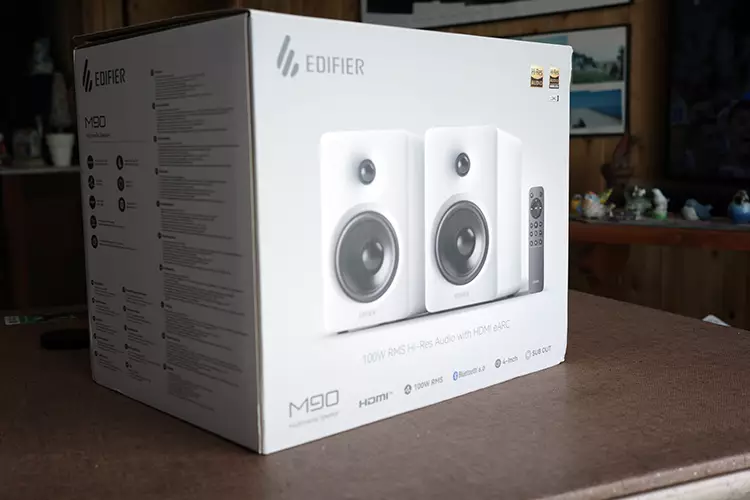
The sound signature quality of the Edifier M90 within my television setup makes for an easy switch from my budgetary soundbar/subwoofer, to start. Combined with the Edifier T5s subwoofer, our TV game has certainly been raised.
Used in nearfield situations, such as my work desk, also makes perfect sense. The diminutive size lends itself to a variety of placement options. I can more easily incorporate the Edifier M90 into multiple desktop locations than many comparable speakers.
Plus, to me, the white gives a nice accent against the preponderance of black colored components, complementing both equally.
I do wish the Edifier M90 came with XLR inputs to maximize user options, but I found that the USB-C and optical options worked perfectly fine when using a small CD player I have in for review. The versatility of the Edifier M90 showed through in its efficiency.
As for the sound, the midrange could use a bit of a push forward, but this can be compensated for by equalization. But the low-end grunt (even without a subwoofer) makes its presence felt in the variety of situations in which placed.
The smooth top-end was also pleasing in its ability to tone down potentially strident television material, such as explosive sounds that otherwise might become tiresome. I appreciated that aspect of the tuning.
The Edifier M90 is a reasonably priced nearfield speaker that works equally well with the HDMI connection to your television needs, and that could be its greatest strength. One that now resides in a permanent setting, until I move it for nearfield use, which will be equally pleasing.
Edifier M90 Technical Specifications
- Drivers: 4″ long-throw aluminum mid-bass drivers, 1″ silk dome tweeters
- Amplification: Dual Class-D bi-amplified (4 channels total)
- Total Output (RMS): 100W (mid-bass 35W × 2 + treble 15W × 2)
- Frequency Response: 50Hz – 40kHz
- Signal-to-Noise Ratio: ≥ 85dB (A)
- Digital Processing: 24-bit/96kHz end-to-end
- Audio Inputs: HDMI eARC, Optical, USB-C, AUX, Bluetooth
- Bluetooth: V6.0 — LDAC, SBC
- Sub Output: Yes (dedicated RCA)
- Dimensions (Active): 133mm × 212mm × 225mm
- Dimensions (Passive): 133mm × 212mm × 210mm
- Colors: Black & White
- Net Weight: 6.05kg (pair)
