


Marcus reviews the Austrian Audio The Arranger, a new set of high-end open-back reference headphones featuring a proprietary 44 mm DLC driver. It is currently priced at $1299.00.
Disclaimer: This sample was sent to me in exchange for my honest opinion. Headfonics is an independent website with no affiliate links or partnerships. I thank Austrian Audio for their support.
Click here to learn more about the Austrian Audio products that we have previously reviewed on Headfonics.
This article follows our latest scoring guidelines, which you can find in more detail here.
The Composer has worked its way into my daily rotation for some time now. Austrian Audio’s flagship headphone has become a sleeper hit for me with its modern design and language, high comfort levels, and excellent neutral to clean sound signature.
Am I hoping for the same from the new Arranger, priced a bit lower at $1299? Probably not, but not in a bad way.
The Arranger straddles the middle region that Austrian Audio has been missing for some time now, considering that after the €2499 Composer its a steep drop down to the €349.65 Hi-X65 model.
With an aesthetic closer to the Hi-X65 than the Composer, the Arranger is a very comfortable headphone to wear but delivers a more colored, heavier-hitting sound signature than the precision and clarity of the Composer.
Pitched as a Studio tool, I suspect audiophiles on tighter budgets might find The Arranger an appealing headphone, but there is plenty of dynamic driver competition, such as the cheaper Sennheiser HD 660S2, and the ZMF Headphones BOKEH Open.
How does it perform and compare to the Composer and alternatives? I found out in my full review below.
Features
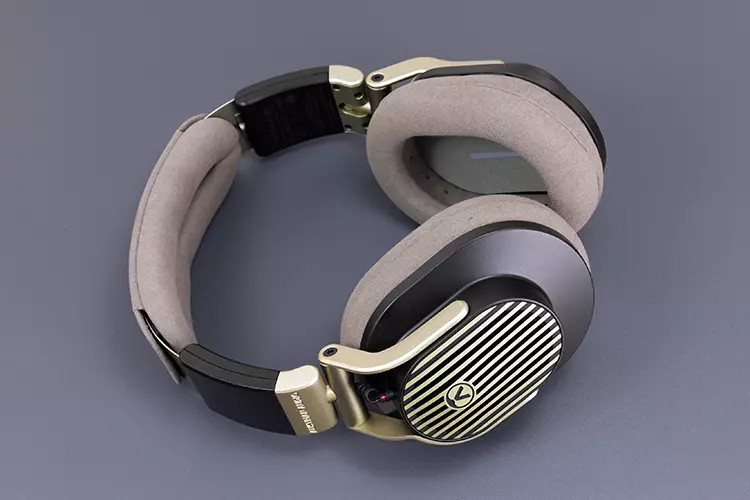
The Austrian Audio The Arranger is a set of open-back circumaural headphones equipped with an entirely new 44 mm dynamic driver and a DLC-coated (diamond-like carbon) diaphragm.
This is not the same 49mm driver used inside the Composer, and there is no direct mention of the proprietary ring magnet being the same, either.
However, I do have to presume there is a strong crossover of technical strengths from the existing lineup inside the Arranger, which would include a version of the ring magnets Austrian Audio typically uses in its headphones.
At 110 dB/Vrms and 25Ω, the Arranger is not quite as efficient as the flagship Composer’s 112 dB/V and 22Ω impedance rating, but it is not that far off. I am expecting them to run just fine on almost anything, similar to how I use the Composer.
Design
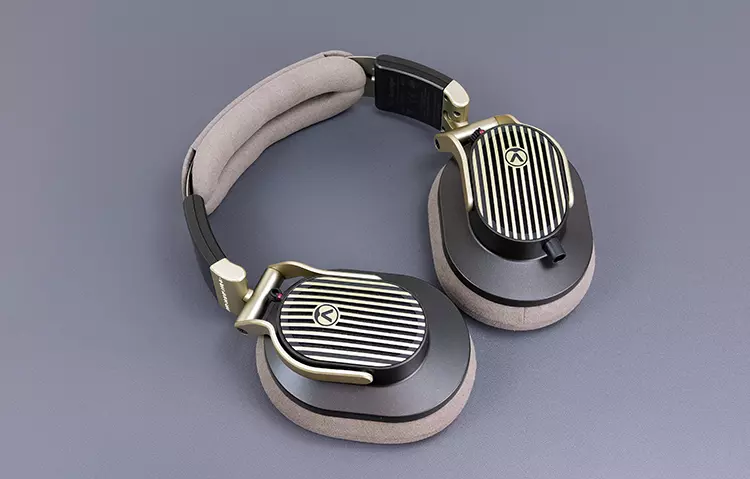
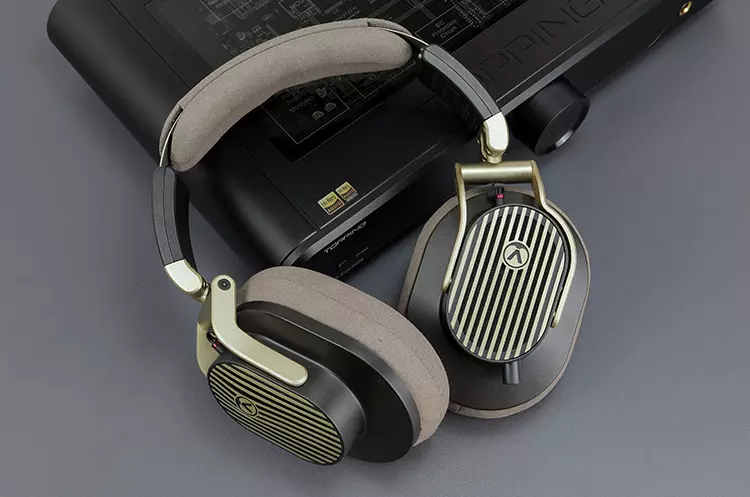
Although adorned with a fair amount of plastic, I quite like the design and form factor of the Arranger.
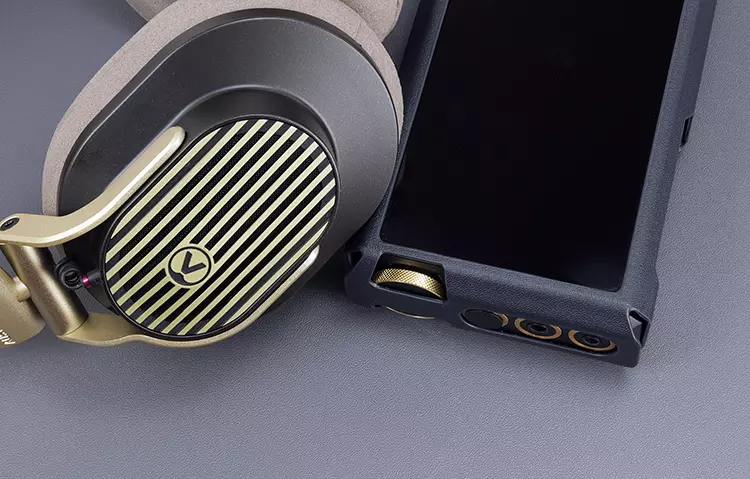
Billed as an open-back, the cup grill is not quite as large open as the Composer and more in line with the aesthetics and dimensions of the Hi-X65. Still, the healthy color mix of retro-70s of taupe, champagne gold, and matte black gives it a fairly urban appeal.
The fact that the Arranger comes as a fully-articulated foldable or lie-flat headphone enhances portability and creates a fairly small profile, ideal for tucking into the accompanying soft pouch.
Personally, I would prefer the optional hard case for additional protection, but that was not sent to me for a final opinion.
The Soft suede leatherette fabric used for the headband cover and ear pads feels premium and very nice to the touch. Austrian Audio has made a point to mention that they are replaceable and serviceable, but they are not magnet-locked in the same way as the Composer.
At 320g, the Arranger is not the lightest dynamic driver headphone in the world. The Sennheiser HD 660S2 at 260g is a good example of just how light one can get in this category. However, it is lighter than the Composer’s 385g rating and more manageable than the 480g weight of the BOKEH Open.

Comfort
Because of the studio pitch, the Arranger’s pressure distribution is tight but quite evenly managed over my head. I cannot see this headphone slipping all over the place during rapid head or body movement.
The slightly angular cup placement, combined with the spacious oval inner pad opening, should fit most ears quite well without pressing onto them. I felt no breathing issues whilst wearing it, so it is unlikely you will experience a huge build-up of sweat during prolonged use.
The choice of memory foam will generate some debate, as the initial wearing experience is not quite as plush as I had hoped for.
Comfort levels are entirely personal, but the foam inside these are a little more rigid than high-end Alcantara versions you find on the Focal Utopia 2022, for example, and not quite as pliable as the Composer leather alternatives.
What I suspect will happen is a softening over time, and perhaps this choice of foam is designed to mitigate any loss of seal or sound performance from malformed pads.
Stock Cable
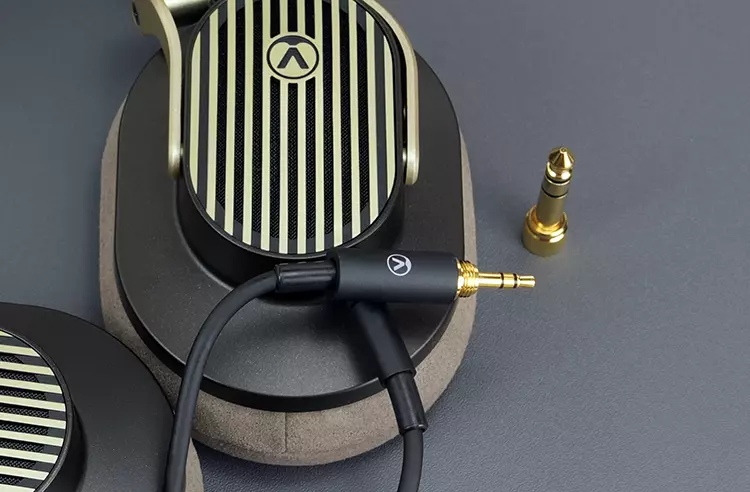
The Austrian Audio The Arranger is fitted with a single-entry directional 4-pin symmetrical socket on the left cup, designed to accommodate their new proprietary 3.5mm connector cable.
This is not the same as the banana plug-type system on the Conductor, which I actually really like after a few years of solid use. It’s quite an easy socket to insert, twist, and lock the cable into, so I have no issues with the system itself.
What I am slightly disappointed with is packaging a 3m 3.5mm terminated single-ended cable and leaving out the 4.4mm option as an optional extra.
I understand the studio pro pitch since 6.35mm/3.5mm is still dominant. However, the headphone is balanced-wired by default, and at that price point, a 4.4mm option would have been ideal for the audiophile community’s preference for the additional output power from balanced portable devices.
On the plus side, the cable feels durable and handles quite well with no memory retention, so it will not tangle or bunch up during use.
It’s clearly designed for desktop or studio environments at that length, so I would recommend grabbing the TACP2 2m 4.4mm terminated version from Austrian Audio for €49 for a more portable-friendly experience.
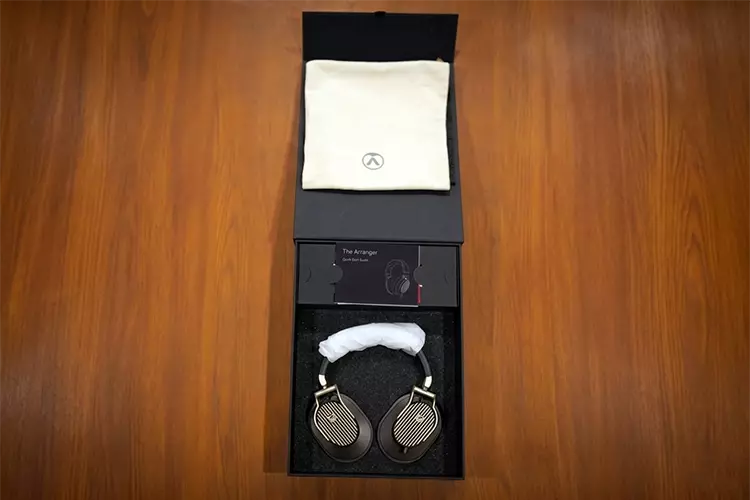
Packaging & Accessories
Austrian Audio always delivers some hefty unboxing experiences. The actual shipment to me was huge, but it’s more like an audiophile equivalent of unravelling a Matryoshka doll with a few outer boxes until you get to the infinitely smaller retail box.
Inside, the layout is slick and modern with the headphones carefully placed on their own foam platform beside the cable box, which has the product booklet fastened on top.
Underneath is an additional soft cloth pouch, which serves as a handy low-profile carry bag when the headphones are folded, but it might not provide a huge amount of protection in the long run.
Consider them dust protectors and grab the company’s €29 HXHC zipped hard case, which should fit the Arranger inside. Geekria also offers some similarly affordable low-resolution alternatives for a similar price.
Sound Impressions
The following sound impressions of the Austrian Audio The Arranger were completed using a mix of the FiiO M27 and, for desktop use, the Topping DX9 Discrete and the Chord Electronics Alto/Ferrum WANDLA GSE combo.
Summary
The Arranger is a departure of sorts from the Composers’ relatively neutral and clean sound signature (a more detailed match-up can be found in my comparison work on page 2 of this review).
This is a more colored tuning, warmer and smoother, with enhanced body courtesy of an extended, elevated bass shelf up to the lower-mids around 500Hz. Vocals are rich in tone, richer than the Composer with a stronger fundamental frequency, but slightly further back from the listener’s position.
Arguably U or V-shaped, the staging dimensions are compact but deep with a stronger sense of space than what I was expecting.
It is not quite as open as the Composer, and there is a minor degree of detail masking in the mids due to the more relaxed imaging positioning relative to the stronger bass output. Otherwise, the control is impressive, especially with good-quality amplifiers.
And that is one thing to note: the Arranger is highly responsive to what you feed it. My initial testing with the Ferrum OOR and the HiBy RS8 II left me questioning why it was considered a bassy headphone. It was punchy, but not overly heavy and slightly sibilant.
Switching to the Chord Electronics Alto and the Feliks Audio Envy, two amps known for excellent lows, soon changed that perception with a far more substantive and pleasing low-end performance.
My personal preference was the Topping DX9, a finely balanced (more affordable) pairing accentuating the smoother tones of the Arranger without sacrificing vocal impact and bass weight.
Frequency Response
The Arranger has a response curve that is accentuated from 20Hz up to around 500Hz, and again another bump from 2k up to 6k.
I suspect that will be the calling card for most initial impressions, with a peak around 50Hz and an elongated mid-bass shelf from 80Hz up to 300Hz. It does not quite have the chops below 50Hz to sound truly powerful.
Certain amplifiers, such as the Alto and the Envy, will accentuate it, giving it a satisfying ‘thud’, but the overall sentiment is fulsome and punchy (particularly with neutral amps).
Aside from a slight drift north of neutral around 5-6k, the Arranger curve stays largely Harman-neutral in terms of quantity in the mids and slightly south of neutral in the highs up to 10k.
From 500Hz up to 2k, I would describe it as south of neutral with imaging a bit further back, giving it that mild V or U-shaped presentation. I would say mild because I never felt it sounded overly recessed.
With its compact staging quality, the vocals are not lost in some massive, atmospheric arena-like presentation, but the tuning does help to create a bit of perceived distance, so it’s not overly narrow-sounding.
Going back to source matchups, the vocal imaging can shift a little perception-wise.
Smaller dongles such as the iBasso DC-Elite will push a more aggressive midrange performance. However, that narrow 5-6k peak can catch a little more treble overtone, giving it a slightly more sibilant quality on naturally bright or upper-registered vocal and percussion performances.
Warmer or more natural-sounding DAPs and amplifiers do not seem to push that sibilant quality into the Arranger’s performance.
Click on page 2 below for my recommended pairings and selected comparisons.
