


Marcelo reviews the Kiwi Ears Halcyon, a unique tribrid MEMS, single 10mm dynamic, and triple balanced armature driver in-ear monitor. It is currently priced at $259 MSRP with Early Bird Kickstarter prices starting from $199.
Disclaimer: This sample was sent in exchange for my honest opinion. Headfonics is an independent website with no affiliate links or services. I thank Linsoul and Kiwi Ears for their support.
Click here to read up on the Kiwi Ears gear previously reviewed on Headfonics.
This article follows our scoring guidelines, which you can read in more detail here.

I have always liked the Kiwi Ears IEM tuning because it is close to my preferred sound signature, which is near-neutral and clear, similar to Kiwi Ears Astral and the Septet.
Upon learning that the Halcyon, which sells for $259 MSRP, is tuned in a similar way, which is studio monitor-like neutral tuning with an enhanced sub-bass boost, I was ecstatic.
Unlike IEMs with other tuning styles, which I set aside after the review and rarely listen to again, the tuning style similar to Kiwi Ears is the one I listen to afterward.
What’s special about the Halcyon is that it’s a tribrid design that features a MEMS driver, a new driver technology with a lighter moving mass than a typical driver, promising higher resolution in the upper treble region.
Will the use of MEMS drive results in a higher perceived resolution? And how will the Halcyon compare to the likes of the Binary EP321 MEMS, the Tipsy M3, and the Kiwi Ears Etude? Let’s find out in my full review below.
Features
The Halcyon is a tribrid IEM featuring a 10mm composite-diaphragm dynamic driver that handles the sub-bass, two DEK-series custom balanced-armature drivers for the midrange, a custom WBFK-series balanced-armature tweeter for the highs, and a MEMS driver for the ultra-highs.
The MEMS driver is the latest technology used in IEMs and requires a separate high-voltage amplifier. Being incorporated into the Halcyon and driven with a single amplifier requires the MEMS driver to have a voltage step-up transformer.
I’m not sure whether the Kiwi Ears claim that the Halcyon is the world’s first MEMS + 1DD + 3BA tribrid in-ear Monitors, as I haven’t verified it.
However, I am 100 percent certain that it is not the first IEM to use a transformer-coupled MEMS driver. That distinction belongs to the Binary EP321 MEMS IEM, which is included in this review for comparison.
There is a piece inside the CNC-machined aluminum alloy housing Kiwi Ears calls a precision-engineered acoustic cavity. This holds the drivers in place and uses resonant principles to control airflow and minimize standing waves.
The Halcyon has a sensitivity of 109 dB and an impedance of 29Ω, both ratings are average among my IEMs.
Additionally, the Halcyon features an effective pressure-release system that prevents pressure buildup in the ear canal, which can cause headache, nausea, and ear pain during walking and running.

Design
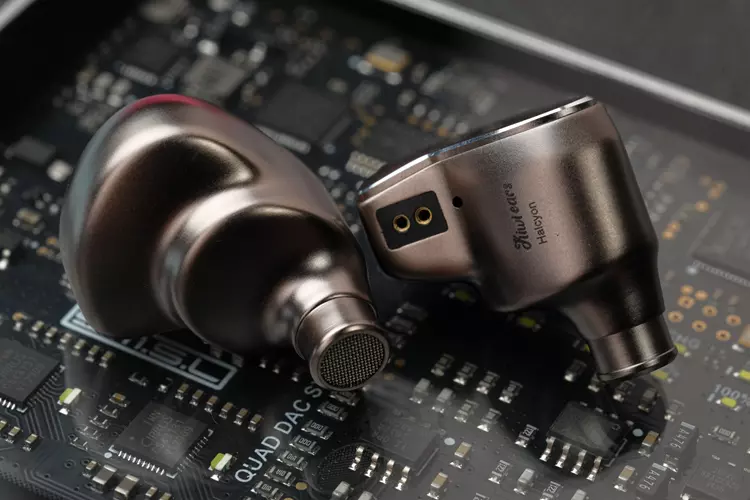
The Halcyon features a mid-sized, lightweight, fully CNC-machined aluminum alloy shell with anodized finish. It weighs only 5.8 grams per shell and has an average nozzle diameter of 6.1 mm.
The anodized finish looks silver most of the time, but at times, depending on the light intensity and angle, it has a warm titanium tint, as you can see in some of the photos.
The vent hole is cleverly located beside the flat 2-pin connectors near the faceplate, which are difficult to find once the cable is connected, keeping the shells looking clean. The faceplate is laser printed with a repeating E and Y pattern.
Overall, the Halcyon has a simple, clean design that looks unassuming yet classy.

Stock Cable
My review sample came with a decent-looking, high-quality-feeling, thick brown 2-pin cable with a modular plug system that includes 3.5 mm and 4.4 mm plugs.
However, I am writing this review before the Halcyon is officially released, and based on its early product page, there should be an option for a detachable USB-C DSP cable that can be EQ-customized, presumably with an app.
Comfort & Isolation
Weight and size are very important for comfort, and Halcyon’s lightweight, medium-size, ergonomic shape and comfy ear tips make it very easy to wear.
The Halcyon blends seamlessly with my anatomy, making it easy to forget I’m wearing it as I get lost in the music.
Halcyon’s sound isolation is average, which, to me, is a good thing, as I still want to hear the ambient sounds when not playing music during walking exercises.
Packaging & Accessories
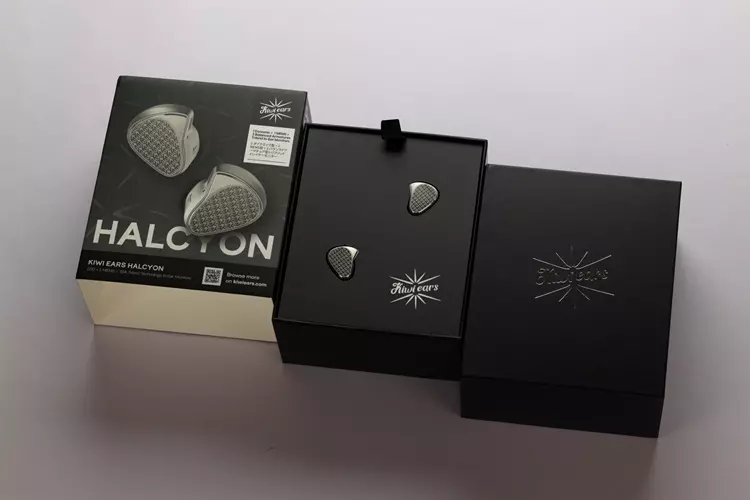
The packaging is simple yet very decent. After I removed the black sleeve with the Halcyon photo, a black box with the Kiwi Ears logo appeared at the top. Once the top cover was removed, I was greeted by the Halcyon IEM pair on display.
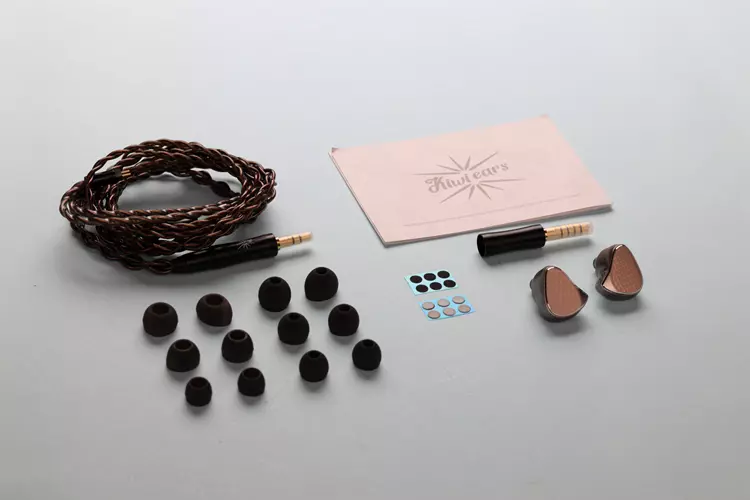
The package measures 131 x 112 x 65mm and contains the Halcyon IEM pair, a modular cable with 3.5 mm and 4.4 mm plugs, a user manual, six pairs of ear tips, and three extra pairs of tuning filter sets.
Kudos to Kiwi Ears for including the three extra pairs of tuning filter sets, which increases the longevity of the Halcyon, as these tuning filters could get damaged.
Sound Impressions
I did my standard 24-hour burn-in routine to ensure the dynamic and MEMS drivers fully settled. I noticed a subtle improvement in bass depth, tightness, and granularity after the burn-in.
For the sources, I used my iBasso DC-Elite and MUSE HiFi M6 Double DAC amplifiers, with my Android phone and the FiiO M15S DAP, using either YouTube Music, UAPP, or PowerAmp music player Apps.
I used the stock cable with the balanced 4.4 mm plug. Unless otherwise noted. I used the narrow-bore tips for their more exciting, engaging sound compared to the flatter, blander sound of the wide-bore tips.
Measurements
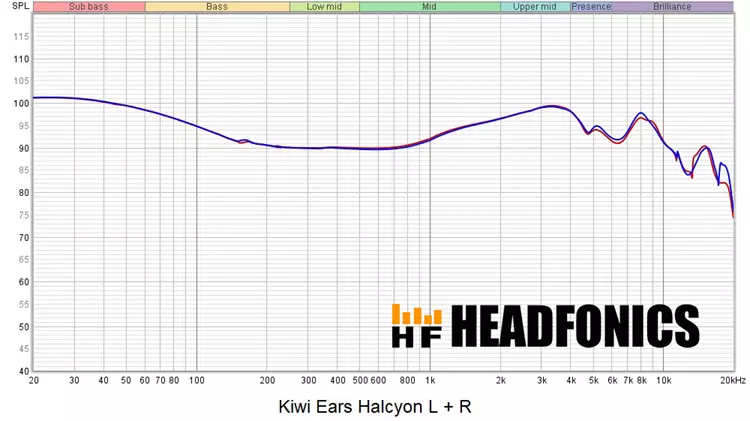
My measurement of the Halycon reveals an excellent channel match, which is very impressive, given that it consists of five drivers per channel.
The bass boost occurs only below 200 Hz; this should result in a clean upper bass. The pinna gain has a 10 dB bump near 3 kHz, which is a good elevation that balances vocal presence without upper midrange shoutiness.
The 8 kHz peak is audible in actual listening; however, it is not as peaky as it appears on the graph, because the measuring tool adds its own peak in the 8 kHz region.
Summary
The Halcyon sounds neutral with a bass boost; it forms a bassy, mild L-shaped sound signature, where the sub-bass is apparently boosted while the upper bass to upper treble remain near-neutral and relatively flat.
I find the bass quality very high; it has a deep, powerful presence, with elasticity, articulation, detail, and granularity. The lower bass never interferes with the upper bass and lower midrange, making for clean bass characteristics.
Midrange is flat, neutral, and coloration-free; it has an accurate note weight, which is neither too light nor too heavy. The upper midrange is slightly laid-back in its response, which contributes to its accurate note-weight presentation.
I find the lower treble sounds slightly dark; however, the upper treble is slightly elevated, extended, airy, and detailed.

Coloration
I wouldn’t call the Halcyon a neutral-sounding IEM, as the boost in the sub-bass is obvious upon first listen. Its presence is always perceived in every song I listen to, including 80s lean-sounding pop music.
There is also additional energy in the upper treble, which I presume corresponds to the peaks at 8 and 14 kHz based on my measurement.
However, these deviations from absolute neutrality do not negatively color the sound, akin to nasal, shouty, or distorted coloration; they are nothing like that. They add excitement and engagement to the musical experience without detracting from the original sound or musical intention.
Soundstage
Even though the Halcyon does not have the biggest stage or the grandest presentation, its staging is good and certainly above average.
There is good width, height, and depth, and it never sounds claustrophobic. I find the staging performance to be neutral and accurate. The Halcyon does not add too much artificial space in the soundstage.
The Halcyon has a slightly laid-back upper midrange, resulting in not-too-defined, slightly diffused imaging, especially in the main vocals.
Nonetheless, the imaging performance has an acceptable definition. There is a fair amount of side-to-side space to separate the instrument, and a mild front-to-back layering.
Not the cleanest background decay I’ve heard, but it is fairly clean and certainly above average. It does not abruptly cut off the instrument decay, which would make the sound dull and dry; there is nice sustain in the instrument decay as well as in the vocals.
I must add that the Halcyon, with the narrow-bore ear tips, seems to sacrifice a bit of imaging performance for a more spacious sound staging.

Medium Bore Ear Tips
The Halcyon included two types of ear tips: narrow-bore and wide-bore. The wide-bore tips sound mid-forward with a bland upper treble and have a smaller stage and ill-defined imaging.
In comparison, the narrow-bore ear tips have an exciting upper treble and a larger stage; the upper midrange is recessed, resulting in so-so imaging.
I was puzzled why Kiwi Ears didn’t include a medium-bore ear tip, or ear tips with an in-between bore size between the two included ear tips.
I tried medium-bore tips, specifically the Acoustune AET07 ear tips, and they are the best of both narrow- and wide-bore ear tips. The upper midrange is more forward, while the upper treble remains energetic and exciting without too much boost.
This also results in a wider soundstage and improved imaging performance.
However, there is a noticeable reduction in the sub-bass due to the rise in the upper midrange, hence making the overall sound more neutral.
Dynamics
Regardless of the ear tips used, the Halcyon sounds engaging and very dynamic, especially in how it presents the bass. And the midrange and treble have good energy, preventing them from sounding boring.
Halcyon can take a lot of power and go very loud without distorting or entering compression. My hearing would be the one to give up way before the Halcyon would distort.
Click on page 2 below for my recommended pairings and selected comparisons.
