

Selected Comparisons
The following selected comparisons to the Topping DX9 Discrete were completed using a mix of the Austrian Audio Composer, the Focal Utopia 2022, and the ABYSS JOAL using a balanced output connection.
Sources included the SMSL PL200 for coaxial testing and a Windows 10 with ROON for USB.
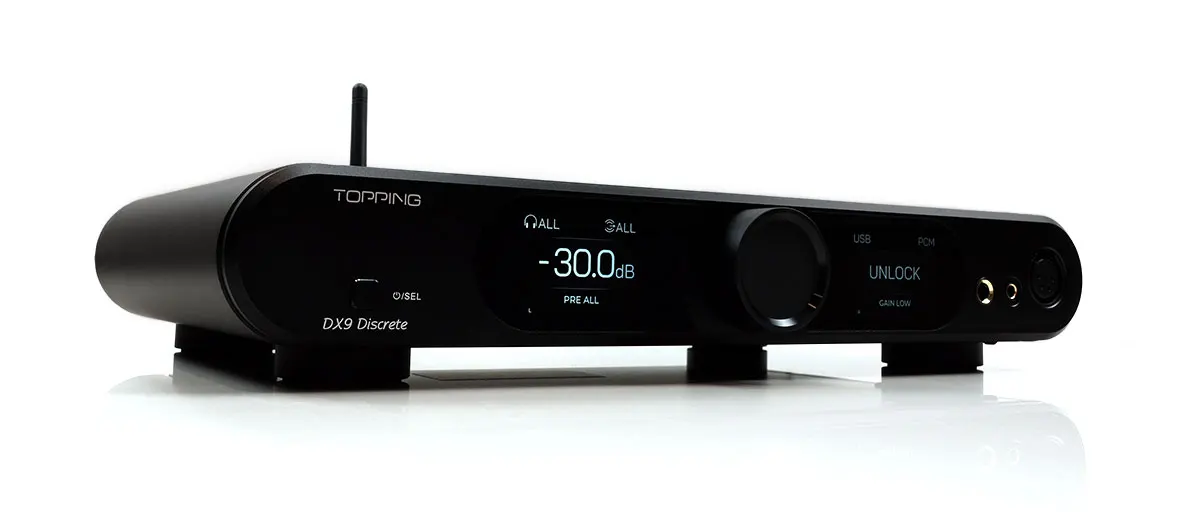
Topping DX9
The Topping DX9 is the original variant of this series of integrated desktop DAC/Amps and was launched in early 2024 as a limited-run series to celebrate the company’s 10th anniversary.
Technical
I have gone through a lot of the comparative points of these two components already, so I will try to be brief.
The most significant change from the DX9 to the DX9 Discrete is the new 1-BIT PSWM discrete-engineered DAC. Previously, the DX9 used an AKM delta-sigma solution, but not a run-of-the-mill DS design.
Topping somehow managed to acquire the classic AKM 4499EQ flagship sometime after the original factory fire, which wiped out most of AKM’s stock. The classic DAC chipsets are still highly regarded today and something of a rarity.
Both devices can decode up to DSD512 and PCM 32-bit/768kHz via USB and I²S, dropping down to 24-bit/192kHz and 24-bit/96kHz for coaxial, optical, and Bluetooth.
Where the value-add is missing on the DX9 is the Discrete versions onboard DSP and the ability to link up with the Topping Tune PEQ software via USB.
Where I personally find the DX9 to have an advantage over the newer DX9 Discrete is the change in the I²S pin configuration, which means I can no longer use my Cayin I²S-capable transports to feed the unit.
Both have similar analog output capability with lineout and pre-amping features. They both use a 6-channel discrete-engineered NFCA amplification with matching PO numbers of up to 7W into 32Ω balanced and <0.1Ω output impedance.
Design
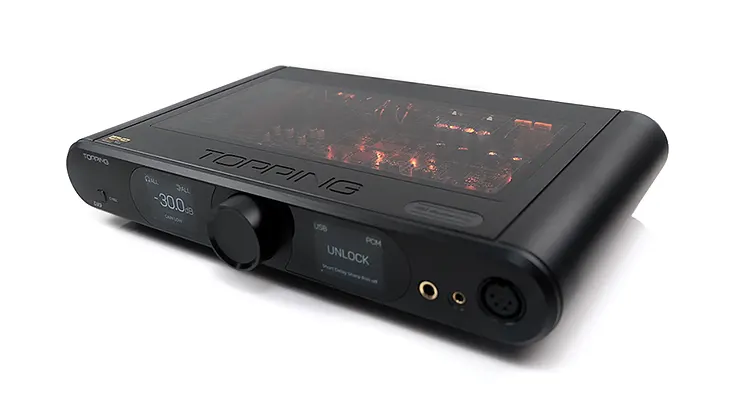
As with the technical, the design side is largely unchanged, which I do not mind as its low-profile, wide but shallow form factor makes the DX9 Discrete quite an easy desktop unit to fit into tight spaces.
My only caveat is that the slightly higher level of heat from its plexiglass makes me cautious about stacking anything on top of either DX9 unit. However, with the aesthetically attractive LCD glow, it’s not really a unit you want buried under a stack of more mundane hifi components.
Most of the changes are in the menu system; some I like, some I feel are overly complicated compared to the original DX9. The DX9 Discrete has an abundance of settings, almost too many. The level of control is far more granular, but it can also be overwhelming for the newcomer.
The additional DSP layer on the DX9 Discrete is a nice addition. My tip is the Dynamic setting, which brings an “Everything All At Once” dynamic to the playback. The rest retain a smoother sound or an airier, brighter tone, depending on your choice.
Performance
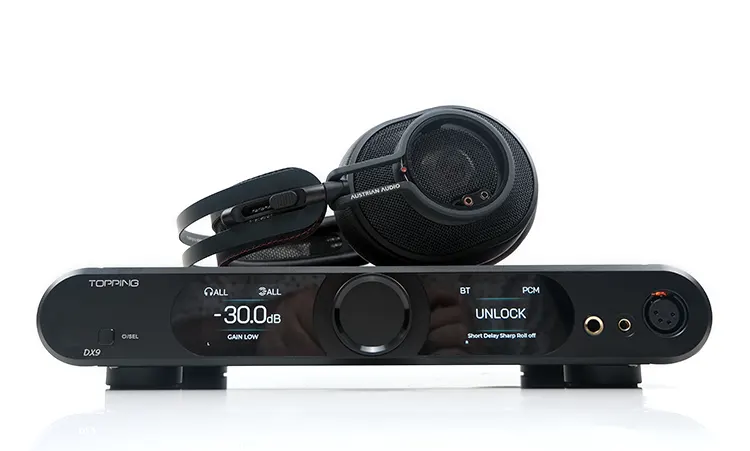
I tested these two units with the Composer and the JOAL, two headphones that can deliver decent bass when required, but otherwise not the most overpowering for lows.
And that was the case with the original DX9. I could pick up on some staging depth with a decent punch and a refined, polished set of mids. There was a slight sweetness to the vocal delivery with good treble extension.
However, the DX9 Discrete brought aspects of the recordings that these two headphones did not display when paired with the original, namely body and a more natural tone to note timbre.
I heard a much fuller set of lows with excellent body and texture from both headphones. In fact, there was more body and texture throughout, with a more forward and distinctly vivid vocal imaging experience.
Arguably, the coloration is more overt with the DX9 Discrete, but it’s delivered in a more life-like and dynamic manner over the relatively linear and polite presentation of the original DX9.
It also seems either the dynamic range has had a more substantial lift or Topping has increased the DX9 Discrete’s default gain levels by around 2.5 dB over the original DX9.
With both headphones, I found myself pushing up the volume of the DX9 to match the impact and vividness of the DX9 Discrete, especially for vocal impact and bass power.
And even then, the DX9 Discrete soundstage sounded deeper and more holographic compared to the DX9 with both sets of headphones.
HIFIMAN Serenade
The HIFIMAN Serenade was launched in 2023 and represented the first time the company launched a desktop DAC/Amp with R2R decoding and integrated streaming all in one box.
Technical
The DX9 Discrete uses a 1-BIT 16-element PSRM DAC, set up with an ultra-fast switching logic array and a precision voltage reference design, which reduces the number of resistors required to develop a suitable array. Sampling is All-To-DSD.
The Serenade uses an in-house R2R solution called the HYMALAYA Pro DAC, which is a discrete-design resistor-based modular chipset based on the company’s FPGA algorithm.
Like Topping, HIFIMAN are looking to efficiency in delivering R2R decoding, so this is a modular chipset solution rather than hardwired into the board.
Both devices use an XMOS XU316 USB chipset, but the Serenade can only decode a maximum of DSD256 and PCM 32-bit/386kHz, compared to the DX9 Discrete’s 32-bit/768kHz and DSD 512.
To get equivalent rates on the Serenade, you need to use its RJ45 input (think LAN). The Serenade also has coaxial and optical inputs set to PCM 32-bit/192kHz.
The wireless options are fluidic on the Serenade but superior to the BT-only mode on the DX9 Discrete.
The top-of-the-line version is wireless, meaning lossless transmission over WiFi. It originally launched with BT, but that feature seems to have now been dropped in favor of 2 models: LAN and a hybrid LAN/WiFi version.
Both amplifiers are discrete designs with the Serenade using a Class A circuit with no coupling capacitors, combined with an FET opamp implementation. The DX9 Discrete uses its own 6-channel NFCA modular amp system.
The DX9 Discrete is the more powerful amplifier at 7W into 32Ω balanced compared to 4W from the Serenade.
Both units have lineout and preamp functionality, though the Serenade does not have dedicated outputs for both. It does have an analog input, which I wish the DX9 Discrete had.
Design
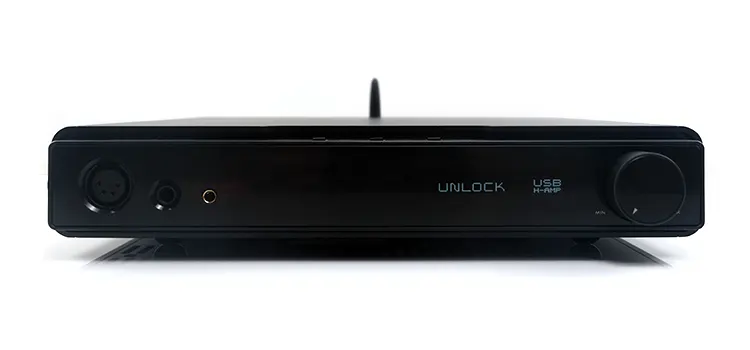
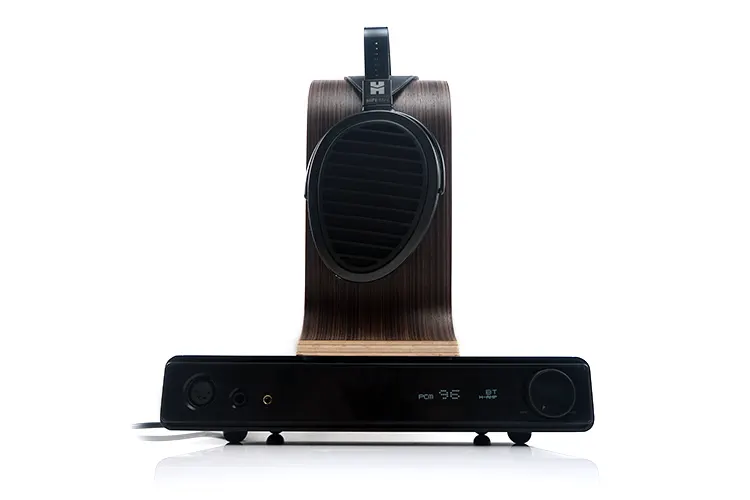
Honestly, the form factor of these devices are not that far apart. Both are low in height and quite sleek-looking, with the Serenade a little boxier in dimensions and the DX9 Discrete wider, but shallower.
Although both have curved sides, the DX9 Discrete’s curvature is more exaggerated, and of the two, it’s also about 1kG lighter and more comfortable for handling.
What the Serenade is missing is that show-stopping glowing plexiglass top panel of the DX9 Discrete. Some might argue that it is fine; they can stack on top of the Serenade more easily as a result.
Front PO is the same; both units have balanced and unbalanced XLR, 4.4mm, and 6.35mm jack options. The rear panel differs. I would say the DX9 Discrete is more diverse with dedicated lineout and pre-amp connections, BT connectivity, as well as dual coaxial inputs.
What it lacks is the Serenade’s RJ45 or WiFi input options, though my HIFIMAN unit here is LAN only. I usually use a mobile router with a short LAN cable connected to the Serenade as a roundabout way of creating a wireless device.
The menu system on the HIFIMAN is far more basic than the DX9 Discrete’s plethora of adjustable options. It doesn’t have any themes or cool effects, such as VU meters or the same level of individual connectivity control. Nor does it offer anything like Topping’s Tune software.
That being said, NOS/OS filtering on the Serenade is solid, perhaps not as transformational as the onboard DSP of the Discrete, but for R2R DACs, a NOS setting is almost mandatory in my book.
Performance
For this comparison, I went with the Utopia 2022 and the JOAL, with the differences more clearly laid out on the Utopia than the JOAL.
Both will give you more of an analog sound rather than bit-perfect, polished delta-sigma, but I do feel that the DX9 Discrete amplifier is the more neutral of the two in frequency emphasis with both headphones compared to the Serenade.
The Serenade is sweeter and lusher-sounding, but it also comes across as a little more languid in its delivery, not as tight and with a slightly longer note decay than the DX9 Discrete.
Vocals were not as robust or full-bodied as the DX9 Discrete presentation, despite having more bass bloom.
The Serenade delivers a fuller low-end, but it doesn’t have the same punch and density. This is warmth and attack softness combined with a more laid-back vocal imaging experience on the Utopia 2022.
The DX9 Discrete is more linear with its transition from the lows to the mids and has a slightly more intimate and full-bodied vocal presentation.
Mids and highs are firmer sounding on the DX9 Discrete with a stronger fundamental frequency, whereas the Serenade presents its mids in a ‘politer’ manner.
Overall, the DX9 Discrete sounds the more driven and balanced of the two amplifiers, with the Serenade the more graceful and sweeter. I would go with the DX9 Discrete with warmer headphones and the Serenade with brighter presentations.
Ferrum ERCO
The Ferrum ERCO was launched in 2022 and was the company’s first integrated desktop DAC and headphone amplifier. It has been superseded by the ERCO Gen 2, but new old stock can still be found on sale at price points close to the DX9 Discrete.
Technical
The ERCO is a classic delta-sigma DAC design, coupled with pre-amp, line-out, and headphone amplification. Unlike the 1-bit 16-element PSRM inside the DX9 Discrete, the ERCO uses a single-channel Sabre ES9028PRO DAC chipset implementation with an independent I/V implementation.
Perhaps a bit dated in 2025, but still quite a good performer and backed by a balanced proprietary IC power amp design for its headphone amplifier topology, with a series of micro-controllers for output switching.
The ERCO decoding levels are a bit lower than the DX9 Discrete at up to DSD256 and PCM 32BIT/384kHz. However, both coaxial and SPDIF levels are matched at PCM 24-bit/192 kHz.
The Ferrum unit does not have Bluetooth receiving capability, but can accept an analog input on its rear panel, which I find quite useful for 3rd-party DAC/amp matching.
These two have broadly similar headphone amplification capability at 6.1W in a 50Ω load for the ERCO and 7W into 32Ω for the DX9 Discrete.
They should be able to power the same types of headphones, but be warned, the ERCO does not have a 4-pin XLR output, just 6.35mm and 4.4mm. I suspect that was done to preserve the OOR amplifier status as well as endear itself to 4.4mm users.
Design
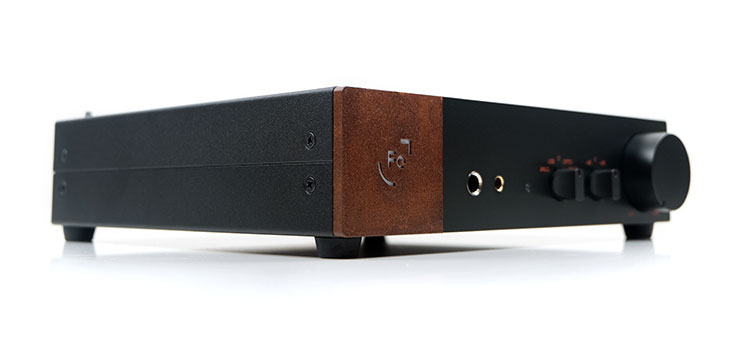
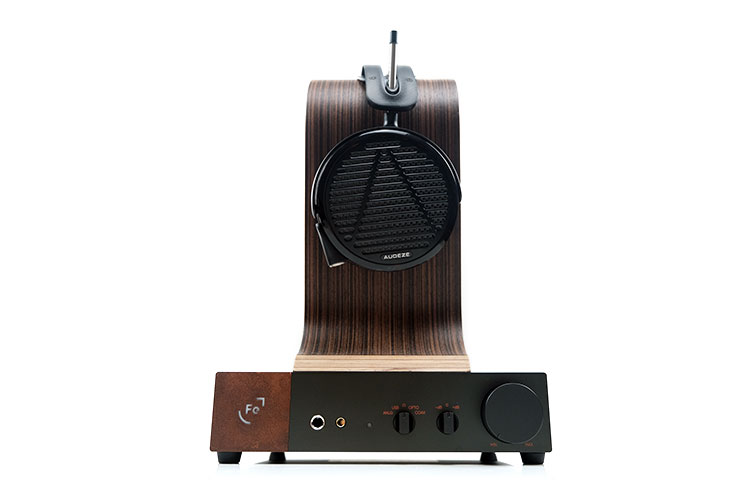
Despite the relatively compact dimensions of the DX9 Discrete, the ERCO is even more compact and light by around 1kG. Its shape and size are designed so it can neatly stack with the compatible HYPSOS power supply, so one can consider it part of a wider ecosystem.
The ERCO shape is more conservative than the DX9 Discrete. It has a familiar Ferrum boxy design language offset with some tasteful fingerprint-resistant matte-black finished Corten steel panel and textured black for the main chassis.
The DX9 Discrete does not need to be quite as snazzy in its finishing because of the glowing plexiglass finish on the top panel and its huge design benefit – dual LCD screens.
The ERCO has no screens, just a mechanical filter switch, making it very basic in terms of controls but also very easy to operate. There is no remote control for the ERCO, so it’s not as useful for a lounge-type HiFi system as the DX9 Discrete.
Unlike the DX9 Discrete, the ERCO does not have a dedicated pre-amp and lineout feature, nor does it have dual coaxial inputs or I²S. It does have that analog input, uses USB-C for signal management, and HYPSOS compatibility.
Overall, the DX9 Discrete is the more feature-rich and complete desktop DAC/Amp, but the ERCO’s compact size and simpler interface make it ideal for headphone users.
Performance
I switched back to the Composer and retained the Utopia 2022 for this comparison, given that one is quite neutral and the other is warmer-sounding.
It might be a touch crude to say this is digital versus analog. Still, there is an element of truth to that, with the ERCO sounding pristine, clean, and polished in its delivery and the DX9 Discrete a little more textured and analog in its presentation.
I can see pros and cons for both based on my chosen headphones. The Composer’s upper-mids and highs tend to sit on the fence between sharp and clean, depending on the setup.
The DX9 Discrete introduced more texture, softened the attack a little, and generally offered more body with a very natural sound throughout.
The ERCO had more of a high-contrast sound with shorter decay, a punchier mid-bass delivery, but with an overall timbre that was cooler or more neutral in tone.
The emphasis on detail was perhaps more prominent on the ERCO, with space more noticeable, but on the Composer, it sounded more clinical than natural.
The DX9 Discrete flowed more smoothly on the Composer, and though not quite as punchy, its overall presentation was denser-sounding throughout.
I got a similar feeling with the Utopia 2022, though the ERCO was more in its element with the Focal’s warmer tuning and penchant for micro-detail.
The DX9 Discrete’s softer attack and slightly longer decay, combined with a more natural harmonic balance, draw you more into the performance, becoming less about chasing every drop of information.
My Verdict
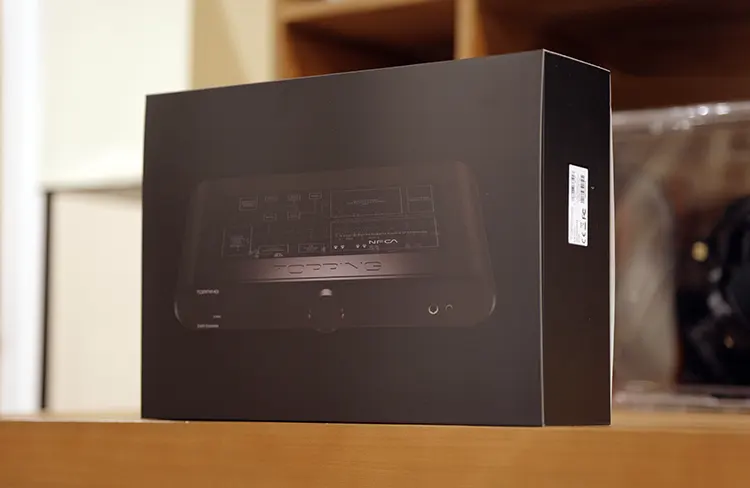
The Topping DX9 Discrete desktop DAC/Amp is a worthy successor to the DX9. It retains many of the original’s excellent capabilities, but replaces the polished, clean tone of its predecessor with a smoother, more authoritative analog sound signature
You still get a powerful headphone amplifier that can handle almost any headphone, individual lineout, and preamp options for maximum flexibility, and wireless LDAC receiving should you wish to retain a degree of flexibility.
The new onboard DSP and link-up with the Topping Tune software have real value add, allowing you to store multiple profiles for almost any headphone out there. You can even create your own or tweak existing ones to how you like any headphone to sound.
Nothing is perfect. The change in the I²S pin configuration renders Cayin transports such as the N7 and N8ii micro-HDMI ports incompatible. That is a shame.
The new menu UI is more granular, but could overwhelm newcomers, especially when trying to understand how to use Topping Tune.
Aside from that, the performance-to-price ratio is very strong with the DX9 Discrete and answers a few queries I had from the original after over a year of solid use.
Topping DX9 Discrete Technical Specifications
- DAC Architecture: Self-developed 16-element PSRM 1-bit discrete
- USB Processor: XMOS XU-316
- Max Supported Formats: PCM up to 768kHz/32-bit; Native DSD512
- Headphone Amp Six-channel discrete NFCA module (39 transistors per module)
- Max Headphone Output: 7,080mW × 2 into 32Ω load (balanced)
- THD+N (DAC): <0.00006% (A-weighted, XLR)
- THD+N (Amp): <0.00007% (A-weighted)
- SNR: 131dB (A-weighted, XLR)
- Dynamic Range: 131dB (A-weighted, XLR)
- Noise Floor (Amp): <0.5µVrms (balanced)
- Inputs: USB, Bluetooth 5.1, 2x Optical, 2x Coaxial, AES, IIS
- Outputs: XLR, RCA (Line/Pre Out); 6.35mm, 4.4mm, XLR-4 (Headphone)
- Bluetooth Codecs: LDAC, aptX Adaptive, aptX HD, aptX, AAC, SBC
- Volume Control: Fully balanced hybrid relay volume control
- Dimensions 34.0 cm (W) x 22.5 cm (D) x 6.0 cm (H)
