

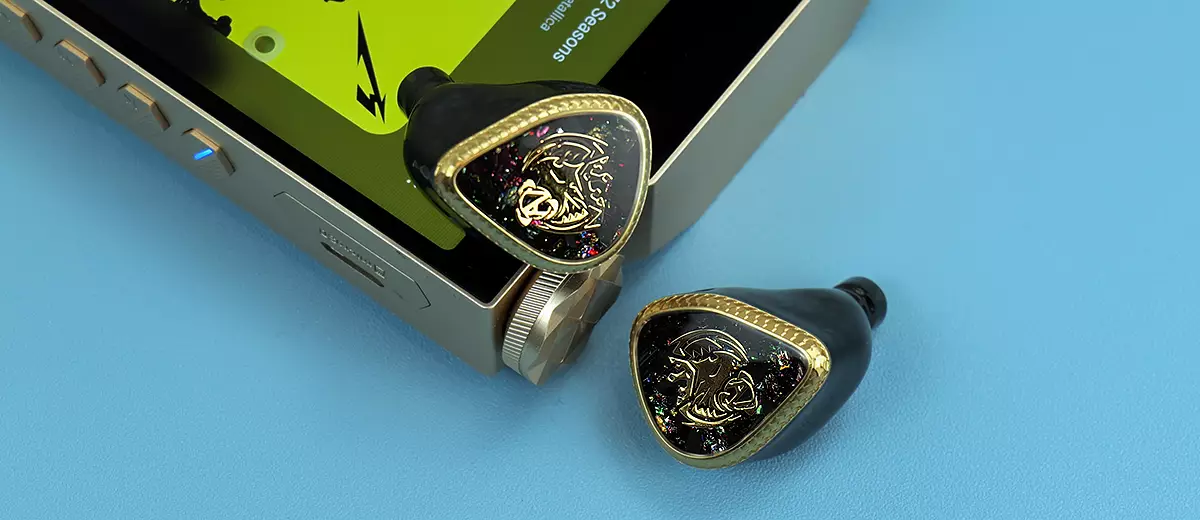
Marcus reviews the Nostalgia Audio Pendragon, the company’s flagship quad-hybrid 14-driver universal in-ear monitor, currently priced at $3799.00.
Disclaimer: This sample was sent to me in exchange for my honest opinion. Headfonics is an independent website with no affiliate links or status. I thank the team at Nostalgia Audio for their support.
Click here to read more about Nostalgia Audio products we have previously reviewed on Headfonics.
This article follows our current scoring guidelines, which you can read here in more detail.
The Nostalgia Audio Pendragon is the company’s most ambitious IEM to date, and with a price tag of $3799, it sits firmly on top of the product line as their latest flagship offering.
I have not included the $32k Royal Camelot in that lineup, as it seems to be a niche, special-built-to-order offering for the fabulously wealthy and is currently listed as sold out.
I knew that previous offerings, such as the Tesseract and Camelot, were either limited runs are sold out, with the Pendragon and Durandal effectively replacing them as Nostalgia Audio’s lead summit-fi products for 2026.
The quad-hybrid 14 driver Pendragon is perhaps their most complex configuration to date. However, it might also be their most accessible tuning thus far, with a powerful, full-bodied performance combined with a relaxed set of highs.
Does it put the older Tesseract and my previously reviewed Durandal in the shade? And how does it compare to recently released competing hybrids such as the PLUSSOUND Allegro II? I found out in my full review below.
Features
The Nostalgia Audio Pendragon is a complex IEM, at least in terms of driver configuration.
Inside, it has 14 drivers of varying types, including dual 9.2mm dynamic drivers for the ultra-lows, two dual-diaphragm bone conduction drivers for the mid-lows, 6 BAs for the mids and highs, and 4 electrostatic drivers for the ultra-highs.
The Pendragon is rated at 19Ω for impedance with an SPL of 115 dB/mW @1kHz, so it’s not a terribly hard monitor to drive, and with the latest EST drivers, it doesn’t need the same levels of gain for volume as the older generation EST drivers.
Some of the acoustic engineering technology has been drawn from Camelot and enhanced, but using drivers that first appeared inside the Durandal.
That includes an updated XBS II Extreme Bass System with upgraded titanium alloy connection materials (previously copper) and micro-nano 3D printing technology for enhanced airflow and an improved low-end transient response.
The same micro-nano 3D printing has also been applied to their in-house Spiral Flow Device (SFD) technology, first seen in the Tesseract and then the Durandal.
SFD II (Spiral Flow Device II) still creates a rigid helical formation, producing a spiral soundwave flow in the tubes to maximize the Pendragons’ midrange resolution and vocal performance. However, the micro-nano 3D printing technology approach means better precision and accuracy.
Design
I have sort of dubbed Nostalgia Audio as the packaging kings of IEMs, such is their attention to every aspect of detail and their deep exploration of the Arthurian legend and associated subject matter.
It is no surprise that the Pendragon is heavily themed with the Arthurian stories and drawn from the “Matter of Britain,” a collection of medieval works. Not just the shells, but the packaging and cable all fit into this one cohesive thought process.
The Pendragon’s design language is more consistent with the Durandal material and aesthetics than the Tesseract’s cyberpunk vibe.
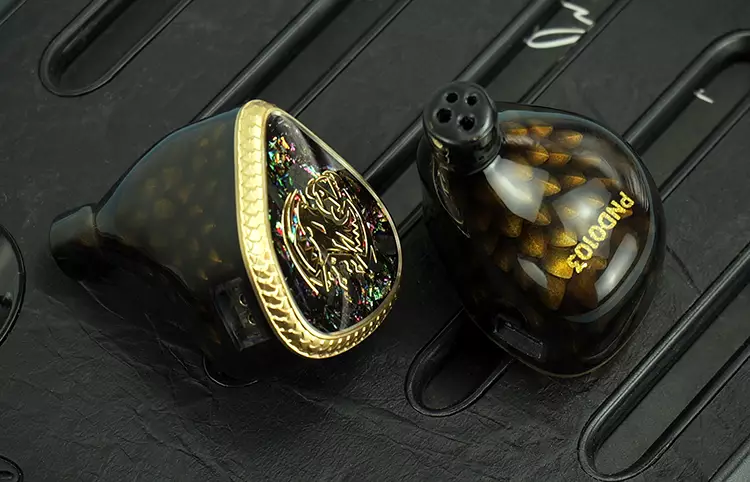
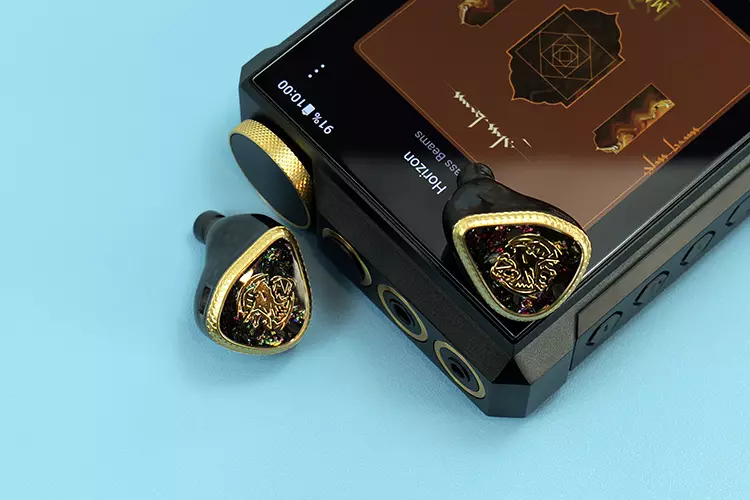
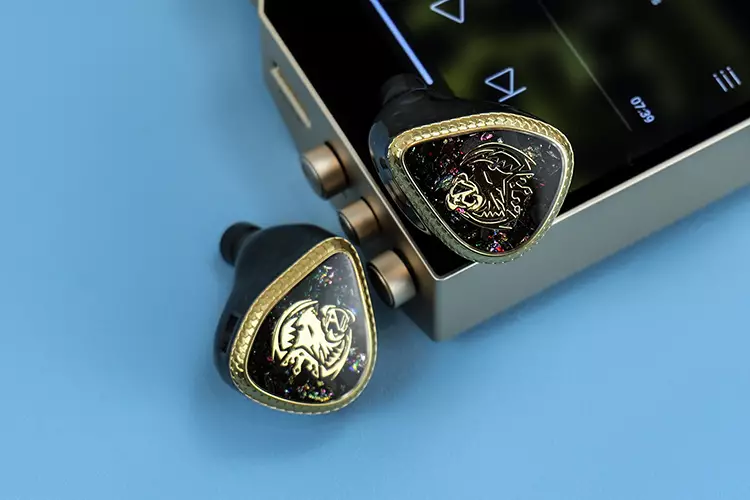
That means a mix of 3D-printed shells and CNC-machined aluminum, creating a gorgeous ‘warm-toned’ dragonscale aesthetic on the underside, topped by a decorative ‘gold-plated’ fender on the top side.
This plating beautifully frames the intricate faceplate, which consists of ‘Multi-Color Fragmented Carbon Fiber Panels’ and a gold dragon logo overlay for the faceplate, creating a very colorful and striking shell design.
The Pendragon shells are certainly more ambitious-looking compared to the Durandal, but this also means they are substantially bigger, which may have implications for fitting with some ears.
Comfort & Isolation
It’s not that I can’t fit the Pendragons in my ears; they absolutely do fit and come with a decent selection of ear tips that allow me to nail it.
Rather, it’s the flex from the dynamic drivers I find a little off-putting. It’s similar to the flex levels from the Durandal, with that trademark pop on insertion or when you move it around to get a sweet spot for isolation.
The comfort levels are fine, but given it’s a big IEM shell with decent nozzle lengths, I found that they hang outside my ear a bit rather than sit flush, and the ideal ear tip size was smaller than my usual pick.
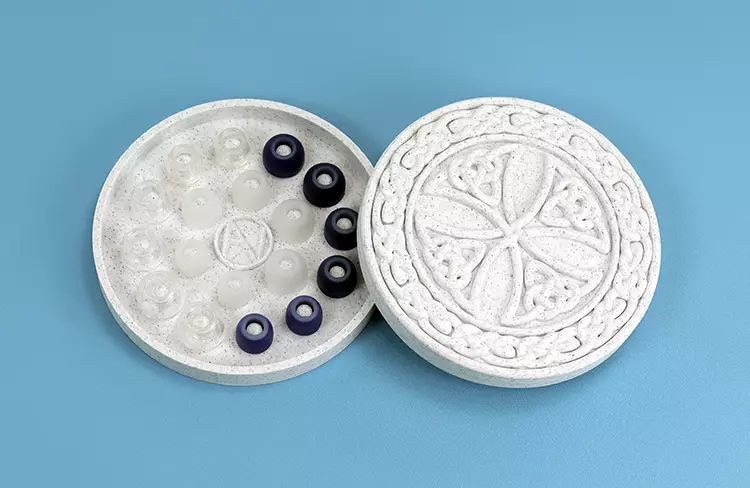
The Pendragon comes with three different types of tips: Symbio W in blue, Nostalgia’s XWB, and LSR (Liquid Silicone Rubber) tips in small, medium, and large. All of them are packed in a very cool Arthurian stone-themed screw lid tip case.
The hybrid Symbio W isolates well and produces a deeper, more powerful bass response, but I found them perhaps a little too dark-sounding and also too firm on my inner ear canals for long-term comfort.
The LSR tips are comfier than the firmer Symbio W tips and offer a balanced presentation, but I preferred the XMB variants for their better treble performance and the comfiest fit.
Stock Cable
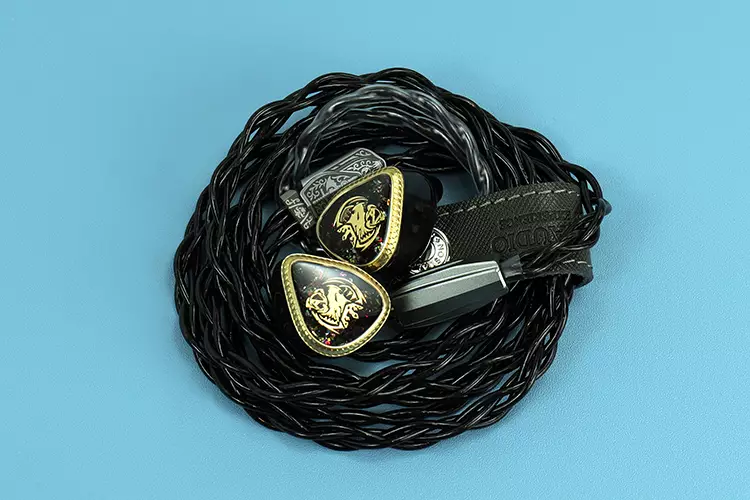
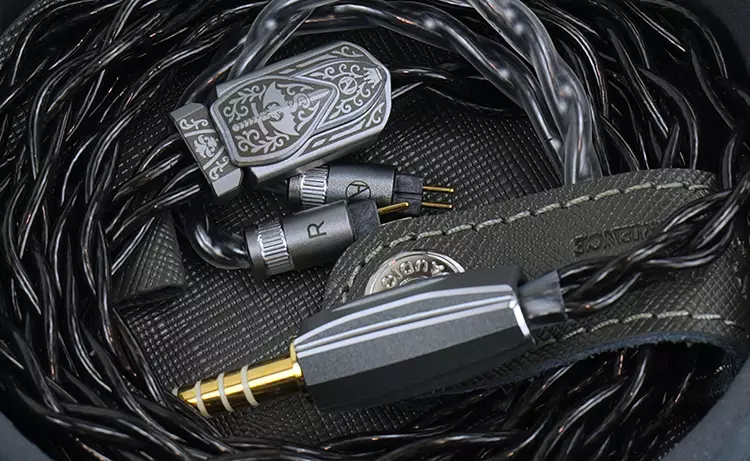
The Pendragon’s stock cable, Caliburn, was designed in-house exclusively for this flagship IEM.
True to Nostalgia Audio form, the aesthetics are tightly intertwined with the Arthurian theme, with an intricate patterned splitter, matching chin cinch, and robust connector barrels.
All of this is finished in a two-tone gunmetal and silver color with a smoky coffee brown colored braided custom SoftFlex PVC jacket protecting the wire.
There is a fairly noticeable block of silicone memory wire coating near the 0.78mm 2-pin connector barrels, though it’s relatively pliant and not too rigid.
I can also see a small sliver of silicone wrap for tension relief at the main jack barrel head, which is a sight I prefer to be internalized in the barrel rather than peaking its head outside.
Inside the jacket, the wire is a coaxial shielding structure with a 21.5AWG 4N OFC copper core in a Litz Type 4S four-wire configuration with a 5N silver-plated OFC copper inner shielding mesh.
It has a dense feel to the handling, though by no means a heavy cable. I have tested much heavier, such as Effect Audio’s 16AWG Code 24 monsters. Memory retention is low, as is microphonics, so it’s well behaved and nicely insulated.
My one nitpick is the choice of 2-pin enclosures at the base of the connector barrels. They are the type typically used for recessed sockets, giving them a fairly lengthy profile when connected in a flush socket.
Packaging & Accessories
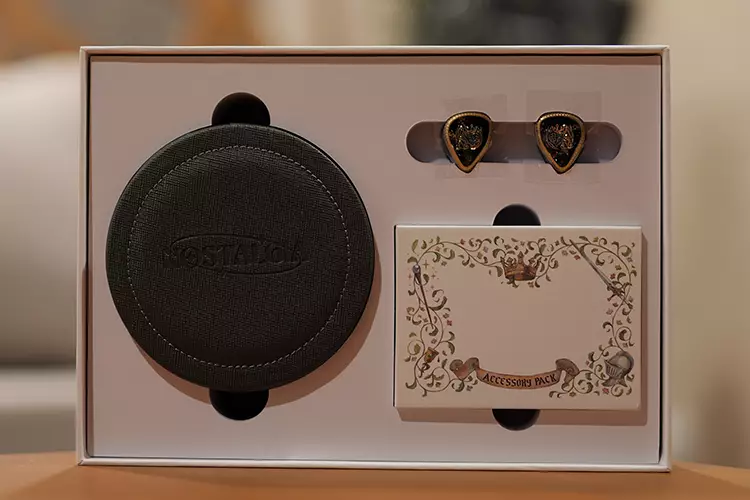
As with all of Nostalgia Audio’s retail packages I have received, the Pendragon layout is meticulous, with just about every aspect of this tidy rectangular box integral to the Arthurian theme.
From the outer cover, complete with tapestry-like dragon, wizard’s staff, helmet, and sword drawings, to the beautiful, large carry case, complete with a trapdoor at the base for the replica carved roundstone ear tips case, nothing is missed.
It’s almost seamless, making me wish more IEM companies would do something like this, given the price points we are at now.
Aside from the headline inclusions, you get a metallic warranty card, protective nylon mesh cloth bags, and branded stickers.
Carry Case
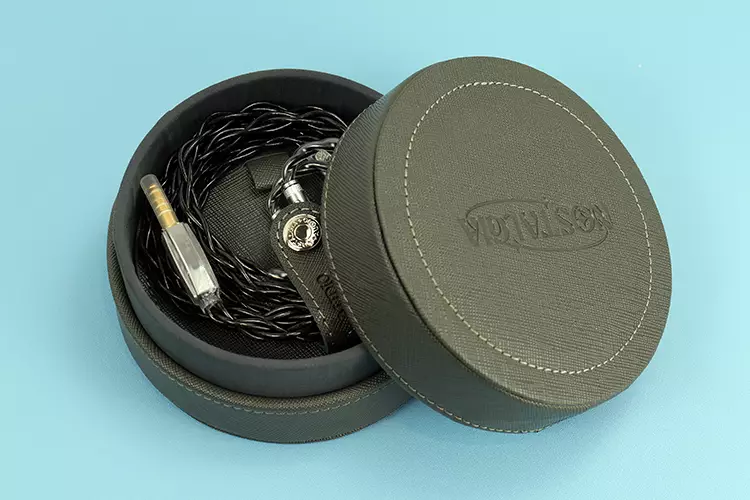
The Pendragon’s green leather puck-style case is beautifully finished, but it’s a bit big to be purely portable.
There is plenty of width, but given the trap door mechanism to house the eartips, the upper-layer is surprisingly shallow, meaning just one cable will fit easily with the IEMs, or with no cable several IEMs.
I would remove the trapdoor layer and the ear tips tray if you want deep storage options with this case.
Sound Impressions
The following sound impressions of the Nostalgia Audio Pendragon were completed using a mix of the iBasso DX320 MAX Ti, the HiBy RS8 II, and the FiiO M27 as my main sources and amplification.
Summary
The Pendragon is a full-bodied, natural-to-warm sound signature, with a relaxed, smooth-sounding set of mids and highs.
It can deliver a fairly hefty bass response with excellent layering, much more so than the previous Nostalgia IEMs I have tested. Bass guitar plucks and rhythm guitar crunches are saturated with an excellent fundamental frequency, giving them plenty of gravitas when required.
Where it can fall short is a slight lack of contrast and presence in the mids, particularly on vocals. It’s not as forward or sparkling as the Tesseract, with the upper-mids often deferring to an elevated set of lower-mids that carry a bit of warmth from the heightened bass shelf.
On the downside, this can create a perception of muddiness in busy recordings that push hard on the lows, but on the flipside, with sparser mixes, vocals sound rich, smooth, and sibilant-free.
Neutral sources and amplifiers, such as the FiiO M27 and the DX320 MAX Ti, will get the best out of this sound signature. They act as a natural balance to the warmth of the Pendragon.
For example, the DX320 MAX Ti’s penchant for a detailed, energetic treble presentation enhances clarity and dynamic range to the Pendragon mids. The M27 also seems to excel with the Pendragon by providing additional openness and space in the same region.
Less suited are more relaxed, warmer sources, such as the HiBy RS8 II, unless you use PEQ. A narrow peaking filter over the 4 kHz range provided the Pendragon some welcome vocal presence and contrast (albeit at the cost of a little bit of body).
Overall, the Pendragon has plenty of detail, a gorgeous fatigue-free coloration, and is ideally suited to those who want extended, easy-listening sessions rather than pinpoint technical performances.
Frequency Response
Everything from 20Hz to 500Hz is north of neutral on the Pendragon. It has a long bass shelf peaking at 20-60Hz, followed by a gradual drop in amplitude towards 500Hz.
That pretty much maximizes those dual dynamic drivers’ performance in terms of fullness and depth, creating excellent texture and layering, and ensuring lower-register instruments sound rich and dense to the ear.
It’s not a massively fast sound, but it’s heavier than the Durandal and far more powerful than the Tesseract’s BA driver lows. It’s the IEM of choice from Nostalgia Audio’s lineup for dance, synthwave, mellow R’n’B, and modern soul recordings.
From 500Hz up to 2k, the Pendragon FR also sounds north of neutral by 1-2 dB, so it carries a bit of that bass warmth and additional presence in the lower-mids.
Great for string instruments with satisfying bass guitar plucks with lingering decay trails that I love to hear with country-influenced 80s hard rock.
Slightly less so for vocal mixes if the bass and lower-mids get too much energy with a modest pinna gain and lower treble that remains south of neutral between 2-8k.
Vocals still have plenty of body, but the modest injection of presence and a laid-back treble tuning keeps the positioning further back and the tonal coloration quite even-harmonic with lower levels of contrast.
There is a modest bump around 8k that helps keep a bit of accuracy in the upper registers, but it could do with a bit more treble fill around 4-5k by about 4 dB.
The good news is that the Pendragon responds really well to PEQ, so if you are a vocal lover, a quick adjustment there brings a welcome added dimension to the Pendragon’s soundstage.
Click on page 2 below for my recommended pairings and selected comparisons.
