

Sound Impressions
Summary
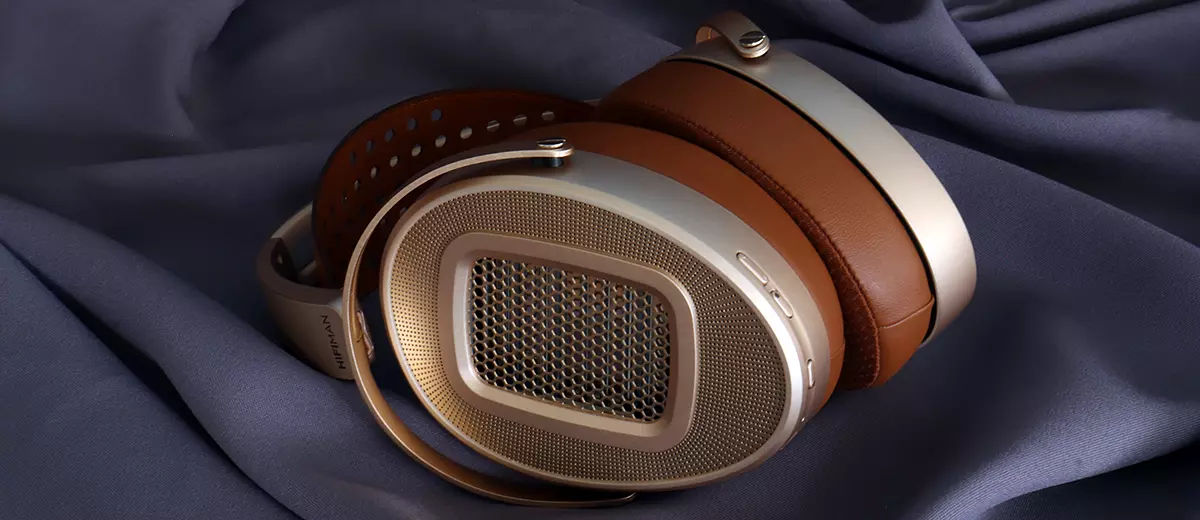
When you use the HIFIMAN HE1000 WiFi on Bluetooth, it sonically shines above the rest of the pack.
But on WiFi, it rivals the USB connection in audio quality, and can even rival some of the best portable accompanying gear with a set of HIFIMAN HE1000 Unveiled.
Most will agree that the tuning implemented by HIFIMAN here is uncommon for their house sound of yesteryear.
It’s not bright or midrange forward, but rather balanced, warm, and soft-mannered, lacking any seriously aggressive areas in the total frequency response.
In general, it’s an airy but focused presentation. There is a full-bodied frequency response with a bass response that, at its lowest point, has presence and solidity. The top end is not bright, but on par with the mids as well, and they are all well balanced.
The midrange is tamed and sits below the common HIFIMAN tuning in intensity. In other words, it’s not a midrange forward headphone, nor is it generally bright-sounding.
The overall sonic character tends to favor balance with a pinch of warmth over anything else.
Detail levels are upscaled for a wireless headphone in that lots of nuances come forth in the HE1000 WiFi over most that can only be countered with a more forceful presentation, giving off a more impressive initial impact, but inducing fatigue in the long run. The HE1000 WiFi takes the opposite approach.
Bass
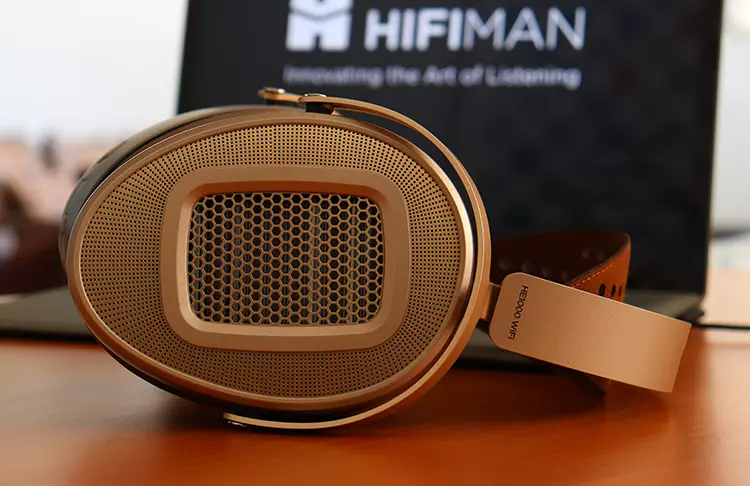
The HIFIMAN HE1000 WiFi has an uncommonly warm-sounding bass from their past tuning that supplied mostly lean, clinical bass tones. Bass has gained some weight and is now in better balance with the rest of the spectrum.
When it comes to bass, I’m very sensitive to that frequency range, and I’m able to detect a 4Hz frequency tone. I feel as if the HE1000 WiFi has some sort of subsonic filter applied, more than likely at the DSP level. It hits the necessary bass notes, but nothing else.
That is beneficial for battery life, but can be overdone by masking sub-bass frequencies if done at the DSP level.
You can still hear plenty of rumble sub 35Hz and down to around 25 Hz. The HE1000 WiFi supplies more of an audible experience with a small sense of impactfulness that prefers note distinction over visceral forcefulness.
I wrote the above based on what I audibly heard, and then verified this by running a tone sweep, which confirmed a dip below 35Hz, a bass effective down to 24Hz, and bass that’s ineffective below 22Hz.
I did notice a creamy texture over one that’s overly clinical or sterile. The bass carries a bass texture that can be summed up as warm, with a medium amount of density and body. The bass can also be described as a bit sultry, with a flowery aspect and a lukewarm charm.
Midrange
Once again, there is a different house sound here because the HE1000 WiFi midrange has a preference for smoothness over a bright and forward presentation. Again, it’s a tuning that avoids fatigue by remaining under a certain threshold in intensity.
Tonality is pretty much spot-on, but those who want intensity might find their demeanor a bit timid over some of the past HIFIMAN tuning that were mid-bright and mid-forward.
The HE1000 WiFi midrange is produced with a central focus, rather than having an expansive presence. Perhaps a consequence of the grill and narrowing of the breathability of the driver, if compared to the HE1000 Unveiled.
The midrange is well-balanced, which only produces a small rise in the 7kHz frequency area on a tone generator, while below that area is produced in a quite linear fashion, with very small variations in any particular frequency.
There is some texture, but I feel that it doesn’t rival their best vocal tuning below the 3k tier, which is found on their Svanar IEMs. It prefers smoothness over presence, lifelike tone, and natural intensity over excess spice and tartness.
Treble
HIFIMAN commonly tunes their headphones with class A amplification and R2R DACs because R2R DACs produce a relaxed upper region, which complements the HIFIMAN bright signature.
But that doesn’t disallow crystallinity and sharp notes to flourish and come through on the HE1000 WiFi. There’s weight and energy behind each high note, which does give the high frequencies a sprightly, hearty character.
The high frequencies here sound open and spacious. But not to the point of losing definition or narrative. The high frequencies are well controlled, especially considering that they’re being fed via a wireless transmission.
There is, again, a veer from the bright sonic overall character of the past in favor of smoothness and a calm demeanor. The highs are in line with that concept.
The HE1000 WiFi highs are well extended and detailed; they’re less harsh compared to older HIFIMAN models, but they’re still produced with enough energetic boldness, and are tuned to avoid high-frequency fatigue and fretful overtones.
Staging & Dynamics
The HIFIMAN HE1000 WiFi produces lots of airiness and height over most things. The overall soundstage is wide, but doesn’t veer too far out, which, in my opinion, would ruin the overall realism of what you’re hearing.
I’m sensing that some of the elements have a small amount of widening in their size and position, or what I call aural smearing or widening.
The shape of the elements becomes enlarged, which makes them lose some of their focus. It’s mostly in the midsection, not in the high-frequency or bass production.
I’m not sure if that is a product of tuning, recording methods, or simply a product of the internal components. But since I can’t upscale to better components, I can’t make comparisons on this matter.
The HE1000 WiFi dynamics are supplied on a medium serving size, following today’s trend of smoothness over aggressive tuning that might induce listening fatigue, giving the listener some breathing space.
Wireless Performance
I already determined that the HE1000 WiFi wireless performance is similar to the wired option sonically via the use of a USB cable. But WiFi has another benefit besides providing enough bandwidth to produce lossless audio, compared to Bluetooth.
I dare anyone to pick up any Bluetooth audio device, either with a headphone or a dongle, and go into another room to break the visual line between you and the source. We all know that once you leave the source visually when using Bluetooth, you get dropped like a lit firecracker.
On the HE1000 WiFi, you can go outside and not experience dropouts. I did just that, and it worked flawlessly. You get total freedom of movement to anywhere the WiFi signal can reach.
To say that the source itself can be in one room, the router in another room, and you can go outside or into any other room with no dropouts is a huge benefit in itself. That’s something I haven’t experienced before, until now.

Selected Comparisons
HIFIMAN Arya WiFi
Technical
These two variants are made from the same cookie cutter. They both employ all the planar magnetic driver modern-day HIFIMAN treatment with the Neo Supernano Diaphragm generation 2, Stealth magnets, along with their new Enhanced Magnet design.
What are the differences in build or anything else? I can tell they use different driver variants. However, both models use a variant of their parent headphone, the Unveiled variant.
The Arya WiFi would be considered by most a downscaled version of the HE1000 WiFi, but they share electronics, button placement, and function, with a similarly sized driver, headband assembly, and the same new generation composite headband assembly.
Design
There are so many similarities when it comes to overall build aspects that if they were to use the same color scheme, you would not be able to distinguish them.
I do prefer the blackout theme of the Arya WiFi over the HE1000 WiFi’s fancier color scheme. It looks too rich for my personal tastes. I’m a black theme user, need I say more?

Performance
What intrigued me the most about A//B comparisons between these two is how close they are to each other, with a few differences sonically that were quite subtle but noticeable.
Somehow, I felt that the Arya WiFi produced a wider soundstage, perhaps larger in general, with no loss in focus and definition either. Heck, I might even have to say that for every day listening, I might prefer the Arya WiFi.
The Arya WiFi is smooth, balanced, and has a natural tonality on top of a full-spectrum sonic profile that rivals the Organic variant of the Arya line, since it has a touch of warmth alongside a high-frequency section that is well defined but never strident.
But then you give them a second listen and discover that the HE10000 WiFi produces a higher level of detail that’s missing on the Arya WiFi. Choruses become better defined, giving the listener a better picture of the chorus participants and better individual spatial separation.
The Arya might be the choice for most in a quick listening test and might even strike a better first impression. All I ask is that you give them both a listen if you have a chance. But I’m certain you’ll agree with me.
What makes these two different sonically is the extra detail retrieval of the HE1000 WiFi, not much else. In frequency response, linearity, and distortion levels, these two are eerily similar.

HIFIMAN HE1000 Unveiled
Technical
Being one of my favorite headphones in my collection, the WiFi variant has a tough battle to fight here. The HE1000 Unveiled is considered by most as the best-sounding HE1000 release.
The asymmetrical driver, the Stealth magnet, the nanometer-thickness diaphragm, and most of HIFIMAN’s planar driver advancements are present, absent the window shade system of the older HE1000 variants.
What do I like about the HE1000 Unveiled? The unveiled sonic experience is that if you use a glass window as a metaphor, the difference from the older veiled models is that when you listen to the Unveiled, there is no window.
The HE1000 Unveiled produces a highly detailed picture of the recording, and doesn’t sound too analytical or clinically sterile, but rather fun-sounding due to its large soundstage, and smooth demeanor with a realistic tonality.
Design
The HE100 Unveiled carries over the old-style spring steel, which holds in place the metal piece slider and the metal piece that holds the headstrap.
It’s a simple design that some HIFIMAN fans consider their best design, as far as durability and comfort. But it’s time to move on, and HIFIMAN stepped up to the plate with a newly designed headband assembly, used on the HE1000 WiFi.
The HE1000 Unveiled does use a timeless black and silver color scheme that is preferred by most over the champagne and Noctua brown color scheme. I also like the black and silver more so.

Performance
The Unveiled concept rears its head here in that it is the more unrestricted model, as far as driver ventilation is concerned.
The HE1000 Unveiled sounds wider and produces more detail in placement, better focus, as well as more microdetail. The problem lies in the fact that you can’t upscale the HE1000 WiFi variant.
It’s the inheritance of the HE1000 variant in that you can’t upscale, killing off any synergy discovery possibilities or the fun process of experimentation with different types of gear.
So you have two clear choices here. It’s between a sonic profile that’s good enough and an opportunity to upscale, experiment, and possibly obtain better sound through better synergy. Chose wisely.
My Verdict
This is it, the pinnacle of wearable wireless audio gear. The HIFIMAN HE1000 WiFi takes the crown in the general wireless headphones segment, although it’s the unique WiFi implementation that gives value to this set, and it falls within a segment where there is no competition yet.
The freedom of roaming anywhere your router can reach and still produce lossless sound that is leaps beyond Bluetooth is worth the price of admission.
HIFIMAN just opened up a new chapter in audio with their WiFi line, and the HE1000 WiFi is the one to beat in the general wireless headphone category.
To be honest, nothing comes close, and we’ll have to wait a while for the technology to flourish enough for there to be any competition.
HIFIMAN HE1000 WiFi Technical Specifications
- Operating modes: WiFi/Bluetooth/USB Audio
- Frequency response: 8Hz to 65kHz ±5db
- Channel separation: 105 dB @1kHz
- Net weight: 452g
- Battery life: WiFi mode 6.5 to 7.5 hours
- Battery life: Bluetooth mode 23 hours
