

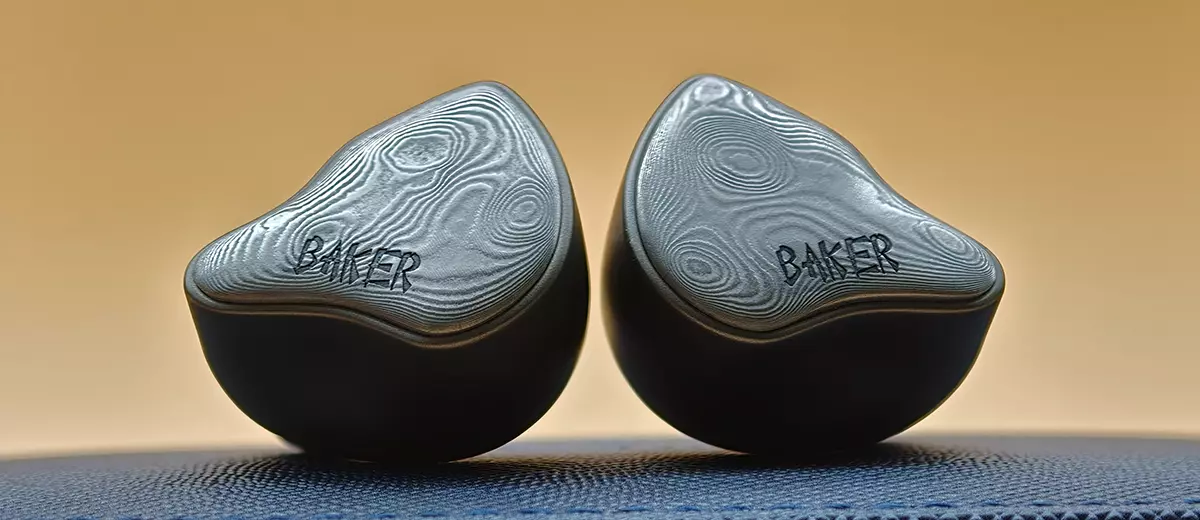
Kurt reviews the Yanyin Baker, a hybrid 8-balanced armature and dual planar driver universal IEM finished in aluminum and Damascus steel. It is currently priced at $499.00.
Disclaimer: This sample was sent to me in exchange for my honest opinion. Headfonics is an independent website with no affiliate links or status. I thank Linsoul Audio for their support.
Click here to read more about the Yanyin audio products previously reviewed on Headfonics.
This article follows our current scoring guidelines, which you can read in more detail here.

Yanyin has firmly established itself in the audio community with standout releases like the Canon and Moonlight series.
They secured this reputation through the Canon’s tunable versatility and the Moonlight’s distinct tribrid implementation.
Now introducing their latest contender, the Yanyin Baker, priced at $499, features a unique hybrid configuration of six balanced armatures and two planar drivers.
With a setup that notably lacks a dynamic driver, can this release deliver the complete flagship experience expected at this level? And how does it compete against mid-tier competitors such as the MOONDROP METEOR and Xenns Mangird Top Pro? I found out in my full review below.

Features
The Yanyin Baker features an 8-driver hybrid configuration managed by a 4-channel 4-way electronic crossover. This combination utilizes six balanced armature drivers with two micro-planar units.
However, specific details regarding the driver manufacturers remain undisclosed. It is currently unknown if these are branded units from Knowles or Sonion, or if they are custom drivers developed in-house.
Yanyin has given the Baker a newly designed metal sound tube to house the components. The main stated benefits of this inclusion are better performance and improved comfort for the user.
They also report a low distortion rate of just 0.3% for the Baker. This suggests that the IEM should maintain a clean output without adding any unwanted grain or noise to any listening experience.
Design
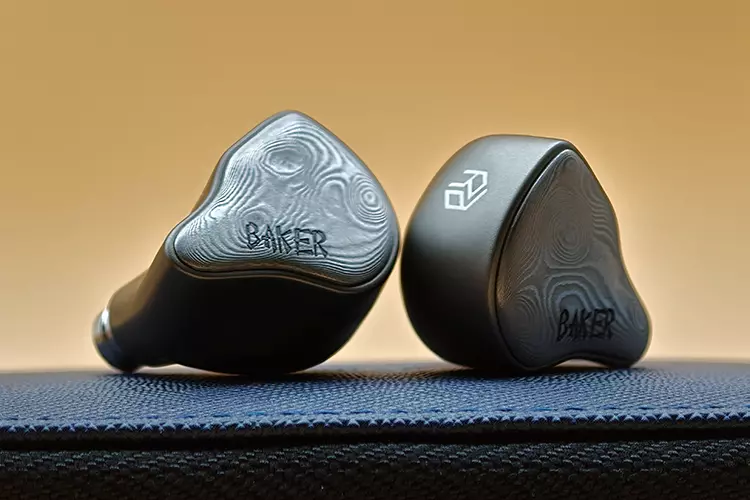
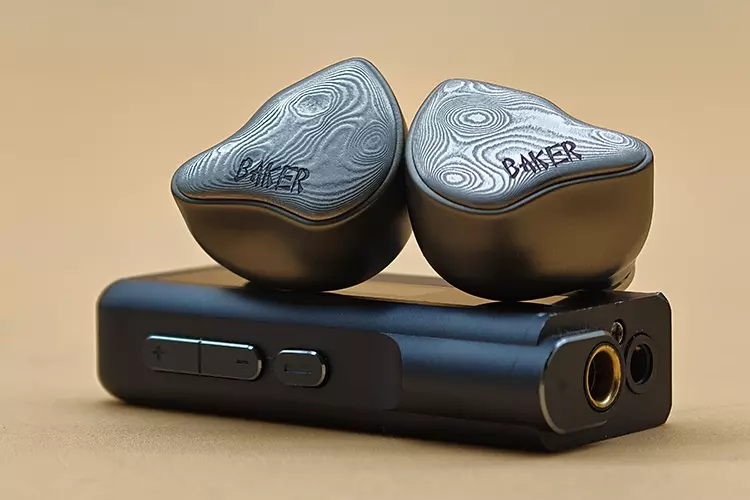
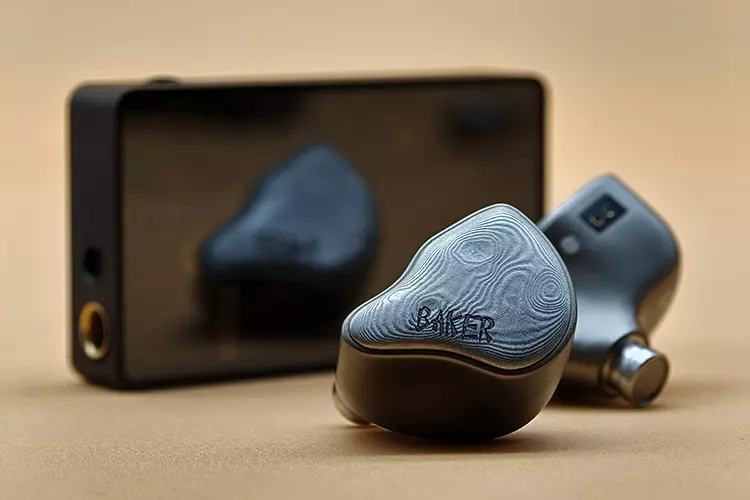
The faceplate of the Yanyin Baker is crafted from Damascus steel, featuring a complex pattern of rippling lines that resemble topographical maps or wood grain.
This textured surface is left completely bare, allowing you to feel the grooves of the steel directly without any acrylic layer in between.
This industrial aesthetic is paired with a smooth gray aluminum alloy shell that gives the entire unit a rugged monochromatic look.
The main body is fully metal, matching the faceplate to create a solid and unified build.
However, the branding choices detract significantly from the otherwise clean design. The model name “Baker” is etched prominently onto the lower portion of the faceplate in a stylized font that disrupts the flow of the Damascus pattern.
Yanyin continues this heavy-handed approach on the inner shell, where the name appears again alongside serial numbers and channel indicators. Their logo is also printed on the rear of the housing, resulting in a cluttered visual presentation.
A short metal nozzle extends from the housing, finished with a fine mesh filter and a prominent lip to secure ear tips.
Standard 0.78mm 2-pin connectors are mounted flush against the shell surface, with a single mesh vent to alleviate any pressure buildup right next to it.

Comfort & Isolation
The Yanyin Baker is surprisingly compact for an eight-driver set, sitting with little to no protrusion from the ear. Its aluminum shell is lightweight and feels cool to the touch upon insertion.
The fit is impressive, slotting deeply into the canal with a molded feeling that mimics a custom IEM. This ergonomic shape remains comfortable for long listening sessions and accommodates smaller ears with ease.
Passive isolation is significantly increased by this secure fit, with a reduction of up to 26 dB, effectively lowering the volume of loud external noise.
The flush profile makes it a good choice for sleeping or traveling, as it avoids painful pressure when lying on your side.
Ear Tips
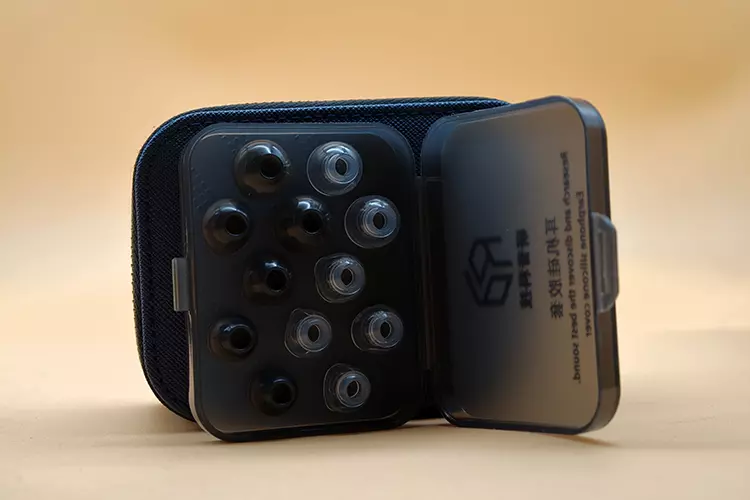
The Yanyin Baker comes with two distinct sets of silicone ear tips, though the specific material composition remains undisclosed.
One set features a clear design with a taller, narrower flange, while the other utilizes a wider black flange that sits shorter on the nozzle.
Both options provide excellent comfort for long-term use without causing any itchiness or pain. The black tips are designed to cover the entrance of the ear canal, whereas the clear variants allow for a deeper insertion depth.
In terms of sound, the wide black tips help the subbass rumble spread more evenly across the stage.
Switching to the clear tips shifts the focus, pushing the midrange more forward for better vocal presence.

Stock Cable
The included cable is a 1.2m 6N Single Crystal Copper Plated Silver wire sheathed in a matte black finish.
This dark aesthetic is accented by gray metal hardware on the splitter, chin slider, and plug housing, perfectly matching the Baker’s industrial theme.
Build quality is excellent, offering a rugged and sturdy texture that avoids the cheap, plasticky feel of common stock cables.
It behaves exceptionally well in daily use, draping straight down without any tendency to twist or tangle.
The cable is modular, allowing for 3.5mm and 4.4mm balanced usage, fitting for any setup. It employs a threaded screw-in mechanism that ensures a rock-solid connection, eliminating the risk of disconnecting, which is often found in simple friction-fit alternatives.
Despite its durable construction, the cable remains remarkably lightweight and does not drag down on the ear. On initial unboxing, the 0.78mm 2-pin connectors are encased in black plastic barrels that act as their protection from scratches and debris.
Packaging & Accessories
The Yanyin Baker arrives in a dark metallic outer sleeve featuring a Damascus steel pattern that directly mimics the faceplate design.
Flipping the box reveals a detailed specification list on the back, covering everything from the specific driver configuration to the cable parameters.
Removing the outer sleeve proved to be a difficult task, as the tight fit requires significant force that risks tearing the packaging.
Once opened, the plain black inner box utilizes a book-style flip lid that, unfortunately, suffers from a weak and easily torn hinge.
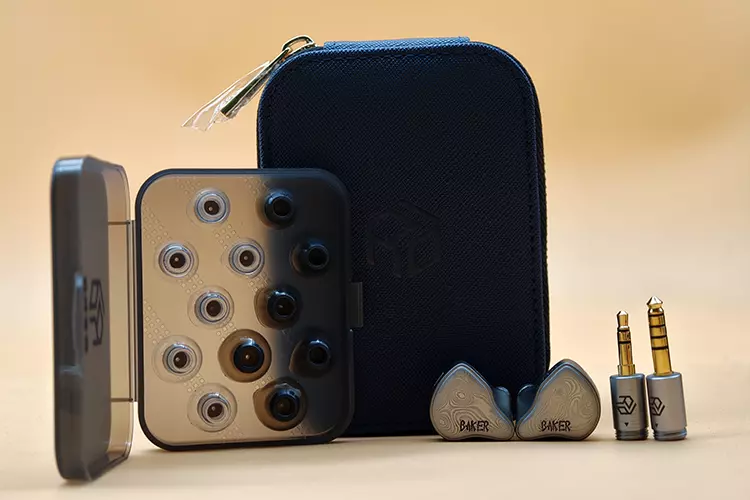
The interior is divided into two sections, with the right side presenting the earpieces and modular plugs seated in a foam cutout.
This placement is an odd choice, as the 3.5mm and 4.4mm connectors are typically packaged with the cable rather than being displayed upfront.
On the left, a separate box featuring a “221B Baker Street” door illustration houses the textured blue carrying case.
Lifting the foam layer reveals the final accessories, including the ear tips container, a VIP card, and the standard paperwork.
Inside the blue carrying case, the stock cable is stored with black plastic covers protecting the 0.78mm connectors. The accessories included are complete, but it notably omits inclusions like a cleaning brush or mesh replacement tool.
Sound Impressions
The following sound impressions of the Yanyin Baker were completed using a mix of the Heartfield R1 and Colorfly CDA-M2 dongle DACs in a balanced output format.
Bass
The Yanyin Baker delivers an impressive low-end performance that defies the expectations of a set lacking dynamic drivers. It pumps out a bass response that is remarkably textured, speedy, and highly detailed.
The subbass serves as the foundation of this excellence, offering a presentation that is accurate and tightly controlled. Its speed is practically unmatched, showcasing a level of refinement that keeps the low end incredibly fast.
While the mid-bass remains detailed, it notably lacks the physical thump required for a truly energetic experience. It is certainly not a basshead-level tuning, as it prioritizes precision over the boominess needed for heavy impact.
This lack of weight impacts percussion, leaving drums sounding somewhat restrained and deprived of their natural authority. They still sound clean and distinct, but the strong impact simply isn’t there to drive the rhythm forward.
Bass guitars fare reasonably well but suffer from a timbre that feels slightly artificial to the ear. The individual plucks tend to blend into one another, preventing the instrument from sounding completely realistic or separated.
Mids
The midrange is arguably the best part of the Yanyin Baker, offering a performance that feels natural and right. It maintains a realistic timbre that completely avoids the plastic or metallic sound often heard with balanced armature drivers.
Vocals are positioned forward with a distinct bite, making them sound energetic without ever becoming shouty. This tuning keeps vocals as the main focus of the mix without causing any ear fatigue.
Male vocals are rendered with a full body, carrying the right amount of weight to sound convincing. Female vocals are equally impressive, possessing an open tone that is never held back.
Clarity is excellent throughout this region, with no muddiness or bleed from the bass to hide the details. Separation is precise, allowing every small part of the performance to be heard clearly.
Instruments are handled with the correct timbre, avoiding the slight artificial feel found in the bass guitars. They sound lifelike and organic, ensuring they remain free of any odd coloration.
Treble
The treble delivers an impressive sense of air that keeps the stage feeling open and unrestricted. This extension prevents any congestion, ensuring that the upper frequencies breathe freely without feeling suffocated.
This openness aids the excellent detail retrieval, allowing every nuance and subtle sound to be revealed with precision. The micro-planar drivers work efficiently to uncover small details that might be lost on less capable sets.
However, this energy brings some harshness, particularly with cymbals sounding too pronounced and energetic in the mix. This added bite can become fatiguing over time, especially when listening to genres heavily reliant on percussion.
Sibilance is also an odd case, as it is unclear if the sharpness comes from the IEM or a bad recording. Regardless of the source, this results in a fatiguing experience that gets worse with prolonged listening.
Staging & Dynamics
The soundstage stands out as a major strength of the Baker, offering a spacious presentation that extends well in width, height, and depth. This immersive feeling creates an open environment where sounds have plenty of room to breathe and move freely.
Pairing this expansive stage with precise imaging results in a highly convincing spatial experience. Instruments and vocal cues are consistently placed with accuracy, ensuring that every element occupies its correct spot in the mix.
Separation is equally impressive, as the presentation never becomes congested even during the most chaotic passages. In fact, the Baker shines on heavier tracks by showcasing its ability to keep complex layers distinct and organized.
The dynamic range is handled with proper distinction, effectively capturing the contrast between subtle details and louder impacts. Transitions between these volume shifts feel smooth and natural rather than hitting you with abrupt force.
While there is some capability to scale with power, pushing the volume high is generally not recommended. Doing so tends to amplify the treble harshness, eventually crossing into sibilance that ruins the experience.
Click on page 2 below for my recommended pairings and selected comparisons.
