

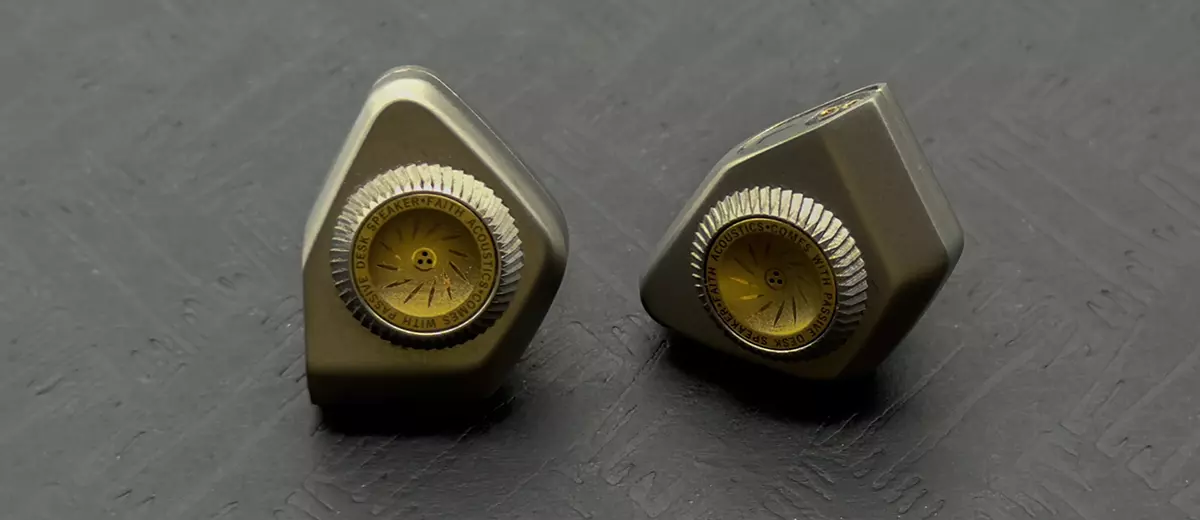
Select Comparisons
iBasso Audio EPITOME
Technical
The recently released flagship from iBasso Audio, the EPITOME, has a 20-driver-per-side configuration. The layout is split between 12 balanced armatures, with a mix of 10 Sonion and 2 Knowles drivers and 8 Sonion electrostatic drivers per side.
The balanced armatures handle the lows, mids, and high frequencies up to 12 kHz. The eight electrostatic drivers cover the 10 kHz to 20 kHz region. A 5-way crossover network ties these splits together.
The EPITOME has an impedance of 17 Ω at 1 kHz and a sensitivity rating of 113 dB/Vrms. It is super easy to drive and never feels hungry for power. It does not scale up the way the E1000 does.
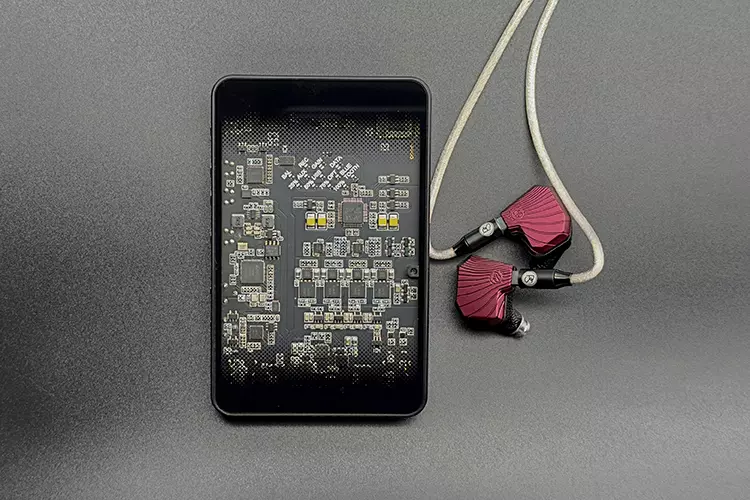
On my Lotoo PAW Gold Touch, it needs at least 5 volume clicks less than the E1000. It may also have noise issues with extra powerful sources, so those are not ideal for the EPITOME. It really just asks for a clean and decent source.
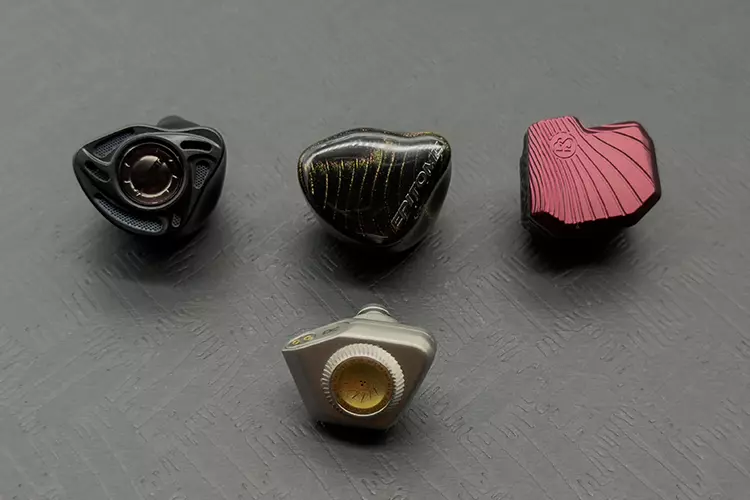
Design
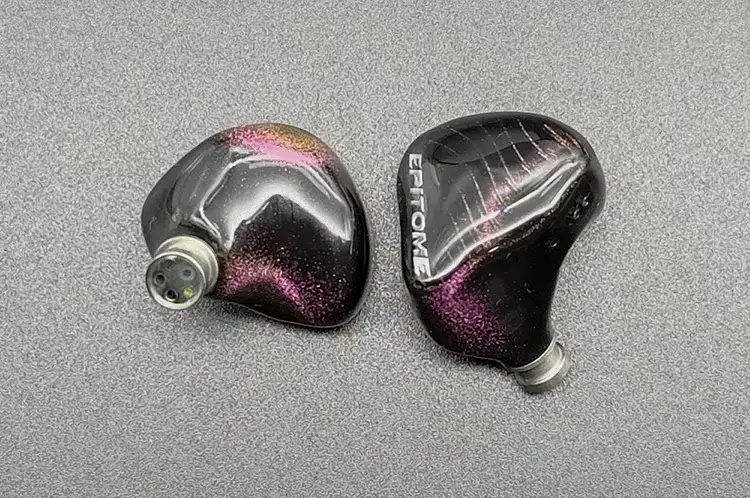
The EPITOME has larger shells, but they are still lightweight and ergonomic, so the fit is generally quite comfortable. The resin housing has black and deep burgundy undertones, and it throws a soft rainbow-like shimmer when it catches the light.
It looks and feels premium in hand. That said, for someone with smaller ears, the E1000’s tiny shells are likely going to be the easier fit.
EPITOME also has a nicer, more complete packaging experience. It comes in a leather box, includes an extra carry case, and throws in more accessories and tip sets.
The E1000 keeps things more boutique and minimal, so the accessory count feels a bit limited in comparison.
iBasso includes a cable similar in style to the E1000’s with the EPITOME, but it has noticeable microphonics, which makes it less enjoyable to use at times, even though the synergy is fine.
The second cable with the EPITOME is the real highlight. It has modular termination with both 3.5mm and 4.4mm adapters, plus a USB-C option, which gives it a clear edge when connecting with different sources.
Performance
EPITOME keeps the bass line clean and almost ruler-straight, with a leaner sense of punch and a more reserved physical shove. It is the kind of bass that behaves, stays fast, and never tries to warm up the rest of the tuning.
E1000 carries more texture and a more convincing sense of weight, and the bass notes feel more shaped. It also has better dynamic swing, so when a track asks for impact, it responds with more life.
Both sets miss that extra lower-mid density that adds thickness to male vocals, strings, and guitars, so neither sounds rich in a syrupy way. But E1000 still feels a touch fuller and richer. There is a stronger emotional pull.
EPITOME keeps the midrange clean, polite, and technically tidy. It is balanced and well-mannered, yet it can feel slightly more “observational” compared to the E1000, which sounds more present and more involving.
EPITOME’s top end has more shimmer and definition up top. It has a refined brilliance. The E1000 approaches treble with more energy in the lower treble area.
The notes feel taller and more separated, with a stronger sense of “presence” in the attack. EPITOME gives you a smoother sheen, and the E1000 gives you a more vivid outline.
EPITOME throws a stage that feels very wide, with notes floating around effortlessly and a strong sense of openness. It is spacious in the left-right spread, and it keeps the image clean even when things get dense.
E1000 trades some of that width for height and a more natural, holographic shape. The stage feels more three-dimensional and immersive, with more height.
E1000 wins me over with tonality and coherence. It clicks faster, feels more emotionally direct, and the dynamics give it that extra realism that makes you want to keep listening.
PLUSSOUND SONORA SE
Technical
PLUSSOUND recently refreshed one of their earlier releases, the SONORA, as the SONORA SE.
It packs a modest count of eight drivers per side in a clean tri-hybrid layout. You get two 10mm dynamic drivers for the low end, four balanced armatures covering the mid-lows through the mid-highs, and two electrostatic drivers handling the top end.
Tying everything together is a new 6-way crossover network and some internal enhancements. The SONORA SE has an impedance of 10 Ω at 1 kHz and a sensitivity rating of 110 dB/Vrms.
It has a similar drivability to the E1000 and shows some scaling properties. Like the E1000, on my Lotoo PAW Gold Touch, it takes more than 35 volume steps to reach a comfortable listening level.
Design
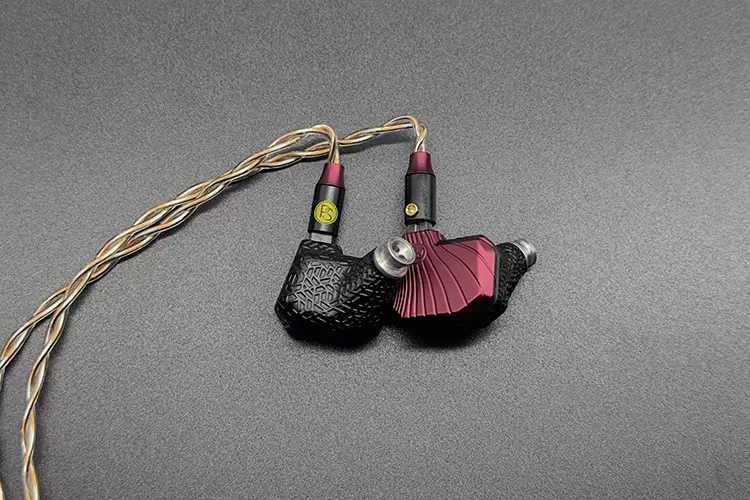
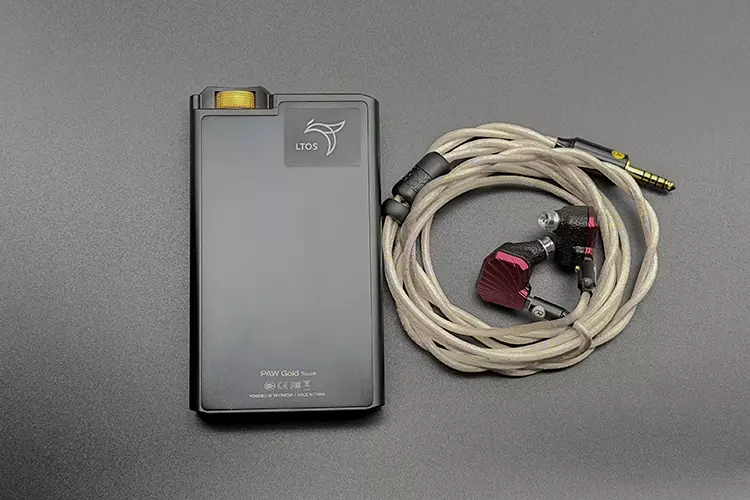
SONORA SE has some similarities with the E1000 in how the shells are outlined. There are sharp little facets, tiny steps, and clean edges all over the shell. It is finished in black and has a grainy, geometric pattern that gives it a nice grip.
It still has much bigger shells, and from images, it can look heavy and awkward in your ears, but that is not the case in real life. SONORA SE is comfortable to wear and does not bother you with its size and fit, even in long sessions.
E1000 is tiny, so people with small ears may favor its size. But tiny shells can come with a fit challenge, so do not forget to try as many ear tips as you can before you give up.
PLUSSOUND packs a solid array of accessories in a very compact manner, keeping the whole package small. E1000 takes a similar approach and gives a nice experience with the wooden box. The only setback is the lower number of accessories.
PLUSSOUND’s cable also feels better built than the E1000’s stock cable, though I do not find performance being affected in any way.
Performance
SONORA SE reaches deeper with more sub-bass presence and keeps the mid-bass very controlled. This bass line feels planted without getting thick or boomy.
E1000 takes a slightly different approach with a mid-bass tilt and does not have the same level of depth, but it makes up for it with texture and realism. The bass on the E1000 feels more tactile and detailed.
Midrange is “tone and emotion” versus “clean and technical.” E1000 is the one that locks in timbre and makes vocals feel natural with a stronger emotional pull.
It pushes detail easily, but without ‘shouting it’. It feels effortless. It is not as warm or rich, but it still holds onto a good sense of naturalness. It also comes off as the more detailed of the two in a purely technical sense.
SONORA SE uses its EST setup to give the top end more air and that floating sense of openness, with a cleaner lift that helps cymbals and overtones hang in space. The E1000 is not the airiest up top, but it brings more energy and presence, a bit more in the lower treble.
SONORA SE feels more shimmery and spacious. E1000 feels taller and more physical in how treble notes stand in the mix.
Technically, the stage width feels fairly close between the two, but E1000 throws a more convincing sense of height and depth, which is a big part of why it feels more holographic.
Layering is also slightly better on the E1000, and the coherence is the main trick it keeps pulling. Everything feels tied together as one continuous picture.
SONORA SE feels like the more technical tool. It separates faster and keeps things cleaner when tracks get dense.
Softears Enigma
Technical
The Softears Enigma is a tribrid multi-driver IEM that includes dual dynamic drivers, six custom balanced armature drivers, and four Sonion electrostatic drivers.
For the low end, the Enigma uses a combination of an active 10 mm wool-based biological diaphragm dynamic driver along with two additional BA drivers, delivering a blend of power and speed.
There is also a second beryllium-coated diaphragm dynamic driver deployed in a passive role to absorb unwanted vibrations and standing waves.
The midrange is handled by four full-range custom balanced armature drivers, while the high frequencies are covered by four third-generation Sonion electrostatic drivers.
The Enigma is rated at an efficient 10 ohms, with a sensitivity of 121.5 dB/Vrms at 1 kHz. I do not find it power-hungry, but it does favor sources that bring extra juice.
On powerful sources, you can expect both the E1000 and Enigma to stay very stable and for the sound to open up. On my LPGT, the volume knob sits at a similar level for both IEMs.
Design
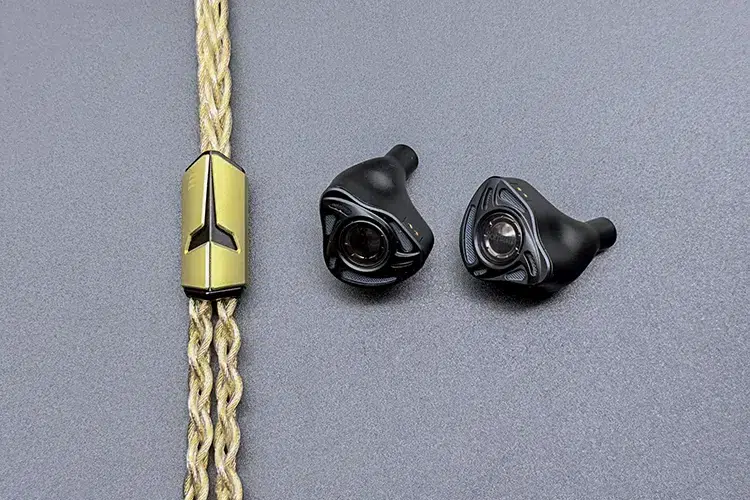
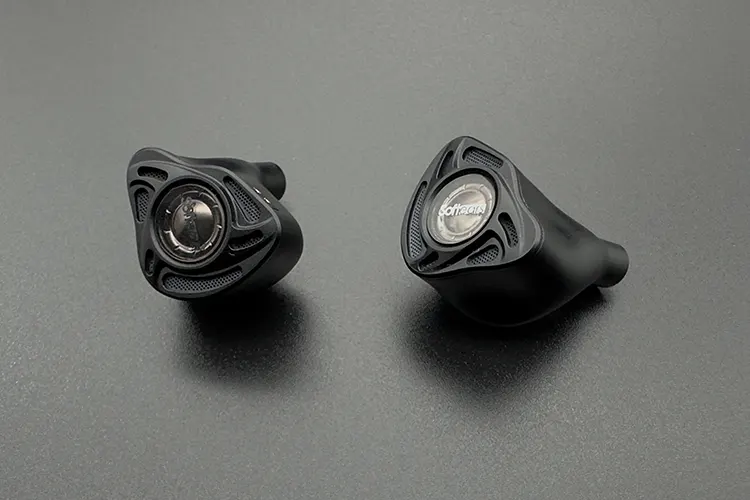
Enigma sports a very intricate and futuristic look, with cutouts on the faceplate that resemble a rotating disc and an artificial sapphire-like crystal at the center.
In terms of design, I find Enigma to be a lot better than many flagships even today. E1000 follows a different design language by keeping it minimal and slightly mechanical in its look.
Enigma’s shells are not too large and are lightweight. The ergonomics make them quite comfortable overall. Enigma’s narrower, longer nozzle allows for deeper insertion, resulting in a more secure and stable fit.
E1000 does have very small shells and almost disappears in the ears, but it comes with fit challenges.
Enigma also packages the IEMs and accessories in a very grand presentation. It comes bundled with two cables.
One is an Effect Audio premium cable that complements its aesthetics well, with a lot of extras included in the package. Faith Audio Labs keeps it a bit more toned down, giving off a boutique vibe.
Performance
In the low end, Enigma is the one that comes in thicker and warmer. It has more volume and a stronger sub-bass foundation. It feels weightier, moves more air, and hits with real authority.
E1000 stays leaner in comparison. The texture and fine detail are more convincing, and bass lines feel more “readable.” Enigma’s bass can sometimes smooth over a bit of those tiny nuances.
Midrange is where Enigma leans into that musical, lush style. It carries more weight in the lower mids, which gives vocals and strings more body and warmth.
It is not as clean and carved out as the E1000, but the detail is still there in plenty. Enigma’s vocals also sound a touch more highlighted and expressive.
E1000, on the other hand, feels like the cleaner and leaner take on the same idea. Enigma gives you more density and richness. E1000 gives you more cleanliness and control.
Enigma’s treble is very smooth and easy to listen to. It does not have as much lower-treble crunch, which can make it a bit subdued overall. The flip side is that Enigma has a nicer sense of air up top, with a lighter shimmer that helps the stage feel open without pushing sharpness.
E1000 adds that extra layer of energy and liveliness in the lower treble. It is not necessarily “airier” than Enigma, but it feels more present and more engaging.
Enigma throws a stage that feels similar in shape, with good height and depth, but it does not try to win in width. Compared to the E1000, it trades a bit of clarity for dynamics and fullness.
E1000 is a bit better at layering, and it keeps things more arranged on the stage. E1000 is the cleaner, more organized one, with a better sense of space.

My Verdict
Launching your first product straight into the $4000 bracket is a bold move. There is no long legacy here, no decade of past hits that the community can point to and say, “yeah, these guys know what they are doing.”
So, when a new name shows up at this level, it either feels like pure confidence or pure risk. In the case of Faith Audio Labs, it feels like confidence backed by real execution.
The E1000 does not come across like a “first attempt.” It feels like a statement. It is also a reminder that one well-engineered dynamic driver, if tuned and implemented properly, is still enough to play in the big leagues.
The bass is one of the strongest parts of the whole tuning. It is not just about quantity. It is about texture, control, and how clearly it renders layers. It easily rivals some of the best bass presentations I have heard in this bracket.
The midrange is clean, highly resolved, and emotionally convincing. It is not just a technical listen. It pulls you in. There is plenty of air and openness up top, and it gives the sound a lively, spacious feel.
When Faith talks about bringing a “near field speaker” flavor into an IEM, it does not feel like marketing fluff.
The E1000 has a grand, immersive presentation with a real sense of scale. The layering and separation are excellent, and the imaging locks in confidently. Make sure you pair the E1000 with a capable source and give it some real power to stretch out and show what it can do.
Overall, the E1000 is not just a strong debut; it is a serious flagship that earns its place. If you are hunting in the premium space, the E1000 should be on your list.
Faith Audio Labs E1000 Specifications
- Driver Configuration: 10.2mm Full-Range Dynamic Driver with Passive Radiator
- Magnet: Dual Neodymium (9000 Gauss Flux)
- Diaphragm: 80+ Layer Dual-Sided Titanium Sputtered
- Impedance: 45 Ω
- Sensitivity: 115 dB
- Frequency Response: 20 Hz–20 kHz
- Cable: 1.5m, 4-Core High-Purity OFC, 4.4 mm Balanced
- Housing: CNC Aerospace-Grade Titanium Alloy
