

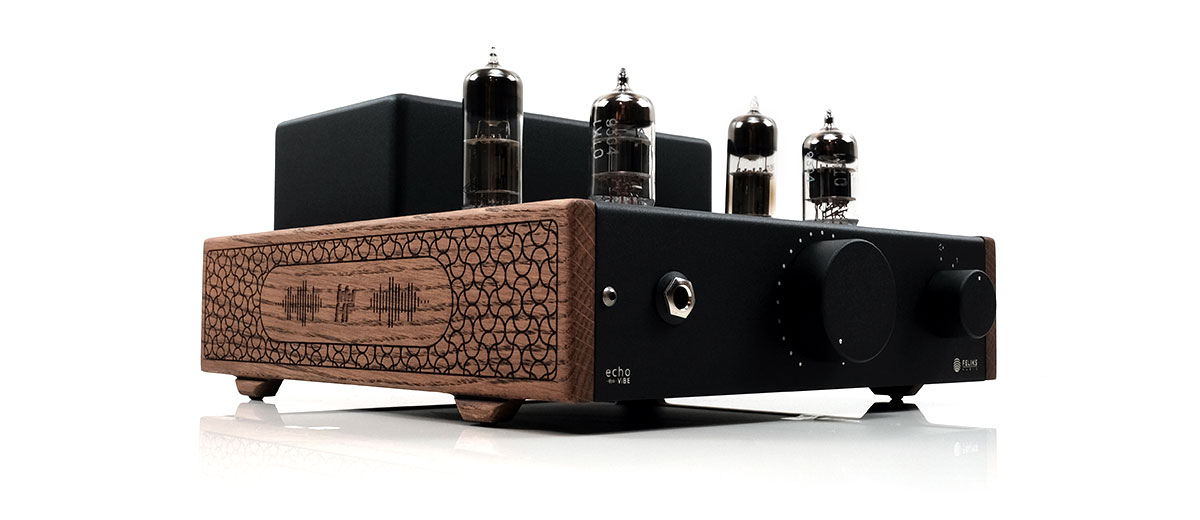
Marcus reviews the Feliks Audio Echo Vibe, a compact headphone amplifier designed to provide an affordable gateway into OTL tube amplification. It is currently priced at €999.00.
Disclaimer: This was sent to me as a sample in exchange for my honest opinion. Headfonics is an independent website with no affiliate links or services. I would like to thank Feliks Audio for their support.
Click here to read more about the Feliks Audio products previously reviewed on Headfonics.
This post follows our scoring guidelines, which you can read in more detail here.
Up until this point, my experience with Feliks Audio tube amplifiers has been their high-end offerings, including the flagship Envy and their premium EUFORIA evo OTL amplifier.
However, Feliks Audio really came to prominence on Headfonics 10 years ago with its more affordable offerings, namely the Elise, Espressivo-E, and the entry-level sub-$500 Echo, introduced back in 2018.
Since then, Feliks has updated the Echo to the Echo II, which is now known as the Echo Classic. The €999 Echo Vibe is an offshoot of the Classic with some improvements on the original formula, and sits just above the Classic in terms of pricing.
The TLDR? If you want to dip your toes into affordable OTL tube amplification, the Echo Vibe is a solid choice.
Its diminutive size, combined with a wide connectivity range and a natural, spacious tube sound, will do wonders with your high-impedance dynamic driver headphones.
However, the Echo Vibe has some tough competition from the likes of the well-engineered Cayin HA-2A, so if you want to understand how this tube amp performs in more detail and against the likes of the HA-2A, then read on.

Features
The Feliks Audio Echo Vibe is a single-ended desktop OTL (Output Transformerless) tube amplifier designed specifically for headphones, though it does have a line output on its rear panel.
It is capable of delivering up to 350mW of single-ended output power with a 20 dB gain level, so perhaps not an eye-catching level of grunt.
In fact, headphones with a high current demand might struggle here, and Feliks has recommended that headphones of 80Ω and upwards, such as the ZMF Headphones BOKEH Open, will perform best with the Echo Vibe.
I believe that is a consistent power rating for various loads with a voltage bias that caters to headphones with impedance levels that range from 80-600Ω. Combined with the 20 dB amplification, there should be no issues with volume levels using correctly matched headphones.
Tubes
The Echo Vibe is equipped with two NOS (New Old Stock) 6N6P Russian double triode power tubes used for low-frequency amplification and two NOS 6N1P miniature 9-pin medium-gain double triode driver tubes.
The stock tubes are unbranded as far as I can tell, but variants under brands such as Sovtek and Svetlana are fairly ubiquitous and affordable tubes to acquire.
You can also opt for E88CC, 6N3P, 6DJ8, and 6922 for the driver tube choices and 6N6Pi for the power tube to further broaden your tube rolling choices.
Design
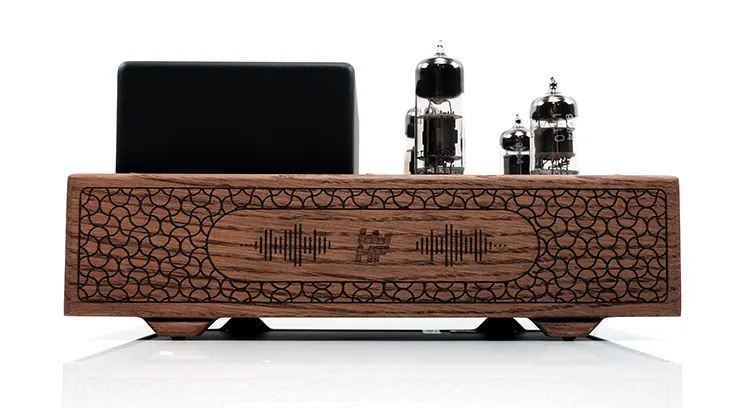
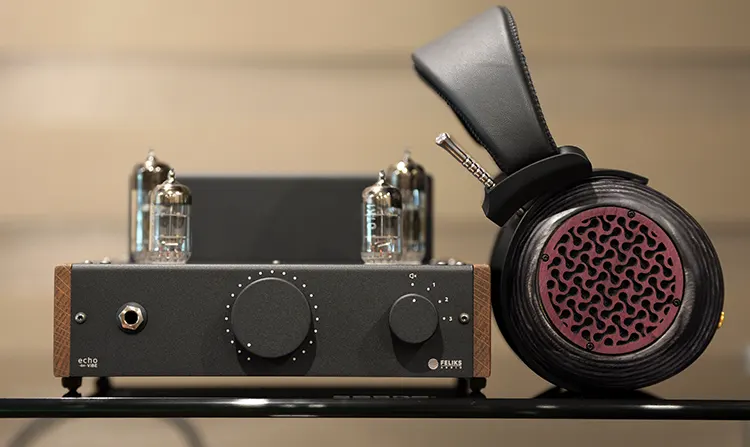
The Echo Vibe design language is simple yet stylish, with a folded anodized black aluminum chassis with gorgeous solid oak panels, complete with intricate etching that includes our Headfonics logo in the center. Perfection! :)
There are no fancy guards or cages (save for the venting grills on the top and base), no VU meters, or LED lights. The only indication you will know the amplifier is powered up is the glow from the tubes and the audio signal output some seconds later.
To complete the visual, the Oak finish is extended to four solid wedged feet at the base, gripping my polished wood table quite nicely, and ensuring there is no unintended slippage when in use.
I must say that the Echo Vibe form factor is pleasingly light and compact. I am used to heavy tube amps, more so with the toroidal PSUs at the rear creating a strong rear-end weight bias.
That does not seem to be the case here, with a balanced weight distribution despite having a toroidal transformer housed at the rear.
During use, the latent heat from the Echo Vibe’s chassis is not too bad, and certainly not as hot as the EUFORIA evo. However, one slight critique is the noticeable heat transfer to the dials on the front panel over prolonged periods
I/O
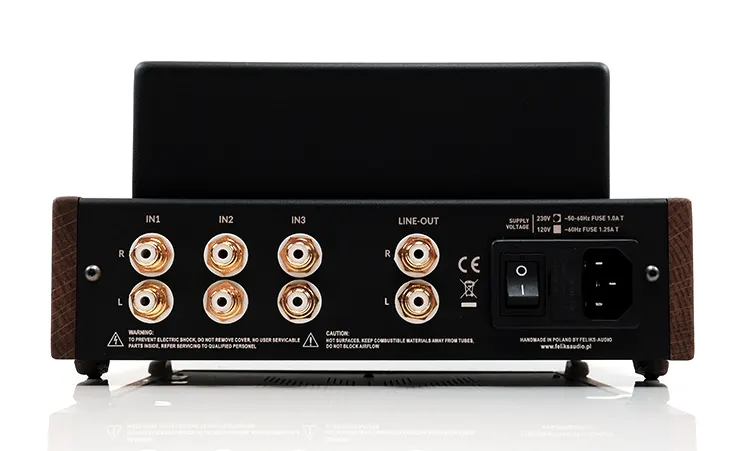
The back of the Echo Vibe impressed me a lot more than the front. I did not expect such a compact amplifier to have no less than 3 SE inputs, allowing me to pair the amplifier with three different sources should I require it.
That is a reviewer’s dream, to be honest. The ability to line out from a DAP, attach a DAC, or a streamer with analog output means the Echo Vibe is a very versatile tool.
Not only that, it has an SE line-out for pre-amp capability, meaning you can slot this little guy right into the heart of a much bigger hi-fi system.
Like the EUFORIA evo, the power switch is on the back panel, which might not suit those looking to position the Echo Vibe into a tight desktop space or close to the wall. I would love it if it were on the side, but that would ruin the lovely oak panel designs, so the back it is.
On the front panel, the Echo Vibe is equipped with an RK27 Alps potentiometer for volume control and a multi-selector dial for managing input source selection. It also has a mute option for the audio signal, depending on your preferences.
The PO on the Echo Vibe front panel is simple, just one 6.35mm single-ended output. There is no official impedance rating for the socket, but I would assume around 20Ω based on my experience with the EUFORIA evo.

Packaging & Accessories
As with most mid-sized or compact tube amplifier offerings from Feliks Audio, the Echo Vibe is securely packed in a brown box with ample protective black foam, and the tubes are housed in a separate foam tray.
Also, since the tubes are unbranded, they are numbered 1-4 on their boxes with matching indicators for which tube goes into which gold-plated ceramic tube socket, highlighted in the small manual. Pay careful attention to that; you do not want to mix them up.
Aside from the tubes and amp, you also receive a satin cleaning cloth, the user manual, and a power cord tailored to your specific regional requirements.
The Echo Vibe does not use a switchable power supply, so always check the rated power for the amp at the back panel before powering it up. It should be either ticked 230V or 120V.
Sound Impressions
The following sound impressions of the Feliks Audio Echo Vibe were completed using a mix of the Gustard X18 DAC, Cayin’s N7 pre-out, and the iBasso DX320 MAX Ti‘s single-ended line-out.
Headphone pairings included the ZMF Headphones BOKEH Open, BOKEH Closed, and the Sennheiser HD 660S2.
Summary
The Echo Vibe is a smooth-sounding and weighty OTL tube amplifier that, like its bigger brother, the EUFORIA evo, leans a little to the darker side of neutral with a very black background and excellent microphonics control.
It has particular strengths in driving medium-to-high impedance dynamic driver headphones, where excellent sub-bass depth, a slightly elongated decay trail, and rich, liquid-like vocal performances are noted consistencies.
Particularly so with the ZMF Headphones BOKEH Open and Closed variants, whose excellent soundstage qualities are gobbled up by the Echo Vibe.
Ranged against excellent solid-state headphone amplifiers, such as the Topping DX9, the Echo Vibe is a little more relaxed and languid in its delivery, and not quite as aggressive in the highs.
For staging height, it’s not a walled-in sound by any means, but the treble on most paired headphones is not that forward, nor is the resulting midrange timbre high in contrast or treble sheen.
For headphones such as the Sennheiser HD 660S2, that’s a plus in my book. On the DX9, the performance was tight, extended, and airy, but the treble overtones were more aggressive, producing a slightly sharper sound. With the Echo Vibe, it was smoother, meatier in most instrumental notes, and far more agreeable.
The drawbacks should not be surprising. This is an OTL amplifier, best suited for high-load dynamic drivers with sub-300mW maximum power handling. It cannot drive planar headphones such as the NOIRE XO without significant distortion.
In its current tube configuration, the Echo Vibe is perhaps less of a technical insight, banking more on emotional appeal. Headphones of a similar nature are ideal pairings.
With resolving higher impedance headphones, such as the Utopia 2022, the Echo Vibe lacks the technical ‘chops’ to compete with high-end tube amplifiers such as the EUFORIA evo or the Envy.
Click on page 2 below for my sound impressions and selected comparisons.
