

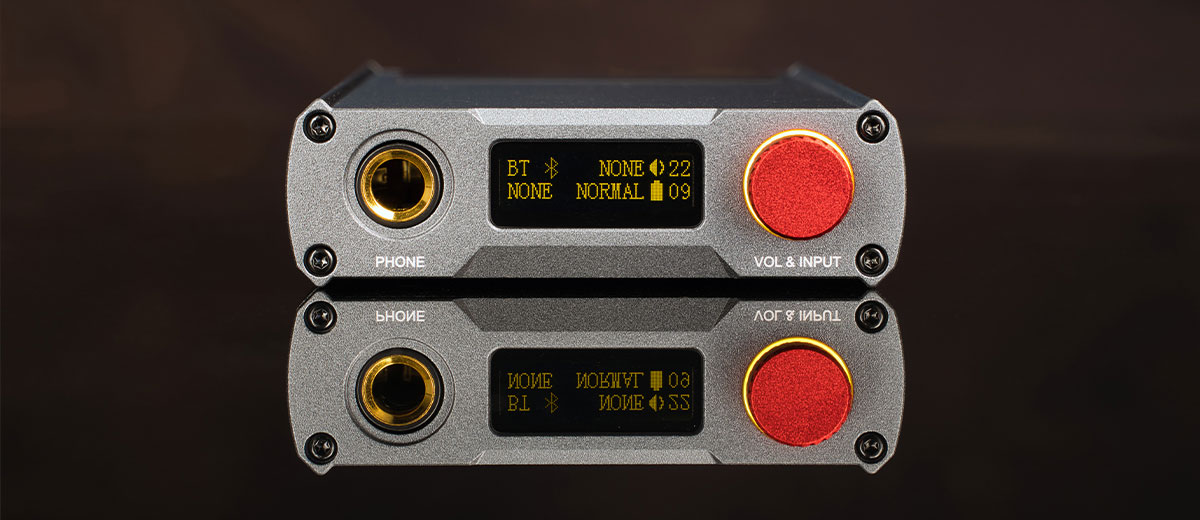
Marcelo reviews the xDuoo XD05 Basic2, a portable CS43131 DAC and 750mW opamp-swappable headphone amplifier with wireless support. It is currently priced at $299.00.
Disclaimer: This sample was sent in exchange for my honest opinion. Headfonics is an independent website with no affiliate links or status. I want to thank Shenzhen Audio and xDuoo for their support.
Click here to read more on xDuoo products previously reviewed on Headfonics.
This article follows our current scoring guidelines, which you can read in more detail here.
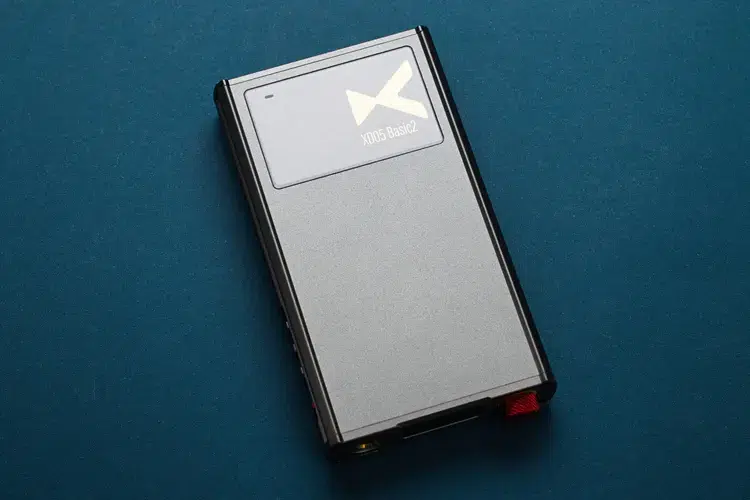
The new xDuoo XD05 Basic2 is one of the more affordable battery-powered Bluetooth DAC/amplifiers in xDuoo’s long XD05 product line.
At $299, it is in the lower-middle priced range in the series, which starts with the $155 XD05 Basic and goes up to the $799 XD05 Pro. Some have been reviewed here before, including the XD05 Pro, XD05 BAL 2, XD05 Plus, and the XD05T.
One thing they have in common is the replaceable op-amps feature, which is fantastic for die-hard audiophiles who want to subtly change the sound. That includes me; unfortunately, no extra op-amps are included in the package.
I’ve been using battery-powered DAC/amplifiers for years and have always been curious about xDuoo as a company, as the first xDuoo product that arrived at my table.
I wonder how it sounds compared to the similarly priced and featured Topping G5 and the recently reviewed MUSE HiFi M5 Ultra. Let’s find out in my review below.

Features
The XD05 Basic2 uses the famous Cirrus Logic CS43131 converter chip, which sounds great, but is also economical due to its low price. The analog signals are then passed to an OP+BUF amplifier section to power its 6.35 mm output jack.
The XD05 Basic2 doesn’t need balanced output due to its powerful 750 mW per channel output power, but there should be a 4.4 mm output jack to negate the need for an adapter.
For decoding, the XD05 Basic2 supports PCM 32bit/384kHz, DSD256, and MQA 8x decoding. Via Bluetooth 5.4 LE Audio if offers LC3, aptX, and up to LDAC.
It can run on battery, DC power, or USB-C while charging, and it has two USB-C inputs, one for charging and one for audio.
The op-amps are user-replaceable, and xDuoo provided extra screws in the box in case you lose some. Understandably, they didn’t include op-amps because good op-amps are expensive and would increase the price of the XD05 Basic2.
The XD05 Basic2 uses a 99-step digital volume control with high and low gain, plus a selectable 6 dB bass boost. Its compatibility with Windows, Linux, macOS, Android, and iOS makes it usable in almost any situation.
Design
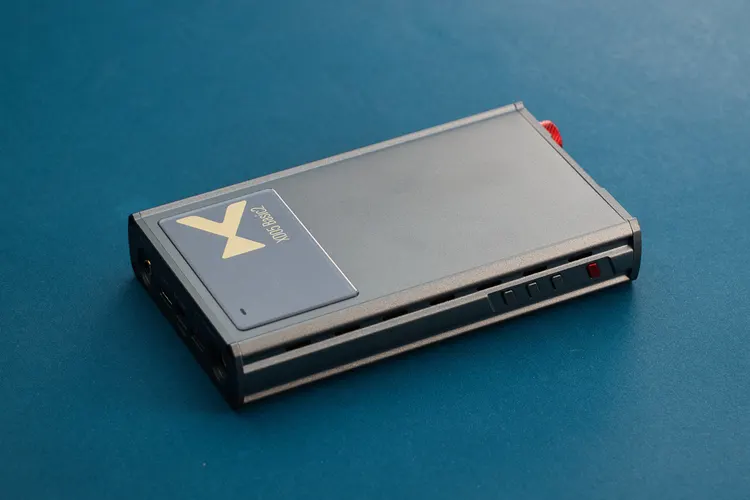
The XD05 Basic2 has a nice utilitarian design with a retro look on the front, and a science fiction space-age look on the rest of its chassis. The red knob and the OLED screen look gorgeous.
There are nice vents on both sides, which you can see through the chassis, and help in the cool running temperature of the XD05 Basic2.
The XD05 Basic2 has a big battery-powered DAC/amplifier form factor with I/O and control at the front and back. Its dimensions are 5.5″ x 2.95″ x 0.9″ (13.9 x 7.5 x 2.3cm), and it weighs 8.61 oz (244 grams).
Display
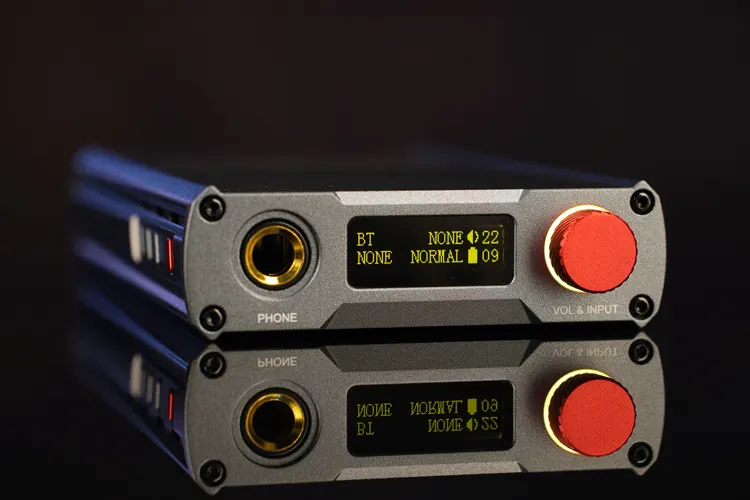
The XD05 Basic2 has a 22mm x 8 mm OLED display at the front, which is very legible and has a nice amber lettering. It displays the volume level, input, sampling rate, bass boost, gain, and the battery level indicator.
I don’t like the way the battery level is displayed. A battery icon is always full, and the actual battery indicator is on its right side, with the number ranging from 0 to 10, where 0 is a low battery and 10 is full. I wish the battery icon also indicated the battery level.
A nice amber light encircles the volume knob, but I wish it could be dimmed or turned off, including the OLED screen.
I/O
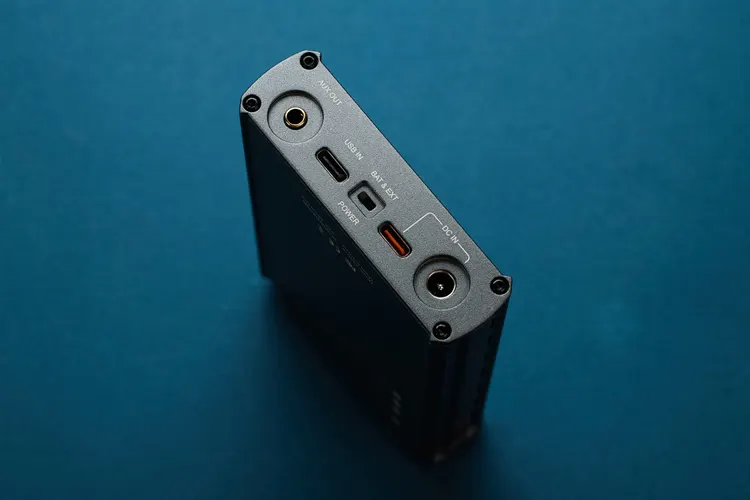
There is only one 6.35 mm headphone output jack on the front of the XD05 Basic2. It should have included a 4.4 mm jack to negate the need for an adapter, and 6.35 to 4.4mm adapters are not common.
The XD05 Basic2 includes a barrel-type power and charging connector on the rear, which accepts 5- 12V/2A of power, but the package doesn’t include a power adaptor.
There are two USB-C ports, one for charging and one for audio, allowing you to charge and use them simultaneously. A power source selector switch allows you to choose between external or battery power.
An auxiliary output on the rear is a nice feature that allows you to use the XD05 Basic2 as a dedicated DAC with an external headphone amplifier or a speaker system.
Controls
A lone red volume control knob is at the front of the XD05 Basic2 and doubles as a push-button input selector switch.
There is only one slide switch at the back for selecting between an external power source and the internal battery.
On the left side are the power, mode, bass boost, and Bluetooth pairing buttons. A three-second power button press will turn on the device, and a two-second media button press will turn it off.
The mode button will switch between High and low gain. The bass boost button will increase the bass by 6 dB, and a three-second press at the Bluetooth pairing button will put the device into pairing mode.
Battery & Charging
It took about 3 hours to fully charge the XD05 Basic2 with a USB-C PD charger, including my MacBook and QC charger. I don’t have the old slow charger, but it should take 6 hours or more to charge if I did it fully.
I wish the charging times were shorter, but on the positive note, the XD05 Basic2 never got hot while charging; it is cooler than the Topping G5 and the SMSL DS20, which are included here for sound comparison.
Connectivity
Bluetooth
The XD05 Basic2’s Bluetooth 5.4 pairing speed is fast, on par with other devices using the latest Bluetooth chips.
There is almost unnoticeable latency, which is negligible when watching movies and playing slow games.
Still, it is not ideal for fast games that require sound feedback to be as real-time as possible, just like any other fast Bluetooth connection from different devices.
I noticed that the XD05 Basic2 could receive a stable signal from my Samsung S21 Ultra phone for about 30 feet or about 9 meters, which is good and on par with other devices I tested.
USB-DAC
The XD05 Basic2 connects quickly and without fuss to all my digital audio players (DAPs) and the Samsung S21 Ultra Android phone.
It also connects fuss-free with my PC and Laptop, automatically routing audio to the XD05 Basic2 when plugged and automatically routing back to the speaker audio when unplugged.
Even though the manual suggested installing the drivers, which can be downloaded from their site. Perhaps old computers need a driver to operate.
Packaging & Accessories
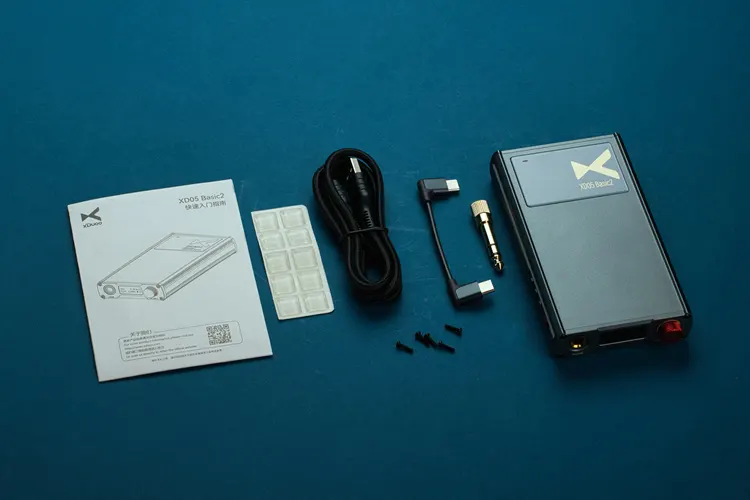
When you open the XD05 Basic2’s white and unassuming box, you’ll be greeted with a black rigid box that contains the XD05 Basic2, a Type-C USB Cable, a short Type-C to C OTG cable, a 6.35 to 3.5mm converter, rubber feet, a user manual, and a warranty card.
I would love it more if it included a leather case, but that would surely hike the price. The packaging design is simple, utilitarian, and does not waste too much material.
Sound Impressions
Even though I tried the XD05 Basic2 with my PC, Laptop, and DAPs for a connection test, my Samsung S21 Ultra phone was the sole digital source used in the listening evaluation and comparisons.
I used PowerAmp and UAPP music player Apps in their default audio settings without filters, EQ, and audio enhancement.
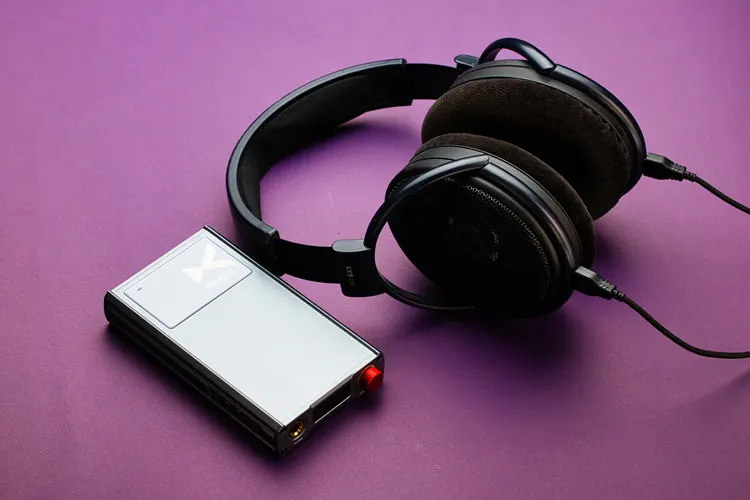
For the IEMs and headphones, I went with the MOONDROP Harmon, DUNU Falcon Ultra Ti, Kiwi Ears’ Astral, and the Sennheiser HD 6XX.
I let the XD05 Basic2 run for about 24 hours in total, playing random songs, before taking a serious listen. I noticed that it has an analog type of sound, where the details are there but not upfront.
Summary
I didn’t know what to expect as I had never heard an xDuoo product before, though, from what I’ve gathered reading reviews, it seems that the sound tuning of xDuoo leans towards warmth and organic or analog sound signature. And at first listen, the xDuoo XD05 Basic2 didn’t disappoint.
I was greeted with slightly fatty bass that is neither the fastest nor the tightest, but very natural and organic. It is not too loose or too controlled, it is just right. There is some correctness to it that I can’t quite pinpoint, but I feel that it is realistic.
The XD05 Basic2 midrange may not be the cleanest I’ve heard, but it sounds lush. It is not a sterile type of midrange and certainly not mechanical-sounding.
It doesn’t have the most evident or longest instrument decay, but the decays are delivered thickly and lushly, avoiding sounding analytical.
While the XD05 Basic2 treble is not the most pristine, it certainly doesn’t sound muddy or dark.
Even though it is transparent, there is a slight diffuseness to it that gives it an analog characteristic in sound that is unlike the ultra-clear and glossy digital sound signature of other DAC/amplifiers.
Coloration
Tonally, if I can assign the XD05 Basic2 with one, it sounds slightly V-shaped in sound signature or coloration.
Though it is energetic in the midrange and has a flat perceived frequency response, slight excitation exists in the bass and lower treble.
Staging & Dynamics
The XD05 Basic2 does not have the widest or the deepest soundstage I’ve heard, but it is not the smallest; there is enough space to make it sound natural. It is like you are in a real environment listening to a live musical performance, at or near the front of the stage.
The shape of the soundstage is spherical, which is ideal for a natural surround sound feel. There is good height, plenty of lateral and longitudinal instrument placement, and ambiance cues.
Regarding the XD05 Basic2’s imaging performance, it’s not the most defined; there is some diffuseness to them, but they are stable with good clarity.
Of course, this would depend on the IEMs or headphones used, but this assessment is based on comparing the other DAC/amplifiers.
Due to its 750mW output power rating, the XD05 Basic2 has a good dynamic range. But it does not have the boldest dynamic delivery I’ve heard. The bass tautness and transient response are less sharp than those of more technically and analytically sounding DAC/amplifiers.
That said, as can be expected, the resolution is not the highest there is. It has a clear sound and reasonable resolution, but due to its slightly diffused presentation of sounds, as mentioned above. It doesn’t have the minutiae or nuances of the best in this regard.
Click on page 2 below for my recommended pairings and selected comparisons.
