

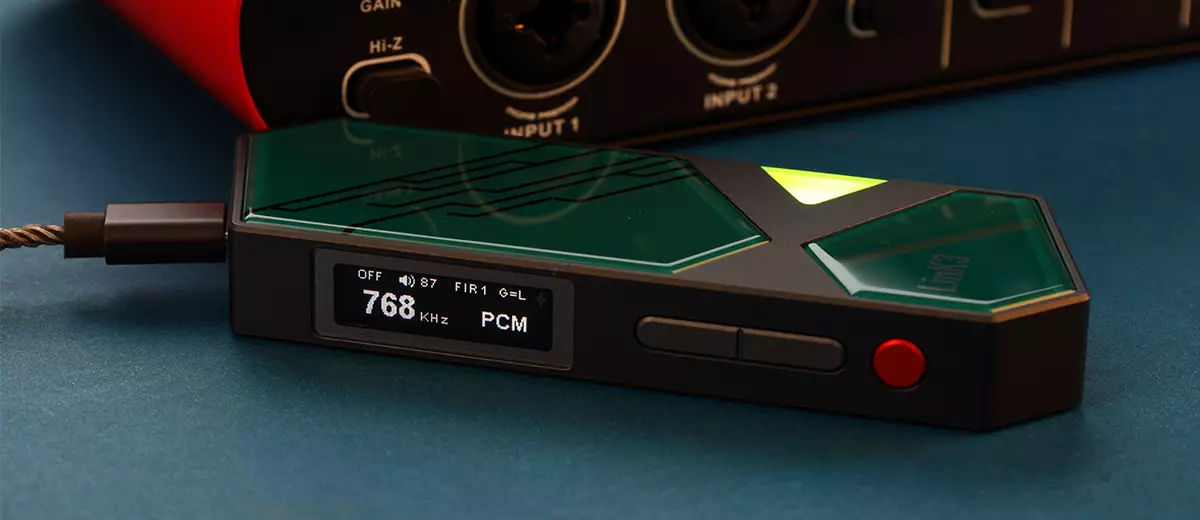
Synergy
I am pleased to report that I experienced no noise issues and no popping or scratching sounds from the headphones or IEMs at any time during use.
Additionally, it doesn’t pick up on RF interference when placed near my phone.
I also find that the Link3 pairs well and sounds good with difficult-to-drive headphones due to its high output rating.
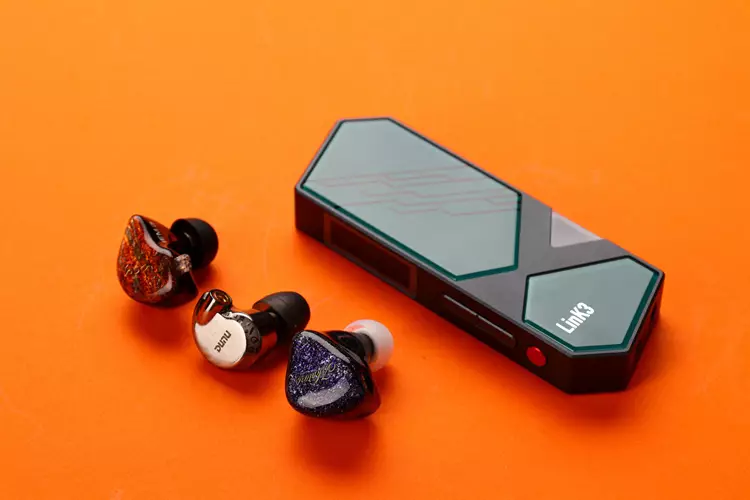
IEM Pairings
That said, I find the Link3 explosively dynamic when paired with any of the IEMs in this review, as well as other relatively difficult-to-drive planar IEMs not included in this review.
When paired with a simple, easy-to-drive single dynamic driver IEM, the DUNU Falcon Ultra, the sound is effortlessly dynamic, slightly warm, and detailed.
Switch to the neutral hybrid IEM, Tipsy M5, I hear the slight warmth and thickness added by the Link3, and the level of detail remains relatively good. There is a subtle added thickness in the bass, yet the sound remained very controlled and clear.
Finally, when paired with the QoA Martini, which has a moderately V-shaped sound and a fat bass due to its strong subwoofer bone-conduction driver, the sound is pleasantly thick and warm with very good control of the Martini’s subwoofer.
I hear good details, thick tonality, and bass dynamics without sounding bloated in the Link3 and Martini pairing.
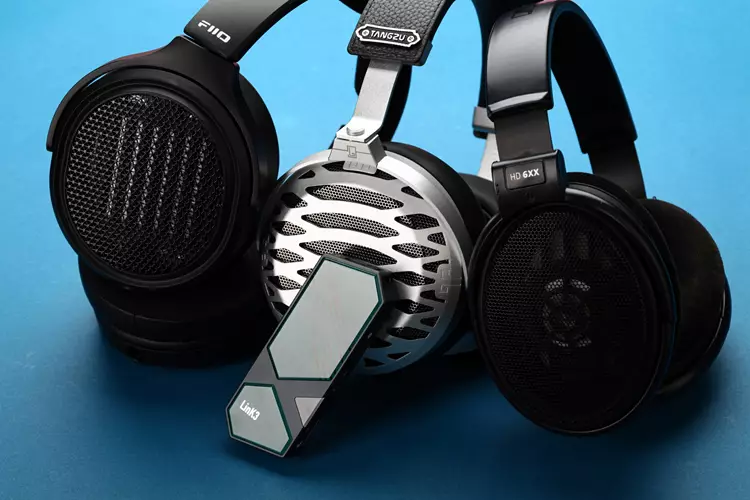
Headphone Pairings
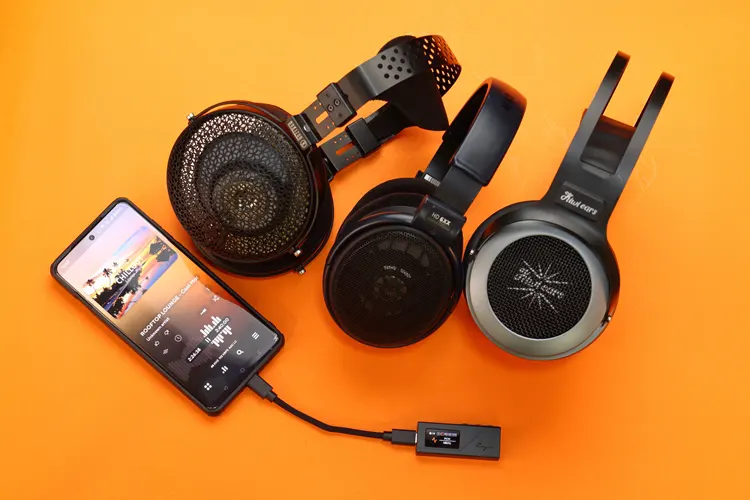
Today, we have a relatively difficult-to-drive selection of headphones: the FiiO JT7 and the TANGZU OX Demon King, both planar headphones, and the Sennheiser HD 6XX, which is known to be difficult to drive. The HD 6XX has a high impedance of 300Ω, which is almost ten times the normal 32Ω impedance.
When paired with the FiiO JT7 and its stock 3.5 mm cable, I am at about 85-90% volume for my normal, slightly loud listening level. I could set it to 100% volume, and the sound is very loud without distortion.
The warm, thick, bassy sound of the Link3 adds much-needed body to the FiiO JT7, which at times can sound thin, midrange-centric, and slightly bright.
I experience the same performance when I pair the Link3 with the OX Demon King with its 3.5 mm stock cable. I am also at about 80-87% volume for my normal-to-loud listening. There is good dynamic headroom, and the sound is very dynamic.
I love the way Link3 added energy to the bass, which counters the energetic treble in the OX Demon King very well. I must say that this is an excellent pairing.
Lastly, with the Sennheiser HD 6XX with a third-party 4.4 mm balanced cable. I set the volume to 80-85% for my normal-to-loud listening levels. I hear a dynamic sound with good dynamic range.
There is good energy in the bass, and the sound is generally good; however, for my personal taste, I tend to prefer the HD 6XX with a more analytical, more transparent, and airier-sounding source, so I cannot call this pairing excellent.
This pairing should serve people who like warmer and darker sound signatures very well, though.
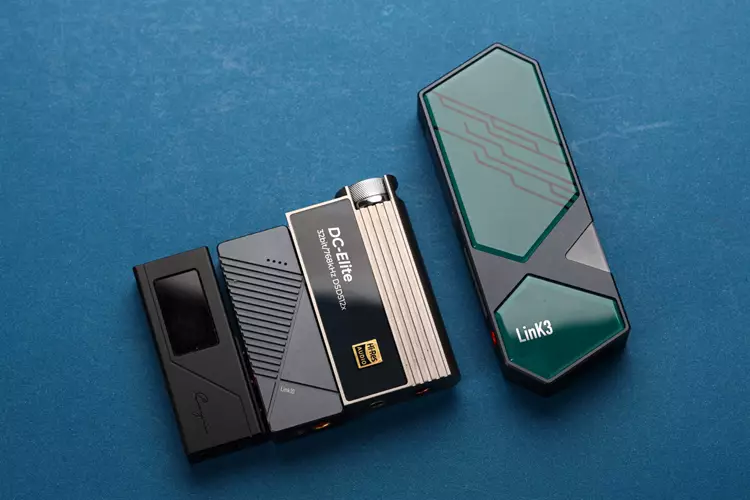
Selected Comparisons
For this comparison, I mostly used the Tipsy M5, as it is a very neutral and revealing set that helps me pick out minute differences in sound between the sources.
I also use the Sennheiser HD 6XX, which is a well-known, difficult-to-drive headphone, to test its driving capabilities.
Please note that the difference between these dongle DACs is subtle and might not be audible to some; however, the difference between their maximum loudness is noticeable.
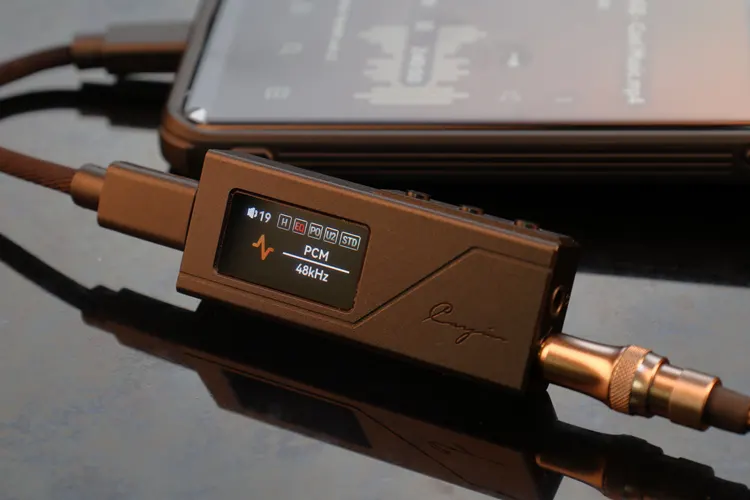
Cayin RU3
Technical
The most glaring feature is the Cayin RU3’s 560 mW power output, which is the highest I have reviewed in this form factor. I’m also delighted by the inclusion of the 0.96“ IPS color display.
The USB input is handled by the SPV5068, a high-performance dual-core processor that serves as a USB bridge for data and digital audio signals.
The digital signal is then passed to the ES9069Q high-resolution dual-channel digital-to-analog converter chip, which uses two OPA1602 dual-op-amp ICs from Texas Instruments for current-to-voltage conversion.
Two SGM8262 stereo headphone amplifier chips then amplify the signal, producing a true balanced output.
Design
The RU3’s 60 x 25.4 x 11mm size is median in its form factor, and it is lightweight at only 24 grams, despite its chassis being CNC-machined from solid aerospace-grade aluminum and finished with a durable anodization process.
My review sample is black, but it is also available in light Cyan and purple colors.
Performance
The RU3 sounds more neutral, with a neutral bass and midrange, and slightly relaxed yet still neutral treble, which makes it slightly thinner and less energetic.
Compared to the mildly U-shaped sound of the Link3, with its elevated bass, relaxed upper midrange, and a boosted upper treble.
I find the soundstage between the RU3 and the Link3 to be very similar in size, but upon prolonged listening, the Link3 is more spacious. I also find the Link3 more detailed due to its boosted upper treble.
When driving the HD 6XX at normal volumes, they are about equal, but at higher volumes, the Link3 has an obvious advantage in cleanliness and effortless dynamics.
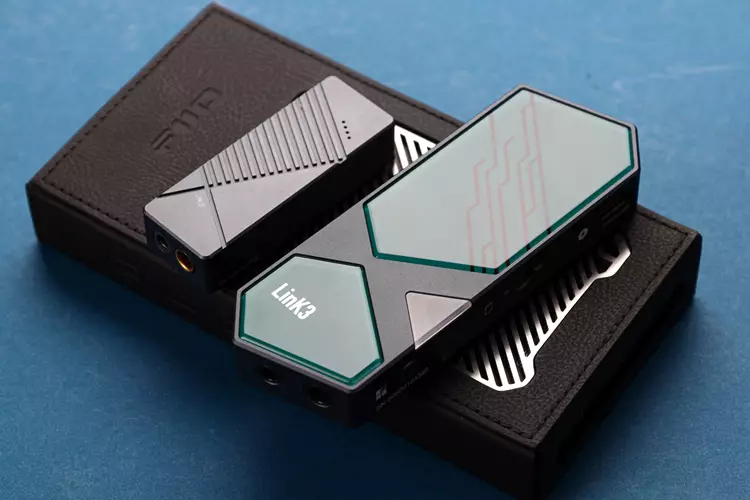
xDuoo Link10
Technical
The xDuoo Link10 features two CS43131 DAC chips, one per channel, which serve as both digital-to-analog converters and headphone amplifiers. And supports PCM 32-bit/384 kHz and Native DSD 256 digital audio signals.
The Link10’s USB input features dual operating modes, supporting both USB 1.0 and USB 2.0. USB 1.0 is used for handheld gaming consoles, while USB 2.0 is used for normal music playback.
Design
The Link10 body is CNC-machined from a single piece of aluminum alloy and finished with a durable, dark grey anodization, with tempered glass covering the back.
The Link10 is a small, lightweight dongle DAC, measuring only 2.36 x 0.91 x 0.51 in (6.0 x 2.3 x 1.3 cm) and weighing 25 grams, making it easy to fit inside most IEM carrying cases with the IEM inside.
Performance
Of all the comparisons, this one has the most similar sound signature, as both have the xDuoo analog-style house sound. However, upon prolonged listening, the difference became more obvious to me.
Both the Link10 and the Link3 have subtly warm boosted bass and a neutral midrange, but when it comes to the upper midrange and treble, the Link10 is more neutral, with a slightly relaxed upper midrange and boosted upper treble compared to the Link3.
The Link3 has a wider soundstage and higher resolution, while the Link10 has a more analog-style sound signature, where resolution takes a back seat to warm tonality.
When driving the HD 6XX, the HD 6XX is not revealing enough to hear the tonal differences between the two.
However, it is obvious to me that the Link3 is much cleaner and does not suffer from compression at or near maximum volume as much as the Link10.
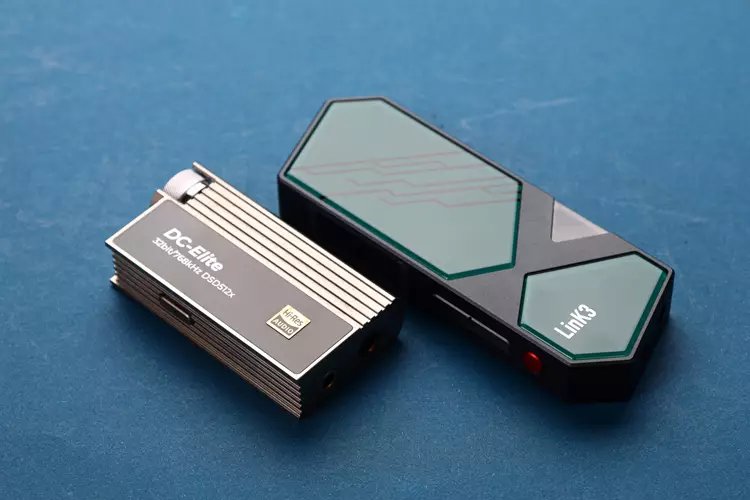
iBasso DC-Elite
Technical
The iBasso DC-Elite features a ROHM BD34301EKV DAC chip, which is rarely used in portable devices, unlike the more common ES9039Q2M chip used in the Link3, a difference that contributes to the DC-Elite’s distinct sound.
Additionally, it features a physical series-resistor stepped-attenuator volume control, further enhancing its uniqueness. However, it isn’t as powerful at 280 mW compared to the Link3’s 1000 mW.
Design
The DC-Elite features an industrial-looking titanium chassis, enhanced by tempered glass on the front and back, and an attractive knurled knob at the top.
The DC-Elite is large, but the Link3 is larger and feels bulkier. However, in terms of appearance, DC-Elite looks more refined with its titanium chassis and knurled knob.
Performance
The tonal difference between the DC-Elite and the Link3 is obvious to me. DC-Elite sounds very analytical with its flatter overall perceived frequency response, and has a very detailed, extended, and airy treble.
The Link3, by comparison, is less detailed and resolving but has a warm analog-like organic sound signature.
In terms of staging, the DC-Elite has a more spacious stage, thanks to its high resolution and the extended airy treble. I also find the DC-Elite more transparent, with more instrument separation, making it easier to pick out an instrument in a song.
The Link3 is not as highly technical performing as the DC-Elite, but the choice between the two boils down to whether you want an analog and organic sound of the Link3 or an analytical sound of the DC-Elite.
When it comes to driving the HD 6XX, there is a big difference in maximum loudness and cleanliness between the DC-Elite and the Link3.
The link3 is much louder, cleaner, and more dynamically effortless, while the DC-Elite struggles with dynamic compression and harmonic distortion when driving the HD 6XX at maximum volume.
My Verdict
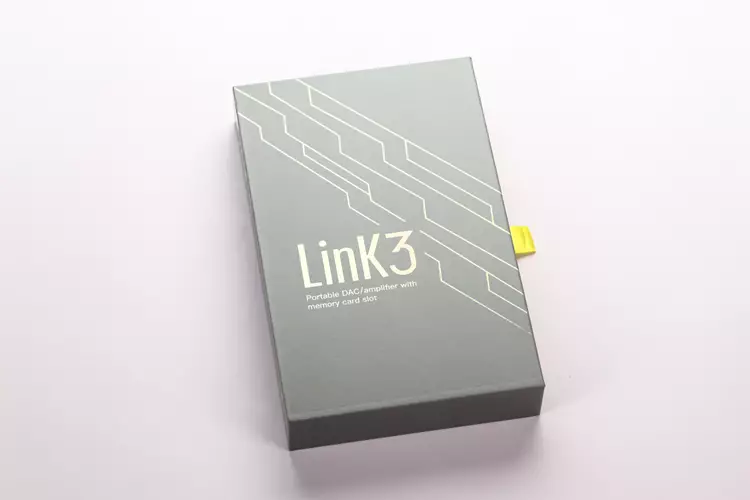
The xDuoo Link3 is a feature-rich dongle DAC with very useful features. It has a Micro SD card slot to expand the storage capacity of the source phone.
What I like most about the xDuoo Link3 is its clean, high-power output and the dynamics in the sound. I also like its ease of use and setting adjustments, thanks to its display screen.
What I don’t like is that it is big for a dongle DAC, and it heats up during use. I wish the next iteration of the Link3 comes in a smaller package and runs cooler.
Still, the above complaint becomes a very minor inconvenience when you consider that the xDuoo Link3 is very powerful, drives headphones cleanly and effortlessly, drives IEMs with ease and explosive dynamics, and has a MicroSD card slot.
I would recommend the xDuoo Link3 to people who need its features.
xDuoo Link3 Technical Specifications
- Input Interface: Type-C
- Power Consumption: 5V / 0.27A
- USB System: UAC1.0 / UAC2.0
- Headphone Output: 3.5mm + 4.4mm
- Sampling Rate: PCM 16–32bit / 44.1kHz–768kHz, DSD 1Bit/2.82m-22.57MHz
- Super Mode Output: 32Ω 500mW (Unbalanced) / 1000mW (Balanced)
- Normal Mode Output: 32Ω 360mW (Unbalanced) / 700mW (Balanced)
- THD+N: 110dB@1kHz (Unbalanced) / 112dB@1kHz (Balanced)
- SNR: ≥120dB (Unbalanced) / ≥130dB (Balanced)
- Crosstalk: ≥75dB (Unbalanced) / ≥123dB (Balanced)
- Frequency Response: 20Hz – 20kHz (±0.5dB)
- Expansion Interface: Micro SD (up to 2TB)
- Dimensions: 10.7 × 3.8 × 1.5 cm
- Weight: 70g
