

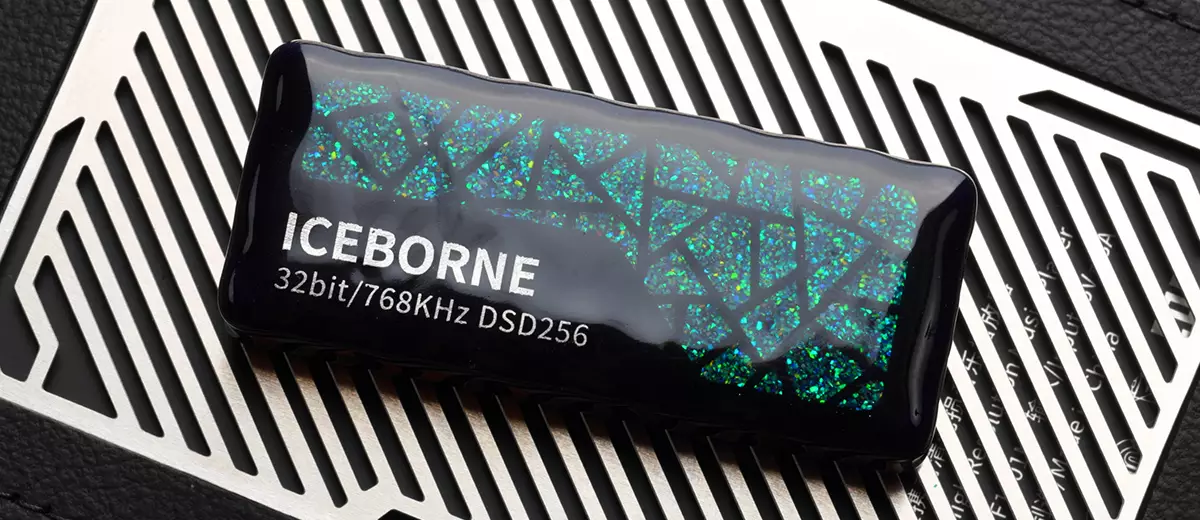
Marcelo reviews the AFUL ICEBORNE, a new dual CS43198 dongle DAC with a unique resin body and up to 300mW of balanced output power. It is currently priced at $149.99 MSRP.
Disclaimer: This sample was sent to me in exchange for my honest opinion. Headfonics is an independent website with no affiliate links or status. I thank HiFiGO and AFUL for this opportunity.
Click here to read more about AFUL products previously reviewed on Headfonics.
This article follows our current scoring guidelines, which you can read in more detail here.
The AFUL ICEBORNE sells for $134.99 and fits into the dongle category, but with a unique, fully molded-in resin shell design that feels warm rather than cold like metal.
This is AFUL’s second DAC/Amp since the AFUL Snowy Night, which was released in early 2024, more than two years ago.
AFUL is not one of those companies that release products every few months, which could mean they put more time and effort into each product release.
While I do not expect the full resin housing to affect the sound or offer any improvement, I am more interested in how the Cirrus Logic CS43198 DAC chip would sound with AFUL’s 2nd implementation of this chip.
So how does the AFUL ICEBORNE perform and compare to other dongle DACs, such as the xDuoo Link10, iBasso DC-Elite and the Cayin RU3? Let’s find out in my full review below.
Features
The ICEBORNE features a dual CS43198 DAC chipset and natively supports up to PCM 32-bit/768kHz and DSD256.
It has a maximum power output of 140 mW into 16Ω using the 3.5mm jack and up to 300 mW into 16Ω using the 4.4mm.
I should make you aware that this power rating is for a 16Ω load rather than the more common 32Ω load, but it should still give you a decent 150 mW output.
Design
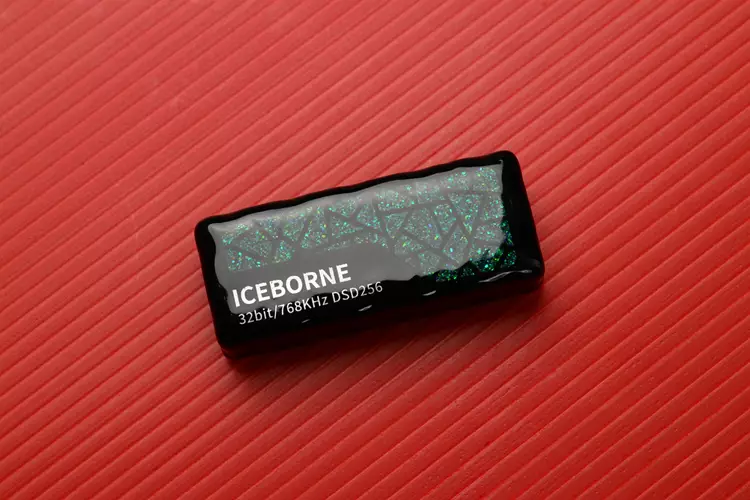
The fully resin single-piece shell looks more beautiful in person than in photos. The rounded corners and wavy surfaces make the ICEBORNE feel elegant and handy; the ice crack pattern of the Suzhou garden window lattice-inspired design looks really nice and ornate.
The ICEBORNE looks like a black block of melting ice, with its wet-look finish and irregular surface. This must be where the ICE in ICEBORNE came from.
The ICEBORNE is regularly sized for a dongle DAC, measuring 54mm (L) × 14mm (W) × 22mm (H) and weighing 25.7 grams.
I/O
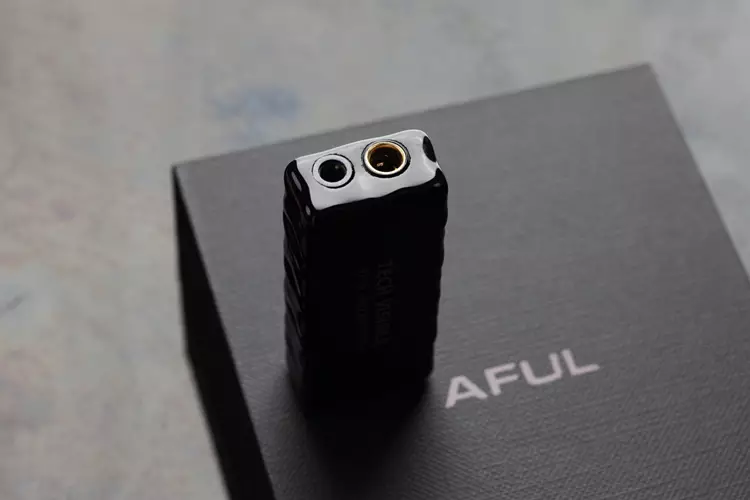
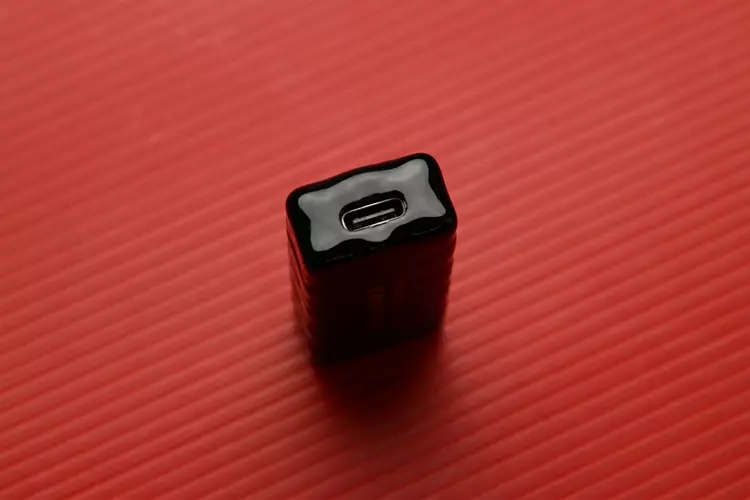
The ICEBORNE’s I/O arrangement is typical for dongle DACs; the USB-C input is on the left side, and both the 3.5 mm and 4.4 mm output jacks are located on the opposite side.
Since AFUL never mentioned it, I must presume the ICEBORNE is only compatible with UAC-2 USB, which is 100 percent fine so long as you don’t use it on gaming consoles and very old computers, which require UAC-1 compatibility. It also has no mic support.
USB-C Cable
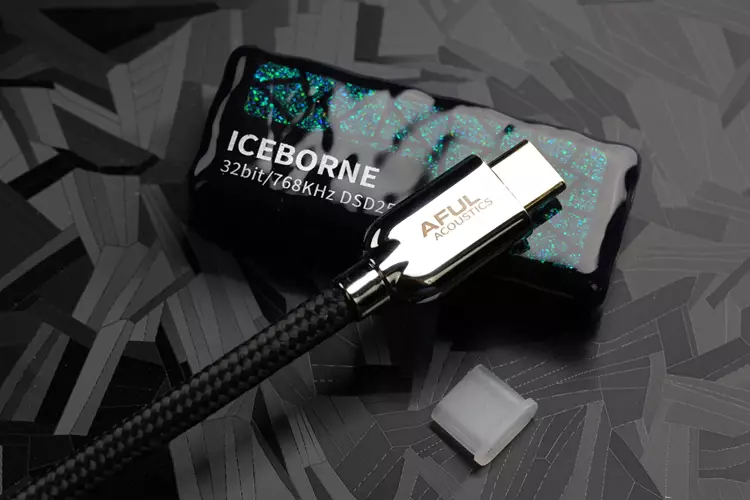
I felt the need to make a special mention about the ICEBORNE’s included USB-C cable. It looks gorgeous.
The shiny silver USB-C plug design is new to me; it looks classy and feels sturdy thanks to its thick, braided cable.
There is an AFUL logo on one side of the plug and an indicator on the other, indicating that the cable is directional. Luckily, I never had issues when I connected it any which way.
USB-DAC
Thanks to its modern design and components, the ICEBORNE never had any issues connecting to any of the sources I paired it with, including my Android phone, MacBook Pro, desktop PC, and Android DAPs.
AFUL provided a download link for the driver; I find it unnecessary. However, I find that it won’t work on some of my small non-Android-based DAPs.
There was no noise when I plugged the ICEBORNE in or out of my phone or DAPs, and I heard no radio-frequency interference, even when I placed it behind my phone.
Controls
The ICEBORNE does not include any controls, not even a volume control, which means the volume level depends on the source’s volume.
The lack of an independent volume control in a dongle DAC has become a controversial topic in recent years on various FB audio groups; most serious audiophiles prefer an independently set volume control in the dongle DAC.
My personal view is that it doesn’t matter whether the dongle DAC has an independent volume control, since I only use the volume on my source device.
At some point in the past, I did try using the dongle DAC’s volume solely and left the source phone’s volume at max.
Having plenty of dongle DACs and switching between them, I often blast my ears when I forget that the dongle DAC’s volume is near max, and I’m using a more sensitive IEM than in the previous listening session.
So, I decided to use my phone’s volume from that point and prevent accidentally blasting my ears.
As for sound quality, I would argue that so long as the volume control is handled digitally before the digital-to-analog conversion, it doesn’t matter whether it is done in the phone or in the dongle DAC.
I must add that sometimes the phone’s volume control offers superior sound quality to the dongle DACs, as on my MOONDROP Dawn Pro. I find it sounds best when I set its volume to max and let my phone control it, albeit only subtly so.
Battery Consumption & Heat
Although I don’t have any measurements of the ICEBORNE’s power consumption, I estimate that it is low.
During the burn-in period, the resin shell is almost cold to the touch, colder than my body temperature in a room with AC.
I suspected that the resin shell insulates the internal heat, but then both the USB-C input cable and the Phone Out plugs for the earphones are also cold to the touch, which could mean the ICEBORNE is cool internally. Another reason for the ICE in ICEBORNE.
Packaging & Accessories
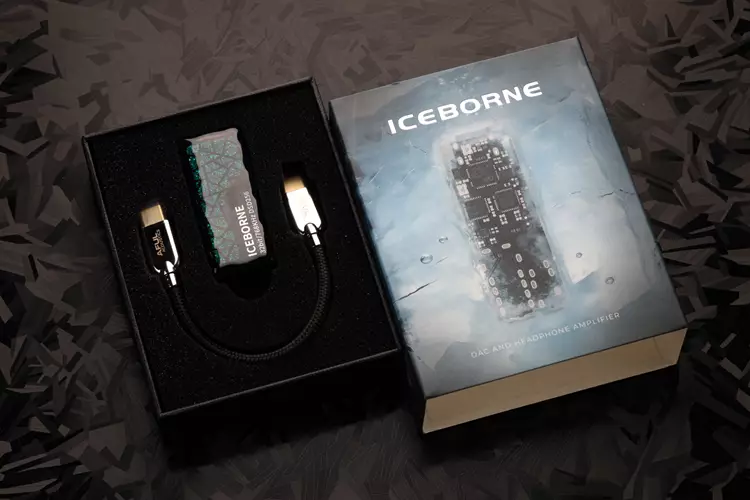
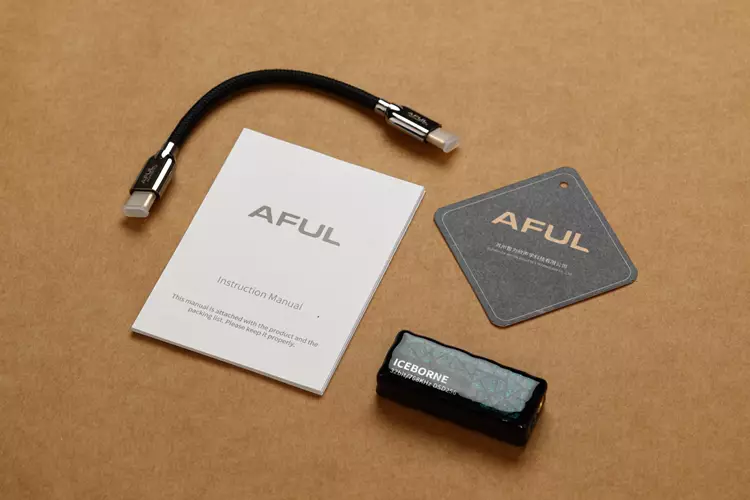
My unboxing is straightforward. ICEBORNE came in a small 102 x 88 x 32 mm box with an outer sleeve printed with ICEBORNE’s internal board and text at the back.
The main box includes soft foam to protect the DAC. The package includes a certificate card, a manual, a USB-C cable, and the ICEBORNE DAC.
Sound Impressions
For this review, I used my DUNU Falcon Ultra, Tipsy M5, and QoA Martini IEMs, as well as the FiiO JT3, TANGZU OX Demon King, and Sennheiser HD 6XX headphones
I used my Android phone and the FiiO M33 R2R as the primary digital sources, using YouTube Music, the UAPP, and PowerAmp. No EQ or any sound-enhancing programs were used.
I performed an overnight burn-in of about 12 hours by letting the ICEBORNE play continuously using a DAP and a single DD IEM with a 4.4 mm balanced cable.
I do product review burn-in regardless of the purpose; in this case, I want to observe how it behaves in prolonged use.
Summary
I’ve heard various implementations of the CS43198 chip in other dongle DACs, and none of them sound the same; they range from bright to slightly dull. So, I didn’t know what to expect from the ICEBORNE.
Luckily, the ICEBORNE’s sound is the one I like: neutral and transparent, without sounding dull or boring.
ICEBORNE has a flat perceived frequency response, an accurate, balanced sound presentation, and good energy, which prevents it from sounding boring, dull, or dry.
The bass might not be the tightest, but for dongle DACs this size, it’s acceptable. I don’t hear any ‘boomy’ sounds or artificial warmth, and the bass remains tonally neutral regardless of the volume.
Midrange is very neutral with no warmth or thinness in sound. I hear no elevation in the lower midrange, which causes a warm sound, and no elevation in the upper midrange, which pushes the instruments forward.
The treble has a flat, extended frequency response with smooth sound, yet maintains good energy and reasonable liveliness.
Coloration
As I said above, the ICEBORNE is very neutral and thus difficult to find sound coloration with.
I hear no nasality in the midrange; the note weight is neither thin nor thick. It sounds accurate with no harshness or sharpness in the treble, giving it a reasonably congestion-free sound.
If I were to nitpick, the bass is not as hard-hitting and tight as the best dongle DAC I’ve heard
Staging & Dynamics
The ICEBORNE might not have the biggest soundstage around, but it certainly has an above-average soundstage size with above-average height, width, and stage depth. It is not the most spacious-sounding I’ve heard, but it never feels claustrophobic either.
The stage shape is wider than it is deep; it is like being in a concert or cinema setting near the stage or screen, though the presentation is not in-your-face. I wish it had more depth.
The instrument decay had good sustain, faded cleanly into the background, and did not cut off suddenly and briefly like some dry-sounding dongle DACs I’ve heard.
I hear nice lateral panning across the soundstage, a reasonable front-to-back layering of the vocals and instruments, and nice definition and presence in the center vocals.
As with the flat, accurate frequency response and neutral, balanced tonality, the dynamics are also neutral and accurate.
There is no excessive energy or apparent excitation of liveliness in any frequency range, yet the ICEBORNE never sounds dull.
Click on page 2 below for my recommended pairings and selected comparisons.
