

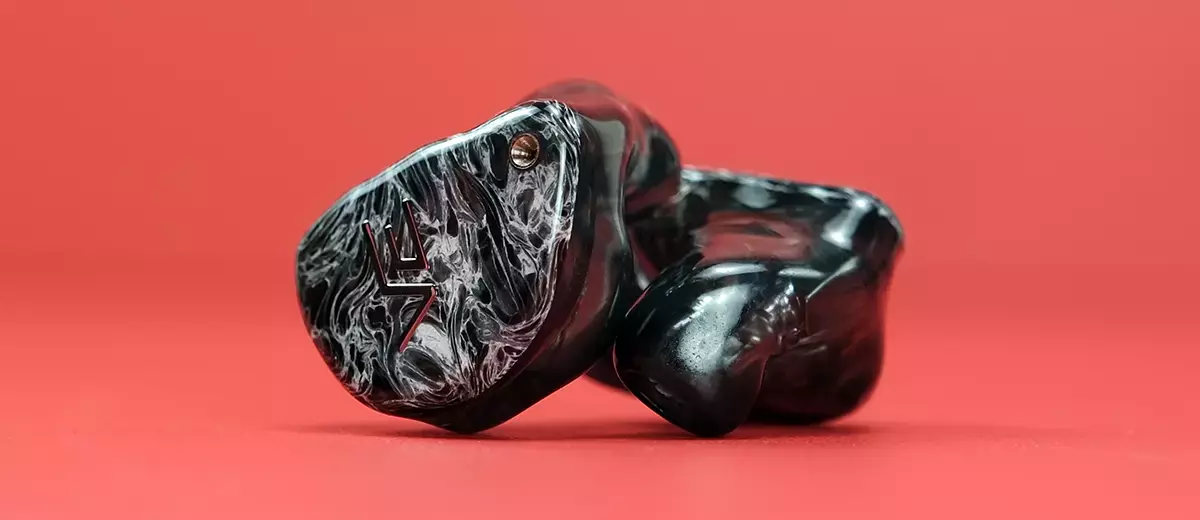
Marcus reviews the Vision Ears VE One, a new hybrid single 8mm dynamic and Balanced Armature driver custom in-ear monitor priced at €900.
Disclaimer: This was sent as a sample in return for my honest opinion. Headfonics is an independent website with no affiliate links or services. I would like to thank the team at Vision Ears for their support.
Click here to read more about Vision Ears products I have reviewed on Headfonics
Note that this article follows our latest scoring guidelines, which you can read in more detail here.
And so we come to the last review of the new Vision Ears VE custom monitor lineup, the VE ONE.
Launched around mid-2025, the VE ONE is the company’s cheapest entry point into its revamped custom IEM lineup, priced at €900.
Along with the VE PRO, this is also an entirely new offering, with none of the older range (VE1 to VE8) matching this new hybrid 2-driver configuration like-for-like.
The VE ONE might not be quite the sweet spot in the range as the VE PRO, but its stellar design quality, accurate fit, and smooth, yet weighty tuning make it an ideal jumping point into the house sound of Vision Ears without breaking the bank for one of the higher models.
This is not an IEM strictly for mixing pros or reference enthusiasts. I find the VE ONE a flexible performer and an easy-to-enjoy sound signature for a wide range of recordings.
That is not to say the VE ONE has no competition at this price point. Pro audio brands such as Bellos, with its sturdy X4, and Ultimate Ears, with its dual-driver UE5 Pro, are also standout choices. All of which are thrown into the performance mix in my full review below.
Features
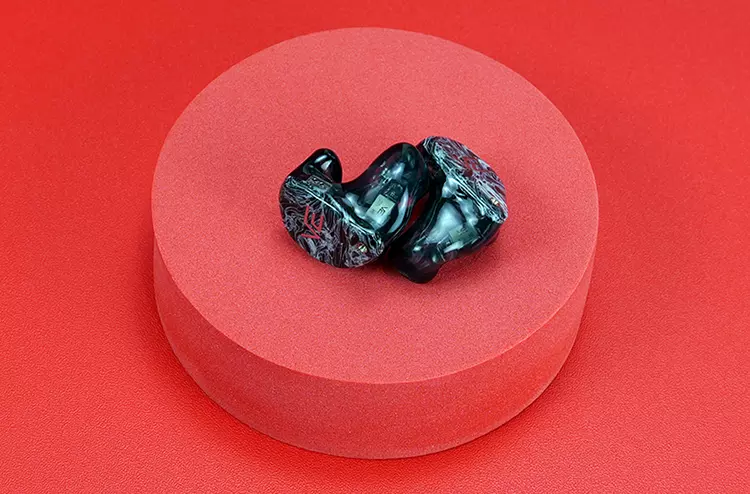
The Vision Ears VE ONE is a hybrid dual-driver 2-way design featuring a single 8mm dynamic driver with LSR (liquid silicone rubber) suspension and an Al-Mg diaphragm for the lows and mids, and 1 BA for the highs.
Like Vision Ear’s other hybrid models in this new lineup, the VE ONE also uses the company’s PRV technology, which stands for Pressure Relief Valve, integrated into the faceplates and is designed to create the correct pressure balance in the shells.
The VE ONE is rated at just 10.5Ω for impedance and has a sensitivity of 110 dB/mW @ 1KHz, so, like most of VE’s IEMs, save for the Elysium and EXT line, this will be very easy to drive from most dongles and DAPs.
Design
I have gone through a fair amount of Vision Ears’ latest designs since I started this epic review series. Aside from the gold sparkle of the VE ZEN sample’s beautiful Obsidian Gold finish, the rest are intricate yet dark and subtle.
Of course, design beauty is in the eye of the beholder, and you can pick from loads of options on their online configurator, so you are not stuck to one offering.
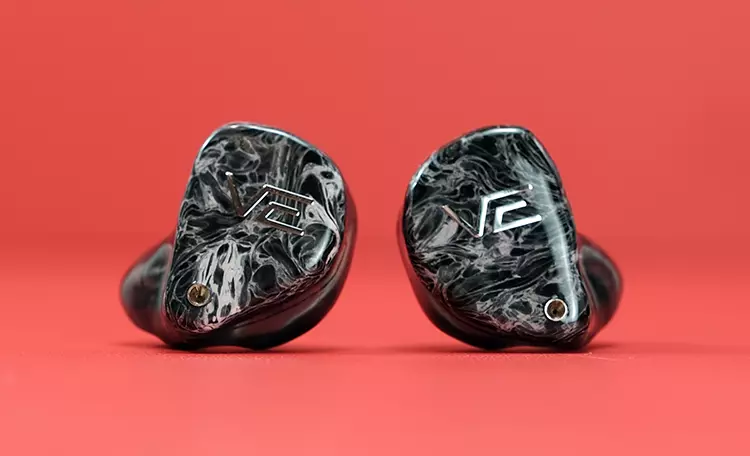
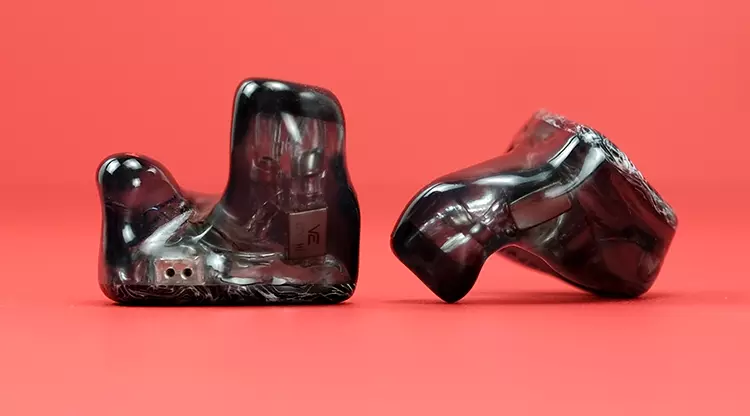
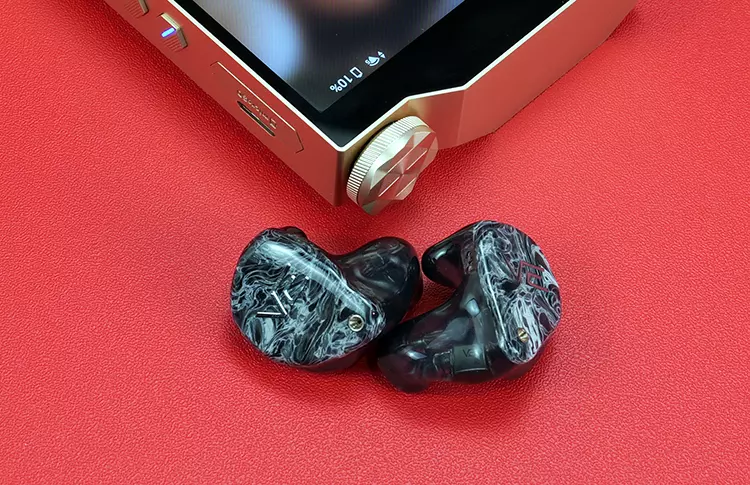
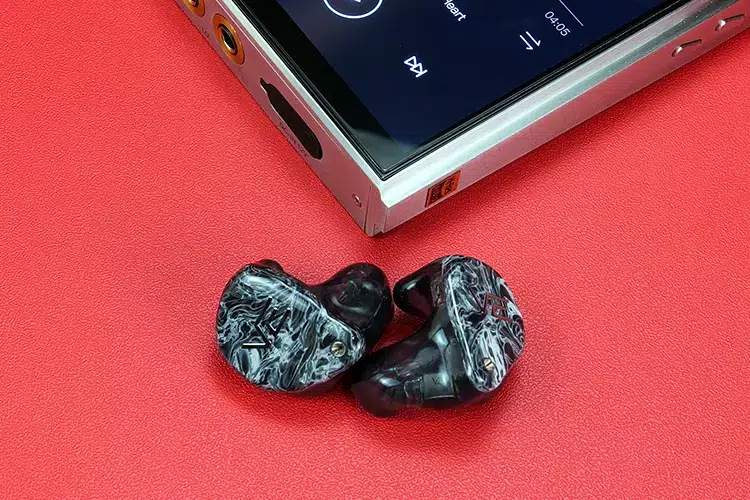
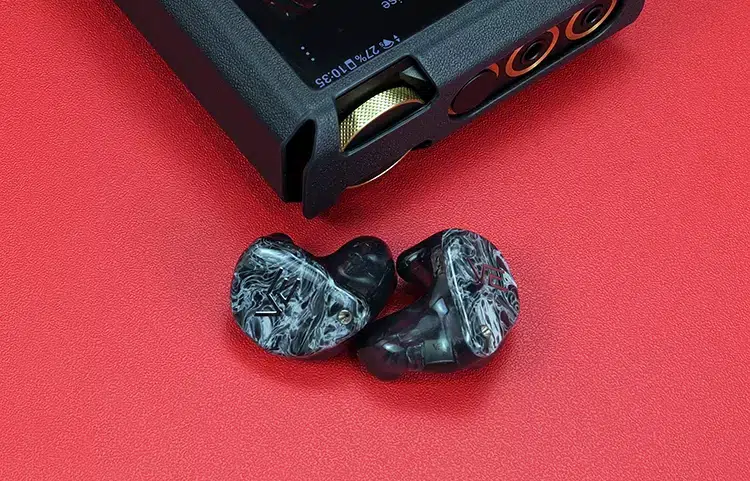
That said, the VE One sample I have here was given the Astral Storm design treatment, and I must say it stands out a bit more than the others.
This one I would rank up there with Obsidian Gold in terms of eye-catching finishing, with its bolder nebula or lava-black-and-white styling across the faceplates, backed by the Midnight main-shell finish.
The only accent on the plate is the small gold ring, which is where the PRV tech exits the shell. It’s a similar ring design and placement to the VE ZEN and VE PRO, the other two customs in the range that have hybrid PRV designs.
This is a two-tone design, which tends to go against my rule of never emphasizing the different components of a custom, namely plate and main shell, but they do complement each other beautifully, so I can break my rule at least once, right?
The form factor is virtually the same as the VE PRO, the next model up. If anything, the VE PRO shell is a tiny bit deeper towards the rear, but you won’t notice it unless you are comparing them side by side.
Comfort & Isolation
Since it is a custom IEM scanned and built from molds of your ear, you should expect a very accurate fitting.
My sample of the VE ONE is no exception, but because it is a hybrid model with a PRV value, its level of isolation is on par with the VE PRO and VE ZEN and a little bit behind non-vented BA driver VE models such as the VE PURE.
Still, compared to a universal IEM, it’s head and shoulders above in isolation, with an almost perfect balance of canal pressure and seal for a comfortable, secure listening experience without interruption.
Though not quite as extended or bulbous as a JH Audio custom nozzle, the VE ONE’s slightly enlarged, horn-shaped nozzle and recessed bore exit tip seal better than regular, narrower custom nozzle designs whose bores exit right at the end. YMMV on this one; it’s very personal to your ears.
Stock Cable
My VE PONE sample did not come with all standard packaging and stock cable, so I cannot offer much insight on the new stock cable and how it handles relative to the Premium upgrade cable that comes with the VE ZEN.
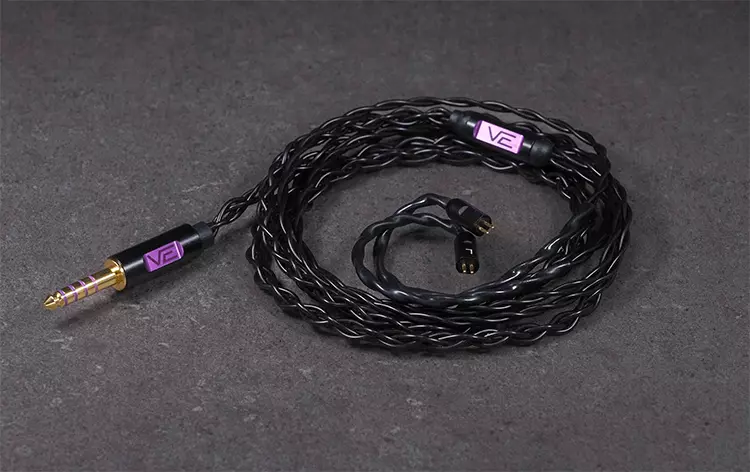
What I can tell you is this is a new 1.35m stock cable with a 4-wire 26AWG Litz geometry, and a mix of 7N Ultra-High Purity Single Crystal Copper and 7N Ultra-Pure Copper Extruded Silver.
Externally, the new VE ONE stock cable appears to be an upgrade over the older P1 Tech cables that came with the previous range.
The external jacket finish is similar to the original EXT or Phönix cable design. It has a black (or transparent) braided TPE material, with 2-pin connectors, and matching slimline jack and splitter barrels. There is also a dash of purple here and there to match the company’s color scheme.
You can choose between a balanced 4.4mm and a single-ended 3.5mm termination during online checkout, but the 2-pin connectors are fixed.
There is also a fair amount of memory-retentive coating at the terminations to help shape the cable around your ears and keep the shells securely in place.
Based on my experience with similar VE cables over the last few years, this cable should be quite light and easy to manage with low microphonics and light memory retention.
Packaging & Accessories
Since my VE PRO sample came without the full accessory lineup. I can only tell you what you will buy as a customer based on Vision Ears’ feedback.
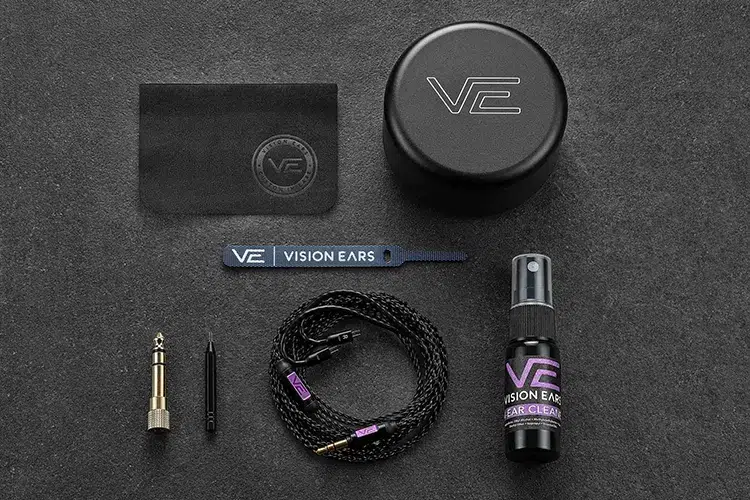
Ideally, you will receive a compact, branded retail box with a very neatly laid out presentation of the accessories, including a carry case (round or square) with the stock cable and CIEMs safely tucked inside.
The rest of the packaging includes a cerumen pen, a 6.35mm adapter (if you have chosen the 3.5mm termination), a cleaning cloth, and an additional bottle of cleaning spray.
Thankfully, Vision Ears did not skimp on the packaging for the VE ONE despite it having a lower price point compared to the VE PRO, which comes with the same accessory lineup.
Sound Impressions
The following sound impressions of the Vision Ears VE ONE were completed using the iBasso DX340/AMP17 and the FiiO M27 in a low-gain balanced output mode.
Summary
The VE ONE perfectly captures the Vision Ears house sound, though I wouldn’t regard it as its most technical or detailed monitor.
It’s more of a tonal triumph and an expose in good driver integration, with a weighty yet smooth-sounding low-end, forward upper mids, and a gentle treble sparkle.
Arguably a U-shaped response, the VE ONE delivers the fullest, most elevated bass response outside of the VE ZEN and XCON X1, with a relatively elevated but linear 2-6k region and just a hint of a drop from 7-10k onwards, but hardly tapered or cutoff.
This is a custom monitor ideal for modern pop and R’n’B, and some genres of EDM where depth and power are more important than exacting control or delicate layering.
It’s also an attractive option for those who like smooth, rich vocal deliveries, though the FR response favors upper-register vocalists over deeper-sounding, guttural singers that stray too close to the bass shelf.
Unnatural sibilance emphasis is very low. The VE ONE veers toward an even-harmonic timbre throughout, with a strong fundamental frequency underpinning most notes, creating a heavy but pleasing sound signature.
Decay levels are longer than the VE ONE’s equivalent dynamic tuning, so when the pace picks up, it doesn’t sound as controlled as its bigger sibling.
The use of a dynamic driver for the lows and mids keeps the tonal quality very coherent, but the lack of layered BA drivers in the mids results in a simpler presentation than the high-end VE models.
Frequency Response
The VE ONE response curve is more of a warmish U-shaped curve, with an elevated and extended bass shelf from 20 Hz up to 300 Hz, and a peak around 20-50Hz before it drops down to its lowest point around 500 Hz to 1k.
As such, the bass is full-sounding, with sub-bass extension, but shows some mid-to-upper bass bloom and slightly slow decay. It’s not a very fast response, not as controlled or dynamic as the VE PRO’s bass sound signature, but it can hit harder and deeper.
The suck-out from 500 Hz to 1 kHz limits the bass bleed but can dip the presence of some instruments or appropriately registered vocal performances.
You might hear a slight smear relative to the cleaner, more precise VE PRO’s stronger lower-mid tuning, which benefits from the additional BA driver layering to keep the detail and timing tight.
From 2-5k, the VE ONE is elevated but linear, with few peaks and valleys. Vocal imaging and presence are excellent, the tonal control is nicely balanced and forgiving-sounding with big, lush singing performances. Unnatural sibilance and peaky percussion are hard to find.
The 7-10k region drops a few dB in forwardness, but doesn’t sound tapered or drop off dramatically, giving it a bit of sparkle but an otherwise gentle character. It’s still a fairly linear and coherent tuning from the single BA driver, but it lacks the spaciousness and influence of the higher-end VE models.
Staging & Dynamics
The VE ONE exhibits impressive depth and power and generally impresses on the macro level, more so than competing units such as the UE5 Pro, which is quite intimate in comparison. However, it’s not quite as layered and resolving as the higher-end VE multi-driver models.
The listener’s ear will be drawn more to the low-end power and upper-register vocal presence than to a stretched, grandiose, ethereal performance.
The VE ONE has kept the tuning centered and slightly more forward for bass and vocal elements, providing a nice balance for modern pop and slower-paced synth music.
Given the matching amplitude of the 20-100Hz and 2-5k region, anything that registers in the upper-mids will still be clearly heard, but lower-mids instrumental micro-detail will be somewhat muted.
My suggestion is to pair the VE ONE with a neutral punch source and amplifier to retain a good level of dynamic range, without introducing any additional warmth to an already smooth-sounding presentation.
Click on page 2 below for my recommended pairings and selected comparisons.
