

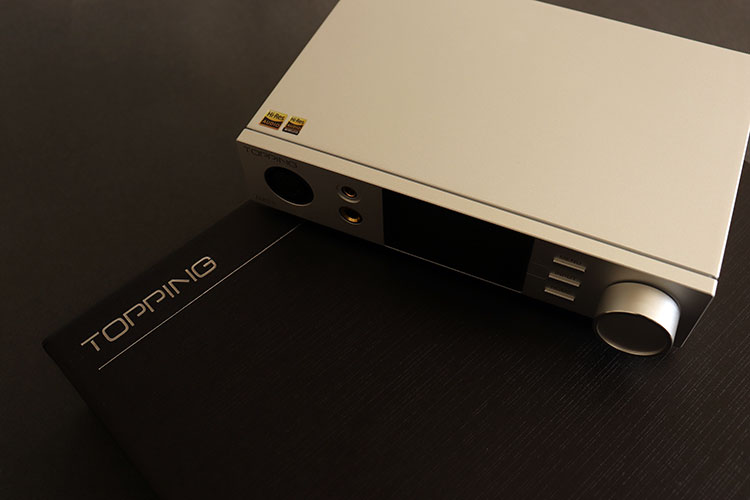
Louis reviews the Topping DX5 II, a 2nd generation compact desktop dual ES9039Q2M DAC with up to 7.6W of balanced amplification output power. It is currently priced at $299.
Disclaimer: This sample unit was sent to me in exchange for my honest opinion. Headfonics is an independent website with no affiliate links or status. I thank the team at Topping for their support.
Click here to read more about the Topping products we have previously reviewed on Headfonics.
Note that this article follows our current scoring guidelines, which you can read in more detail here.
The Topping DX5 was well-received as a DAC amp combo unit when it was released back in 2022, and it was because it offered a lot of performance and convenience in one unit, and it was offered at a competitive retail price to boot.
Topping has released the new generation DX5 II, and not only does it incorporate some major hardware upgrades and some new features, but it’s also introduced at an even more comfortable price at checkout time.
Audio gear has been getting cheaper and better by the year, and the Topping DX5 II is a good example of that trend.
And although Topping has recently released some high-priced items, like the Centaurus desktop DAC and the DX9, they also manage to release satisfying budget gear like the DX5 II.
Features
Built-in EQ implementations are becoming widely accepted nowadays. None could be happier than I since I was getting fatigued by all the sterility in audio gear lately, which is like fine food with no seasoning.
I personally prefer some color, so thanks to Topping for adding this PEQ feature to your lineup.
My first model with a built-in equalizer was the Monolith THX Amplifier & DAC amplifier combo, which was reviewed back in 2019.
Now we have FiiO jumping on board, plus Topping, of course, with models like the Centaurus and the D90 III Discrete. Others, like ADI with their ADI-2, also joined what I call the user-coloration club.
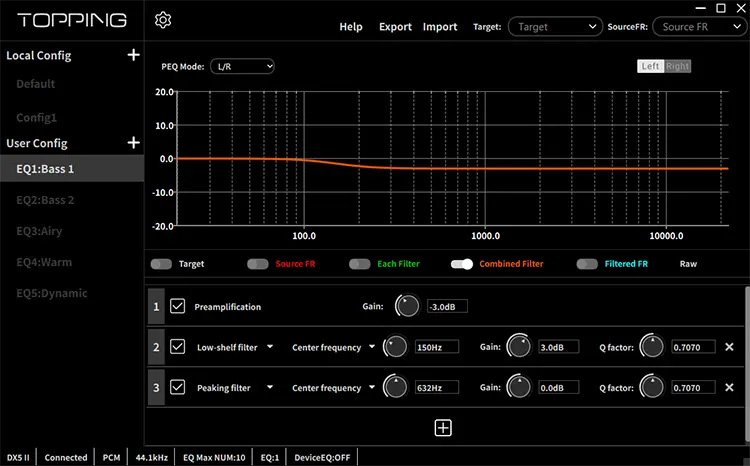
The DX5 II is compatible with Topping’s new Windows OS or iOS Tune software, which includes a 10-band parametric equalizer with adjustable frequency and Q on each band.
This is game-changing and aids in correcting many headphone anomalies or deficiencies. Plus, you can also color the overall output tone if you feel the DX5 II sounds too unfruitful.
The PEQ is also capable of storing user-defined, custom PEQ presets via the application, which gives the user access to them from within the vast onboard DX5 II menu.
The menu on the DX5 II is full of features and will take more than just a chapter to cover them all.
DAC
The DAC section in the DX5 II consists of two ES9039Q2M. This chip is widely used nowadays, but of course, the ES9069 would have been better and also produces a sweeter tonality.
However, considering the bottom line, this is fine. This configuration supplies an eight-channel DAC, which is the norm nowadays.
The DAC is fed via an XMOS XU316 if you use the USB input port, which will give you the highest bit rate capability. The DX5 II is plug-and-play, but I do recommend downloading the Thesycon driver to obtain the best results from Topping’s website.
The DX5 II has MQA hardware-level decoding capability, a feature native on the ES9039Q2M. The DX5 has decoding up to PCM 768kHz/32-bit and DSD512.
Amplification
To me, the major hardware highlight here lies with the amplifier section within the Topping DX5 II. Topping calls this implementation an X-hybrid headphone amplifier design.
The DX5 II uses a triple-stage, hybrid design based on Topping’s nested feedback composite amplifier, or NFCA. All the Topping NFCA amplifiers I’ve heard produce lots of power, ultra-low distortion, and improved efficiency. The DX5 II is not the exception.
To be more specific, the DX5 II’s amplification section uses a discrete input stage, a discrete output stage, and an opamp-based gain stage with a noise floor of just 1.8µVrms.
The DX5 II produces just around the same amount of power as Topping’s L70 separate headphone amplifier, which is rated at 7.6W maximum, which is considerable for the price tag and the size of the DX5 II. It does all that while simultaneously claiming higher efficiency over its predecessor.
Actually, this design proves its efficiency by running off direct house current, and simultaneously remaining cool to the touch, which makes it ideal for people who listen for long periods, and those who leave their electronics on all the time or forget to shut down their gear at the end of the day.
This amplifier design is what I call the antithesis of a class A design, in which efficiency is of no concern and heat is produced in high amounts.
Not with this design, although it produces unrestricted power until it runs out, of course. But it does so in a clean, dynamic fashion.
Design
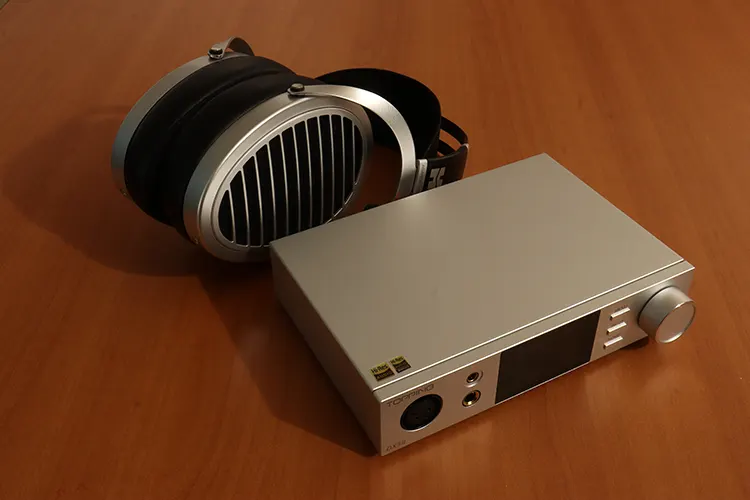
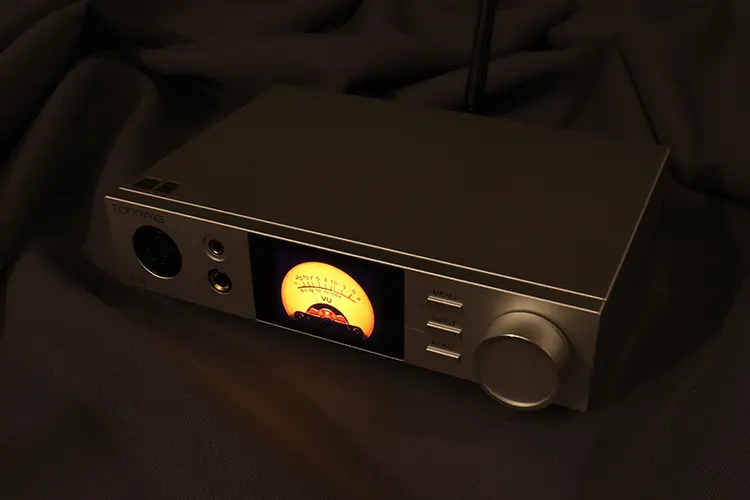
The Topping DX5 II chassis is not too big and is what I call a desktop-friendly size. It measures 15.5 x 19.0 x 4.4cm, including the volume knob protrusion. It doesn’t take up much space.
The cabinet has enough heft so when you press any of the buttons up front, the unit stays firm in its place. Four rubber feet help the unit stay put. They’re soft rubber feet that seem to help auto-level the unit as well, up to a point.
Looks like Topping used aluminum for all the components of the outer shell, including the front panel, which is very thick, vintage gear thick. Plus, the shell is also metal. It seems to be high-grade aluminum all around.
Aesthetics
Topping did a good job hiding all the mounting screws and made the cabinet look seamless. There is a small crevice between the top and front panel that seems to gather dust and other particulate matter, so keep the cookies away. That gap shouldn’t be there.
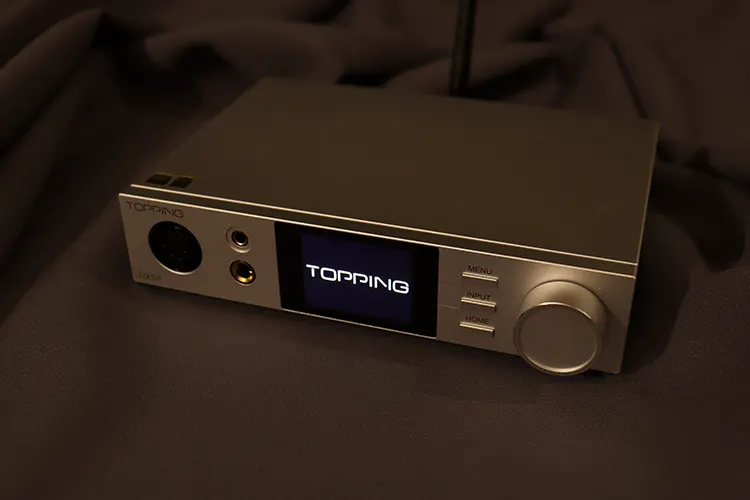
That’s my only dislike of the overall design because the DX5 II looks really good. Not only is it available in 3 colors, but you can also personalize the screen’s main theme. There are three themes to choose from: a digital display, a spectrometer, and an analog gauge.
The menu itself can also be personalized, giving the user the ability to customize even further. The DX5 II uses the Aurora UI on a full-color screen, and it’s a looker.
I/O
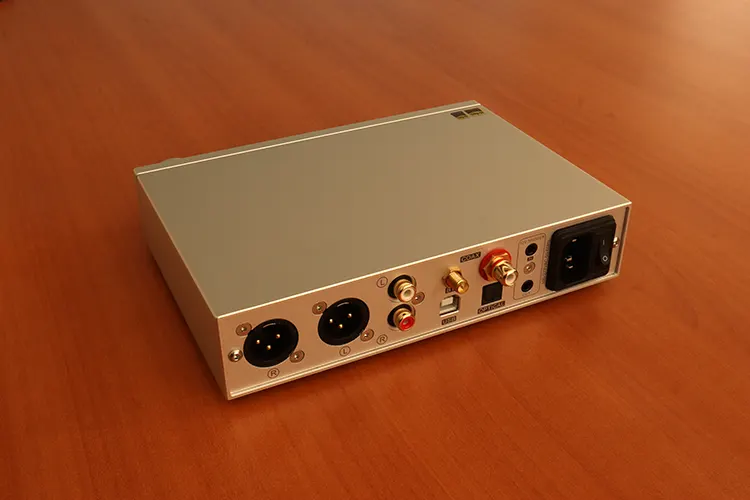
The Toping DX5 II has two analog line output ports, a set of RCA, and a set of three-pin XLR connections that can be used with a fixed or variable output, switchable via the options menu.
That means that you can access the DAC and use the DX5 II as a preamp, but there’s no access to the amplifier section separately.
The other sets of connections are digital inputs. There’s a full-sized USB Type-B connection, and I was surprised that there wasn’t a modern USB-C port available.
There’s an optical plus an SPDIF connection alongside the USB. There are also a couple of 12-volt IO triggers.
On the front side, there are three headphone connections, a four-pin XLR balanced connection side by side to a 4.4mm Pentaconn connection, plus a full-sized 6.35mm connection.
Topping throws in the box a 3.5mm adapter to give the user a total of four out of the box.
Bluetooth
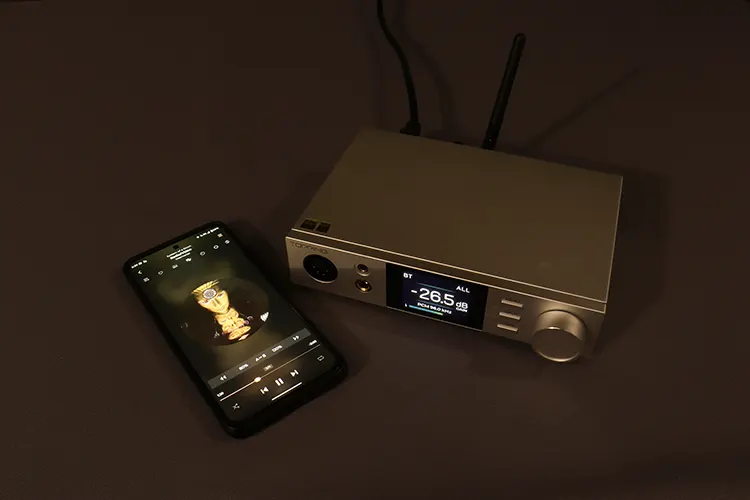
The DX5 II does have Bluetooth receiving capability via an integrated QCC5125 chip with the ability to playback almost any codec available today, including LDAC, but no aptX Lossless.
It receives BT signals via a 5.1 radio, which is not the latest generation, but the LDAC saves it as far as usability because I would hate to use a unit like this with a codec like regular aptX or even worse, SBC.
The amount of receiving distance I could obtain using a Bluetooth 5.1-equipped mobile phone was around 45 feet in a straight line, which is more than enough for any home audio situation.
I use the Bluetooth section of the DX5 II while cleaning house and entertaining guests. I don’t use it for critical listening. But it does an excellent job on LDAC. You just lose a small amount of top-end definition, like 16k vs 20k top-end extension.
Controls
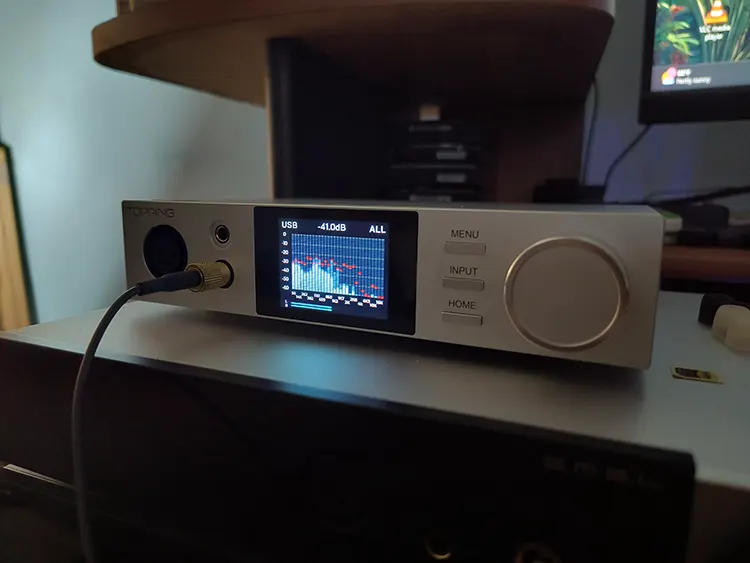
There are three buttons on the DX5 II upfront. The other switch is the power switch, which is rear-mounted right beside the power cord socket.
I dislike rear-mounted power buttons, but the DX5 II remedies that by placing a standby feature up front behind the volume knob. Pressing the volume knob wakes the unit and also enters standby mode.
The three buttons up front control specific features. For example, the menu button gives access to the menu, and you ultimately control the menu via the volume knob and the center button of the volume knob.
The home button, on the other hand, scrolls through the three available screen themes. There’s an analog VU meter theme, the spectrum analyzer theme, and the conventional digital display theme, as previously mentioned. The input button, again, is self-explanatory.
The volume knob feels solid and has indents as you adjust it, but the position doesn’t matter since it’s a digital volume knob.
It does employ fine adjustment in that you can set it to adjust the volume in 0.5 increments, which translates into a 200-step volume control knob. Add to that a two-position gain.
Software
Topping has a limited number of components that are Tune software-ready, and the DX5 II is one of them. Off the top of my head, I know the Centaurus DAC, the D90 III Discrete, and the D50 II, just to name a few, are Tune-ready.
I like this EQ implementation, and one of the reasons is that the adjustments are subtle and the bands are not the type that are set to give off a 10-decibel boost at 3 clicks above flat.
It seems that the limit is set around 10 decibels, and that almost ensures that you can’t go too overboard.
One thing I do recommend you do is to make sure you’re on the latest firmware, since some buyers reported some quirks with the first firmware.
However, Topping was quick on the rebound and released a new version. I’m currently on version 1.57, and I haven’t run into any bugs up to date.
Packaging & Accessories
The box the Topping DX5 II came in is very familiar to me. It’s the same box as the Centaurus, the A90, and the D90 came in, but the size of the box was reduced. It’s a hefty box made from cardboard pulp.
Inside the box, you’ll find the four-foot AC power cord, a four-foot USB A to USB B cable, an SMA-type Bluetooth antenna, plus a product information card.
By the way, you get Topping’s RC-18A remote control, and it uses two AAA batteries, but Topping does not include any, and that’s understandable with all the shipping regulation dilemmas nowadays, so get some prior.

Sound Impressions
The Sennheiser HD 490 PRO Plus and the HIFIMAN Arya Organic were the two headphones I used most often to test the Topping DX5 II. The Sennheiser HD 550, the Arya Unveiled, and the Ananda Nano were also used. I also used the Dekoni Blue to test the 3.5mm power output capacity.
To test the low power side, I used Flare Audio’s Studio to test for the presence of hiss, and I also used the FiiO FX17, the HIFIMAN Svanar, and the ORIVETI OH700VB.
Summary
It was an interesting experience, I felt when I heard the Topping DX5 II for the first time, in that there was a familiar sound there, but there was also a small veer in the overall general characteristics in a sonic sense. I think it was the amount of tameness in the overall signature.
However, the general Topping house sound was still there. The clean, balanced, and neutral characteristics were there, alongside a flat curve.
Compared to the original DX5, the DX5 II has improved transients and sounds more dynamic, plus the DX5 II has lots of driving prowess over the original DX5.
Heck, I like the way the DX5 II sounds over my L70 and E70 combo, sonically speaking, and that’s not a small feat since I like that combo but always felt it was a touch sterile, and it had no tuning capabilities like the DX5 II has to remedy this.
What got my attention the most was that the DX5 II did not sound as digital as some of their previous models, although the characteristic was still prevalent. It was the amicable, musical midrange and an overall character that can be called vivid and inviting.
The bass came through as clinical and clean, however, and a bit too lean for my personal taste.
The good part is that the PEQ can kick the DX5 II into a warm sonic territory, with a potent low end and increased body, but it needs that help. You can also tame peaks in the high frequencies just the same.
Detail? Over the A90 and Centaurus combo, you get ninety percent of the detail you get with that combo, although I think most of the detail in that combo is produced by the Centaurus DAC.
The only lack of the DX5 II is in resolution, but clarity was exceptional.
Staging & Dynamics
I feel that the Topping line of gear, in general, produces what I could call a natural-sized soundstage that doesn’t occupy much space, nor is it ultra-large. It tends to project more width than height. It tends to contain itself within a limited space and prefers to remain intimate.
I did find an oddity in that, somehow, the soundstage was best produced on dynamic driver headphones compared to a large diaphragm driver, which naturally produces a wider sonic panorama.
It seems the DX5 II contains itself, even if the headphone is capable of producing an ultra-wide soundstage.
Overall, the DX5 II can produce a holographic panorama with a personal or focused feeling soundstage. One that can deliver strong separation with enough depth to keep things interesting.
Click on page 2 below for my recommended pairings and selected comparisons.
