

Synergy
PEQ Software
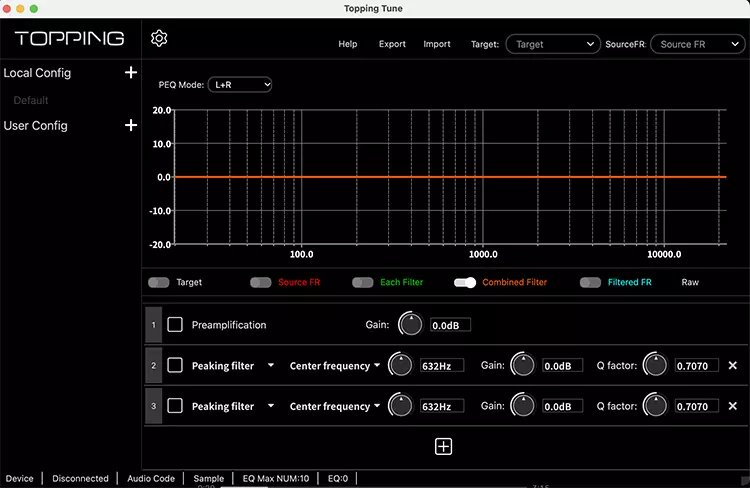
The DX1 II’s 10-band parametric EQ is configured through Topping’s Tune desktop application, available for Windows and macOS.
The implementation mirrors what is found on the DX5 II, allowing per-band adjustment of frequency center, gain, and Q-factor with a clean graphical interface.
EQ profiles can be saved to the unit’s hardware memory and recalled without the computer present during playback, which makes the feature genuinely practical rather than a setup-only tool.
During my testing, I found the Topping Tune app to be straightforward and fast to respond, notably more immediate than web-based PEQ interfaces I’ve used with some competing products.
Creating a mild shelf EQ to add warmth to the mid-bass or bring down the upper midrange forwardness took no more than a few minutes, and the effect translated cleanly to the hardware with no audible artifacts.
The absence of auto-EQ presets, which some competing units offer via their companion apps, is a notable gap.
Users who want headphone-specific correction curves will need to source AutoEQ profiles independently and enter the values manually, a manageable but less intuitive workflow compared to more guided implementations by the likes of FiiO.
For experienced users comfortable with PEQ, however, the raw flexibility of the 10-band implementation more than compensates.
As someone who enjoys using parametric EQ to explore target curves and tailor the sound of specific headphones, the DX1 II’s PEQ proved genuinely useful within my listening workflow.
Power & Efficiency
The DX1 II’s 1000mW balanced output is a significant step up from the original DX1 and delivers meaningful headroom for most consumer and audiophile headphones.
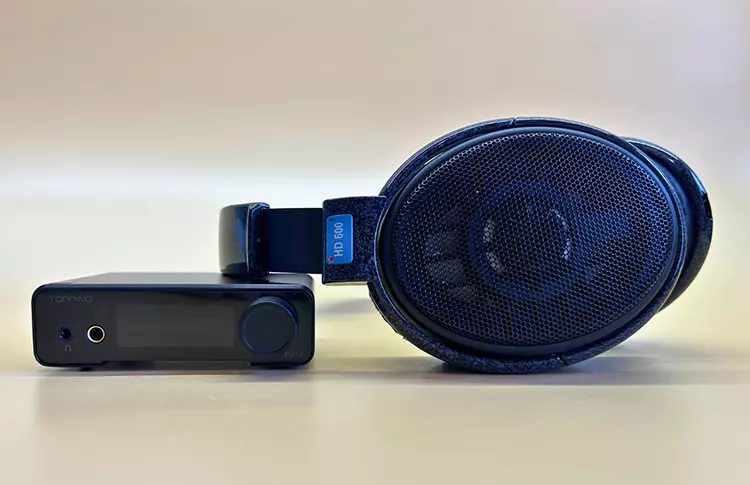
With the Sennheiser HD 600 connected via the 4.4mm balanced output, the DX1 II reached listening volume at around -25dB on high gain, with adequate headroom remaining above that.
With the Audio-Technica R70X, a 470Ω impedance load, the DX1 II required approaching -20db volume on high gain to achieve comfortable listening levels.
The unit handled this without obvious compression or distortion, though dynamics felt marginally less authoritative compared to more powerful desktop amplifiers.
With sensitive IEMs like the MOONDROP Blessing 3 and Yanyin Canon II on low gain, the noise floor remained inaudible in quiet listening environments, which is a real practical achievement for a USB-powered device at this price. No hissing was detected with either IEM at typical listening volumes.
Pairings
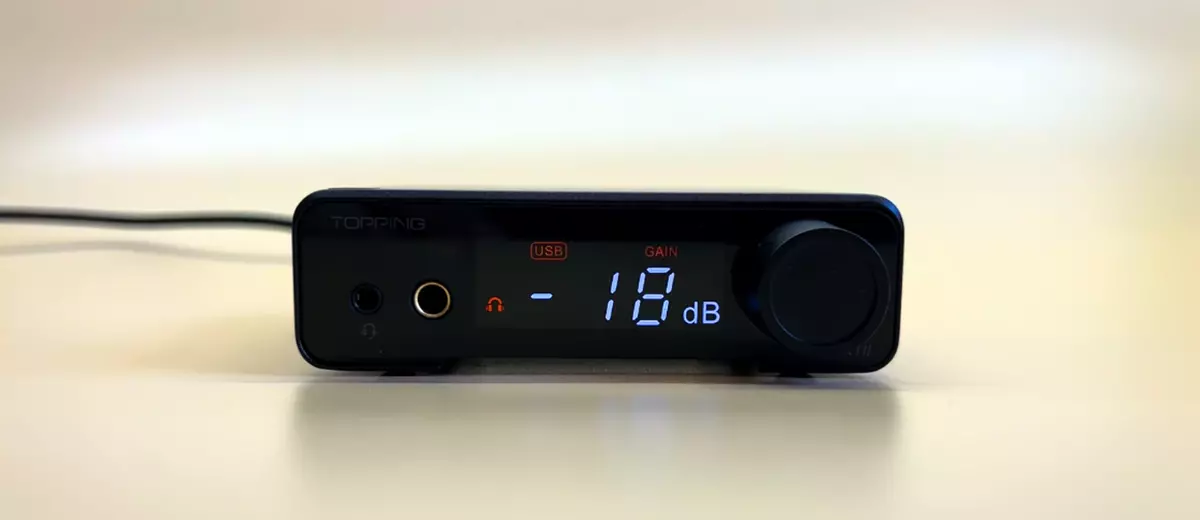
The DX1 II pairs well with warmer, fuller headphones that complement its neutral-bright character by providing the low-end body and midrange density the source itself doesn’t emphasize.
Pairing it with darker or warmer headphones creates a well-balanced listening experience without either component’s coloration stacking.
The Modhouse Argon Mk3 was my most enjoyable full-size pairing. The Argon’s characteristically dark, warm, and smooth tuning works with the DX1 II’s extended top end rather than against it.
The DX1 II had enough power to drive the notoriously power-hungry planar comfortably, reaching a satisfying listening volume at around -18 dB on low gain, which left meaningful headroom above that.
The combination produced a well-balanced, authoritative sound with good bass texture and a smooth, non-fatiguing top end.
The Sennheiser HD 600 pairing was competent and clean, with the DX1 II’s imaging precision and treble extension compensating reasonably well for the HD 600’s slightly lean bass.
That said, I consistently preferred pairing the HD 600 with warmer sources, particularly hybrid tube amplifiers, where the added harmonic density fills in what both units leave a little thin.
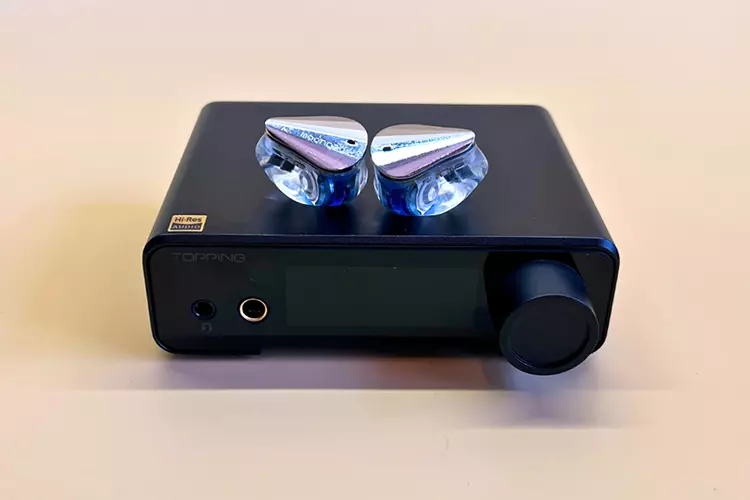
On the IEM side, my preferred pairing was the Yanyin Canon III. Its V-shaped tuning complemented the DX1 II’s overall neutral presentation well.
The Canon II’s natural coloration added the low-end weight and treble excitement the DX1 II doesn’t supply on its own, and the combination sounded lively and engaging across EDM, pop, and rock without any PEQ intervention needed.
Selected Comparisons
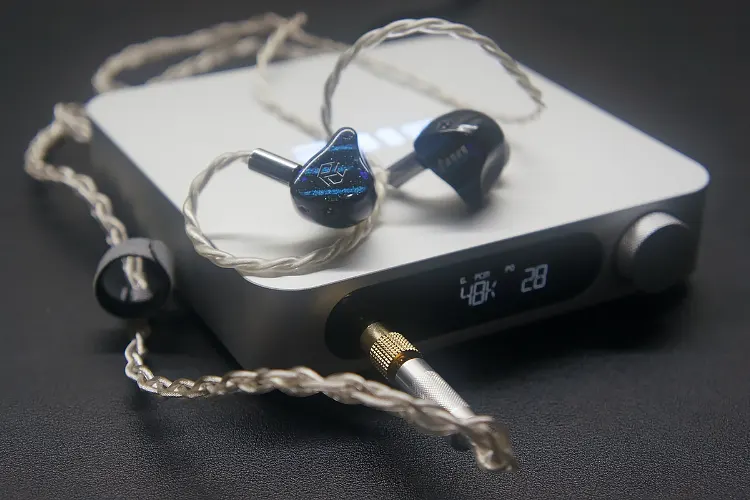
FiiO K11 R2R
Technical
The FiiO K11 and Topping DX1 II occupy similar price territory but represent meaningfully different technical choices.
The K11 is built around a Cirrus Logic CS43198 DAC chip paired with dual SGM8262 amplifiers, while the DX1 II employs ESS’s ES9039Q2M within a fully balanced architecture.
The DX1 II’s balanced output power of 1000mW at 32Ω compares favorably to the K11’s 1400mW at 32Ω through its balanced output, a gap, but not a wide one, for most use cases.
The K11 requires an external 12V power brick for operation, while the DX1 II runs entirely from USB-C bus power. The DX1 II adds optical input and output as well as a 4.4mm balanced line output, connectivity options absent from the K11’s rear panel.
The K11 includes USB, optical, and coaxial digital inputs as a standard feature, giving it more source flexibility for setups with legacy digital sources.
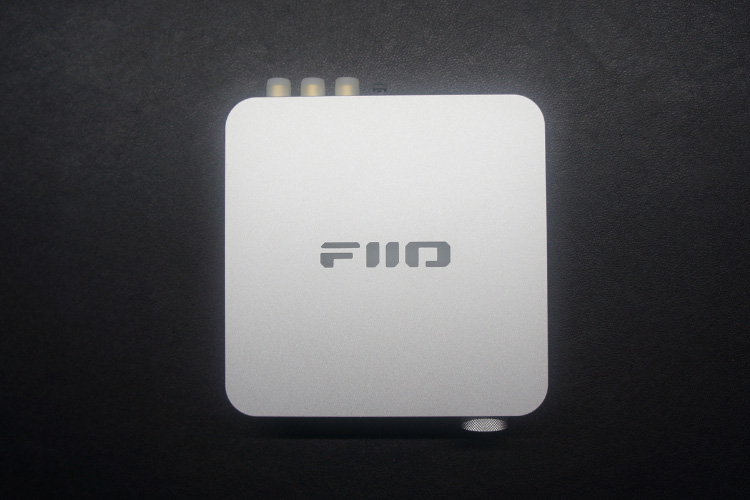
Design
Both the FiiO K11 and the DX1 II are compact, low-profile aluminum units that sit comfortably on a crowded desk without demanding attention.
The K11’s front panel features a monochrome LCD alongside its multi-function volume knob, providing an at-a-glance readout of sample rate, volume, gain, and input source.
The DX1 II has its own display that reads out volume in dB, active input, and current output mode. Neither unit is display-heavy by any stretch, but the K11’s screen is the more informative of the two.
The K11’s customizable RGB FiiO logo adds a visual differentiator that some users will appreciate, and others will ignore entirely. The DX1 II’s exterior is more restrained and integrates more easily into setups where aesthetic cohesion matters.
Performance
The K11 and DX1 II share a broadly neutral tonal orientation but diverge in ways that become apparent fairly quickly in back-to-back listening.
Bass is the clearest area of differentiation. The K11 carries more mid-bass body and note weight, producing a fuller, more physical low-end that is immediately engaging without EQ intervention.
The DX1 II is tighter and more controlled in the lows. On hip-hop and electronic music, the K11 sounds more immediately satisfying; on acoustic and jazz recordings, the DX1 II’s controlled presentation allows the mids and highs to breathe more openly.
Midrange is where the DX1 II begins to pull ahead. The K11 is warm and forgiving here, flattering a wider variety of recordings regardless of production quality.
The DX1 II is more analytically oriented, resolving fine midrange detail with greater clarity, but it also exposes the weaknesses of poorly mastered material that the K11 would smooth over.
For critical listening with well-recorded material, the DX1 II’s transparency is a genuine advantage. For casual all-day listening across a mixed library, the K11’s forgiving character is easier to live with.
Treble clearly favors the DX1 II. The ES9039Q2M retrieves high-frequency overtones, cymbal shimmer, and reverb tails with better definition and air than the K11’s CS43198 implementation, which rolls off noticeably in the upper octaves.
Imaging precision also favors the DX1 II, with tighter instrument placement and cleaner channel separation.
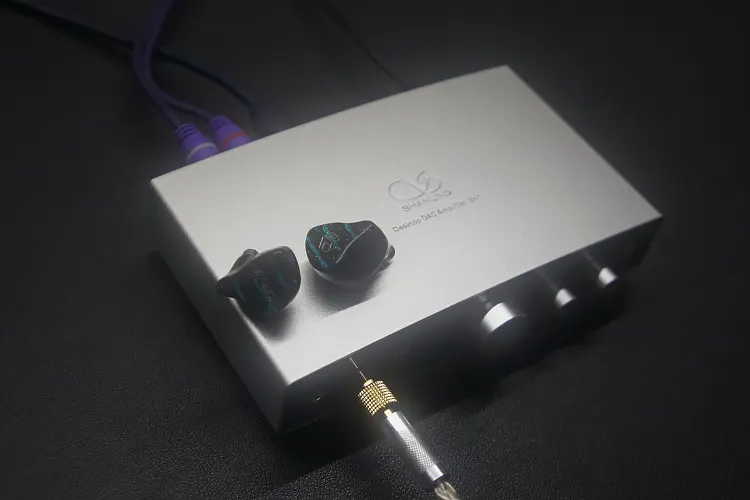
Shanling EH1
Technical
The Shanling EH1 is built around a Cirrus Logic CS43198 DAC and dual SGM8262 amplifiers, delivering up to 1015mW of balanced output power, essentially matching the DX1 II’s balanced output figure despite requiring external DC power for peak performance.
The DX1 II achieves equivalent power entirely from USB-C bus power, which is a notable engineering achievement.
The EH1 includes dedicated hardware bass and treble tone controls offering up to ±10dB and ±6dB of adjustment, a simpler but more immediately accessible tuning option than the DX1 II’s app-based 10-band PEQ.
The DX1 II counters with a UAC mode switch for console compatibility, an optical input and output, and a 4.4mm balanced line output absent from the EH1’s rear panel.
Design
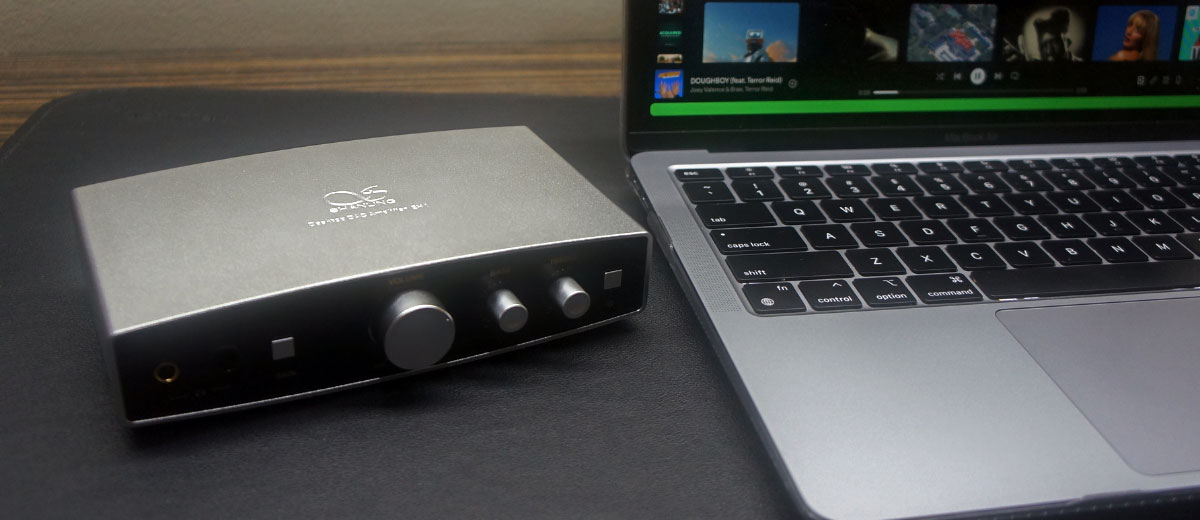
Both feature compact, aluminum chassis with a minimal front face, clean lines, and a restrained aesthetic that prioritizes desk integration over visual drama.
The EH1’s gently curved body and subtle LED ring around its volume encoder give it slightly more visual personality than the DX1 II’s more angular, utilitarian front panel.
However, the DX1 II does include a small display that the EH1 lacks entirely, reading out current volume in dB, active input source, and output mode, information that the EH1 provides no equivalent for beyond the LED indicator.
The EH1’s dedicated bass and treble control knobs add a tactile hardware interface that the DX1 II does not offer on the unit itself.
Both units have comparable build quality at their respective price points, though the EH1’s larger footprint and optional DC power input introduce more cable overhead compared to the DX1 II’s cleaner single USB-C approach.
Performance
Bass on the EH1 is slightly fuller and more forward in the mid-bass region compared to the DX1 II’s more controlled and measured low-end presentation.
The EH1 produces a bass texture that feels a touch richer and more physical, particularly on kick drum hits and bass guitar, where note weight is more immediately satisfying.
The DX1 II responds with better sub-bass definition and tighter transient control, which gives it an edge on complex low-frequency passages where separation and clarity matter more than mass.
Midrange performance is competitive between the two. The EH1 presents a slightly warmer, more forward vocal reproduction; male and female vocals carry a little more presence and body, making it a more immediately musical listen on vocal-centric genres.
The DX1 II is marginally more resolved and transparent in the mids, better differentiating backing layers and fine harmonic detail at the cost of some of the EH1’s organic density.
Neither has a decisive advantage here, and the choice largely comes down to whether you prefer the EH1’s more colored engagement or the DX1 II’s cleaner, more neutral transparency.
Treble and imaging favor the DX1 II by a moderate margin. The DX1 II’s top end is more extended and detailed, with better cymbal definition and high-frequency air than the EH1’s slightly conservative treble tuning.
Imaging precision is also tighter on the DX1 II, with more stable instrument placement across complex mixes.
iFi audio ZEN DAC V1
Technical
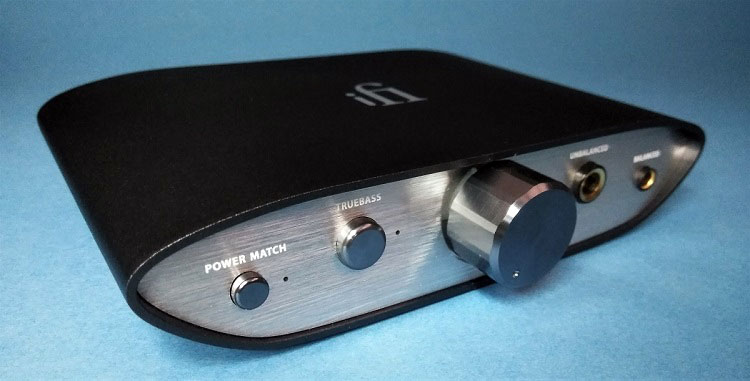
The iFi audio ZEN DAC V1 represents an older design philosophy applied at the same price bracket.
The ZEN DAC employs a Burr Brown DSD1793 DAC chip alongside iFi’s proprietary programming of the XMOS USB receiver, a pairing that is not class-leading on measurement benchmarks but was designed with sonic character in mind.
The DX1 II’s ES9039Q2M chip measures considerably better across distortion and noise floor specifications.
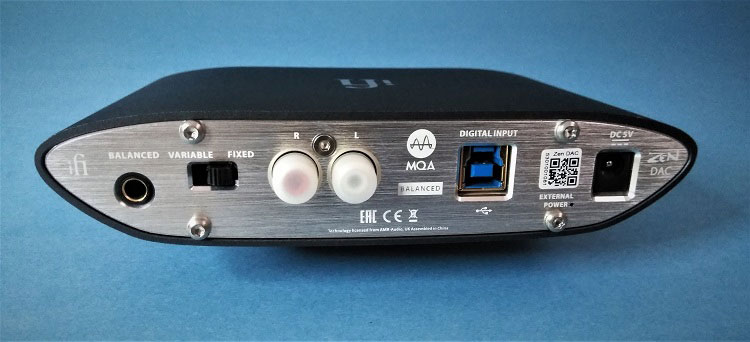
The ZEN DAC V1 is USB-only for digital input, lacking the DX1 II’s optical input and output and its broader connectivity options. Both units support bus-powered operation.
Power output on the ZEN DAC V1 is considerably lower than the DX1 II’s 1000mW balanced figure, making it less capable with demanding headphones. The ZEN DAC V1 does include MQA decoding support, which the DX1 II does not.
Design
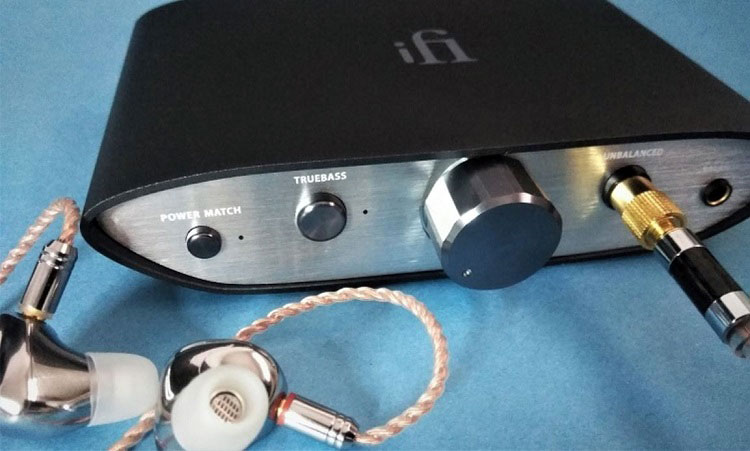
The ZEN DAC V1 and the DX1 II take meaningfully different approaches to physical presentation. The ZEN DAC’s distinctive, rounded aluminum enclosure is notably dense and premium-feeling for its price, with a heft that communicates build quality before a single cable is connected.
Its front panel houses a volume knob, a PowerMatch gain selector button, and a TrueBass toggle, a small but tactile hardware control set that the DX1 II does not replicate.
ZEN DAC V1 has no display, relying instead on a bitrate indicator LED for source feedback. The DX1 II’s small display, which reads out volume in dB, active input, and current output mode, is a functional advantage here.
It provides more actionable operational information than the ZEN DAC V1’s single LED and makes switching between USB and optical inputs noticeably less ambiguous in daily use.
The DX1 II’s more angular, minimal front face lacks the ZEN DAC V1’s visual personality but integrates more cleanly into a modern desktop setup.
Both units are bus-powered and similarly compact, though the ZEN DAC V1’s more unconventional silhouette makes it the more visually distinctive of the two.
Performance
The ZEN DAC V1 and the DX1 II represent genuinely different philosophies, and those differences are audible across every major performance parameter.
Bass on the ZEN DAC V1 is warmer and rounder, carrying more mid-bass body and a sense of physical weight that makes it immediately satisfying on a wide range of music. The BurrBrown chip and iFi’s analog stage tuning produce a lush low-end.
The DX1 II’s bass is tighter and more controlled, with better sub-bass texture and faster transient recovery, though it sacrifices some of that body in the process.
Midrange is the ZEN DAC V1’s traditional strength. Vocal texture, harmonic density, and the organic quality of acoustic instruments are all rendered with a richness that the DX1 II’s more neutral character does not fully replicate.
The ZEN DAC produces an intimate, emotionally engaging midrange that rewards long listening sessions with well-recorded vocal and instrumental music.
The DX1 II is more resolved and detailed in the mids but can sound comparatively lean and clinical on the same material, particularly with headphones that already lean toward neutrality.
Treble extension and imaging precision clearly favor the DX1 II. The ZEN DAC V1’s top end is smooth and inoffensive but lacks the air and high-frequency definition the ES9039Q2M retrieves comfortably.
Instrument placement is also more precise on the DX1 II, with tighter localization and better depth layering in complex mixes.
My Verdict
The Topping DX1 II desktop DAC/amp is a genuinely impressive value proposition in the current entry-level desktop DAC/AMP market.
A fully balanced ES9039Q2M architecture, 1000mW of output power from USB-C bus power alone, a 10-band parametric EQ with hardware profile recall, optical input and output, and a 4.4mm balanced line output at $119 is a feature set that would have commanded considerably more money just a few years ago.
Sonically, the DX1 II rewards thoughtful headphone matching and benefits from light PEQ work to extract its best; it is not the warmest or most immediately forgiving listen at the price, and the gain-via-remote-only limitation is a genuine operational frustration.
That said, in terms of technical performance, feature breadth, and overall value, the DX1 II sets a new reference point for the sub-$120 desktop DAC/AMP category.
Topping DX1 II Technical Specifications
- DAC: ESS ES9039Q2M
- Architecture: Fully balanced
- Output Power: 1000mW × 2 @ 32Ω (BAL)
- Input(s): USB-C, Optical (Toslink)
- Output(s): 3.5mm TRRS (headset/SE), 4.4mm BAL, RCA SE line out, 4.4mm BAL line out, Optical (Toslink)
- USB Playback: 32-bit/384kHz PCM
- THD+N: <0.00007%
- Noise Floor: 0.9µVrms
- Microphone: 4-pole TRRS headset input support
- UAC: Switchable UAC 1.0 / UAC 2.0
- Power: USB-C bus power
