

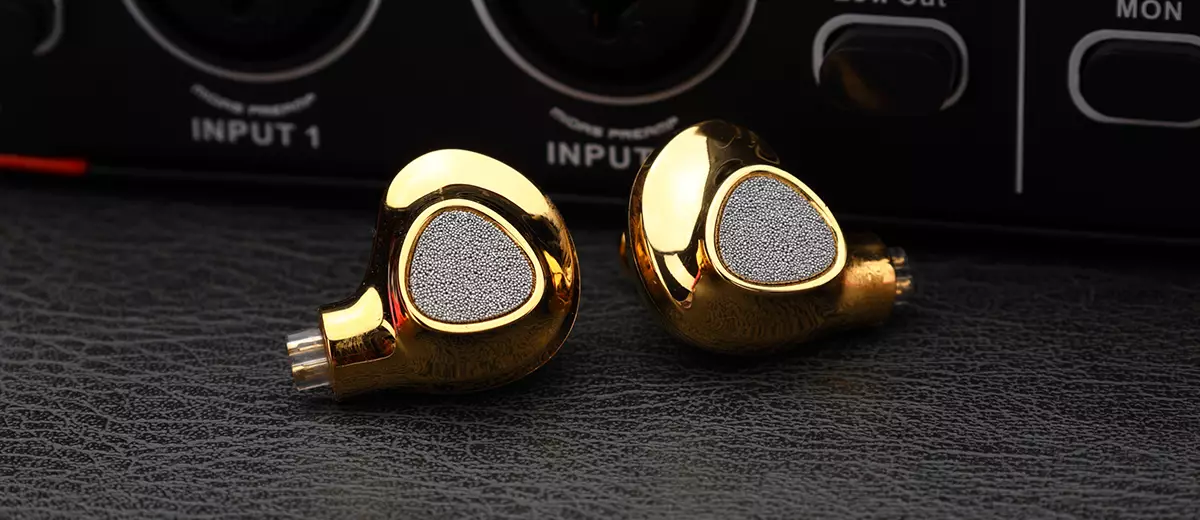
Marcelo reviews the TinHiFi P2 ULTRA, the company’s flagship 12mm ultra-thin planar driver in-ear monitor, finished in a 24K gold-plated shell. It is currently priced at $599.00.
Disclaimer: This sample was sent to me in exchange for my honest opinion. Headfonics is an independent website with no affiliate links or status. I thank TinHifi for their support.
Click here to read more about the TinHiFi audio products previously reviewed on Headfonics.
This article follows our latest scoring guidelines, which you can read in more detail here.
The TinHiFi P2 ULTRA is the latest in the company’s planar-driver IEM series and is currently priced at $599.
It was released in late 2025, succeeding the previous flagship planar, the P2 PLUS, and is positioned above the P2 in the product hierarchy.
I have been curious about TinHiFi for a while now, and I was lucky to hear the TinHiFi T6 and T7 in my previous reviews.
What got me curious about the TinHiFi P2 ULTRA is its 12 mm 3rd-generation, ultra-thin diaphragm planar driver and its transient response speed compared to the competition.
To find out how it performs and compares to the SIVGA Nightingale PRO and the Hidizs MP145 PRO, you can read my full review below.
Features
The TinHiFi P2 ULTRA has a few but high-quality features, the most notable of which is its 3rd-generation 12mm ultra-thin planar magnetic driver with a nanoscale-coated 0.02 mm diaphragm and dual-layer N52 neodymium magnet arrays.
The new planar driver is rated to deliver 7 Hz–50 kHz frequency response, which is a very wide bandwidth, to deliver velvet-smooth ultra-high frequencies, lightning-fast transients, and earth-shaking yet controlled bass that only desktop amplification exceeding 3 W can fully unleash, as the product page said.
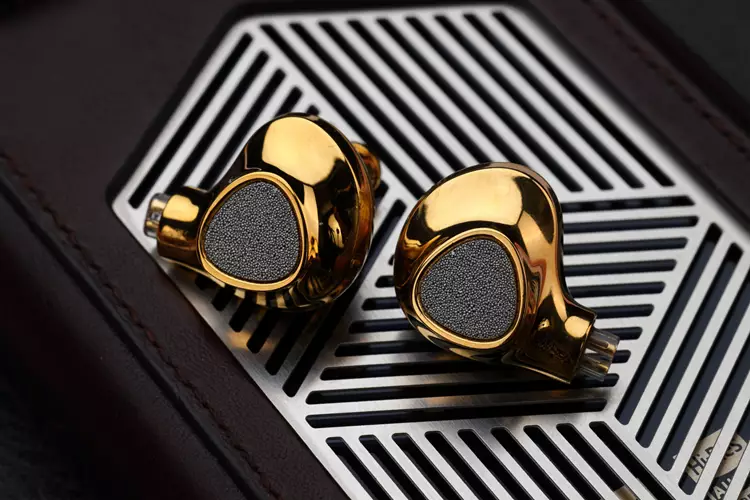
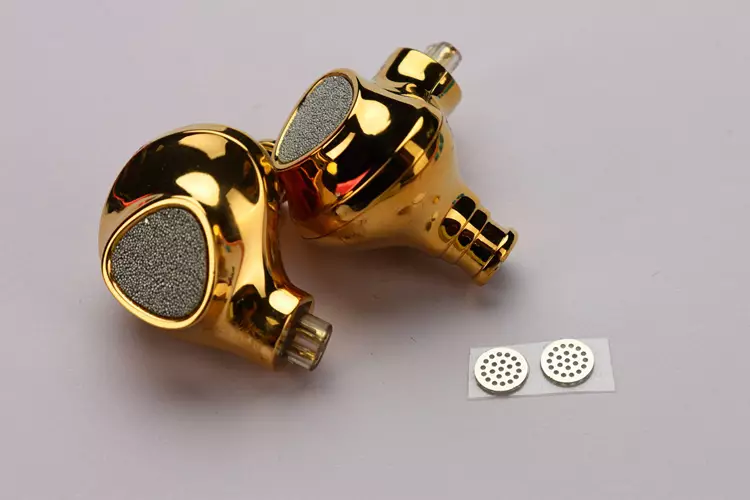
The P2 ULTRA features a unique backwave venting method called the exclusive SPD™ Spiral Dynamic Breathing Panel, an open-breathing faceplate.
It is basically a Precision-machined spiral airflow channel on the rear, combined with a high-density micro-mesh, that creates a sort of “one-way acoustic valve” that vents back-pressure while effectively blocking external noise.
The P2 ULTRA also features effective ear canal pressure relief. This prevents pressure from building up in the ear canal while listening, which can cause fatigue, ear pain, headache, and nausea.
The P2 ULTRA has an impedance of 32Ω and a sensitivity of 98 dB/mW @1kHz, so I can tell right away this IEM will not be super sensitive.
Design
One thing I noticed right away is that the Spiral Dynamic Breathing Panel in the P2 Ultra’s faceplate feels like the surface of a nail file. I tried my nails on it, and it works. I’m not saying it is ugly, but it just looks strange to me, being in the faceplate of an IEM.
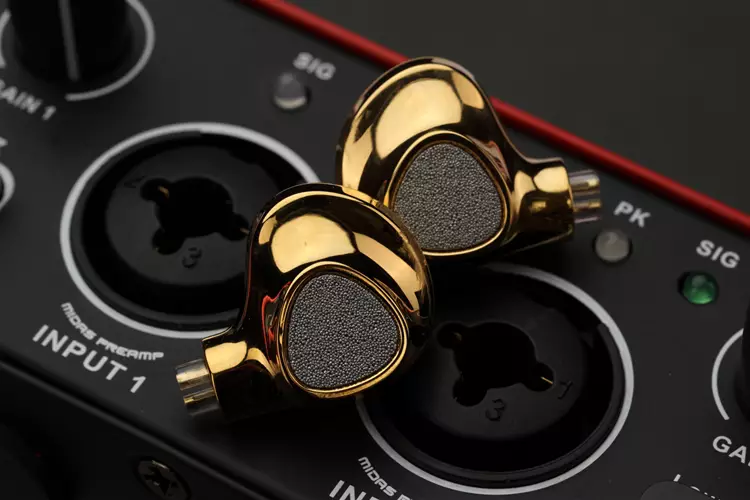
However, the ergonomically shaped, small, lightweight, and 24K gold-plated magnesium alloy shell looks beautiful both in the hands and on the ear. It feels like I am having body accessories when using the P2 ULTRA, as the shiny gold shells add bling to the listener.
I’m happy to see the P2 ULTRA uses QDC-style 2-pin connectors, which are easier to love than the MMCX connectors used in their flagship single-DD IEM, the T7.
The P2 ULTRA is very lightweight at 5 grams per shell, which is below average among the IEMs I’ve tested. It has a 5.8 mm diameter nozzle, which is average and within the ideal limits of 5.6 mm to 6 mm in my opinion.
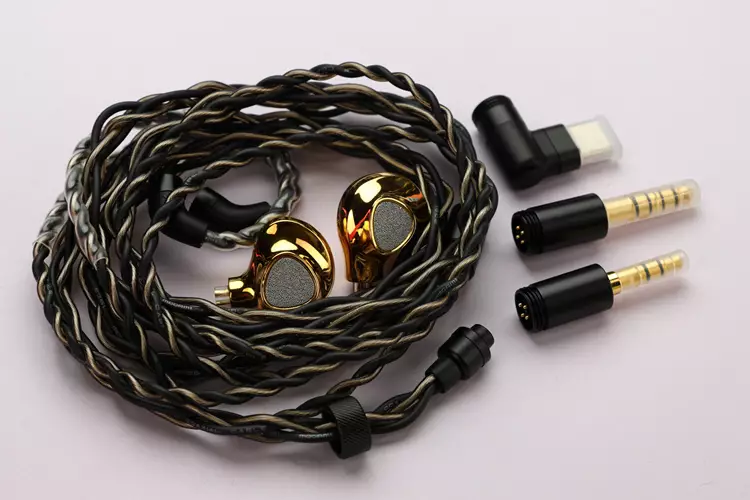
Stock Cable
The P2 ULTRA comes with a thick cable featuring a Japanese Mogami coaxial core and an 8-core 5N single-crystal copper with a thick silver-plated hybrid braid.
During use, the cable feels a little stiff and not very compliant. Which I view as a positive, as it means the wires are filled with real metal conductors.
Unlike lesser-quality cable of similar thickness, which is soft and compliant but has plastic fillers along the copper braiding inside. I learned about this during my DIY IEM cable-making days years ago.
My review unit comes with a modular cable with 3.5 mm and 4.4 mm plugs and a Type-C Single-Ended plug. For an extra $30 or so at checkout on the TinHiFi website, a separate USB-C cable, called the TC01, with or without an Apple Lightning adapter, will be included.
I tried the included USB-C plug, and it sounds nice, warm with an extended treble, but with less resolution than my sources. Its maximum volume is low; it barely reaches my normal listening level, and it doesn’t go as loud as the ANC wireless earbuds I’ve reviewed.
Comfort & Isolation
Thanks to the ergonomic shape of the small and lightweight magnesium alloy shells, the P2 ULTRA is very comfortable to wear. I did my walking exercise, a long listening session, and relaxation in bed using the P2 ULTRA, and it faded easily from my awareness, letting me enjoy the music unbothered.
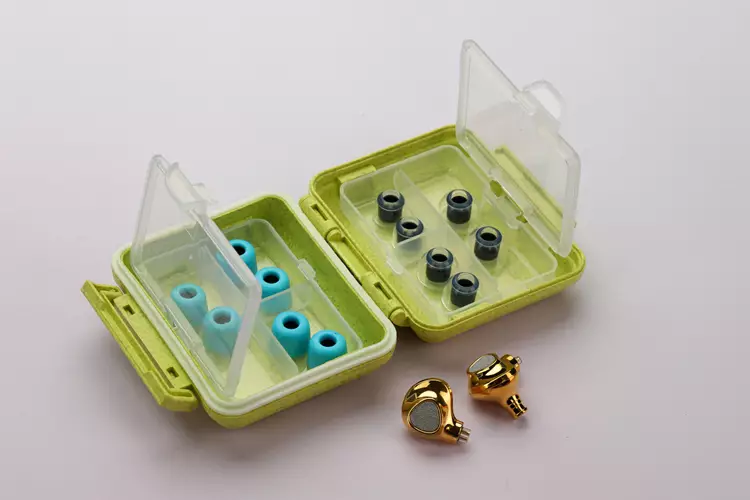
However, I find the liquid silicone ear tips take getting used to and need to be oiled to be effective at air-sealing, as they tend to catch on the outer part of the ear canal and won’t slide in easily, making it difficult to get a proper seal.
Once it is used several times and the surface is coated with skin out, it slides in and seals easily.
Noise isolation is average, which I consider a positive, as I don’t want to be completely deaf to the outside world while wearing the P2 ULTRA during a public walking exercise.
Packaging & Accessories
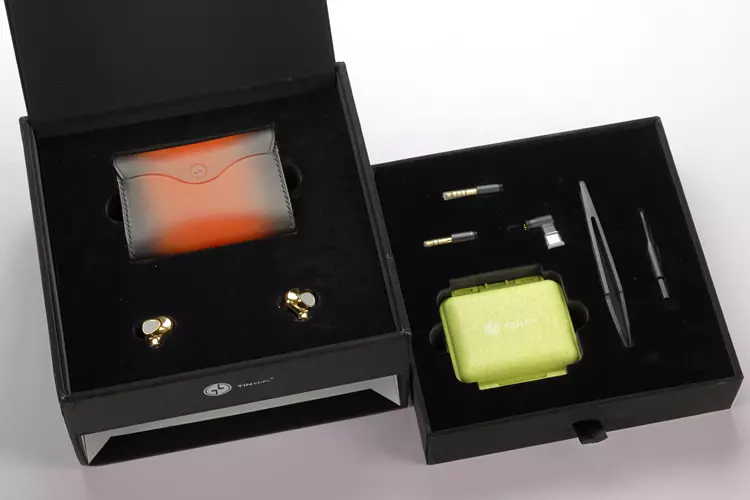
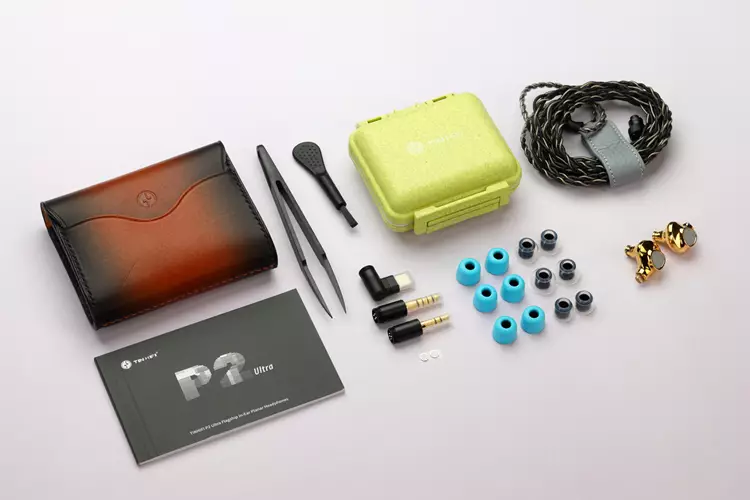
I have a good first impression of the P2 ULTRA’s big black box, measuring 202 x 193 x 104 mm, with an outer sleeve. The main box opens from the top to reveal the P2 ULTRA, with a drawer at the bottom front housing the accessories.
The packaging includes a pair of P2 ULTRA IEMs, a modular cable, a 3.5mm plug, a 4.4mm plug, a Type-C adapter, 3 pairs of memory foam ear tips, 3 pairs of Liquid Silicone ear tips, an ear tip case, a leather storage case, a cleaning brush, a pair of plastic tweezers, a pair of extra metal filters, a user manual and warranty card, and a cable cinch.
Sound Impressions
I spent about 24 hours of the burn-in period by letting it play with a DAP continuously at normal volume while checking in from time to time.
I noticed a subtle improvement in the background’s cleanliness, but in hindsight, I estimate that the P2 ULTRA only needs about one hour of burn-in, as I never noticed it improve after that point.
For the sources, I used my iBasso DC-Elite and MUSE HiFi M6 Double DAC amplifiers with my Android phone, and the FiiO M15S DAP, using YouTube Music, UAPP, or PowerAmp music player Apps. No EQ or any sound enhancement programs were used.
I used the stock liquid silicone ear tips and the stock cable with the 4.4 mm plug.
Measurement
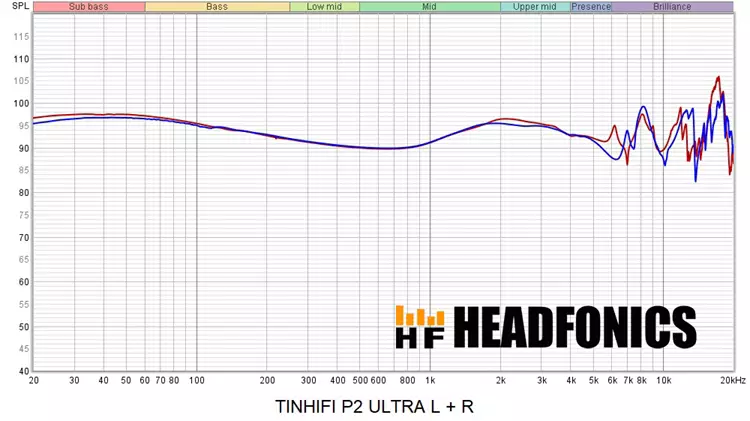
My measurements of the P2 ULTRA reveal a well-balanced channel set, with only a minor, inaudible imbalance in some frequencies.
The peak at 8 kHz is partly due to the measuring tool’s resonance and isn’t as pronounced as it appears during listening; the overall rise in the upper treble is very noticeable, though.
Summary
The first thing I noticed with the P2 ULTRA is the crispness and airiness of the treble. It’s very detailed, nuanced, delicate, natural, and shimmery, without sounding overly bright, harsh, or fatiguing.
The P2 ULTRA has an audiophile-style, analytical, U-shaped sound signature with good subbass presence and extension, a recessed midrange and treble, and a boosted upper treble.
I was wary, before listening, that the bass would be light and thin due to the ultra-light moving mass of the planar drivers. I was very surprised that the bass is extended, weighty, and thick, as if it were coming from a dynamic driver.
Midrange has a lush, relaxed sound with plenty of detail and accurate note weight. The upper midrange and lower treble are recessed, which makes the overall sound presence laid-back.
This kind of tuning ensures a very low fatigue factor, as most people are sensitive in this region of the audio spectrum. However, this also makes the sound too laid-back for some people, including me.
I like the way the upper treble is boosted, as it sounds pristine and airy, with plenty of microdetails without sounding unnatural.
Additionally, the actual perceived resolution is very high, and the transient response is very fast.
Coloration
Aside from the U-shaped sound signature of the P2 ULTRA, I find the upper midrange is recessed, which can make for a non-fatiguing sound even at loud volume. However, it sacrifices the vocal presence and makes the snare drums more subdued.
And even though I like the way the upper treble sounds, natural and non-fatiguing, I find it obviously boosted.
Nonetheless, the P2 ULTRA still sounds natural, avoiding unwanted coloration like thin, dry bass, peaky upper midrange, and dry, harsh treble that I associate with older-generation planar IEMs I heard years ago.
Soundstage
The P2 ULTRA’s soundstage is undeniably spacious, with the instruments and vocals emanating from a distance. When playing some songs at loud volumes, it feels like I’m in the middle of a large concert hall.
The soundscape is wide, deep, and high, with an immersive surround-sound sensation that I find very satisfying.
Although the images could come from the extreme left or right side, with good panning performance and a stable center image of the main vocalist. They tend to be situated at a distance, and few holograms are projected to float in the center front area.
There is good side-to-side instrument separation and a reasonable degree of definition, but the front-to-back layering and the image holography aren’t as good as some of the best I’ve heard.
The P2 ULTRA seems to sacrifice a fair amount of imaging performance for very good staging, which is, in my opinion, a better compromise compared to when it’s the other way around.
Dynamics
The P2 ULTRA has a lively, energetic sound, especially in the bass and upper-treble regions. I never had a song that made the sound anemic, even at fairly low volume levels.
However, I noticed that it has lower-than-average sensitivity, which requires me to increase the volume setting substantially to near maximum on my iBasso DC-Elite to match the normal loudness of the other IEMs for comparison in this review.
Click on page 2 below for my recommended pairings and selected comparisons.
