

Lynn reviews the Sennheiser HDB 630, the company’s new flagship wireless, ANC-capable closed-back headphones, packaged with the BTD 700 BT dongle. It is currently priced at $499.95
Disclaimer: This sample was sent to me in exchange for my honest opinion. Headfonics is an independent website with no affiliate links or services. I thank Sennheiser for this opportunity.
Click here to learn more about the Sennheiser products previously reviewed on Headfonics.
Note that this feature follows our latest scoring guidelines, which you can read in more detail here.
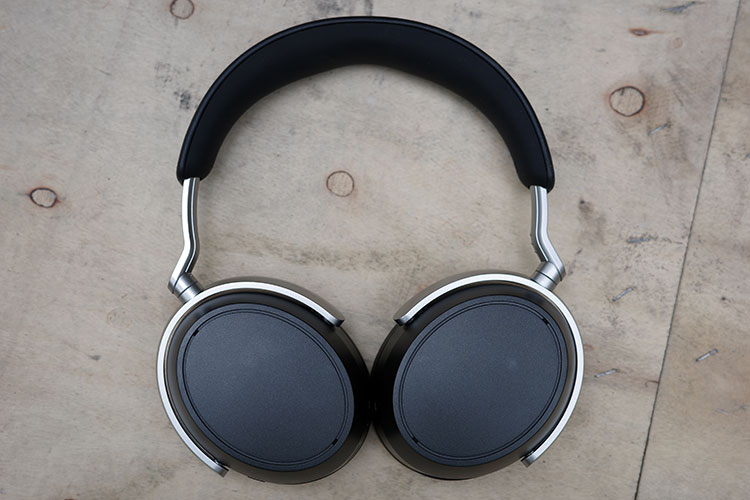
There seems to be a constant race between the top headphone companies surrounding their top-of-the-line wireless headphones.
For many years, Sony had the top ANC headphone in the WH-1000XM5 (and MX4). Others, such as the Focal Bathys, presented audio quality first and foremost. B&W in the PX8 iterations tried to convey both, with modest success.
Sennheiser, on the other hand, tried to present excellent sonic quality with very good ANC, usually second only to the Sony models. With the new $495.95 HDB 630, the company takes a slightly different approach.
Piggybacking off the highly successful MOMENTUM True Wireless 4 and the ACCENTUM Plus by incorporating the tried and true swipe gestures, with the excellent sonic characteristics of the company’s other headphones, the HDB 630 promotes the best of both worlds: sonic quality combined with ANC that the user can define for their beneficial listening pleasures.
The HDB 630 represents Sennheiser’s wireless headphone, gunning to get back on top of the competition. Raising their game, so to speak, Sennheiser is going right after the top tier of wireless headphones.
In reading a couple of reviews, I noted differences in sound descriptions, and I believe this could be because the Sennheiser has recently updated the firmware. This is, of course, just my humble opinion.
Features
The Sennheiser HDB 630 wireless headphones use a 42mm dynamic driver (produced in the company’s Tullamore facility in Ireland), which is slightly larger than the ACCENTUM Plus 37mm version.
Full support for aptX Adaptive, SBC, AAC, and mSBC is included courtesy of Qualcomm’s Bluetooth 5.2 chip, with up to 24-bit/96kHz resolution.
With a 105 dB sensitivity rating, the Senns come across as easy to drive (when wired), reaching quite loud volume levels when the source could provide the energy. With carefully tuned acoustic treatments, precision of reproduction is emphasized, mimicking wired performance.
Two microphones per side, “beamforming” for noise reduction, provide top-quality voice technology for use with your phone. Our son was able to hear me quite well, with minimal wind noise on a blustery Lake Superior day, with the wind cutting right into me.
Combining the headphones, BTD 700 dongle, and the included cables with the case does make for a heavier package, but not so far out of the norm to cause issues.
Plus, the inclusion of the highly rated BTD 700 dongle allows the user to gather Hi-Res audio from many different sources, expanding potential options. Pairing was easy, too.
Using a refined DSP engine, the goal is to reproduce every track with a sense of scale and authority that the competition potentially provides. By and large, this approach works.
Design
Materials
The immediate feeling of quality came to mind when I opened the HDB 630 box. And higher quality than the more plastic MOMENTUM and ACCENTUM variants, which, of course, have a designated price point to hit.
The luxurious feeling is reminiscent of a competitor, but with the Sennheiser flair for efficiency and good looks. There is definitely a Germanic flavor to the design and efficiency.
The headband replaces the Kvadrat fabric with a pleather one (IdeaTex) and adds more padding on the underside. I appreciated this additional material for comfort’s sake and the quality of the build.
A simple single-band approach is still used for the headband, but the additional padding, along with the material change, makes for a thoroughly positive response. The “memory” feel of that extra padding helps to form fit to the user’s head, if you like.
Aesthetics
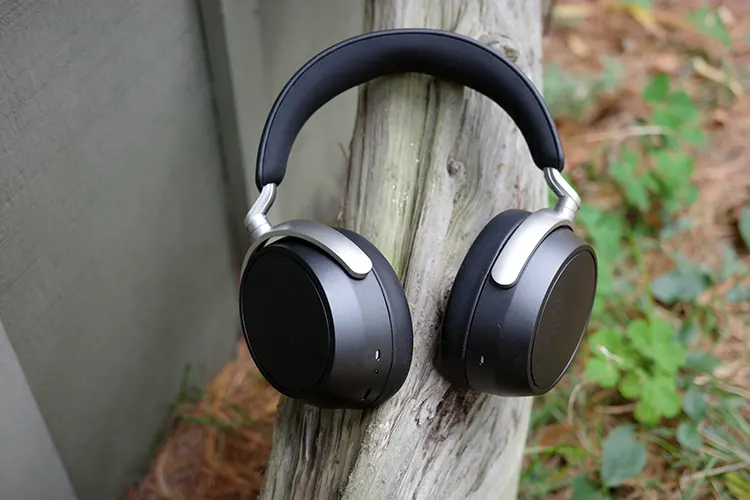
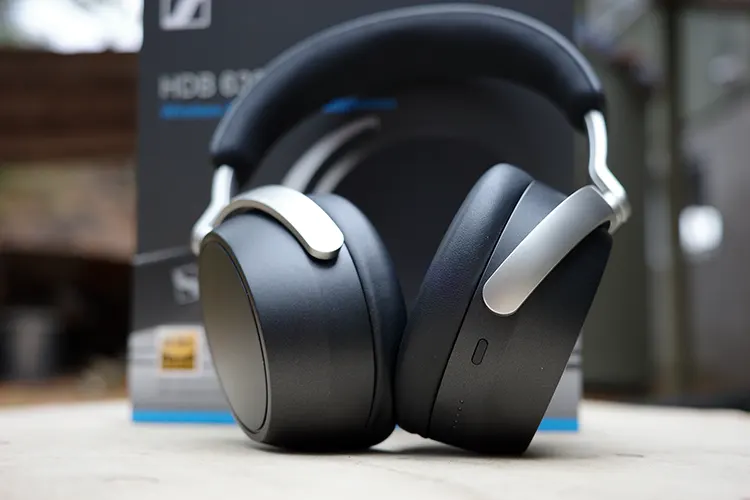
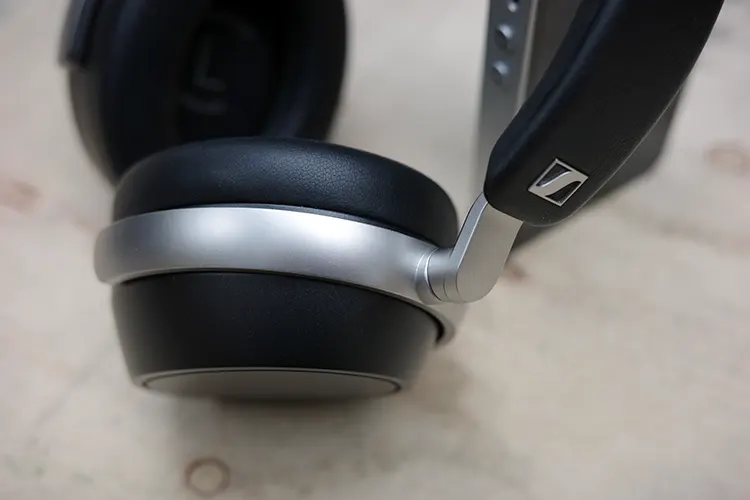
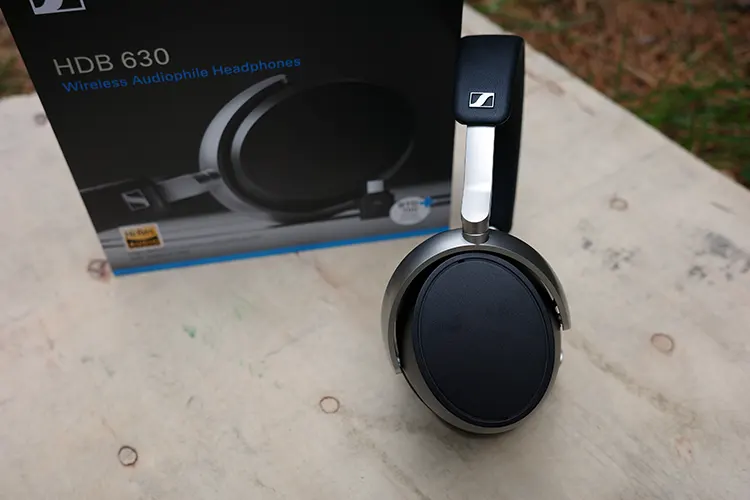
There is also no denying the familial resemblance to Sennheiser’s other wireless headphones, with homage also paid to their exceptional wired headphones, especially the HD 660 series. Design cues meld into a modern look that certainly looks the part.
There is still a fair amount of plastic, but the look and feel make for an upscale appearance not unlike the flagship models the HDB competes against.
That plastic helps hide something I appreciate, which some others have not yet mastered: fingerprints. After repeated hard use in my garage, while working with wood and moving pellets for the upcoming winter, the HDB 630 showed nary a fingerprint.
The stanchions and yoke show a subtle silver in color that adds subtlety to the overall look. Sennheiser moves forward with its tradition of humble-looking offerings, which I appreciate.
The USB-C and aux input, along with the single button, which covers power, pairing, and ANC control (when powered on), reside on the right earcup bottom. Save for an identical microphone on top and bottom, the left cup is bare.
There is definitely a premium feel to the HDBs, which sets them apart from their more moderately priced cousins.
Comfort & Isolation
The HDB 630 feels quite comfortable when placed on your cranial matter, belaying the slightly heavy feel to it.
The pads are eminently comfortable, forming to your head with ease. Sometimes, with ear pads of this manner (slightly smaller and more vertically ovoid), I find the pressure below my ear comes into play. That is usually a sign of poor padding or not enough support for the pad.
The Sennheiser HDB 630 has neither, and long listening sessions (greater than six hours in the garage, plus other dedicated sessions) presented no issues.
The slightly narrow ear cups were never felt, even in movement, which represents an excellent melding of the headband, stanchion/yoke, and ear pad working in concert together, providing an excellent fit.
The only downside to that comfort and pad luxury was lower passive isolation than its competitors. Even with ANC on, using lower volumes, outside influences could be heard. The ANC might work well, but true isolation from the headphone was found lacking by me.
The HD 630 comfort level rises right to the top of the group, besting some that cost significantly more, even. Isolation ends up mid-pack in my estimation, though.
ANC
Sennheiser’s Achilles heel seems to be catching (or passing) the competitors in ANC control. They seem to favor audio quality first, followed by quality in the ANC control, rather than a full-blown isolating factor.
The HDB 630 has better control than the MOMENTUM but still falls behind the best in this category. That may also be by design, as audio quality is first and foremost Sennheiser’s forte.
You can control ANC from your Smartphone while using the HDB 630 on another device, such as your computer. A nice touch, giving the user an on-the-fly ability to adjust. Ranging from Adaptive to Custom to Off, you can tailor the ANC to meet your needs.
Custom allows the user to denote 0-100% total between ANC and Transparency at the slide of a bar. With the ability to tailor Noise Control too, there is adaptability that benefits the ANC experience of the HDB 630.
Transparency can be altered from low to high on phone calls using another slider in a sub-menu, as well as Anti-wind settings of Auto or Max (where I left it).
Controls
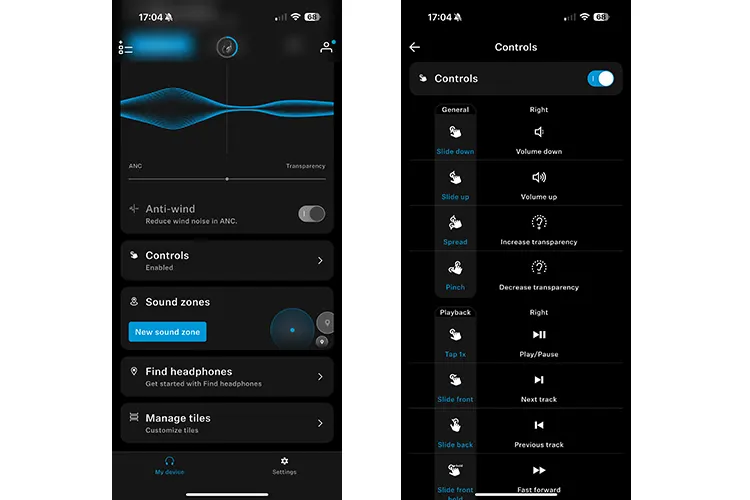
The outside of the HDB 630 right ear cup holds the touch sensitivity area for complete control of the headphones. Using a touch, swipe, or pinch controls all of the functions listed below:
- One tap to play/pause music
- Left/right slide to hang up/answer a phone call
- Up/down slide to increase/lower the volume
- Pinch/spread for blending active noise cancellation with transparency
- Double-tap for pause & full transparency mode (good for quick conversations)
Taking the HDB 630 off and folding it flat puts them into pause mode, much like taking them off would. This even worked while connected to two devices.
What did not always work, though, was the pause when removed from your head. This did work on my iPhone, but not consistently while tethered to my phone and MBP together.
The swipe gestures did function better than the previous iterations, and mostly without fault.
Smart Control Plus App
As part of the pre-launch HDB 630 review process, I was told to download the Beta version of Smart Control Plus (the public version is now live). Quickly, within a day or two of receiving the guidelines.
I was prompted in the document on how to download the app and connect to the HDB 630 the first time by using a Smartphone, so the firmware could be immediately updated.
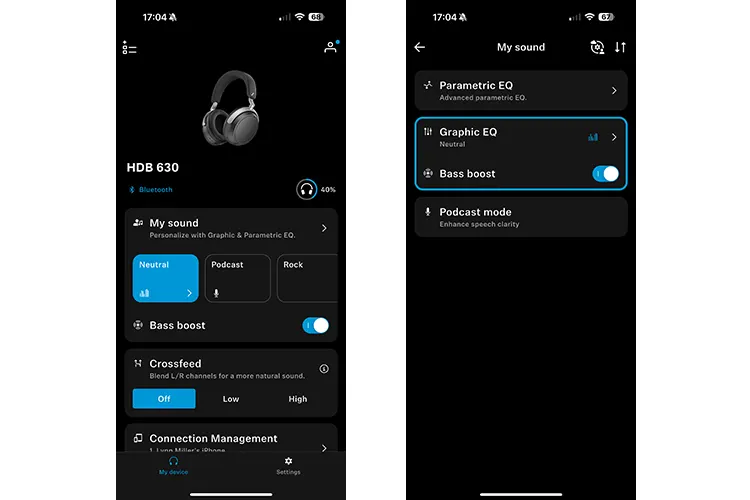
The app comes fully loaded with features ranging from Crossfeed, which is a melding of bass across both sides to even out the sound qualities, adding to the sonic quality, to a Parametric Equalizer.
You can even choose filter types and adjust affected bandwidths (Q). It is nice to see Sennheiser taking this seriously within their architecture.
If you already have a Sennheiser account, you can import your listening preferences and use “Sound Zones,” which change settings automatically when changing environments.
This feature can automatically switch from a more aggressive EQ, such as you might use in the gym, to a more laid-back EQ while having your post-workout espresso and Danish in a coffee shop.
This feature does use location aspects, but that feature is also used for a “find my headphones” feature.
Another nice feature is that the app can be controlled from your Smartphone while using another source for listening.
I could change EQ or Crossfeed using my phone, and the effect would show up on my MacBook as soon as I activated the feature. It is almost like a remote control specialization option.
Battery Life
The HDB 630 is listed as having a 60-hour lifecycle, while a 10-minute charge can provide approximately 7 hours of playback.
I verified the run time over three full 100% charges to 0%, averaging 57.7 hours (56, 58, & 59 hours). Coincidentally, the 59 hours of run time was the last, which could be construed as the battery becoming “conditioned” and running closer to the reported time of 60 hours.
Therefore, the “up to” aspect of 60 hours proves a pretty true statement.
Voice/Call Quality
This is mostly a non-issue with regard to call quality, since most provide good to excellent quality and wind protection.
The HDB 630 is no different, and when talking to our son on a windy Lake Superior day, we had no issue between us. The Beamforming aspect of the included microphones makes this excellent for calls.
Packaging & Accessories
The box is emblazoned with the requisite picture of the HDB 630, along with the necessary information on the back, in multiple languages. The sides and bottom show the functionality options, and box contents, along with resident legal protocol.
Opening the box, you find the case wrapped in paper, protecting it from rubbing on the box, a nice feature.
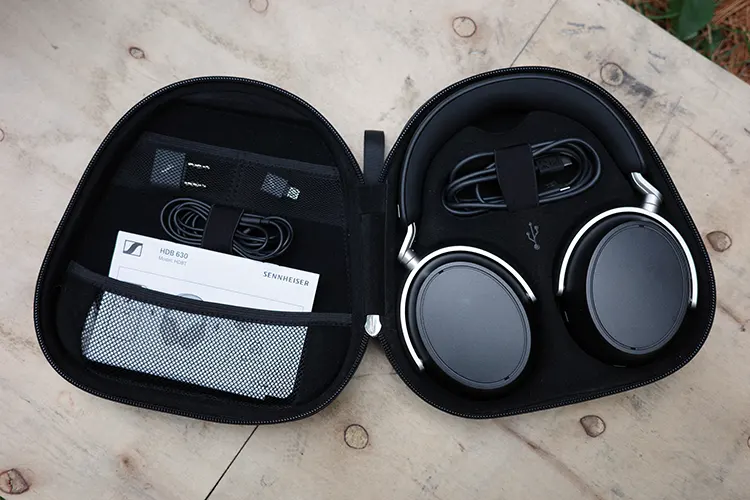
Inside the case, there is a proper place for all involved accessories, efficiently laid out without adding to the size of a normal wireless headphone case. This is truly an efficient use of space and clearly thought out by the engineers.
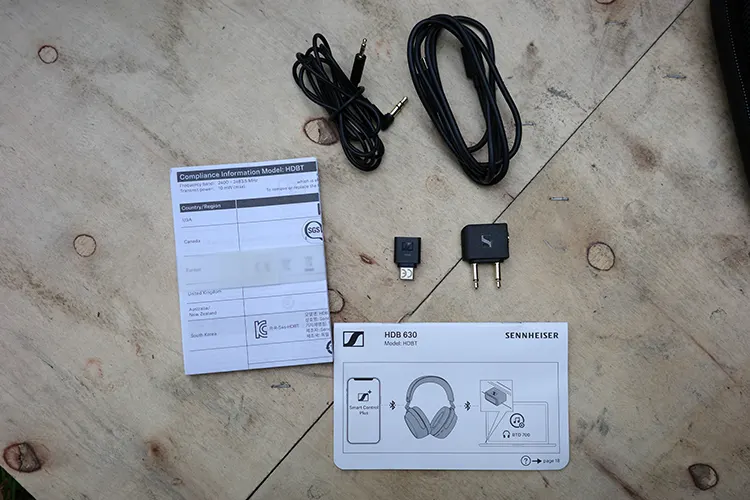
Those accessories include the BTD 700, airline adaptor, owner’s manual, 2.5mm to 3.5mm AUX cable, and the USB-C to USB-C audio cable.
Carry Case
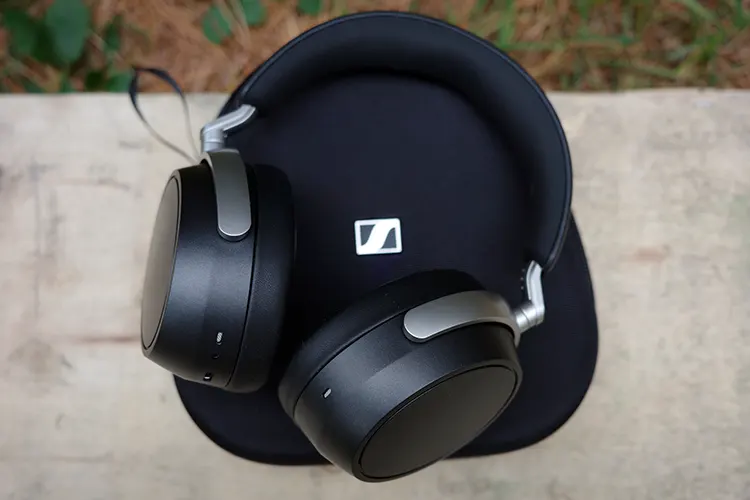
The HDB 630 black carry case is made of a thick Cordura-like fabric on steroids. Tough would not even begin to describe the tactility and protective nature of the case.
A heavy, shielded zipper opens the case in a clamshell-like fashion. A smaller gear loop is used to aid in the opening and closing process as needed.
When opened, the left side holds the BTD dongle, airplane adaptor, 3.5mm AUX cable, and manual. The right side holds the headphones in a flat position (the headband must be all the way in to fit), and a small inset space for the folded USB-C cable.
The hard form gives a definitive space for the HDB 630, but the velour-like fabric used on top gives comfort and protection to the headphones while cradled. This is an excellent case in both size and efficiency.
Click on page 2 below for sound impressions and wireless connectivity performance.
