

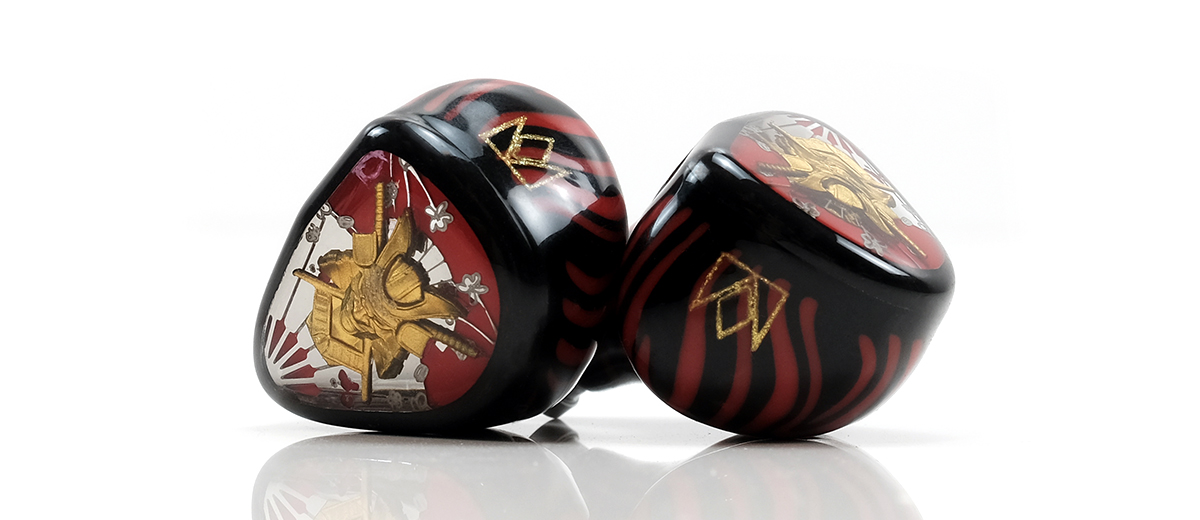
Marcus reviews the Noble Audio Shogun, a high-end hybrid dynamic, BA, EST, and bone conduction driver monitor, and the successor to the Ronin. It is currently priced at $3900.
Disclaimer: This sample was sent to me in exchange for my honest opinion. Headfonics is an independent website with no affiliate links or status. I thank Noble Audio for their support.
Click here to read more about the Noble Audio products we have previously featured on Headfonics.
This article follows our latest scoring guidelines, which you can read in more detail here.

A little earlier this year, Noble Audio released the Shogun, which has been described as the successor to one of my favorite IEMs from their range, the Ronin.
If you are familiar with Japanese history, then the significance and contrast between the ‘Masterless” Ronin and the master himself, the Shogun, should be a familiar story and one which has been transformed numerous times into movies of cultural significance.
In this review context, the Shogun monitor shares some similarities with the Ronin, including a hybrid multi-driver structure and the same high-end $3900 price point.
Where it differs is the inclusion of a dynamic driver instead of BA for the lows with a weightier sound signature, a snazzy new design, and an upgraded “Shogun-themed” stock cable.
So, how does the Shogun perform and compare against Noble’s high-end standards, including the Ronin, Onyx, and their current flagship hybrid monitor, the Viking Ragnar? I found out in more detail in my full review below.

Features
The Noble Audio Shogun is a high-end hybrid universal monitor with a mix of dynamic, BA, EST, and bone conduction drivers.
It has a total of 13 per side, including a single 10mm composite diaphragm dynamic driver for the lows, 6 BA for the mids and highs, and a quad Sonion electrostatic driver array for the ultra-highs.
The dual Bone Conduction implementation covers most of the frequency range and is designed to enhance the listener’s perception of a complex and wide soundstage, something which the Shogun does exceptionally well at.
The Shogun is rated at 23Ω impedance with an SPL of 110 dB/mW @1kHz, so it’s a fairly easy monitor to drive from good quality dongles and DAPs.
However, I found that good quality amplification added some additional snap and impact from the 10mm dynamic driver (more on that in my ‘Synergy’ section on page 2 of this review).
Design
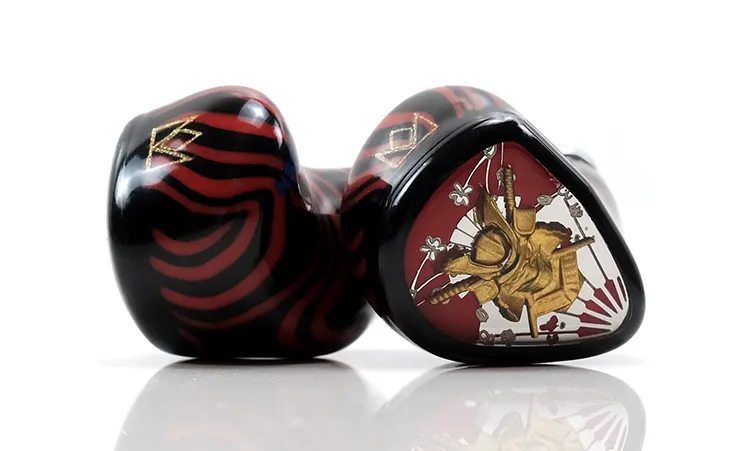
The Shogun has a typical Noble Audio form factor, but with a very intricate Japanese-themed aesthetic. That means a fairly long nozzle to get as close as possible to the second bend of your ear canal and a slightly larger than average shell size.
The shell’s aesthetics are stunning with a striking mix of black and red “menuki” stylings combined with a bold Gusoku armor faceplate theme on top and golden Noble logos on the rear.
It’s probably one of Noble’s most aggressive and complex designs to date. From the precision art spraying for the Gusoku armor, complete with a subtly separated golden “oni mask” armor front and center, to the highly detailed “menuki” sword guards on either side, and all on a red and silver “Ukiyo-e’ background.
The attention to detail here is ridiculously tight in both thought process and physical implementation.
Consistent with recent Noble offerings, the Shogun is also finished with a stainless steel spout for additional stability and durability. I find the new tips also provide a more stable lip to grip onto the ear tips more effectively.

Comfort & Isolation
Long nozzles mean deep penetration; the consistent design principle from Noble Audio and the Shogun is no exception to this rule.
I also happen to favor it, and whilst the passive isolation is not as exceptional as the non-vented Ronin, it is nevertheless well above what you expect from a hybrid vented design.
The shells are not quite flush to the ear; these are relatively large units, but they do not stick out so much as to bother me. The nozzle length and tip choices more than make up for it with a deep and secure fit and varying comfort and isolation levels that will fit most preferences.
As a side note, the new stainless steel spouts have improved mesh grills that work to protect the bores from a lot of dirt that can accumulate in the tubing.
Dirt over time degrades the performance of the drivers, and given how deep these nozzles go, you need to be careful not to pick up ear canal dirt in the process.

Ear Tips
The Shogun comes with 3 different ear tip choices in silicone and foam, and I would strongly suggest you roll all of them, as the performance differs dramatically depending on the tip used.
The silicone comes in two different types: a tall, grey, narrow bore and a smaller, wide bore. Of the two, the wide bore opens up the Shogun’s performance.
I found it far more dynamic and impactful, whereas the narrow bore gave a very balanced and polite tuning and also reduced the level of passive isolation. The foam tips are great for isolation but produce a smoother, more muted performance from the Shogun.

Stock Cable
The Shogun comes with a gorgeous-looking 4-core custom cable finished with a matching black and red Japanese Katana sword handle theme.
The attention to detail here is exquisite. You might not notice it until up close, but the black finish on the barrel sort of resembles the samegawa ray skin that is typically wrapped around the tsuka handle of a Katana sword.
Everything behind it is similarly themed in red and black, so when it’s all connected up to the drivers, it looks very consistent and harmonious in its aesthetics.
The plug is 4.4mm terminated by default with 2-pin 0.78m connectors on the opposite side and a heart-shaped aluminum splitter and low-profile chin cinch in the middle.
The cable itself is 1.8m in length, with a highly complex Litz-based geometry consisting of copper, gold, palladium-plated silver, and pure silver, all from 4N right up to 7N purity levels.
There is also a dual PVC structure to the geometry, which gives it a fairly hefty feel when handling, but the deadening effect is excellent with next to no microphonics or memory retention.

Packaging & Accessories
Noble has recently switched over to these beautiful but hefty carry cases for their high-end monitors, which explains why the familiar retail packaging is now fairly deep and large for an IEM.
The deep-set zippered leather Shogun display case is a little more refined than the Onyx version when set side by side, though you do have the option of a matching pocket-sized carry case, which should just about fit the drivers and cable.
You will need to ensure you have the preferred tips attached before slipping them into the small case, as the Shogun tips tray is too big to fit into it.
Aside from the above, you also get a small Noble-branded soft drawstring pouch in black (which holds the new square tips tray), your warranty card, and some stickers.
Sound Impressions
The following sound impressions of the Noble Audio Shogun were completed using the iBasso DX340/AMP15 and the Cayin C9ii/N7 combo in a low-gain balanced output mode.
Summary
I could best describe the Shogun tuning as sitting somewhere between the power and smoothness of the Onyx and the articulating airiness of the Ronin. This is a very balanced ‘musical’ tuning that is equally comfortable with quiet passages of music as it is slamming heavy BPM house tracks.
The Shogun is a deep-sounding performer with excellent power, offering a smooth set of mids with relatively neutral but clear vocal imaging. Sitting above is a refined set of highs consistent with Noble’s recent tuning that offers good extension but without too much in the way of unnerving lower-treble spikes.
This is topped off with a deep holographic soundstage, with excellent width and imaging clarity reminiscent of the space presented by the flagship Viking Ragnar.
The additional dynamic driver inside the Shogun makes a huge difference if you are comparing it to the lighter, low-end touch of the BA subwoofer-powered Ronin.
It delivers a very enjoyable and healthy level of PRaT, but it is not as L-shaped as the darker-sounding Onyx tuning. There is power, but it sounds more balanced and articulate relative to the rest of the frequency range.
Tips play an important role in how you hear the Shogun. I recommend the blue stem wide bore silicone tips as they sound more immersive and dynamic compared to the polite, more distant sound of the narrow bore grey tips. Foams, I am not a fan of for a long time now, as they also seem to dilute the energy of the Shogun too much.
For source pairing, I recommend a punchy, clean-sounding DAP or Dongle. Setups like the R8 II and the DC-Elite deliver excellent definition and dynamics in the Shogun’s lows whilst injecting some nice treble-fill and sparkle, preventing it from sounding too smooth or laidback.

Frequency Response
The Noble Audio Shogun follows what I would loosely describe as a ‘W-shaped’ sound signature, though the dips and peaks are not hugely emphasized.
Up to 100Hz, the lows exhibit a fairly linear tuning with its sub-bass in line with the mid-bass elevation, registering about 5-6 dB above the Ronin and with more body and force than the more controlled dual dynamic driver tuning from the Ragnar.
From 100Hz up to 900Hz, you get a slow dip that carries some warmth into the mids, providing an excellent fundamental frequency for lower-register percussion, rhythm, and bass guitar strikes.
It’s a very natural tuning to my ear, avoiding sounding too rich and rounded or overly neutral and lean in weight.
There is some pinna gain from 1-4k, but it’s not as pushed as the Ronin’s slightly stronger lift in this region. Still, I find vocals more impactful than the Onyx and the Ragnar, and courtesy of a flatter lower-treble tuning, it also sounds smoother with a more liquid edge to the note attack.
From 5-8k, I find the Shogun tuning to have a slightly darkish tone to it with more upper-harmonic order emphasis from 8-10 onwards.
You get some sparkle and sheen, which helps with clarity, but it’s gentle rather than overt and more for staging height and headroom than a dramatic coloration of the upper-mids.
Staging & Dynamics
The staging ability of the Shogun is the star of the show for me. It sounds expansive, with a very articulate and immersive imaging experience, particularly in its clarity at the extreme ends of its X-Axis.
Very rarely do I find Noble tuning aggressively pushing the mids and bass at all costs, and the Shogun is no exception here. I hear a mix of neutral yet clear vocal imaging and exquisite instrumental layering all around that pulls you into a very holographic presentation.
Combined with excellent dynamic range, I find the Shogun’s 3-Dimensional staging prowess to be at its most dramatic with quieter, more intricate acoustic passages such as Clario’s opening “Nomad” track on her 2024 “Charm Album”.
For the first 50 seconds, it sounds quite centered with a single solo voice and a deep drum accompaniment. However, at that 50-second mark, a beautiful ‘swirling’ background acoustic guitar enters, moving gracefully from the far left to the far right, an attribute the Shogun captures beautifully.
Only the likes of the UM Multiverse Mentor and PMG Audio Apx have that unique ability to layer and image in such an immersive manner.

Synergy
The Noble Audio Shogun is rated at 23Ω for impedance with an SPL of 110 dB/mW @1kHz, meaning it’s not a difficult IEM to drive from a decent dongle or DAP.
Compared to its siblings in the Noble lineup, it’s almost on par with the Ronin, which is the most sensitive IEM I have heard from the company to date.
Only the Viking Ragnar required more volume to sound optimal, with around 2-3 dB more loudness required to volume-match from a balanced output from the iBasso DX340/AMP15 pairing. Background noise from my tested sources are not an issue for the Shogun either.
One small observation. Tips matter in how immersive and dynamic the Shogun sounds.
I would not recommend the foam or grey narrow-bore single-flange tips. They created a more distant and polite presentation that had me pushing up the volume a bit. The more dynamic, wide-bore silicone blue stem tips are the way to go.
DAP Pairings
I tested 4 DAPs and amps with the Shogun and came away with one overriding impression: pick a DAP that has some gusto about it, and the Shogun will shine.
That special sauce could be vocal bloom, excellent bass depth and power, or immersive staging; it doesn’t matter so long as the source and amp are not too soft, laidback, or neutral sounding.
As a case in point was the portable amp in this session, the Cayin C9ii. It needs to be in Hyper Mode for any of the timbre modes to come alive with the Shogun.
Hyper Mode stiffens the lower treble and adds some contrast in the low-end, two areas where the Shogun can often sound soft or dark with the wrong pairing.
The resulting sound is dynamic and punchy in SS, deeper and more powerful in Classic Tube mode, and sweeter and airier sounding in Modern Tube mode.
The DX340/AMP15 is more linear but gets away with it by introducing excellent separation and imaging mixed in with impressive bass note definition. It excels in detail but can lack a little emotion with the Shogun for those who like some coloration in their sound.
The HiBy R8 II brings some heavy coloration to the Shogun lows in Turbo mode. It’s a weighty sound with vocals also to the fore. Though not as complex-sounding as the DX340, it can still sound very dynamic and enjoyable.
I would pick the 1-bit sound over the R-2R tuning from Cayin’s R202 card paired with the N6iii. It’s more precise and holographic in its staging, something that the Shogun’s wide staging quality laps up.
The R-2R enhances the Shogun’s vocal and bass notes with additional weight and warmth, something I feel it does not really need.
Dongle Pairings
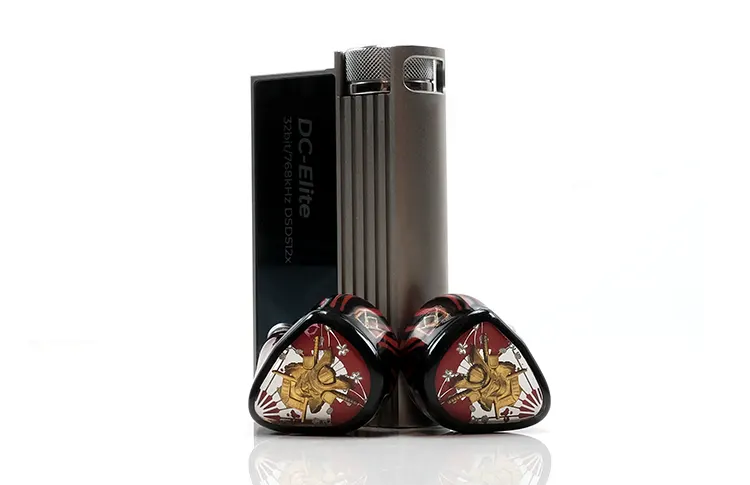
I tested the Shogun with the iBasso DC-Elite, Nunchaku, the Cayin RU7, and the older but still excellent LP W2. As with the DAP impressions, I ended up gravitating to the dongles that had a sense of urgency to them, with impactful bass and good treble presence.
Of the four tested, the DC-Elite and the W2 delivered exactly that, offering the best impact and speed, combined with decent sparkle in the Shogun’s top end.
I would say the DC-Elite has more treble influence, or just the right amount, with the W2 sounding comparatively tamed in the highs but still quite decent. Additionally, the DC-Elite offers a better dynamic range and sounds more resolving with the Shogun.
The Nunchaku sounds weaker in Class AB mode with thin and emotionally disconnected vocal performances. The tube mode is much better, extracting the weightiest bass from the Shogun output of the 4 dongles, but keeping the mids and highs relatively smooth.
It is not as clean and precise as the DC-Elite, but it offers a nice expansive soundstage with great depth, more so than AB mode.
The RU7 sounds wide and evenly balanced, but the lows and vocal presence felt the weakest of the four dongles with the Shogun.
It didn’t quite have that same rounded, punchy tone as the DC-Elite or the same power and depth as the Nunchaku Tube mode. It’s not a bad choice, but it didn’t get my toes tapping in the same manner as the first two dongles.
