

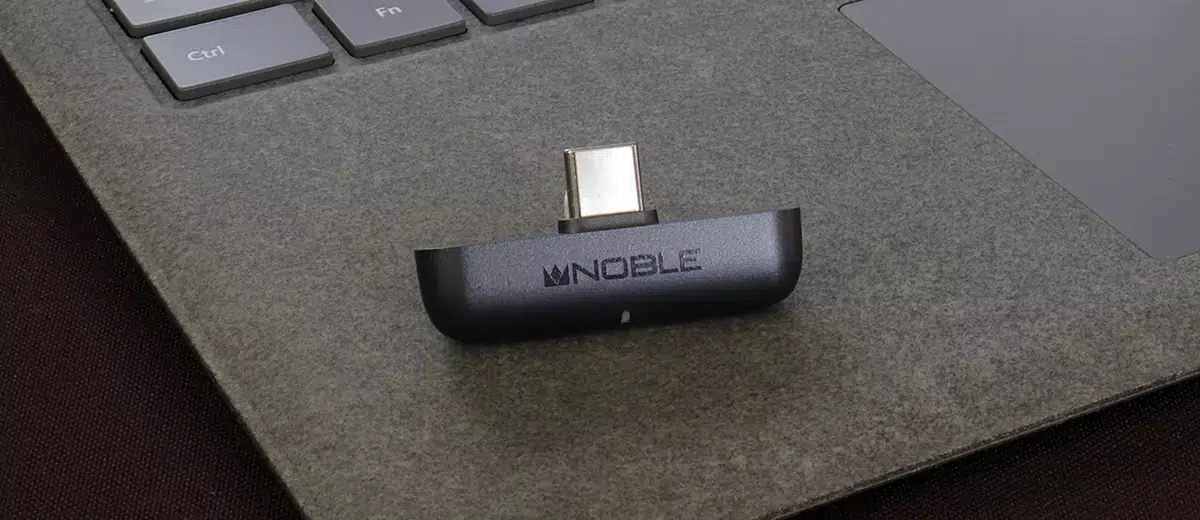
Louis reviews the Noble Audio Sceptre, a new external high-performance USB-C Bluetooth transmitter with LDAC and aptX Adaptive capability. It is currently priced at $69.99.
Disclaimer: This sample was sent to me in exchange for my honest opinion. Headfonics is an independent website with no affiliate links or status. I thank Noble Audio for their support.
Click here to read more about the Noble Audio products previously featured on Headfonics.
This article follows our latest scoring guidelines, which you can read in more detail here.
The newly trending USB Bluetooth transmitter dongle segment is starting to grow. So far, we’ve covered FiiO’s AIR LINK plus Questyle’s QCC Dongle Pro, in which we also cover their first model, the vanilla QCC dongle.
This time, we’re taking a look at Noble Audio’s entry into this segment, the Sceptre Bluetooth transmitting dongle. It’s the newest competitor in this small and presently growing audio gear segment.
Price-wise, the Noble Audio Sceptre sits halfway between the handful of available models, and it has most of the same features that the others have to offer, with a give and take here and there. So what’s the sales pitch here?
Features
The Noble Audio Sceptre is a miniature form factor USB dongle that transmits a high-quality Bluetooth signal via its Bluetooth 5.4 radio to any Bluetooth headphone or Bluetooth receiving device.
I would have thought that by now we would have gotten a 6.0 radio at least, but that’s trivial.
One benefit that the Sceptre does offer is that it takes the load off your mobile device’s built-in solution, which most times has a Bluetooth implementation that’s just there to get you by, and not geared to perform at any optimal level. Sonically speaking. Plus, the Sceptre claims added signal stability.
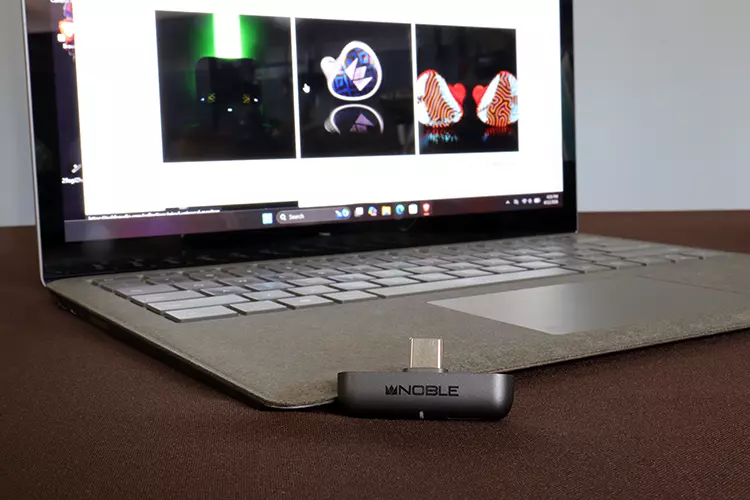
Another type of modern-day device that comes with inferior Bluetooth capability, besides the mobile device, is the modern-day computer or laptop.
You can also throw tablets into the list of gear that would benefit from using a piece like the Noble Audio Sceptre dongle, plus iPhones are only capable of AAC and would highly benefit from a device like the Sceptre.
The Noble Audio Sceptre solves the crappy, outdated, and built-in Bluetooth dilemma by using an up-to-date Qualcomm QCC 5181.
This is more than likely an upgrade over all the above-mentioned components’ Bluetooth internal chips, except for a small list of mobile devices that can operate at up to the aptX Lossless codec. But this dongle is not for those people.
Bluetooth Codecs
An observation I made when these dongles were first released is an obvious one, and that is the fact that most Android mobile devices nowadays can handle LDAC.
So why use a dongle? Most nowadays can also handle the aptX adaptive codec. But unfortunately, most will default to the lowest bitrates of those codecs.
The Noble Audio Sceptre can handle those codecs plus AAC, SBC, and most of the aptX codecs except for the aptX Lossless codec, so where is the codec upgrade here, and where will the improvements take place?
One of the features I do like is that you can select the quality of the codec via their app. In other words, when you use a mobile device with LDAC, it usually defaults to 330kbps or 660kbps bit rates.
With the Sceptre, you can go in and select the highest 990kbps rate, which is the max LDAC bit rate, and it does audibly make a difference.
Some mobile devices have the feature within hidden menus, and sometimes you can force them to run a high bit rate, but the Sceptre brings this up front.
PC and laptop users will benefit the most from this device since they don’t even come with such hidden features.
However, if the aptX Lossless codec is not available on this dongle, the dongle then becomes less desirable because most Android mobile devices can handle LDAC, as stated.
Most people will see codecs and not see that there are higher bit rates that are available. Perhaps a firmware update in the future can give us this feature.
Design
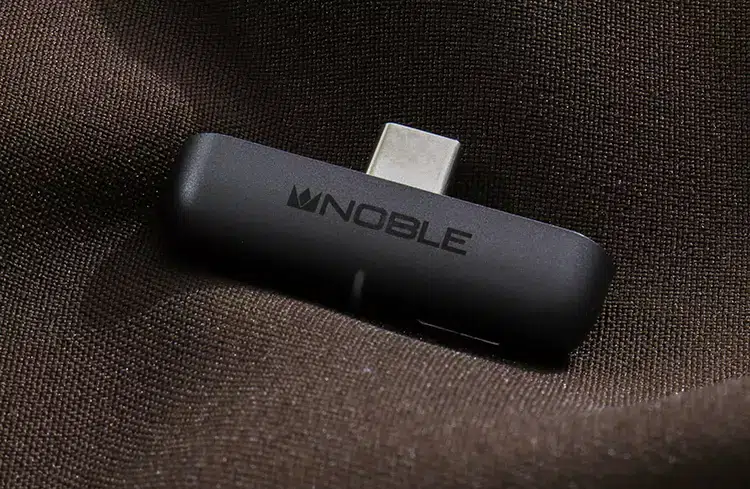
The overall construction is made with a plastic housing and a nickel-plated USB-C connector. Speaking of connections, the Sceptre has a female USB-C connector onboard that can be used for charging the phone without the need to remove the Sceptre from the port.
One feature that you do lose with this feature is the ability to read data off the mobile device. I attempted this on my Windows 11 PC and my daily driver with no success.
I used a known good cable that transfers data just fine from my Android phone directly to my custom PC.
One little nitpick, if I may, if it were up to me, I’d shorten the USB-C bump to be a tad thinner, but that’s just in my case, no pun intended. I
f you have a hybrid protective case or one that has a lot of girth, this will fit the bill, or should I say, case? I have a thin protective case, and there’s a wide gap between the Sceptre and my USB port. Again, trivial.
Noble FoKus app
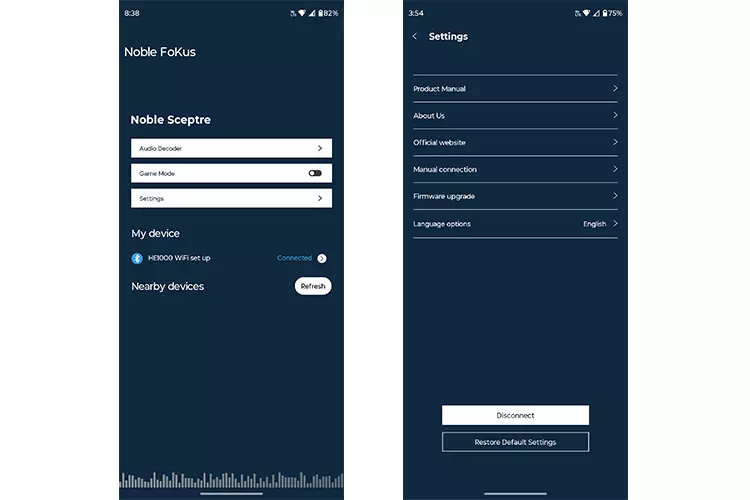
The FoKus app from Noble Audio is very basic and to-the-point. It gives you basic features like a firmware upgrade option when they’re available, and a few other functions.
There’s also a language option, a connection status option, and a few other features, like a built-in product manual and a game mode, which kicks the Noble Audio Sceptre into a game console UAC 1.0 compatibility mode.
But what I found the most useful for sonic improvement was the audio decoder feature, which lets you choose the quality of the codec transmission. For example, LDAC has three settings: a 330kbps option, a 660kbps option, and a 990Kbps option.
The aptX Adaptive has two settings, one high and a stable setting. Now, let’s not confuse aptX Adaptive with Lossless because it’s not, and this is the only aspect that is lacking on this dongle that should have been implemented regardless of anything else.
Packaging & Accessories
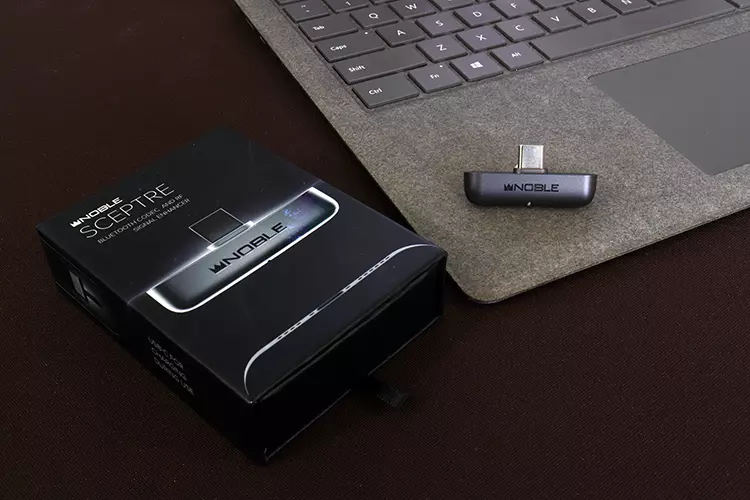
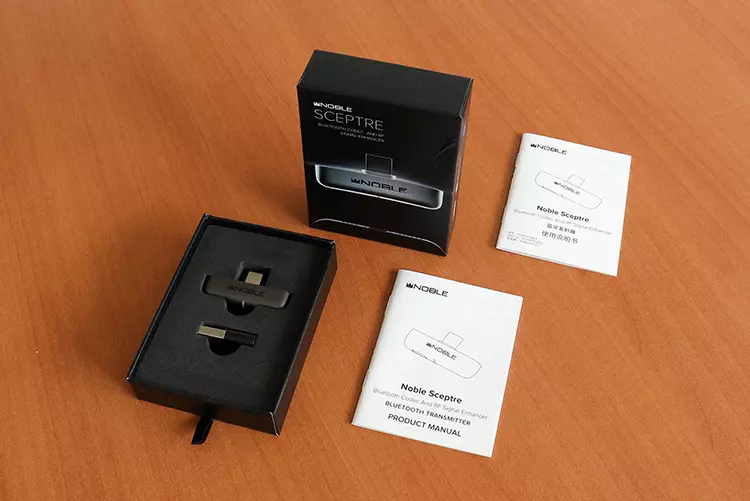
The Noble Audio comes in a typically constructed box made of thick cardboard, and it has a slide-out drawer box that holds all the contents within a foam mold. My box came partially crushed, and the contents arrived just fine.
The internal contents are the dongle, a Type-C to full-sized USB Type-A adapter, and two product manuals. One is written in English, and one is in Chinese. That’s all you get.
Sound Impressions
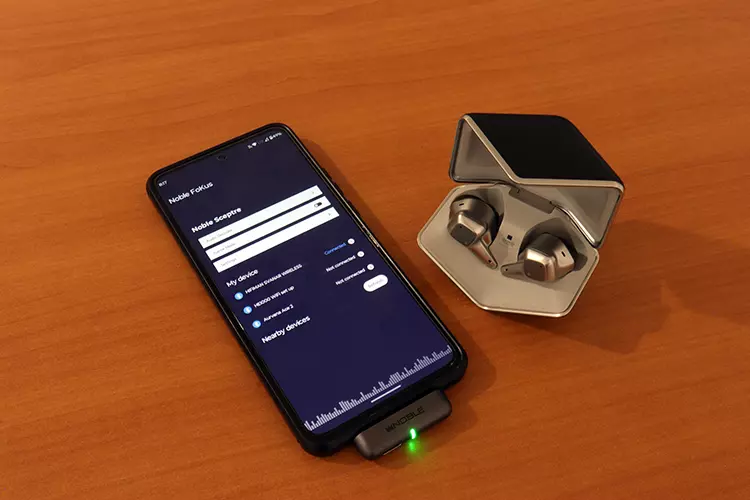
I used my daily Motorola Edge to feed the Noble Audio Sceptre straight off the USB-C port, with the Noble FoKus app, and a custom PC with Windows 11 Pro.
I pulled out and paired the HIFIMAN HE1000 WiFi, the Arya WiFi, and the Creative Aurvana Ace 2, plus my set of the HIFIMAN Svanar Wireless, and used all these sets on LDAC transmitting on the 990kbps bitrate, which is selectable within the FoKus app.
To make a direct comparison, I compared the sound quality of my phone’s Bluetooth capability.
Since the Sceptre is capable of running the LDAC codec at its highest quality level, the quality goes up considerably, compared to a stock mobile device’s Bluetooth transmission quality, especially when it’s in relation to the high frequencies.
Summary
For a Bluetooth transmission, the top end is very clean, only rivaled by a wired connection, and that’s the first thing I noticed. The top end does have a heavy presence, but there’s enough definition within the transmission to produce highs that are well defined but not harsh.
Most times, the high frequencies are the one area that suffers the most, while over a Bluetooth transmission, producing a washed-out top end, which is common with the common Bluetooth transmitting devices. The Sceptre improves on that.
The mids come through well-defined enough and with a natural tone that, at times, makes one forget that the music source is coming from a Bluetooth transmission.
I can’t complain about the bass either, since it doesn’t come through bloated or excessively fat and unnatural. It comes through quite well defined and delivered in a clean, fast, and dynamic manner.
There is a slight suppression of dynamics that is inherent when you use a Bluetooth device, and it’s still detectable on the transmission produced by the Sceptre.
But overall, it produces sounds in an almost tube-gear-like manner. You get that sense of warmth with relaxed dynamics, which is the general description I can give the Sceptre’s overall tonality and easy-to-listen sonic profile.
Soundstage
The soundstage is centric, and it does lose some width, depth, and placement accuracy, but elements don’t lose much focus; you can easily locate elements, and there’s an absence of aura smear, compared to built-in Bluetooth solutions.
Elements are in pinpoint positions. But they’re concentrated closer to the center stage, and there’s not a lot of width and depth. There’s just enough as not to sound atrociously narrow. That’s the price you pay for the convenience of Bluetooth.
But overall, you can’t get any better than the Bluetooth transmission quality that the Sceptre produces from any other device, until the Bluetooth devs come up with higher codecs, which is not anytime soon.
Click on page 2 below for my wireless performance, pairing impressions, and selected comparisons.
