

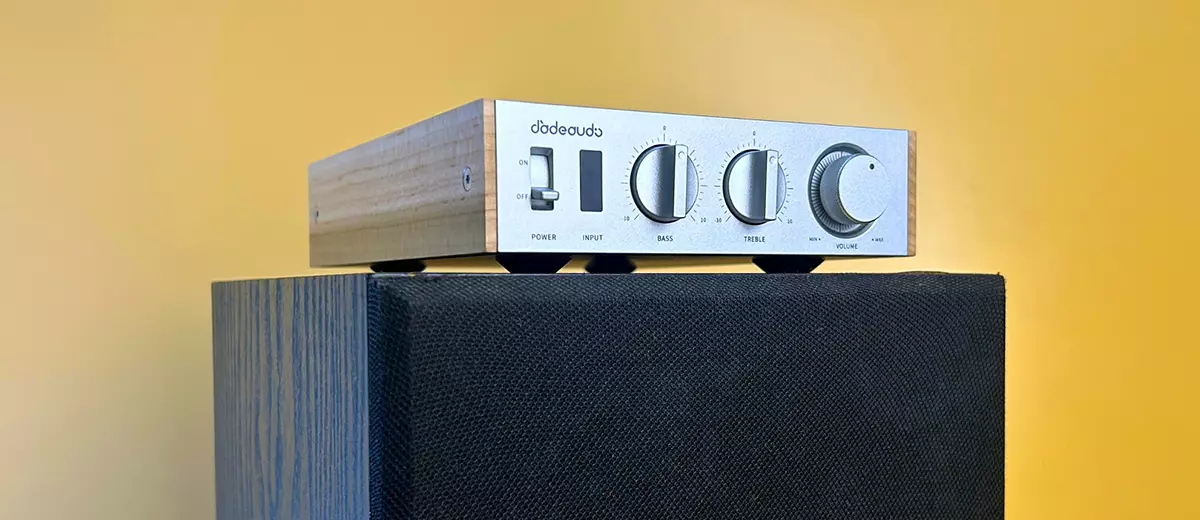
Connectivity Performance
LDAC pairing via the Bluetooth input was seamless across all devices tested; iOS and macOS alike connected quickly and held stable throughout the listening sessions.
Codec status was visible on the front LED, which is a small but useful touch. Latency over Bluetooth was low enough for video use with no perceptible drift between picture and audio when streaming from a phone.
USB-C input handled up to 24-bit/96kHz without issue across Windows and macOS, and the Level 1 was recognized as a USB audio device without needing any driver installation on either operating system.
Coaxial input via the CD transport performed cleanly, and my turntable connected via the RCA line input functioned without any issues. Switching between all three digital inputs was quick and glitch-free.
The analogue RCA input functions as expected for those with an existing preamplifier or external DAC in the chain, though, as noted, this path bypasses the DSP entirely.
For anyone building a fresh system around the Level 1, feeding a digital source directly is the configuration that makes the most sense and gets the most out of the unit.
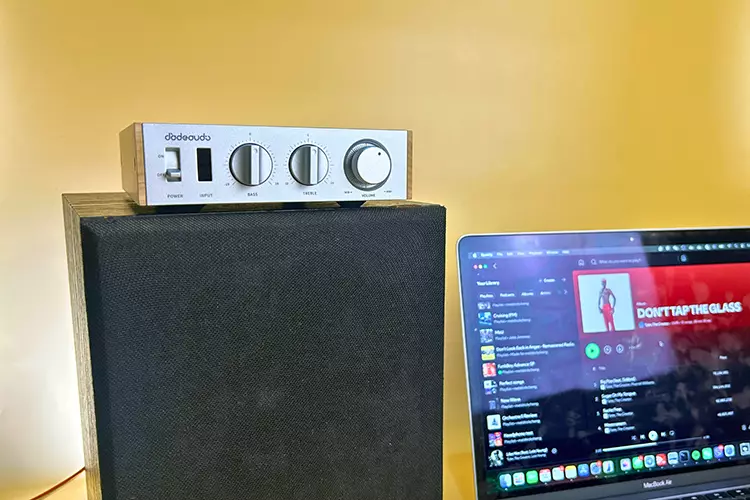
Synergy
Efficiency
The Level 1 drove the Wharfedale Diamond IIIs (8Ω, 88dB sensitivity) without any sign of strain across the full range of content I used.
Neither required the volume knob to push much past the halfway mark at desk distances, and the amplifier’s chassis remained cool throughout.
Power
The 120W per channel figure at 8Ω with the included supply translates, in practice, to a unit that never sounds like it is searching for headroom. Peaks on complex drum passages and orchestral dynamics were handled cleanly with the very clear headroom.
Unlike some less powerful power amplifiers, the Level 1 does not develop any hardening or compression as you push into the upper portion of the volume range.
The sound remained consistent in character, whether at conversation levels or at the point where the speakers themselves began to suggest their limits.
Pairings
The pairing I found most satisfying was the Level 1 with the Diamond IIIs via LDAC Bluetooth from a smartphone, with a mild decrease in the bass adjustment and a slight increase in the treble knob to compensate for the warmer sound signature of these vintage monitors.
The result was a version of the Diamond III that I found to have improved detail retrieval and clarity.
The amplifier’s transparency made the tuning adjustments feel surgical rather than imposing. It gave the presentation more definition without stripping the character that makes those vintage monitors appealing in the first place.
I also ran the Level 1 as a straight power amplifier behind the Technics SL Q303 via analogue RCA, and despite losing the PEQ in this configuration, the amplifier itself sounded capable and composed.
The turntable’s signature slightly elevated mid-bass with good midrange presentation came through cleanly, which confirmed that the Level 1’s amplifier stage itself is well-sorted even without the DSP advantage.
Selected Comparisons
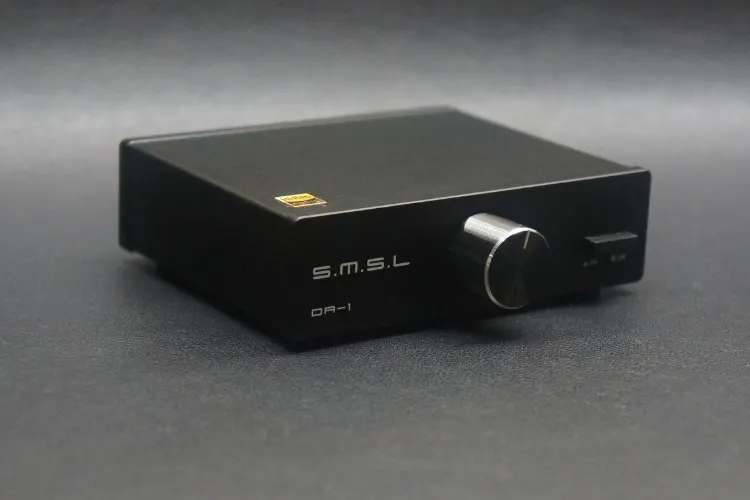
SMSL DA-1
Features
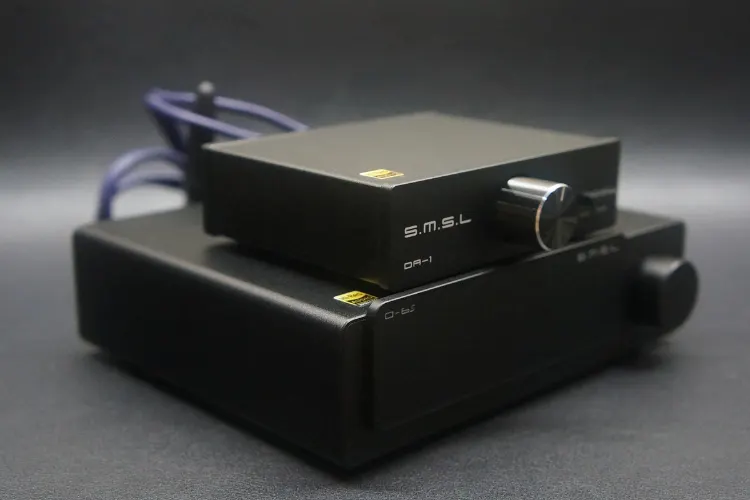
The SMSL DA-1 uses the Texas Instruments TPA3118 chip, delivering up to 65W into 4Ω, and its measured performance within that operating envelope is clean and well-documented.
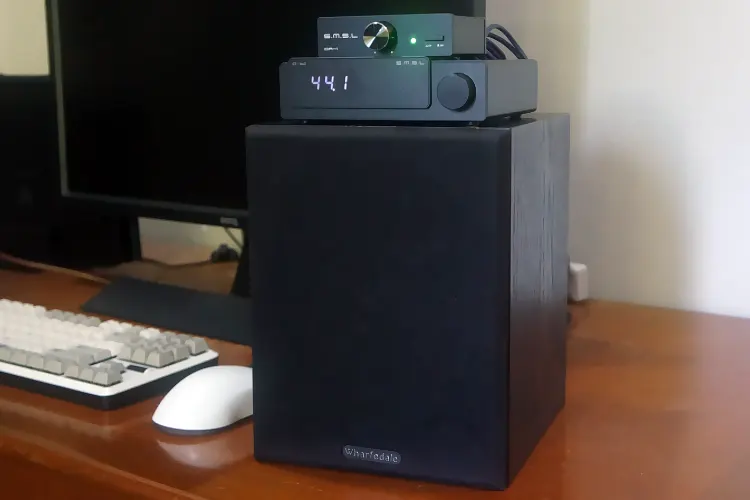
For this comparison, I paired it with the SMSL D-6S as its DAC source, a unit I am also familiar with from prior use, feeding the DA-1 via analogue RCA.
The D-6S handles the digital conversion side with considerably more pedigree than the DA-1 itself brings to bear, which means this comparison is, in practice, a separates stack versus the Level 1’s integrated approach.
What the DA-1 does not bring on its own is Bluetooth, a coaxial or USB digital input on the amplifier side, a subwoofer output, or anything resembling parametric EQ.
The DA-1 accepts only an analogue RCA signal at its input, full stop. All digital source management falls to whatever DAC you place in front of it.
The Level 1 handles the full digital path internally, including LDAC wireless, with considerably less cable overhead and no external DAC required.
Design
The DA-1 uses a CNC-machined aluminum shell with a black anodized finish, chamfered edges, and a deliberately minimal aesthetic that communicates no-nonsense engineering intent.
Paired with the D-6S on the desk, the stack is tidy and cohesive; both units share a design language that makes them feel like they belong together even without being a matched set from the same brand.
The Level 1 occupies more footprint than the DA-1 alone, and slightly less than the DA-1/D-6S stack combined, with its wood-and-aluminum presentation making a more considered aesthetic statement than either SMSL unit.
Where the DA-1 reads as purposefully invisible, something to be tucked behind a monitor and forgotten, the Level 1 has enough personality to hold its place on a visible desk.
Neither approach is objectively preferable; they serve different desk personalities and different degrees of tolerance for cable runs between components.
One area where the DA-1 does not distinguish itself is its hiss behavior in the mid-volume range, a characteristic I documented in my original DA-1 review, which requires some management depending on how sensitive your speakers are and where your DAC’s output sits.
The Level 1 exhibits no such issue, and volume behavior is consistent and quiet throughout its sweep.
Performance
Running the DA-1 with the D-6S in front of it, the stack acquits itself well in terms of tonal character and detail retrieval.
The DA-1 has a distinct signature with a slight lift in the upper midrange and treble that gives it a more forward, energetic presentation, particularly noticeable on vocals and acoustic instruments. It passes this character through cleanly without imposing anything of its own.
By comparison, the Level 1’s internal DAC resolves detail in a more measured, neutral manner, and its top-end presentation is slightly more relaxed than what the D-6S brings to the chain.
On the amplifier side, the DA-1’s TPA3118 at 65W into 4Ω has meaningfully less headroom than the Level 1’s TPA3255 at 120W into 8Ω, and the difference becomes audible at higher volume settings where the DA-1 begins to show its ceiling before the Level 1 does.
For nearfield desktop use within typical listening distances, the DA-1’s power ceiling is rarely a practical constraint.
But for a small-room setup with moderately demanding speakers, the Level 1’s additional headroom is a genuine advantage that the DA-1 stack cannot close regardless of what DAC you place in front of it.
Aiyima T9
Features
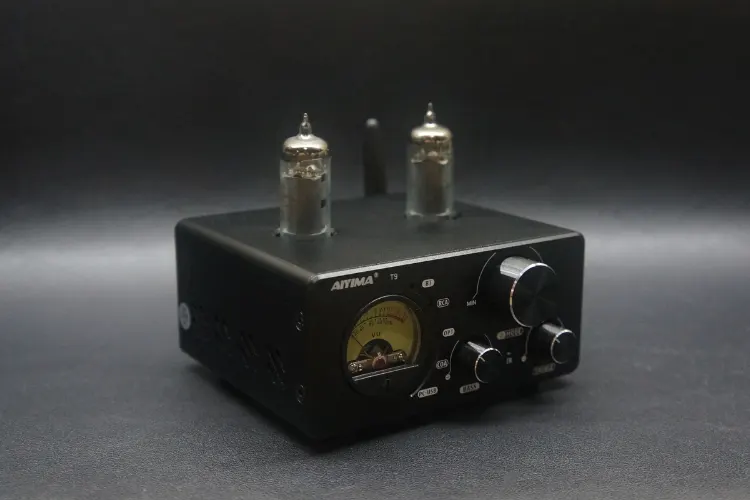
The Aiyima T9 is built around the TPA3250 chip and presents itself as a hybrid tube/Class D design, with a user-swappable 6K4 vacuum tube in the signal path ahead of the Class D amplification stage.
The tube acts as a buffer to the preamp output rather than directly in the main signal chain, but it does contribute a measure of tonal influence that distinguishes the T9 from purely solid-state Class D implementations.
The Level 1 carries no tube stage and makes no claim to that warmth; its character comes from the TPA3255 platform and whatever you feed it.
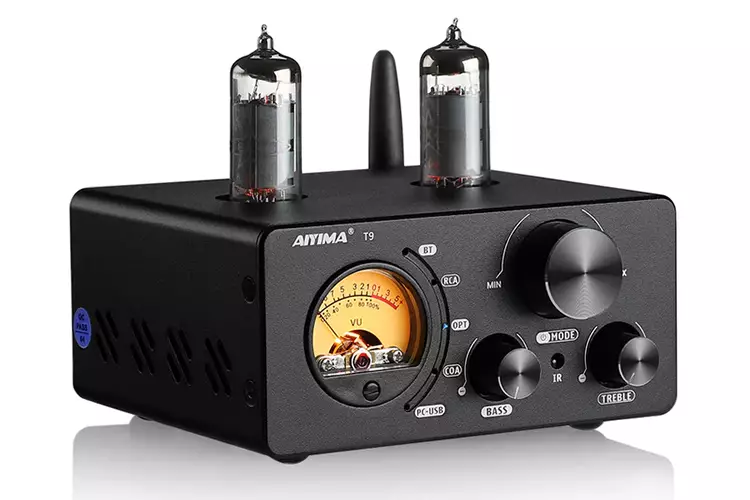
In terms of input flexibility, the T9 matches or exceeds the Level 1 in raw count: Bluetooth, USB DAC, optical, coaxial, and RCA analogue are all present. The Level 1’s coaxial and USB-C digital inputs cover most of the same ground, though the T9 includes an optical input that the Level 1 omits.
Where the Level 1 separates itself is in the control layer: the FiiO Control app’s full parametric EQ has no equivalent in the T9’s feature set, which offers only the conventional bass and treble shelf controls shared by most amplifiers in this segment.
However, the T9 comes with a hardware remote, which I would have greatly preferred. The Level 1 also has a subwoofer output, which is strangely absent from the T9.
The T9 also advertises a “100W×2” output figure, compared to the Level 1’s more conservatively stated 120W into 4Ω at THD+N below 1%.
Design
The T9 is immediately distinctive in a way that the Level 1 is not. The glowing tube on its top panel and flanking VU meters make it visually distinct, closer to a piece of vintage music production equipment instead of a classy Hi-Fi mainstay.
For a certain kind of listener, one who wants the desk to look as characterful as it sounds, the T9 is a compelling object in a way the Level 1 simply is not.
The Level 1, by contrast, is more restrained. The wood side panels and aluminum chassis give it a premium, grown-up desk presence without demanding attention, and I found it easier to stack and integrate into a multi-component setup.
The T9’s taller form factor, driven by the tube sitting upright, makes stacking less straightforward, and the VU meters, while appealing, add to the overall footprint.
Both units include bass and treble controls. The T9 adds VU meter sensitivity adjustment and a more animated front panel overall. The Level 1 adds the RGB codec indicator.
Neither includes a particularly informative display, though the FiiO Control app fills that gap for the Level 1 in a way the T9 has no equivalent for.
Performance
This is where the two products diverge most clearly, and the T9’s tube stage is central to that difference.
The T9 presents a warmer, more rounded character, particularly in the midrange, that the Level 1 does not match and does not attempt to.
Vocals through the T9 carry a slightly more euphonic quality, with a gentle softening of harmonic edges that some listeners will find more musical, and others will find less honest.
The Level 1, by comparison, is more direct, with a more detailed and balanced presentation of acoustic string instruments, crash cymbals, and hi-hats.
At the lower end, the T9’s bass presentation is slightly fuller and more forgiving, while the Level 1’s low-end is tighter and better-defined on well-recorded material.
The T9’s harmonic distortion figure of 0.07%, against the Level 1’s <0.0025%, reflects this gap in measured performance, though those distortion artifacts are precisely what some listeners find appealing about the tube-influenced presentation.
For macro-dynamics, both units acquit themselves adequately, but the Level 1 carries more reserves and cleaner transients at elevated levels. Where the T9 begins to soften at the edges of its operating range, the Level 1 remains composed.
The PEQ available to the Level 1 also gives it a practical advantage for careful system matching that the T9 simply cannot replicate.
My Verdict
For anyone building a first desktop speaker system, the FiiO Level 1 delivers exceptional value.
At just $139.99, it combines the robust TPA3255 amplifier platform with several attractive features, including a good-quality power supply, attractive wood/aluminum construction, and plenty of connection options.
The additional LDAC Bluetooth 6.0 connectivity, with FiiO Control app PEQ functionality, will also appeal to modern HiFi enthusiasts and streamers.
The dedicated subwoofer output is also noteworthy, as this feature remains rare in this price bracket.
There are some compromises. The baffling lack of a hardware remote is the most significant, forcing users to rely on the app or front-panel controls for volume adjustments.
The absence of PEQ support on the analog inputs is also an omission, though less impactful for predominantly digital desktop setups.
Despite these shortcomings, the Level 1 stands out as a competitive all-in-one desktop amplifier solution under $150 and should earn a spot on any budget-conscious shortlist.
FiiO Jade Audio Level 1 Technical Specifications
- Amplifier Chip: TI TPA3255
- Bluetooth Chip: BT8961
- Bluetooth Version: 6.0
- Bluetooth Codecs: SBC / LDAC (up to 990 kbps)
- Output Power (4Ω, 48V/5A supply): ≥120W+120W, THD+N <1%
- THD+N (1kHz / −9dBV @ 4Ω): <0.0025%
- SNR: ≥108dB (A-weighted)
- Dynamic Range: ≥103dB
- Noise Floor: <90µV (A-weighted)
- USB DAC Input: USB-C, 44.1/48/96kHz, 16/24-bit
- Coaxial Input: RCA, up to 192kHz/24-bit
- Analogue Input: RCA single-ended line input
- Analogue Outputs: RCA line output / RCA subwoofer output
- Speaker Output: 4mm banana jacks / bare wire
- Frequency Response: 5Hz – 40kHz
- Speaker Impedance: 4–8Ω
- Dimensions: 181 × 133 × 36mm (excluding feet)
- Power Input: DC 24–53V / ≥5A
- Included Supply: 48V/5A/240W (Merryking)
- App Support: FiiO Control (iOS / Android) — PEQ, EQ presets, channel balance, firmware OTA
- Colors: Black/walnut or Silver/maple
