

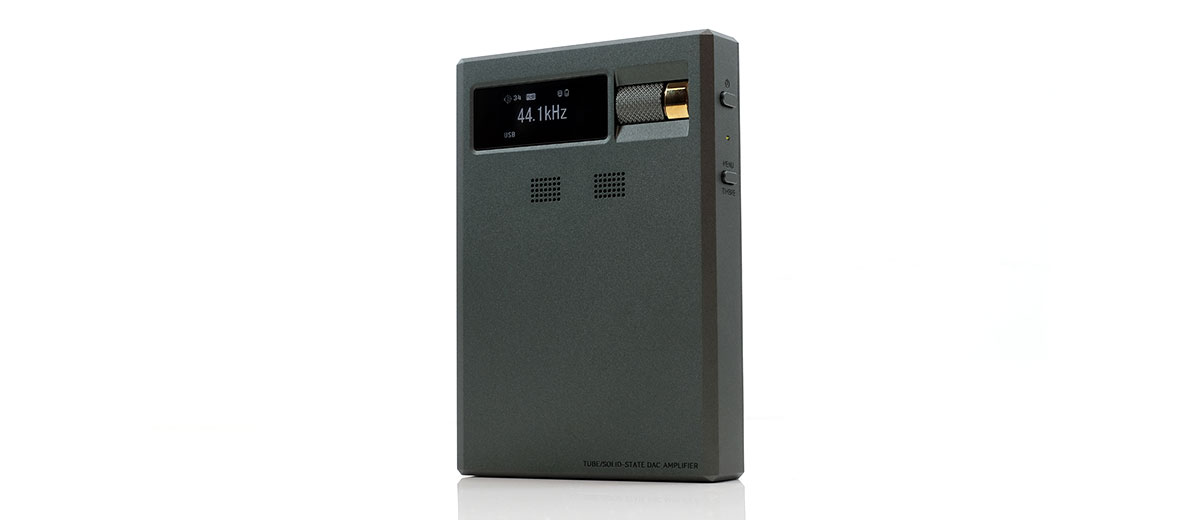
Today, Marcus reviews the Cayin RU9, a multi-timbre tube and solid-state USB DAC and headphone amplifier with up to 1W of power and BT capability. It is currently priced at $499.
Disclaimer: This sample was sent to me for my honest opinion. Headfonics is an independent website with no affiliate links. I thank Cayin for their support.
You can click here to learn more about Cayin products I have previously reviewed on Headfonics.
This article follows our current scoring guidelines, which you can read in more detail here.
Cayin’s RU9 is a surprising release because it follows the company’s current nomenclature for dongles such as the RU6 and RU7, but it looks nothing like a dongle, save for an OTG connection.
What we have here is almost a throwback to the era of the micro portable headphone amplifier from a decade ago; small, compact, and easily stackable.
Internally, the RU9 is anything but retro with a modern DAC, wireless capability, and Cayin’s excellent triple timbre output system courtesy of a NuTube/solid-state design seen in the likes of the N30LE and the C9ii.
At $499, this is also Cayin’s most affordable multi-timbre mode device to date. It’s a clear step in ambition over the smaller dongles, and at a glance, the RU series now has what seems to be the trifecta of flavors: R2R, 1BIT, and tube.
There are, however, other tube dongles and micro amps on the market, such as the soon-to-be-reviewed iBasso Nunchaku and the Chord Electronics Mojo 2. Cayin does not have the market completely to itself.
How did the new RU9 perform and compare to these models? I found out in my full review below.
Features
The Cayn RU9 is a micro-sized portable headphone and earphone amplifier complete with a delta-sigma dual DAC AK4493SEQ chipset implementation, hybrid solid-state and tube amplification, and wireless BT5.1 capability.
It is capable of decoding up to 32BIT/768kHz in PCM and native DSD512 with a BT5.1 wireless ceiling of LDAC, aptX HD, and aptX LL. SBC is also included for iOS users as standard. You can also process up to 24BIT/192kHz PCM via SPDIF using the RU9’s shared 3.5mm port.
At the heart of the RU9’s amplification is a 3-stage amplification circuit consisting of a single Korg Nutube 6P1 voltage stage mounted on a custom-built shock-absorbing silicone platform to eliminate the dreaded tube pin.
This opens the door to Cayin’s 5th Gen Classic and Modern dual tube timbre mode circuit, and, combined with a separate op-amp circuit that bypasses the tube voltage stage, you get the third solid-state timbre mode.
A key differentiator from a typical dongle is the RU9’s built-in 2000mAh Li-Poly battery that delivers just under 5 hours of battery life with QC3.0/DC2.0 quick charging.
This battery plays an important role in shaping the power delivery, which in turn, allows the RU9 to vary its performance to suit your needs. The most important of which is the level of output power from the amplifier.
The levels range from 310mW SE without the battery in use (dongle-style from the OTG source), 620mW balanced using the battery, and up to 1W in Hyper Mode (32Ω load) in DC mode (an incoming DC connection such as a Power Bank rather than the battery).
What you get depends on the mode you choose and the output connection, all of which are rated at 1Ω or less for output impedance.
Design
The RU9 is either a super-sized dongle or a compact, slimline portable amplifier, depending on how you view it or plan to use it.
It measures a ‘squat’ 100mm x 70mm x 15mm and weighs around 150g, feeling relatively lightweight in your hand and quite manageable. However, when stacked with a smartphone, you will feel the difference in balance.
It’s not as slim and tall as the older Oriolus BA300s, but it has a lower profile than the Chord Mojo 2 and older micro tube amps such as the ALO Audio Continental V5.
My theory is that a squat set of dimensions is to ensure it’s compatible with modern phones, whose rear panel is increasingly being gobbled up by huge 1″ sensor cameras. Placed on the back of my Samsung S23 Ultra and Vivo X90, the RU9 fits perfectly; any longer would cause placement issues.
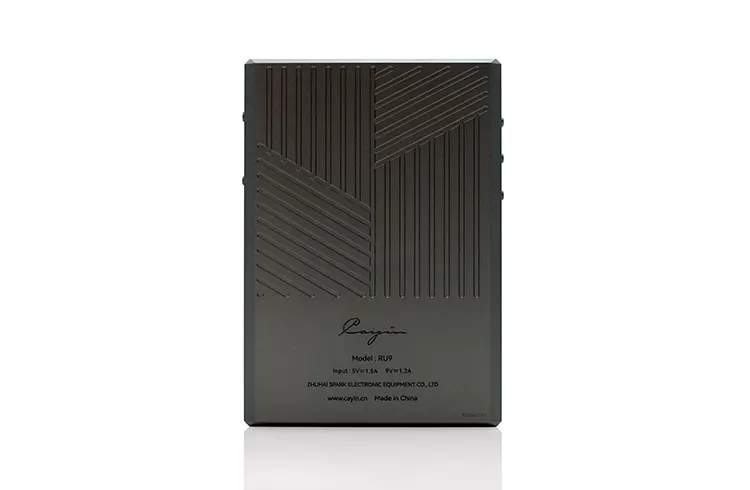
The RU9 is a sturdy piece of kit with a unibody housing built from an attractively CNC-machined aluminum that feels like it can take a hit or two. It is also magnetized on the rear for attaching to compatible smartphones with magnetic backing.
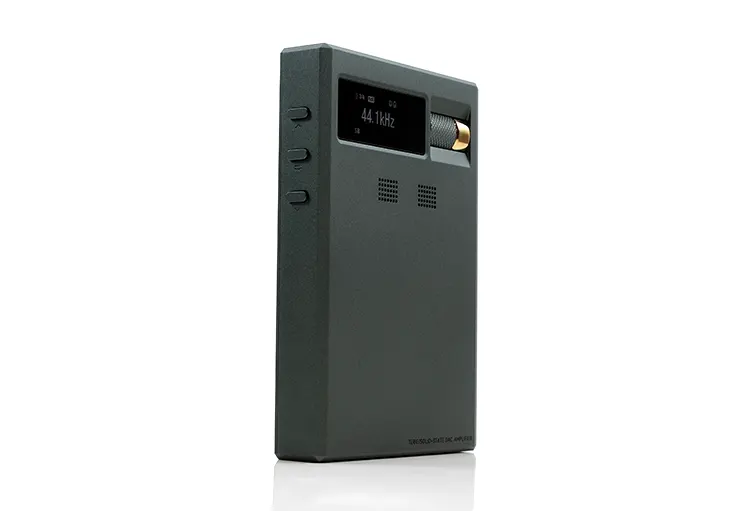
It’s not wholly aluminum, though. On the top panel is a smoky-toned Perspex window to enhance the BT signal power, and on the front panel, there is a small but quite legible 1″ display for status feedback and menu options.
Just beside the screen is a recessed but highly visible knurled and grippy volume wheel, completed with PVD gold accents. Two precision cuts just below allow the trademark green glow of the NuTube to shine through when Classic and Modern timbre modes are activated.
I/O
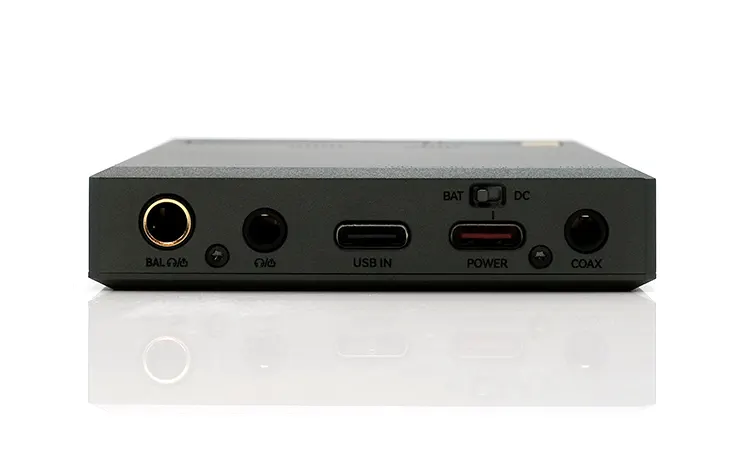
Everything wired is housed at the base of the RU9, with wireless transmission out of the Perspex glass on the top panel. That includes a shared 4.4mm and 3.5mm PO/LO, SPDIF, digital USB input, and the additional USB-C power input with the battery/DC switch just above.
I am used to seeing things get bigger over the years to accommodate more and more ports, so it’s a pleasure to see Cayin fit this much into such a compact form factor.
And it needs to be really if you plan to stack it under a modern smartphone with just the right amount of length from the supplied USB-C to USB-C connector to keep any stack nice and neat when carrying it around.
Controls
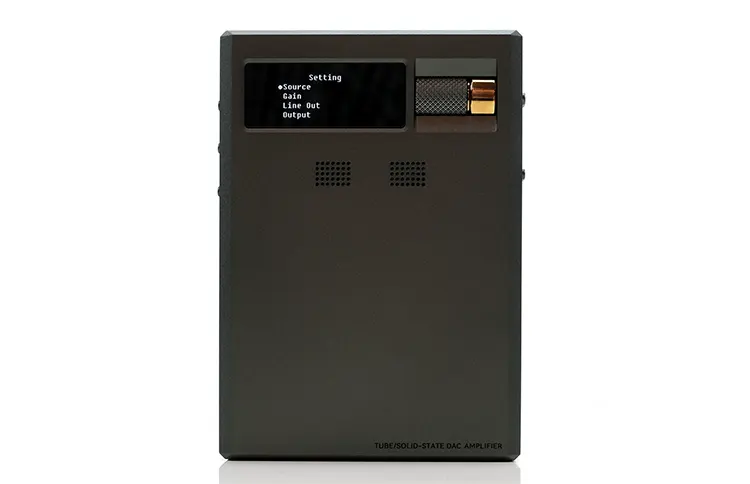
There is a lot of depth to the RU9 features, which is reflected in a fairly deep menu system with plenty of choices and a main screen chock-full of icons surrounding a big sample rate indicator in the middle.
There is no touch control or app integration, however. Consider this a fairly old-school manual button system with a mix of clicky physical buttons on the right panel and the volume dial for scrolling through the line-based menu system.
From the settings menu, you can control your input source, the output mode, such as PO or LO, gain levels, PCM, and DSD filter choices drawn from the DAC, and even the USB Class if you are a gamer.
My only gripe is that if you dally a bit too long, the menu reverts to the main screen quite quickly. I would like to be able to turn that off so I don’t have to rush around changing things.
The second critique is the timbre button sharing duties with the menu button. Yes, long press will get you the menu, and short press will change the timbre, but I wonder how many people change the timbre by accident instead of accessing the menu during use.
The current firmware I have on this sample is V1.3, but I am not seeing any recent updates, so I presume I have the latest version.
Packaging & Accessories
The RU9 packaging is not that far removed from the RU6/7 boxes, with a compact, narrow form factor and everything neatly layered in black foam and fabric inserts underneath.
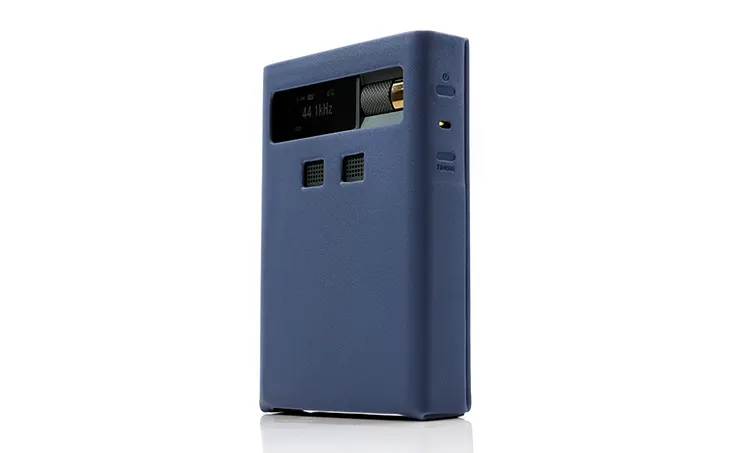
A good quality Nappa leather case comes with the RU9, providing plenty of gaps to access the controls, while avoiding a loose fit and QC stitching issues.
It is a welcome addition, though the color choices are a bit unusual, coming in with what looks like a deep periwinkle shade of blue and a very pale pastel pink alternative. I much prefer the ‘blue’, but I wish there were a green alternative similar to the N3Ultra case.
There is functionality in the case beyond protection. It also has a magnetized rear panel that helps the RU9 project its magnet strength for attaching to phones, DAPs, or tablets. However, the spare 3M MagSafe ring worked better for me, but at the cost of some aesthetics.
Click on page 2 below for my sound impressions and recommended pairings.
