

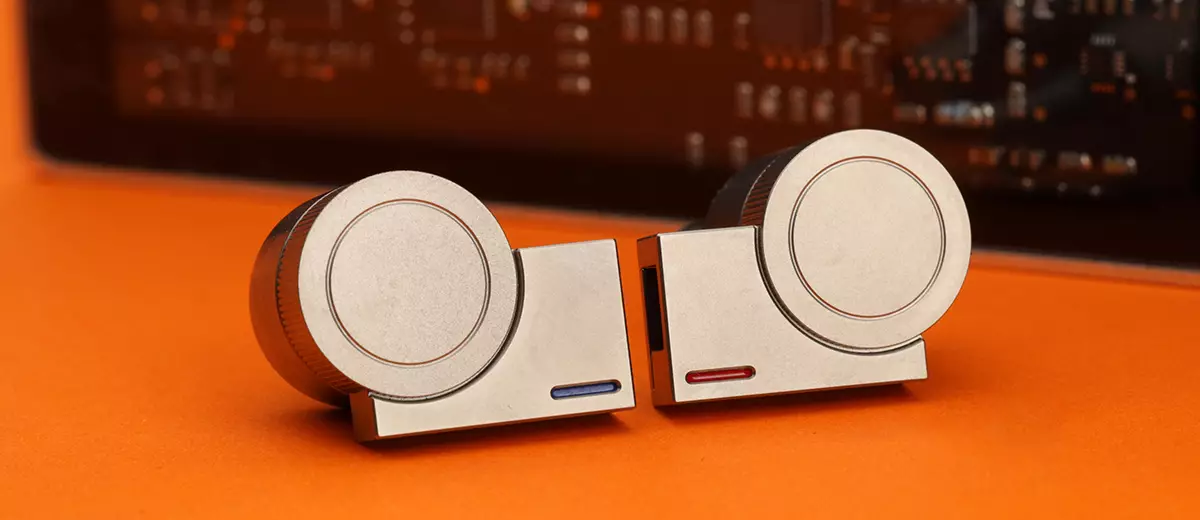
Marcelo reviews the Softears EDGE, a single 11mm dynamic drive universal in-ear monitor finished with a design inspired by the Sigma BF camera. It is currently priced at $499.00.
Disclaimer: This sample was sent to me in exchange for my honest opinion. Headfonics is an independent website with no affiliate links or services. I thank the team from Softears for their support.
Click here to read more about Softears products previously reviewed on Headfonics.
This article follows our latest scoring guidelines, which you can read in more detail here.

Whenever I think about Softears, their single dynamic driver IEM, the Softears Twilight, comes to mind for its unusual shell shape and reputation as one of the best-sounding IEMs of its kind.
Unfortunately, I missed the chance to listen to the Twilight when I was in Singapore and Japan.
And even though I have enjoyed Softears’ other popular IEM, the hybrid Softears Volume S, in the past, I’m still curious about how a dynamic driver Softears IEM would sound.
You can bet I was delighted upon hearing that I’d be reviewing the Softears EDGE, their latest dynamic driver IEM, which sells for $499.
Softears promises tremendous bass output without sacrificing midrange clarity thanks to their 11 mm labyrinth-structured dynamic driver.
Will the Softears EDGE deliver on this promise? And how will it compare to other single dynamic driver IEMs, including the DUNU Falcon Ultra, the FiiO SNOWSKY OAK NANO and the Hidizs MK12 Turris Limited Titanium Edition? Let’s find out.
Features
The EDGE is a single 11mm dynamic driver (dynamic driver) IEM, and is slightly larger than the typical 10 mm driver used in many competing IEMs. It has an impedance of 16Ω with an SPL of 128 dB/Vrms (roughly 113 dB/mW at 32Ω).
Other notable features include a CNC-machined titanium alloy shell to minimize, if not eliminate, resonance.
The labyrinth acoustic structure allows the back wave of the 11 mm dynamic driver to spiral outward to the edge. The internal labyrinth design somewhat resembles the bass section of the iconic B&W Nautilus speaker.
This labyrinth acoustic structure is designed to clean up the sound by precisely resonating to absorb unwanted low- to mid-frequency reflections.
EDGE also features an excellent pressure-relief system that prevents pressure buildup in my ears, which can cause nausea and headaches; the EDGE doesn’t have this issue.
Design
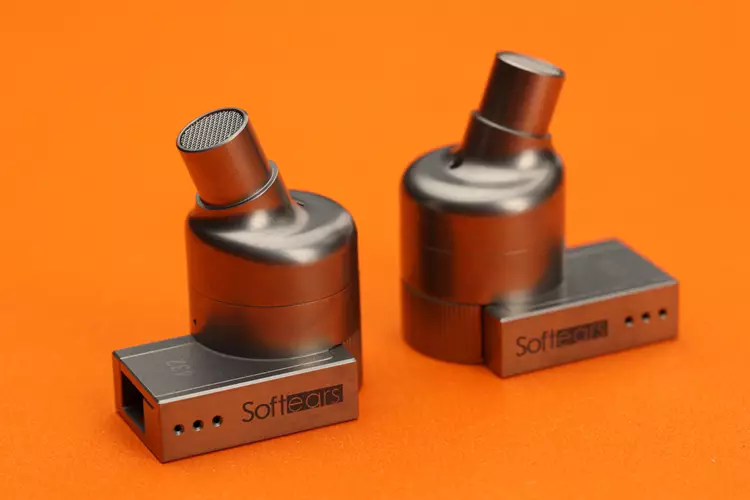
As a photography enthusiast, I find it fascinating that the designers of EDGE took inspiration from the design of a beautiful, relatively recently released camera, the SIGMA BF.
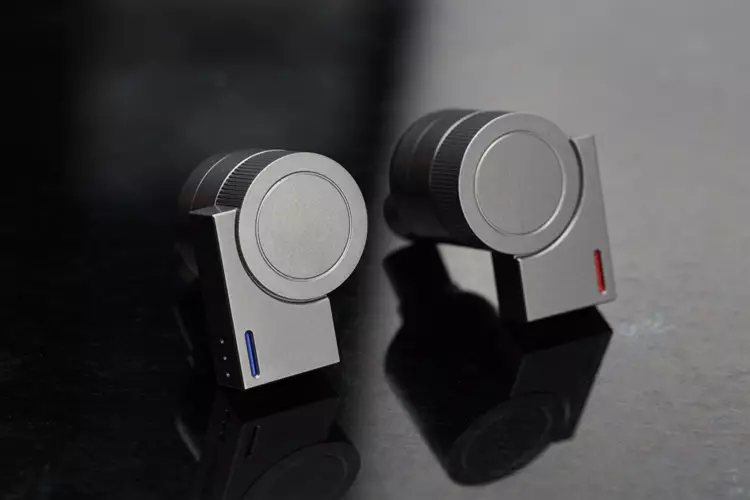
Looking at the SIGMA BF, I can see a resemblance to the EDGE in its rectangular body and circular lens mount.
The whole shell is made of three glued CNC-machined titanium alloy parts: the nozzle and front chamber part, the rear chamber part, and the labyrinth acoustic structure part.
There is a pressure release/bass tuning vent hole near the straight profile nozzle. I do wish the nozzle had a step near the edge so it could hold the ear tips more securely.
I like the knurling on the labyrinth acoustic structure, which makes the EDGE look more industrial and intricate.
The large rectangular part that protrudes from the labyrinth acoustic structure houses the 2-pin connector on one side and three vent holes at the top.
Stock Cable
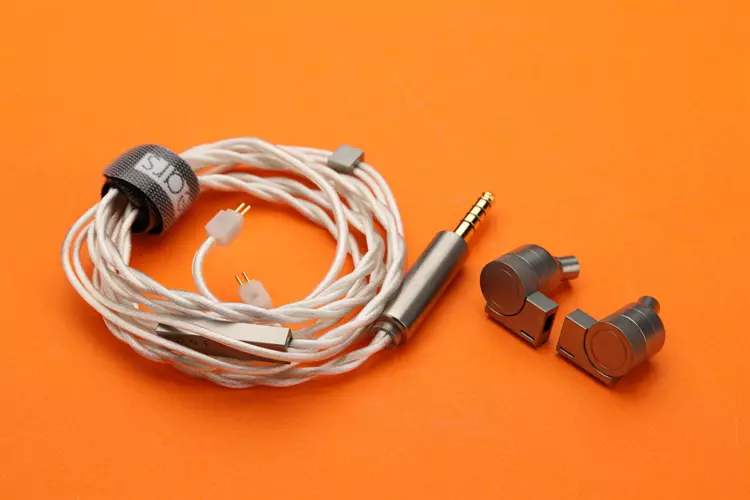
The EDGE’s stock cable looks pretty. According to Softears, it is made of a 7N high-purity rotary-forged OCC core with a silver-plated dual-layer outer structure, terminated with a 4.4 mm balanced plug.
My only reservation is the plastic 2-pin connectors; the rest of the cable’s hard parts are made of metal.
Comfort & Isolation
Despite the angular faceplate design, the parts going to the ear are rounded and ergonomically shaped.
A dynamic driver, a compact size, a 7.6-gram weight, a 5.6 mm nozzle diameter, and high-quality ear tips. The EDGE is very comfortable to wear even in long listening sessions.
The EDGE’s sound isolation is average, which, to me, is a good thing, as I still want to hear the ambient sounds when not playing music during walking exercises. When the music is playing, even at low volume, all the usual ambient noise becomes inaudible.
Packaging & Accessories
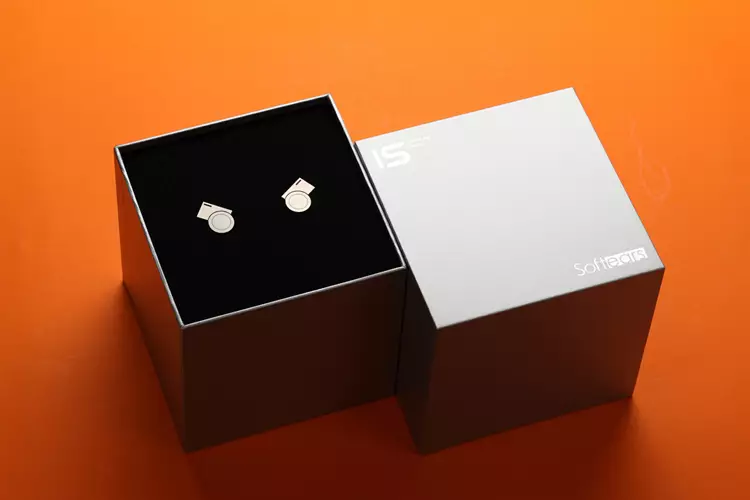
The EDGE comes in a modern cube-shaped silver box with subtle lettering all around, measuring 121 x 121 x 121 mm. All the items inside are protected by plenty of black foam and cardboard.
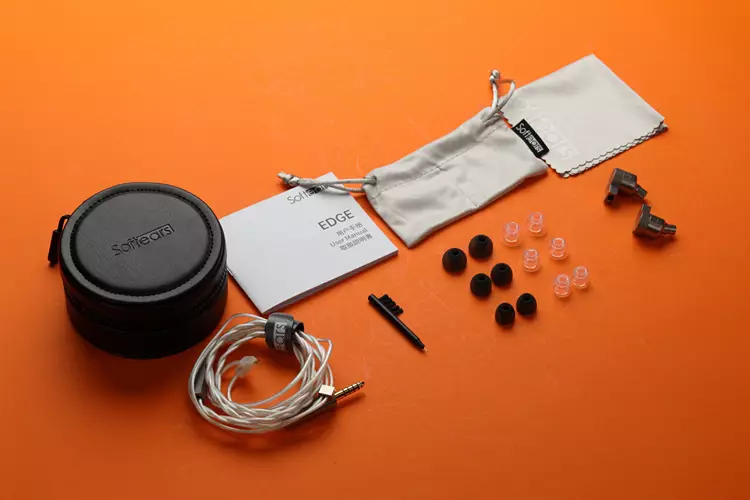
The package includes a pair of EDGE IEMs, a 4.4 mm earphone cable, a storage case, a storage bag, a dust cloth, 6 pairs of Ear tips, a user manual, a mini cleaning brush, and a brand card.
Sound Impressions
I did my standard 24-hour burn-in routine to ensure the EDGE’s dynamic driver has fully settled. I noticed a subtle increase in smoothness to the already smooth initial sound.
For the sources, I used my iBasso DC-Elite and MUSE HiFi M6 Double DAC amplifiers, with my Android phone and the FiiO M15S DAP, using either YouTube Music, UAPP, or PowerAmp music player Apps. No EQ or any sound enhancement programs were used.
I used the stock 4.4 mm cable. For the ear tips, I used the clear silicone ones because I find them more natural and open-sounding than the darker-sounding black ones.
I listen at medium-to-loud volume levels.
Measurements
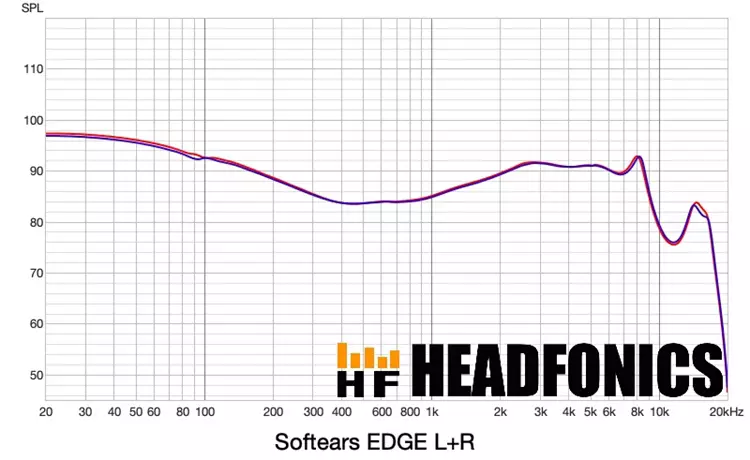
My measurement of the Softears EDGE reveals an almost perfect channel balance, with only a very small imbalance in a very narrow frequency range. This indicates a high level of production quality.
The 8 kHz peak would shift in frequency depending on how deeply I inserted the EDGE into the measurement rig. It is usually, though not always, a measurement artifact and is not audible on the EDGE.
Summary
Looking at the EDGE’s advertised graph before my own measurement, I thought the EDGE was going to sound overtly bassy and muddy, which I might not like. I found out I was so wrong when I first listened to it.
The reason is that, even though bass is well boosted, a cut in the lower midrange, but the upper midrange is mildly forward as well as the upper treble. This results in a moderate V-shaped sound signature.
Yes, there is an obvious boost in the bass, but it is mostly in the subbass region while the upper bass remains clean.
This gives me the impression that I’m listening to a subwoofer-and-satellite speaker system, without the incoherence that sometimes occurs in such systems, thanks to the EDGE’s single dynamic driver configuration.
The bass quality is tight, clean, articulate, and pleasantly deep, which I reckon even neutral-loving listeners would like. It has good separation, so the lower midrange remains clean because the lower bass never bleeds into it.
Lower midrange is slightly recessed but remains neutral enough with an acceptably accurate note weight that is never too thick nor too thin. The upper midrange is slightly relaxed in relation to the bass and upper treble
However, there is still enough presence in the upper mids to give the EDGE a proper vocal presence and acceptable imaging performance.
One of the first things I noticed on my initial listen to the EDGE is the super-smooth, airy treble. It is only slightly elevated in the upper treble, just enough elevation to balance the boosted bass.
The perceived resolution, transparency, and microdetails are high, making me think I’m listening to a well-made hybrid set.

Coloration
From a neutral standpoint of trained ears, the EDGE’s sound tuning is apparent, including the boosted subbass, the cut in the lower mids, and the slight boost in the upper treble.
However, there is no detracting coloration like honkiness or shoutiness in the midrange, sharpness or roughness in the treble, and muddy bass.
I must add that, with the black silicone ear tips, the sound signature is darker and moderately U-shaped.
Soundstage
Thanks to the EDGE’s clean and smooth sound, the soundstage is spacious, enveloping, and immersive. There is no lack of height, width, and depth; the soundscape feels spherical with great surround sound effects.
Due to the recessed midrange, the vocals and instruments feel farther away than usual, giving me the impression that the soundstage is larger than it should be.
This does not detract from the sound quality; rather, it adds more engagement and realism, albeit at the expense of immediacy.
Also, because of the laid-back vocals and instrument presentation, the imaging is laid-back and not well defined, with some diffusion.
It’s not too bad, though, as I can still pinpoint the singer and the instruments’ general direction, and there’s still some front-to-back layering and holography.
I must also add that I find the EDGE to be not the most detailed or analytical-sounding IEM. Luckily, it doesn’t sound dull.
Dynamics
The EDGE’s dynamic performance is very good, especially in the bass. And though the midrange is relaxed, the upper treble has enough energy to counter the bass while remaining smooth, making the sound very musically engaging.
Overall, the EDGE sounds dynamic and goes very loud without compression and distortion.
Click on page 2 below for my recommended pairings and selected comparisons.
