

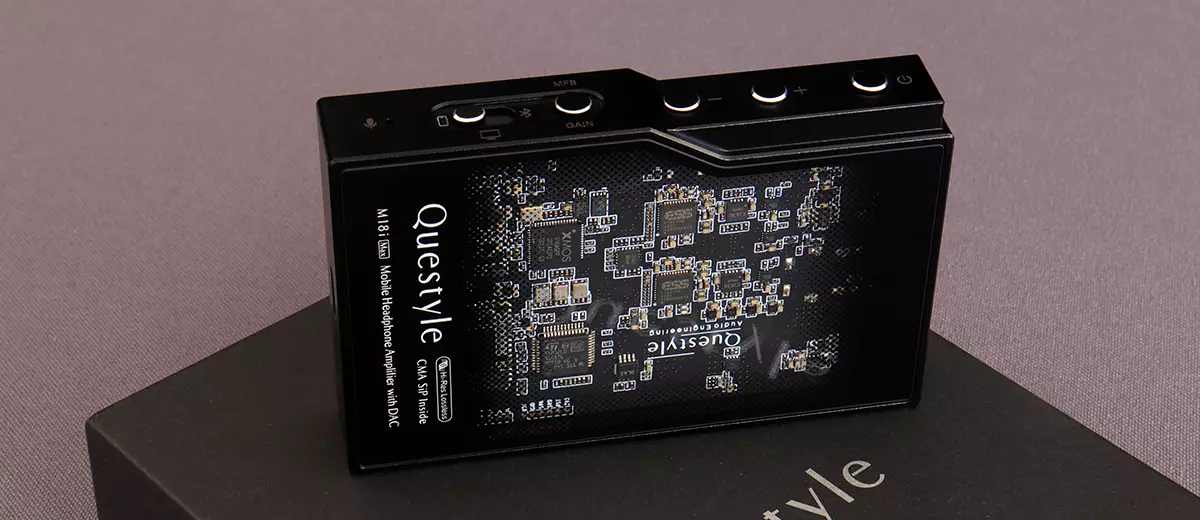
Louis reviews the Questyle M18i Max, a compact wireless-capable ESS ES9219Q portable DAC and headphone amplifier for smartphone users. It is currently priced at $349.00.
Disclaimer: I received this sample in exchange for my honest opinion. Headfonics is an independent website with no affiliate links or status. I thank Questyle for this opportunity.
Click here to read more about the Questyle products previously reviewed on Headfonics.
This article follows our current scoring guidelines, which you can read in more detail here.
My most recent rendezvous with Questyle was a month ago, when we took a look at the QCC Bluetooth dongle. Before that, we took a look at the most revered SIGMA Pro back in January.
Questyle’s forte lies with models like the SIGMA Pro, which has become a hot item lately because it’s turned out to be one of the best battery-powered portable DAC amplifier combo models currently available, especially if you like analytical gear.
Models like the smaller SIGMA and their dongle DAC lineup follow suit, including the M18i and the M15C, which are some of Questyle’s backbone models.
To me, what’s unique about the new model, the M18i Max, is the form factor. It’s a model that promises performance in line with the SIGMA line, but in a smaller package that falls between their dongle DAC line and their full-sized portable models.
How does it perform and compare to the likes of the original M18i, the recent NiPO A100, and FiiO’s BTR17? I find out in my full review below.
Features
The M18i Max offers USB DAC amplifier capabilities, a Bluetooth DAC amplifier, and can drive most headphones.
The M18i Max can also handle phone calls with its built-in microphone, and do it while not draining your battery since it has one of its own.
The model name is in line with the M18i, but the M18i Max mostly resembles a miniature SIGMA. They do share Questyle’s CMA SiP tech and the TTA triple-stage decoding architecture.
What changes in the new M18i Max model? The overall size has been increased along with an improved analog stage, but there are no new features except for the see-through window, à la SIGMA Pro, and improved battery life, which received the biggest upgrade.
DAC
Inside the Questyle is a dual 32-bit ES9219Q, which is in a rather high tier amongst the ESS line of DACs. The one inside the M18i Max is an improved version of the ES9218 in various areas that claims to solve some sonic issues.
The ES9219Q claims to solve the ESS hump and offers a more balanced sonic signature by incorporating an ALP mode with a slightly softer transient response, making it more forgiving when the music gets hot and complex.
One thing I did notice is that although this DAC chip has the capability of hardware rendering MQA, the M18i Max sticks to PCM and DSD formats, PCM 384kHz, and up to DSD256, to be exact, using an XMOS USB platform, which is all fine by me.
Amplification
When you explore the innards of the Questyle M18i Max, you’ll find that it uses Questyle’s patented current-mode CMA amplifier topology that gives the M18i Max the Questyle house sound.
Questyle is also one of those companies that uses top-shelf components, like Torex and Infineon semiconductors, aside from unique circuitry design.
The usual dual headphone out configuration is driven by four discrete CMA SiP amplifier modules, which handle the output section. The bottom-line power output numbers were given to me by Questyle, but they look understated on paper.
The M18i Max is rumored to produce the same amount of power as the original model, which was rated to produce around 260mW at 32Ω, which is not much, to be honest, compared to their next model, the SIGMA.
Design
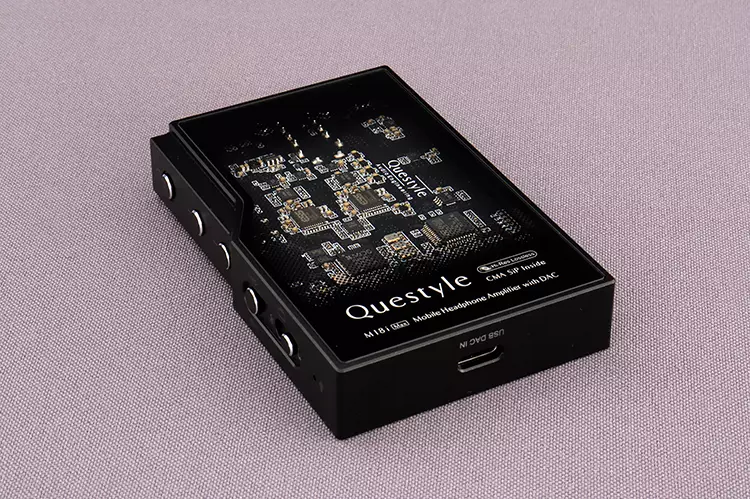
I would consider the Questyle M18i Max a small-form-factor portable DAC amplifier since it falls, size-wise, between their SIGMA and the previous M18i, which was still rather large for a dongle. But as a portable, both are easy to carry.
The design retained the digital display from the original model, which shows a limited amount of data onscreen. But the design also gained the Questyle trademark transparent glass that allows you to peek inside.
The chassis is made from a single piece of CNC’d aluminum with an anodized black finish. There are some sharp corners, but there are no abrasive areas or indents that help you hold the unit either, and it’s rather slick in the hand.
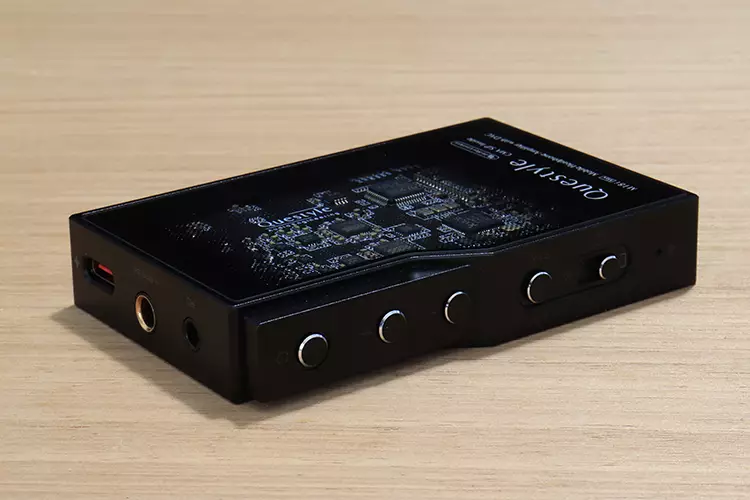
One thing I do like is that all the buttons are on one side, facilitating one-finger operation. I use my thumb since it seems to be designed with that in mind. It feels intuitive to operate that way.
I/O
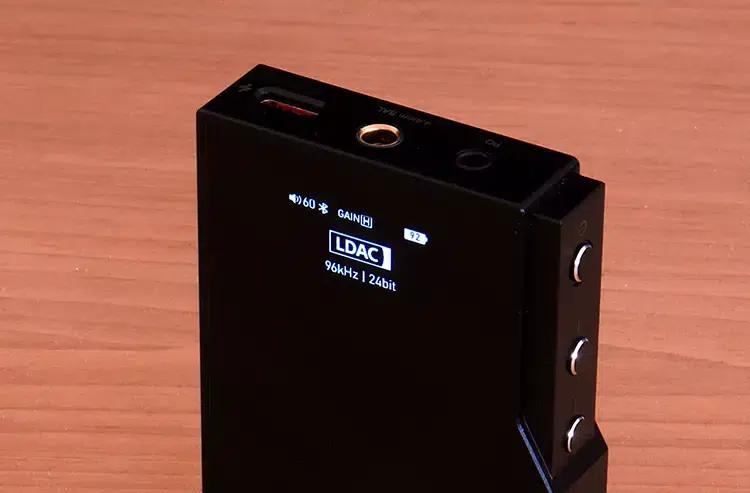
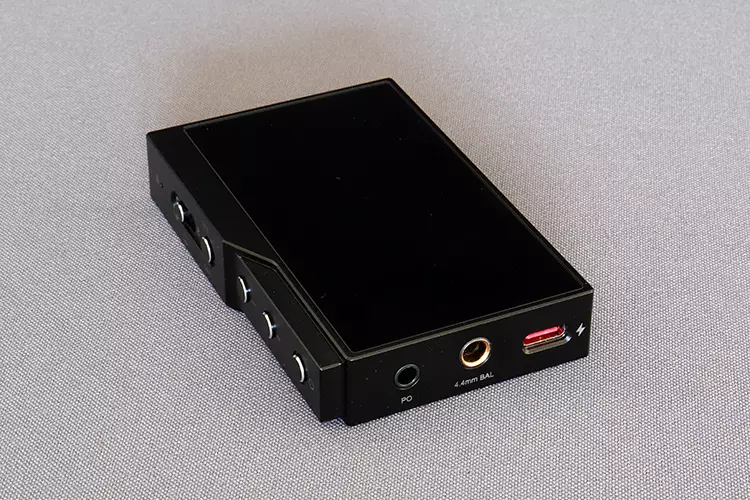
The Questyle M18i Max has the usual dual headphone setup that consists of one 3.5mm single-ended connection alongside a 4.4mm Pentaconn balanced headphone output connection.
On the other end, there’s a USB-C connection that is exclusively for the DAC input, while on the side of the two headphone connections on the other end sits a separate USB-C connection, which exclusively charges the battery.
I’ve had instances where I forget to plug in a second power source to charge the battery, and at that time realized that I was low on charge. To be honest, I feel that this model does not need a secondary USB-C port.
The charging cycle starts when you place the M18i Max into PC mode and when taken out of phone mode. The phone mode appears to disable charging. For this, you don’t need to have the exclusive charging port connected.
Controls
The controls are the same as on the original M18i, and they manage the same functions as on the original M18i. So let’s start with the volume control.
Two buttons control the volume in 1% increments. The volume control is a 60-position, which is okay, but it’s not a now-common 100-step volume as some others have implemented, even on budget-level gear below the M18i Max.
There is a two-way gain that, on low, can comfortably push my pair of Sundaras. On high gain, it does so even better. I didn’t hear any his on low gain or on high either with some of my most sensitive IEMs. This guy sounds totally clean.
Then there’s a mode switch that allows you to switch the M18i Max into Bluetooth mode, PC mode, or phone mode.
Phone mode disables the charging capability, so if you connect the M18i Max to a mobile device, it will not drain your battery. But it will charge from your mobile device if you put it into PC mode.
All the buttons are the same size, except for the mode switch, which is a slider. You would think that being all the same would cause an issue, but the half-side raise is there so you can instinctively know where your fingers are placed on the unit, and it improves ergonomics.
Bluetooth
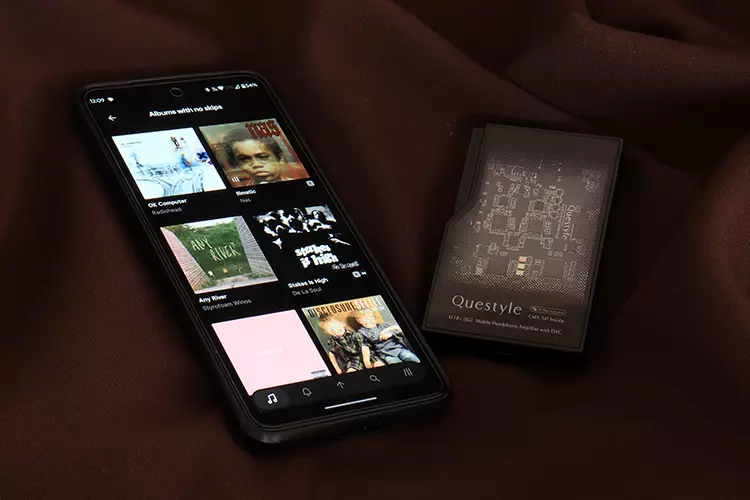
Built into the Questyle M18i Max is a modern-day Bluetooth receiver that runs on a 5.4 Bluetooth radio and supports most of the modern-day codecs, except for the aptX Lossless variant, which I would have liked to have seen implemented on this device.
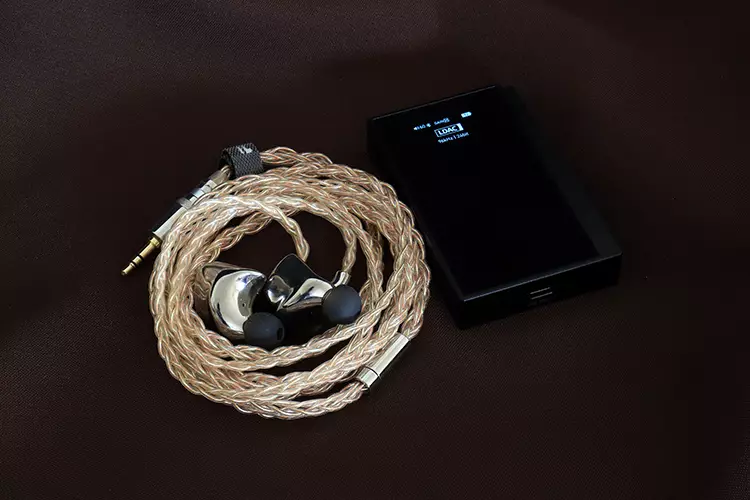
Everything from standard SBC, AAC, aptX HD, and Adaptive is game. Plus, you can run LDAC, LE, or low-energy Bluetooth Audio on the M18i Max.
I prefer to run LDAC on the M18i Max, but remember to set your device’s Bluetooth LDAC bitrate to 990kbps.
Do not make the mistake of running LDAC 330kbps, then complain of crappy sound. But when you kick the device into high rates on high-tier codecs, transmission distance suffers.
Most of the time, I paired the M18i Max with their QC dongle Pro on LDAC and could not walk 14 feet away without experiencing a load of dropouts. At 17 feet, sonics were not pleasant, and at 18 feet, there was no reception to speak of.
However, I do feel that the M18i Max sounds way better as a DAC amplifier being fed by the USB-C connection. The Bluetooth, to me, sounded somewhat compressed and narrow in soundstage in comparison.
The soundstage just didn’t present itself with the holographic capability that the DAC amplifier is capable of when on Bluetooth and on LDAC.
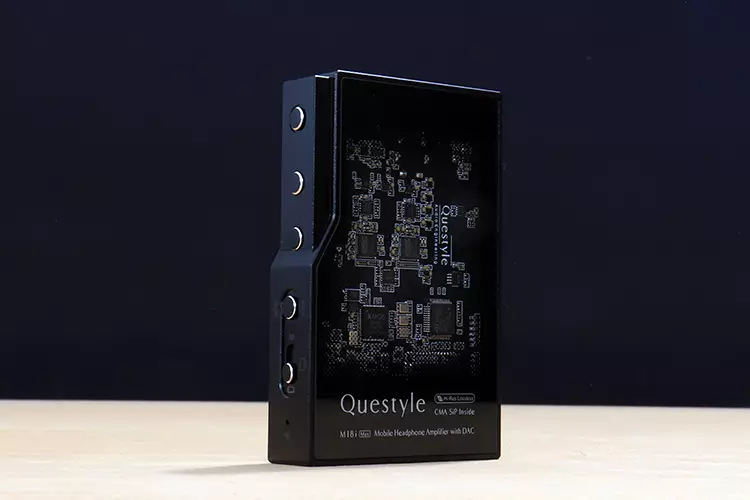
Battery Life
One of the areas Questyle was concerned about, it seems, was battery life, since that was one of the major complaints of the original M18i.
Perhaps the larger battery made it necessary to increase the chassis size. Knowing that now, the size increase makes more sense to me.
This time around, Questyle threw in an 1800mAh battery, which is over three times the size of the original model’s battery. I did most of my battery endurance testing on high gain, by the way.
At 60% volume, I was getting approximately 15 minutes of audio via Bluetooth for every 5% battery life, which is one of the fastest ways of draining the battery, besides using the phone feature, which throws the mic into the mix. That translates to around a little over four hours, in my case.
When using the M18i Max as a DAC amplifier, I was getting over 5 hours, close to six. However, even on standby, there was a small amount of battery drain occurring in Bluetooth mode. I didn’t see the same when the M18i Max was in DAC mode.
I’m not an easy-to-please listener and like to listen at loud levels of volume, and those numbers are very good. I bet you can get close to eight hours or a bit more if you use a very efficient IEM set and use just a moderate amount of volume.
Packaging & Accessories
Questyle packaging has been more than satisfactory to me. I mean, the packaging doesn’t have any wow factor upon inspection, but it protects the contents.
The packaging is well laminated, even though the major theme here is an all-white back with black letters and outline drawings.
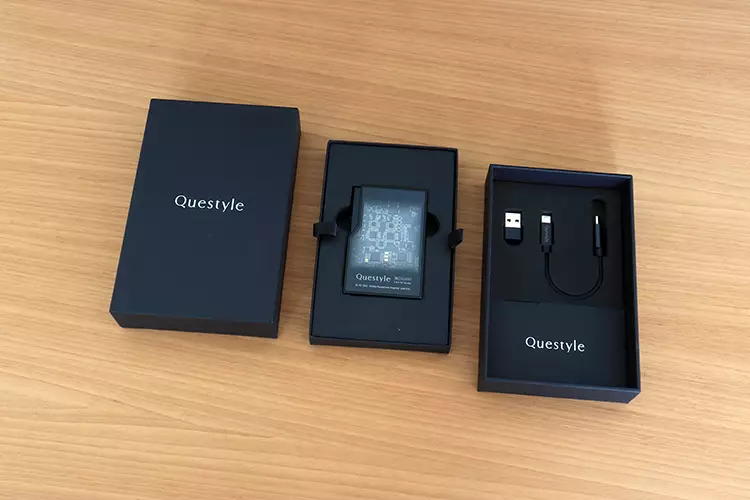
The outer shell is just a sleeve, which, when removed, reveals a black box with the Questyle logo upfront.
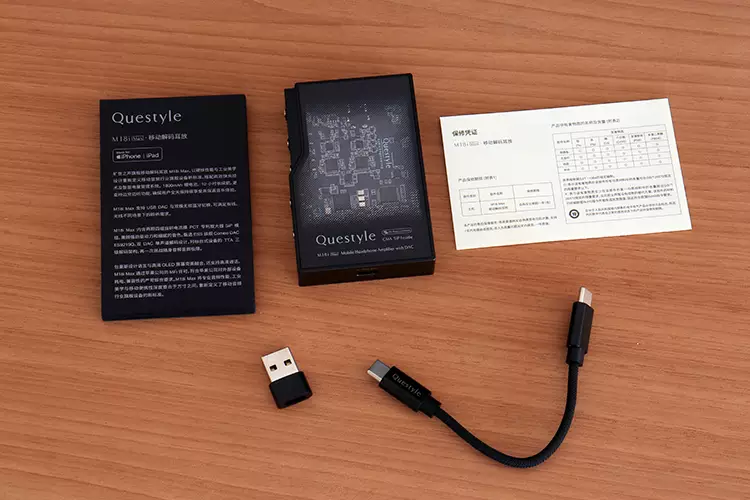
Inside, the M18i Max sits in a cardboard cradle, and below are the accessories. They consist of a six-inch USB-C-to-USB-C cable, a USB Type-A adapter, and some paperwork.
Sound Impressions
I used all three input methods. I transmitted Bluetooth to the M18i Max via their QCC Pro Dongle with LDAC, and used my custom-built PC with Windows 11 to feed the M18i Max via USB, as well as my daily mobile phone. My favorite was the USB feed method.
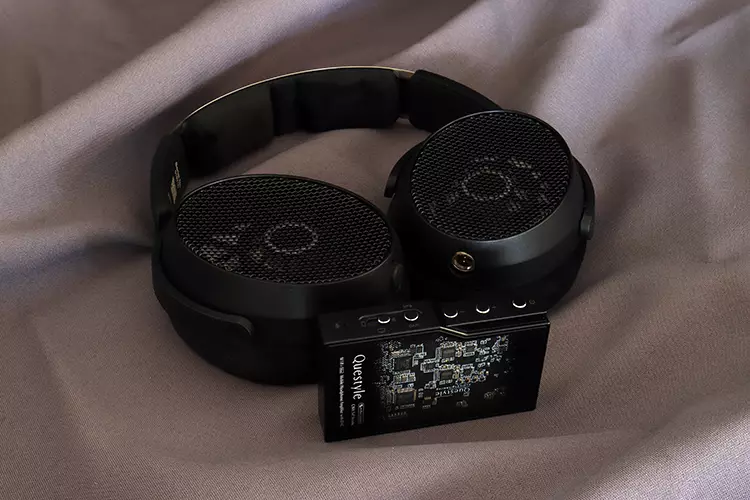
I used my trusty HIFIMAN Sundara, the Meze Audio 99 Classics Gen 2, Sennheiser’s HD 490 PRO Plus, FiiO’s FX17, the ORIVETI OD200, and the HIFIMAN Svanar IEMs.
Summary
My introductory words to describe how the Questyle M18i Max sounds would be expansive, but not excessively wide, focused, and linear, with a midrange inclination over the bass and treble regions, which helps in the production of detail.
It’s a hint musical, but still presents itself as a neutral-sounding device that doesn’t sound excessively dry, and even though I would also classify it as a reference-like sounding device, it doesn’t sound clinically sterile either.
The M18i Max paints music over a clean background in a highly resolving manner. It excels in transparency in that elements within the recording are distinctly produced. But there’s also a natural and slightly warm texture to the overall presentation.
The M18i Max produces audio with a very low noise floor, and with an amicable tonality that produces an overall sonic presentation with excellent detail retrieval.
Timbre
The M18i Max has a slight forwardness in the midrange but sounds balanced overall. The bass is clean and to the point, with a good amount of texture; the high frequencies are clean and produce shimmer, but are restrained and well controlled, although they are presented with a touch of excitement.
There is a richness and an organic aspect that make instruments sound convincingly realistic in timbre. Instruments that have bite are produced as such, while vocals are produced with no glare and without sounding too thin, but rather lifelike.
The bass response is tight and controlled, but never bloated or artificially elevated. The M18i Max also produces a lush midrange that projects energy without becoming too harsh or sharp. It produces a midrange that is pleasingly realistic and convincing.
Staging
The M18i Max is a portable device capable of producing lots of microstaging, within a realistically sized soundstage that is not uber wide, but a bit contained, which keeps everything within focus and not too outward or stretched.
The M18i Max center stage is well pronounced and solidly produced with a good amount of depth. There’s also an above-average width in the remaining soundstage that again retains focus.
Layering is a strong point that not only allows the M18i Max to produce excellent imaging precision, but it also produces a well-layered panorama with very well-defined positioning, front to back.
Dynamics
The Questyle M18i Max is a speedy little devil that is a common trait of their CMA amplification. Dynamics are very expressive in that low-to-high passages occur quickly with no overhang.
Impactfulness doesn’t suffer either since quick changes in loudness occur with crisp attacks and decay. Microdynamics are very good as well and are produced in a way that makes it easy to hear a lot of background details, breath, vibrations, etc.
The overall sonic presentation never sounds compressed either, nor does it produce a lingering effect, and it prefers speed over soft-mannered placidity.
Click on page 2 below for my recommended pairings and selected comparisons.
