

Louis reviews the NiPO A100, a new MagSafe-equipped portable DAC and headphone amplifier with up to DSD512 decoding and 550mW of power. It is currently priced at $399.
Disclaimer: This sample was sent to me in exchange for my honest opinion. Headfonics is an independent website with no affiliate links. I thank NiPO and Musicteck for their support.
You can click here to read more about the portable amps and DACs we have previously featured on our website.
This article follows our latest scoring guidelines, which you can read in more detail here.

Up for review is a portable DAC/amp from a new brand for Headfonics. The company is called NiPO, which they say comes from an abbreviation of a game called Nine Point created by Sam Loyd, which promotes creativity and a break from fixed thinking patterns. NiPO is based in Shenzhen.
Currently, NiPO has three products listed on its website ni-po.com. They have two opulent-looking DAPs, the N1 and the N2, plus today’s subject, which is their portable battery-powered DAC amplifier, the A100.
The NiPO A100’s main niche is enhancing the sonic capabilities of any mobile phone. NiPO calls it the ultimate mobile device companion, and although it may seem like a simple device on the surface, it’s not. There’s a lot of complexity, but it’s all on the inside.
Dubbed the compact N2, the A100 borrows NiPO’s core technologies, which include a proprietary acoustic foundation flagship player architecture found inside their flagship N2 DAP.
Features
The NiPO A100 is not a DAP. It’s a versatile, small-form-factor portable DAC amplifier that incorporates a built-in battery. Also, it is compatible with many types of devices via OTG, including Android and iOS smartphones, tablets, computers, and transport devices.
The NiPO A100 has a single ES9039Q2M DAC chipset implementation capable of decoding up to 32-bit/768kHz and native DSD512 via USB.
The NiPO A100 also includes some usable digital filters. I counted nine in total, and they’re all accessible on the fly via the G button.
Amplification
The NiPO A100 relies on a set of voltage feedback, rail-to-rail, high current SGM8662 OP-amp amplifier chips from SG Micro. Old timers call them spiders.
The A100 can produce a reasonable 550mW at 32Ω or 4.1V balanced and a more moderate 125mW or 2V at the same 32Ω impedance.
There’s also an output impedance listed of 0.22Ω and a 0.44Ω rating, suitable for impedance-sensitive gear.
Design
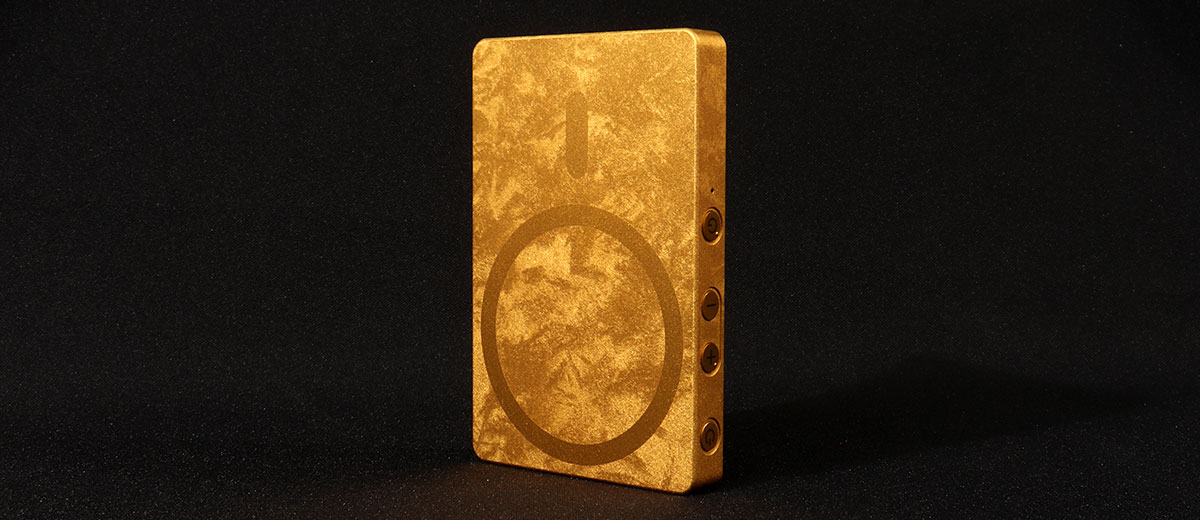
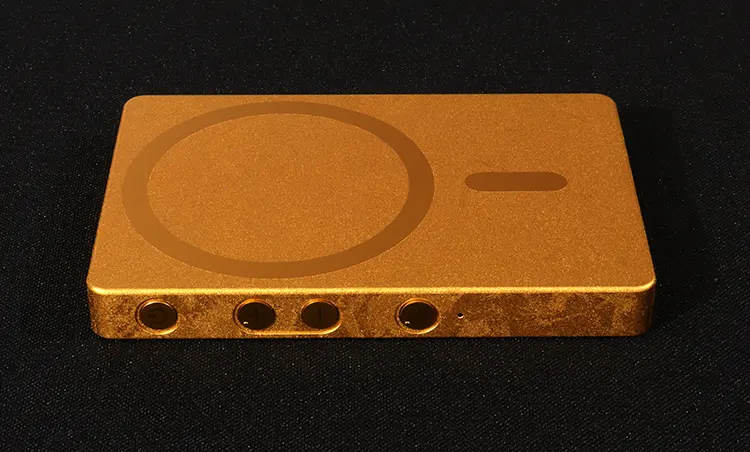
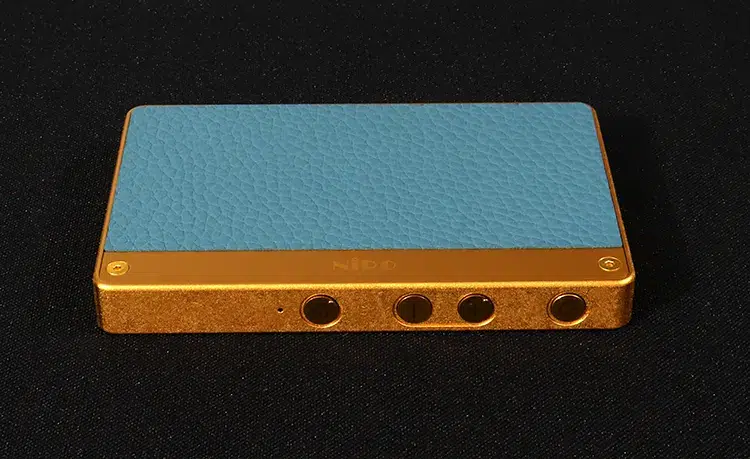
The NiPO A100 looks luxurious, and the first thing that hits you is the nano-textured chassis that, at times, looks like it’s been held by someone who’s been eating fried chicken. Only upon a closer look do you realize it’s a fancy finish.
This finish is called Photolithography nano texture, and it goes above and beyond some other companies that just give you a vanilla black chassis.
You can say this is one step above a brushed finish, but I know there will be some that will feel like the finish is not their preference, but I like it.
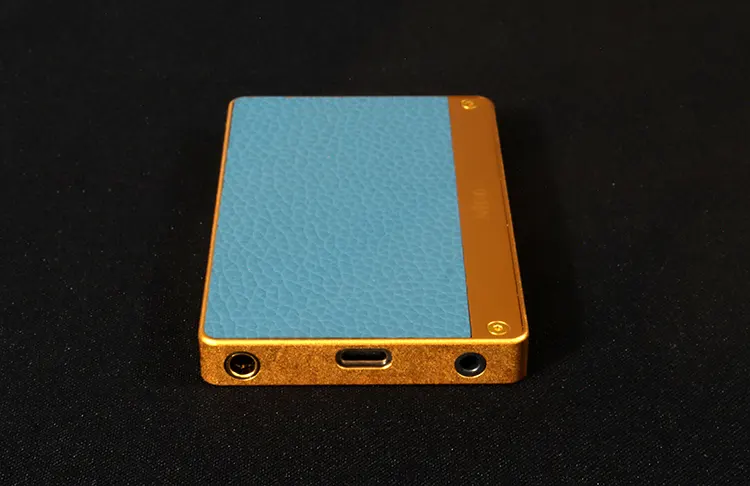
The only aspect that clues you into how the A100 was assembled is the two visible set screws that hold the chassis together right below the leather insert, which, by the way, is available in three colors: blue, black, and red.
All the corners are round, all the edges are smooth, and it feels like one solid piece. The leather insert is a nice touch, and the only eye sore is the mentioned set screws.
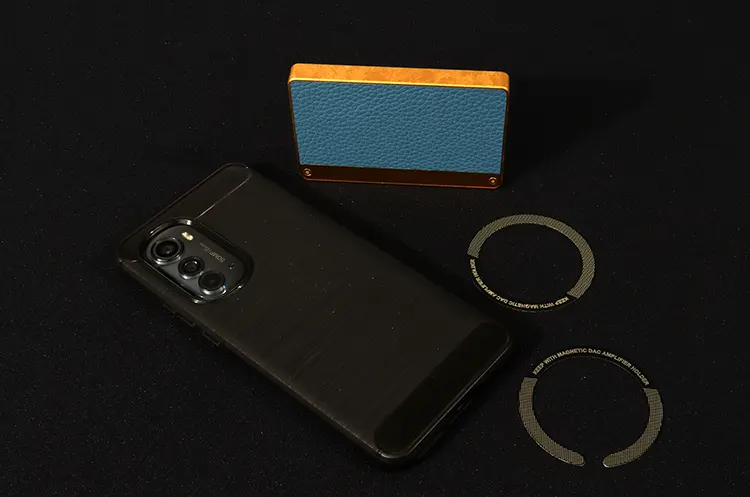
One of the cool features of the A100 design is the built-in MagSafe magnetic lock design, which takes the place of rubber bands and beats them hands down.
NiPO includes two rings with adhesive backs that stick to the back of any mobile device, and that enables the A100 to lock onto the mobile device via magnets.
I/O
The NiPO A100 has three IO ports, a USB-C connection, a 4.4m balanced headphone output jack, and a 3.5mm conventional single-ended output.
I like the fact that you only have to deal with one USB-C plug for audio and charging the internal battery, but the charging system has a procedure that shouldn’t be. I’ll be more specific in the next section.
I found two quirks here in this area. First off, it seems that there’s an issue when attempting to use IEMs or any headgear that uses a 4-pin 3.5mmTRRS plug on the A100.
I tested two models, the Helm Audio F2 and the recently reviewed Flare Audio Studio IEM. The effect I got was on was completely out of phase, so don’t count on using this type of connection.
Controls
The NiPO A100 has four push buttons on one side of the body. That makes it a one-handed operation device, which I like, especially in a portable scenario.
There are two volume buttons alongside another dual-function button that controls the gain setting and the digital filter selection. The other button is the power button that controls the power and the charging mode selection.
Two of the buttons, the positive volume and the filter selector button, have a raised Braille bump. I do wear glasses, but I do have some eyesight, and I found the Braille bump to be very useful. Who would have thought?
The buttons do promote positive feedback by providing a distinct click each time you press any of the four buttons. They also seem to be made from the same metal material as the chassis.
However, they don’t have the Photolithographic effect; they’re just gold-toned with black identifying symbols, giving enough contrast to be highly visible.
Battery Life
The NiPO A100 has excellent battery life. Charging the 39000mAh Li-Polymer battery can be done quickly in around 2.5 hours. Plus, if you use IEMs, you’ll get over 10 hours of playback time.
However, I dislike the charging system in that you have to double-press the power button to slip into charge mode.
The unit also comes with a warning not to double-tap the power button while connected to a phone due to a high current drain that can momentarily occur during the procedure.
The unit uses a single USB-C port for signal and charging, and that’s simple enough, but you can’t charge the unit while in use because the unit will not turn on while in charge mode.
This makes this model specifically for portable use, since in a desktop scenario, you would have to stop using the A100 once the battery reaches 0 and would have to interrupt listening to charge up.
I understand the concept of isolating the charging circuit from the main circuitry, but I miss the days when you just plug the thing in, like, for example, a phone.
I must say that NiPO has a niche for producing good sound with little battery drain and excellent battery life.
Packaging & Accessories
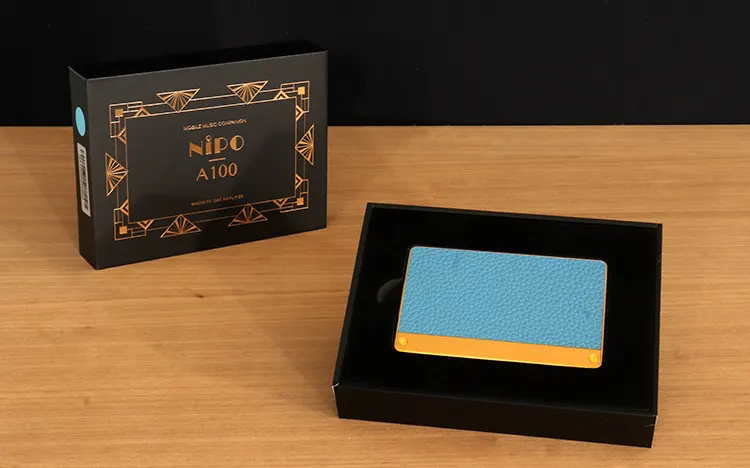
First off, the front of the box looks like a retro movie intro template from the times when movies were silent. The retro-look is achieved by using gold over black, which delivers an attractive high-contrast aesthetic.
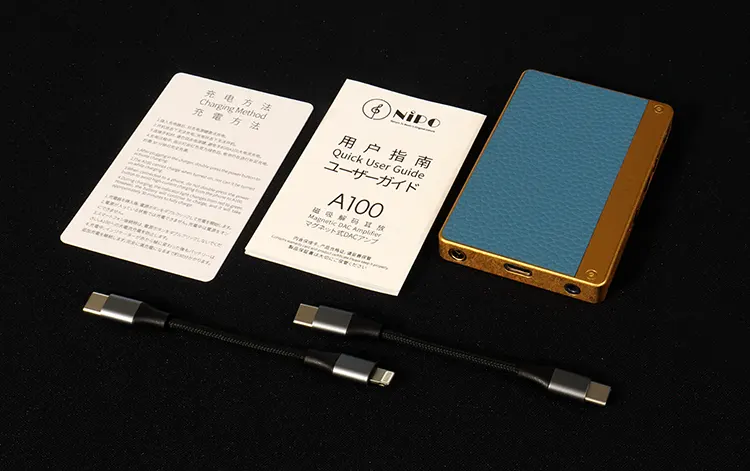
Another aspect I like about the A100 packaging is that it includes Lightning connectivity alongside USB-C connectivity. I’m not an iPhone user, but I sympathize and feel good when a company doesn’t forget them, as some do.
You get an O ring and a C ring for the MagSafe. The other inclusion is the warranty card, which doubles up as a quick guide.
Sound Impressions
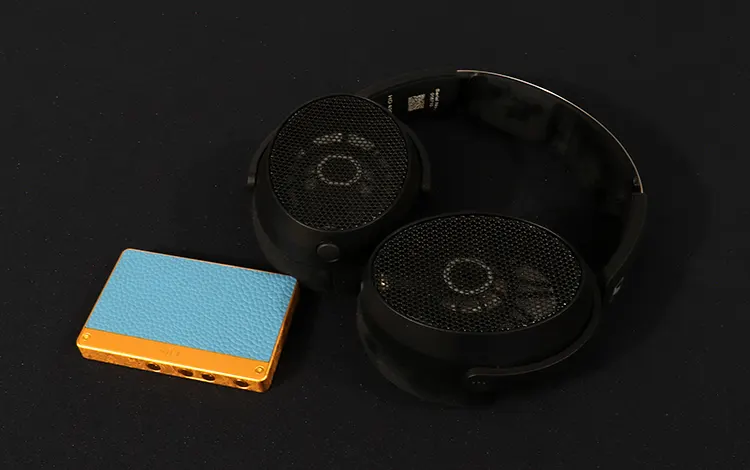
Understanding the functionality of the NiPO A100 and knowing that it was designed for IEMs, I still used full-sized headphones like the Arya Organic, the Ananda Nano, and the Sennheiser HD 490 PRO Plus.
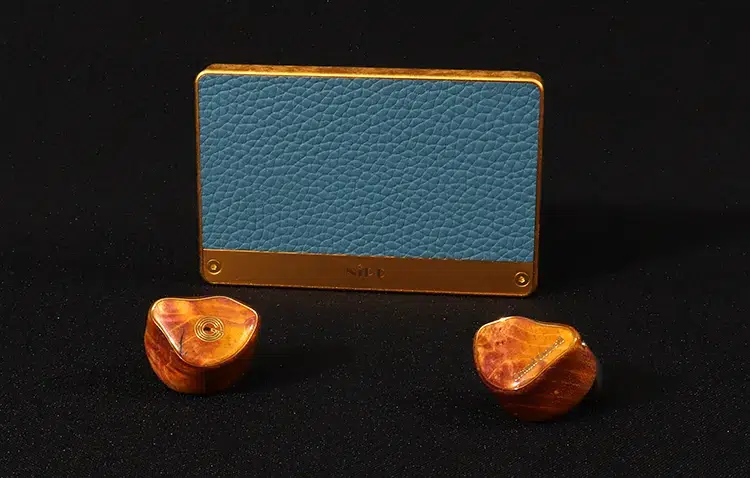
The IEMs I used included the Grand ORIVETI Supremacy, the HIFIMAN Svanar, the FiiO FX17, and the HIFIMAN RE2000 24K gold edition.
I fed the A100 two ways: one with my Motorola Edge using the stock A100 cables, and the second, with my custom Windows 11 PC on a USB 3.1 port. I kept the A100 on minimum phase, and no additional filters were used.
Summary
The NiPO A100 is a linear sounding device with a clean profile, which seems to be another one of NiPO’s niche points. The frequency response is well extended, covering deep bass, and to highs that produce lots of sparkle.
The background is dark, and there is no hiss perceived, even with sensitive IEMs. This darkness makes way for a clear view into the music it’s producing.
Transparency is another virtue of the A100. It uses a clean canvas to paint the music onto, revealing the music and some of the intricacies within recordings.
The overall sonic signature is one of uncolored clarity and resolution. Some will consider the A100’s distinctiveness lies within its analytical capability, since it tends to sound cogent and organized, but I think it’s a touch musical.
The A100 sonic signature is bold and full-bodied. Vocals come through with a pinch of body, which gives them some intimacy, while the bass is punchy but controlled. The high frequencies are produced politely and avoid being too bright or harsh.
It’s a capable device that sounds lively and engaging, that leans on the technical side of the coin. You can say it’s not a fuzzy, warm-sounding device, but one that focuses on delivering clean, snappy sonics with a minimum amount of coloration.
Staging and Dynamics
The most prominent part of the NiPO A100 soundstage is its height and width. This little guy can produce a large soundstage. The A100 also produces lots of width and depth, but the latter is the most shallow portion of the soundstage, although adequately produced as well.
Not only does the A100 produce a large stage, but it also produces precise positioning. There is expansiveness; however, the staging most times feels like it’s in the head rather than on the outer edges.
The width capability is there. I’m guessing it’s interpreting the recording because the layering is decent, and the overall stage never feels claustrophobic.
Click on page 2 below for my recommended pairings and selected comparisons.
