

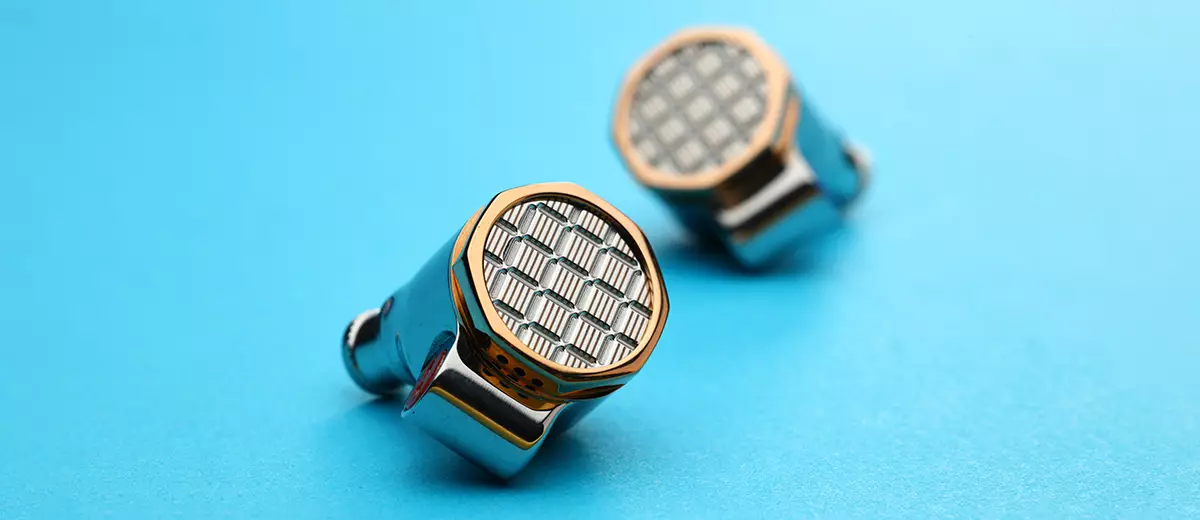
Marcelo reviews the FiiO SNOWSKY OAK NANO, the sub-brand’s flagship single 13.8mm beryllium-coated dynamic driver and titanium shell IEM. It is currently priced at $449.00 MSRP.
Disclaimer: I received this sample in exchange for my honest opinion. Headfonics is an independent website with no affiliate links or services. I want to thank FiiO for their support.
Click here to learn more about the FiiO audio products previously reviewed on Headfonics.
This post follows our current scoring guidelines, which you can read in more detail here.
The SNOWSKY sub-brand by FiiO is focused on the budget end of the market. It offers products with fun, less-serious designs, such as the DISC, ECHO, Melody, and Anytime.
And when the FiiO SNOWSKY OAK NANO, which sells for $449 MSRP, arrived, I was totally surprised that it ships under the SNOWSKY brand.
Not that I should expect any less, given it’s not under the FiiO main line, because any brand can release truly flagship-worthy products.
Especially upon reading OAK NANO’s specs, which list a large 13.8 mm Beryllium alloy dome diaphragm with a 1.5T motor system dynamic driver, and really piqued my curiosity and excitement.
How will the OAK NANO perform? And, more importantly, how will it compare with other single dynamic driver IEMs that use semi-exotic diaphragm materials, such as the Hidizs MK12 Turris Titanium Edition and the DUNU Falcon Ultra? Let’s find out.
Features
While most single dynamic driver IEMs use a 10 mm driver, OAK NANO uses a large 13.8 mm beryllium alloy dome with a W-shaped diaphragm, a dedicated surround design, and a pure titanium chamber.
The large-diameter driver has almost twice the radiating surface area of a typical 10 mm dynamic driver. Having a larger driver also allows for a stronger-than-usual 1.5T external magnetic circuit, whereas 1T or below is normal.
This might not mean anything on paper, but in real life, OAK NANO is the strongest magnetism I’ve experienced in IEMs. I can feel them pull toward each other when they are placed about an inch (2.5 cm) apart, and then they drag toward each other on the table.
Even with the cable attached, a single OAK NANO could confidently carry the other OAK NANO with magnetism alone.
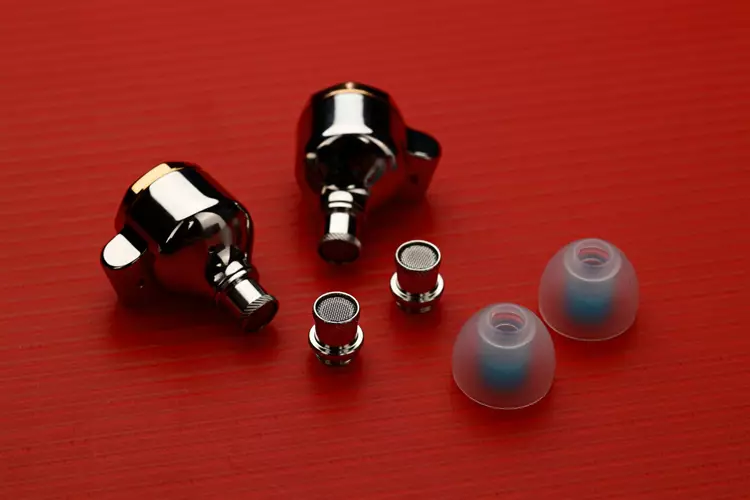
Other features include airflow-optimized front and rear titanium chambers and a replaceable tuning nozzle system with two nozzle types. OAK NANO has a 50Ω impedance and a sensitivity of 112 dB/mW @1kHz.
Additionally, OAK NANO features an effective pressure-release system that prevents pressure buildup in the ear canal, which can cause headache, nausea, and ear pain during walking and running. OAK NANO doesn’t have that issue.
Design
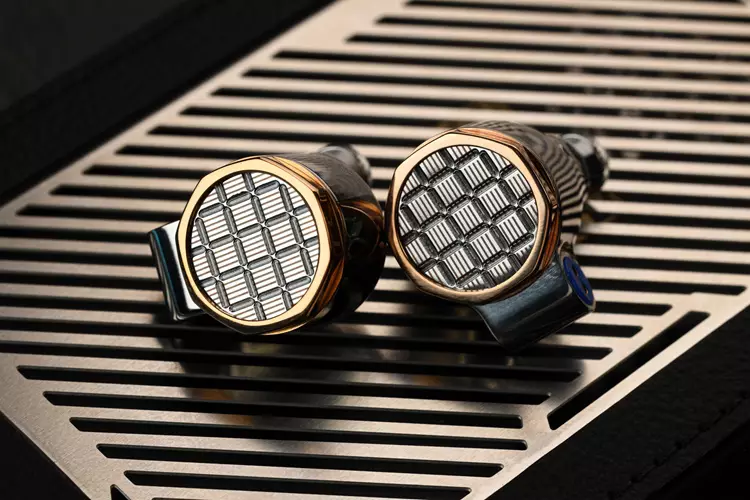
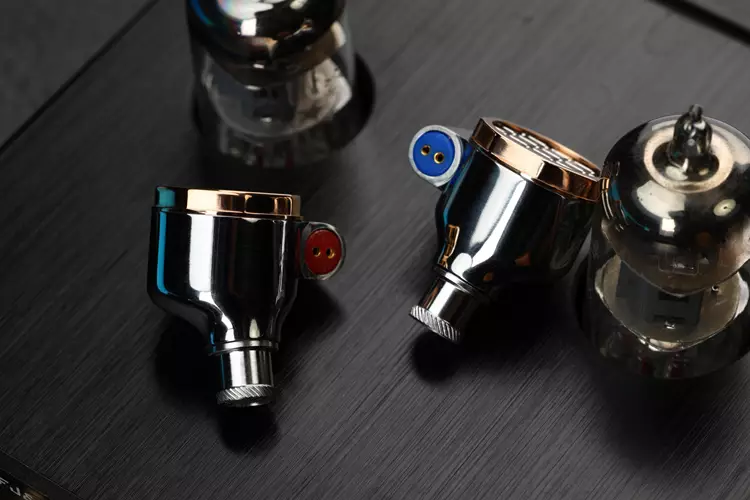
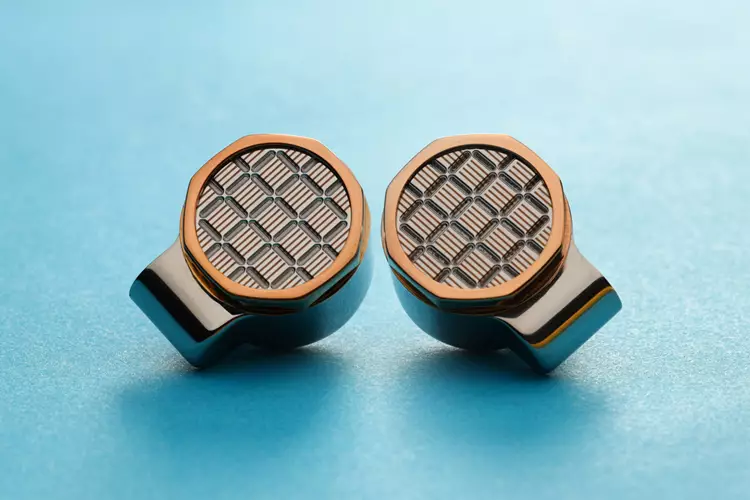
The first thing I noticed about the OAK NANO’s design is the beautiful golden octagonal faceplate with a circular center section filled with a silver-colored matrix of carved-out four-lined squares.
It’s difficult to describe, so you’ll have to look at the photos to see the unique design.
There is an outrigger on the side for the color-coded, red for right and blue for left, 2-pin connector. And three vent holes are located near the junction of the face plate and the 2-pin connector outrigger.
Another vent hole can be found in the surface near the replaceable nozzle. The nozzles have a knurled outer edge for easy removal/installation and provide grip for the ear tips as well.
The OAK NANO is made entirely of metal, with a mirror-like silver finish on most parts. Despite that, each weighs only 9.6 grams, which is within the average range for IEMs. The shell is medium in size, and the nozzle is 6.2 mm in diameter.
Comfort & Isolation
Weight and size are very important for comfort, and OAK NANO’s average weight, compact medium size, ergonomic shape, and comfy ear tips make it very comfortable to wear even in long listening sessions.
OAK NANO’s sound isolation is average, which, to me, is a good thing, as I still want to hear the ambient sounds when not playing music during walking exercises.
When the music is playing, even at low volume, all the usual ambient noise becomes inaudible.
Ear Tips
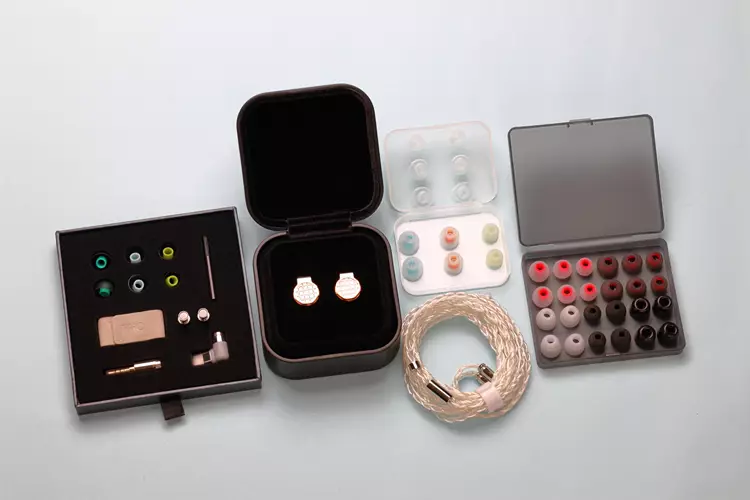
I must commend FiiO for including 8 ear tip types totaling 23 pairs, including the factory-installed ear tips. The set includes foam and dual-flare tips, as well as 5 more very comfortable, high-quality-feeling conventional ear tip types.
I tried all the ear tips, and they all sounded good, so I decided to use the factory-installed “balance” ear tips to simplify the review.
Stock Cable
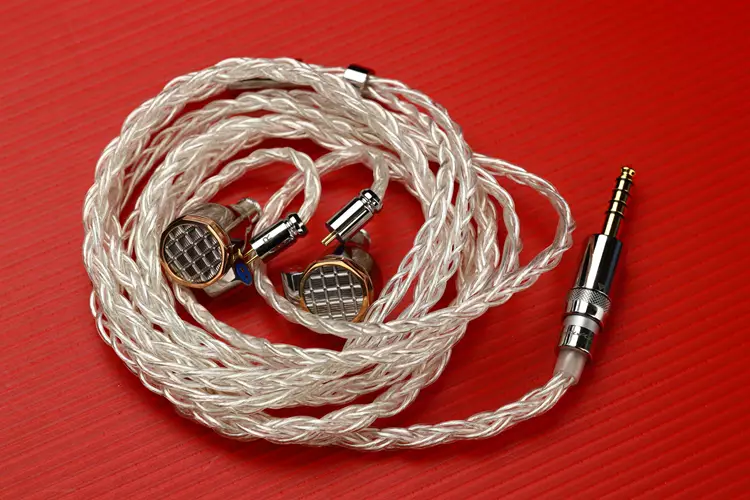
The OAK NANO includes an attractive-looking, modular, 8-core, silver-plated single-crystal copper cable, finished in clear white silver. All the hardware is metal with a mirror-like silver finish.
The modular cable system includes one thing I wish every mid-priced to high-end IEM set had: a USB-C plug that users could attach to the system. 3.5 mm and 4.4 mm plugs are included as well.
My only complaint is that there is no clear indicator of the correct orientation when switching between plugs. I have to rely on the small dent in the tiny four-pin connector, which is difficult to see and align, even with my glasses on under bright light.
Packaging & Accessories
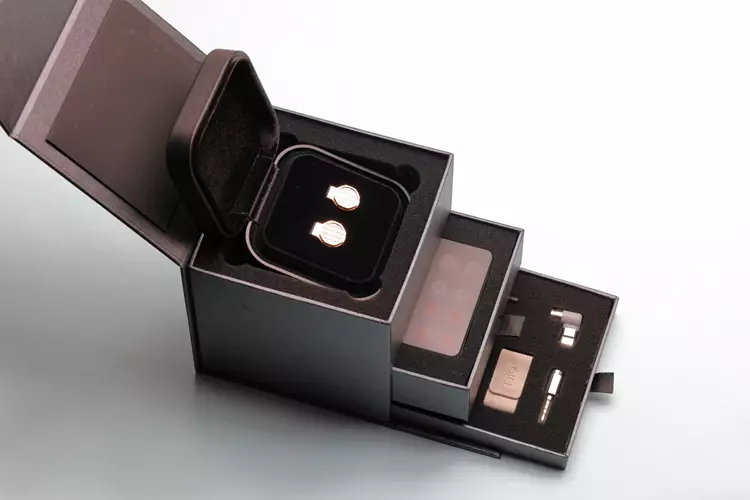
The box is unassumingly average in size, measuring only 122 x 122 x 126 mm, but the internal packaging design is cleverly classy. It has an external sleeve with the SNOWSKY OAK NANO in front, and some text printed all around.
Once the sleeve is removed, a magnetized top cover, into which the manual is inserted, opens to reveal a leather-plastic box that opens like a ring case used when a man proposes to his GF. It includes the OAK NANO IEM pair and the cable.
Another magnetized door in front covers two mini drawers containing 22 pairs of ear tips, with a plastic organizer case on most of them.
A small cleaning brush, USB, 3.5 mm, and 4.4 mm plugs, an extra pair of tuning nozzles, and a real leather magnetic cable organizer are included as well.
Sound Impressions
I did my standard 24-hour burn-in routine to ensure the dynamic has fully settled. I noticed a subtle increase in bass presence and overall smoothness after the burn-in.
For the sources, I used my iBasso DC-Elite and MUSE HiFi M6 Double DAC amplifiers, with my Android phone and the FiiO M15S DAP, using either YouTube Music, UAPP, or PowerAmp music player Apps. NO EQ or any sound enhancement programs were used.
I used the stock cable with the balanced 4.4 mm plug and the red ringed nozzles. For the ear tips, I used the ones that were factory-installed with the OAK NANO.
Measurements
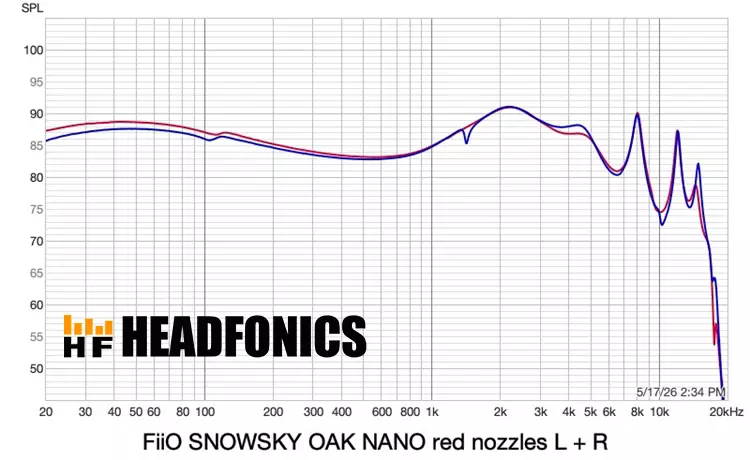
My measurement reveals a good channel balance, with only a minor, imperceptible imbalance in some regions of the frequency range.
I also include the measurement comparing the frequency response of both the red and black nozzles.
The 8 kHz peak would shift in frequency depending on how deeply I inserted the OAK NANO into the measurement rig. It is usually, though not always, a measurement artifact and is not audible on the OAK NANO.
Summary
I have reservations about reviewing single dynamic driver IEMs with semi-exotic diaphragm materials larger than 10 mm, as I find them to have a somewhat slow transient response and to lack micro-detail in the upper treble. I later found out I was mistaken about the OAK NANO.
Out of the box, the sound is kinda elevated in the lower treble with a hint of midrange forwardness, which sounds fine but nothing special. It was with the black nozzles, which were factory-installed.
And then I tried the red ringed nozzles. The sound quality blew me away, and I knew right then and there that it would be the one I’ll use for this review and forever.
With the red-ringed nozzles, the OAK NANO has a very neutral and very clear sound signature. There is an equal presentation of bass, midrange, and treble, without sounding dynamically flat or boring.
What made the OAK NANO special is the perceived resolution, clarity, cleanliness, and air in the sound. It has the benefits of a single-driver’s coherence and bass response, but with technical capabilities comparable to those of multi-driver hybrid and planar IEMs.
The bass is tight, well-controlled, clean, and very accurate; the midrange has a flat, neutral response, with both female and male vocals having accurate note weight and clarity.
The highs are very extended that if I didn’t know it was a single dynamic driver set, I would have thought it was a well-integrated hybrid set or at least a planar.
The treble is full of tiny micro details, making it hard to believe the sound comes from a single dynamic driver.
Thanks to OAK NANO’s efficient driver, it gets very loud and sounds acceptably good when used with the included USB-C plug, but not as good as the sources I use in this review.

Coloration
In its stock form with the black-ringed nozzles, I find the sound a little too bright, with a hint of midrange forwardness, which could lead to earlier listening tiredness, but not fatigue, as it is not harsh or shouty, just on the brighter side.
With the red-ringed nozzles, the sound becomes very revealing, neutral, and free of coloration, with no prominence in any area of the audible frequency range and no coloration such as nasality, bloom, excessive brightness, or harshness. OAK NANO sounds very natural.
This makes the OAK NANO a worthy neutral reference set for reviewing and evaluating the sources’ sound.
Soundstage
Another special quality I find with the OAK NANO is its staging; it is spacious, open, and huge. It has an almost incredibly big soundstage for a single DD IEM, and way above average, nearing the top when compared to good hybrids and planars.
The OAK NANO’s soundstage has very good height, width, and depth, giving every instrument and vocal its own distinct space on the stage. This makes the soundscape spherical, giving me a surround-sound sensation, as if I were at a concert in the real world.
Additionally, the imaging is very good. I like it very much when an IEM has a huge soundstage without sacrificing imaging performance; the OAK NANO is such an IEM.
I get holographic imaging, with the main vocal accurately rendered in the front center, floating neither too far nor too near, with very good definition and stability, even when the bass drums and the synths are blasting in the background.
The background instruments also have very stable, well-defined imaging; they are spatially well separated laterally and exhibit good layering due to front-to-back separation.
I also noticed that in some songs where a xylophone and synths play the same note simultaneously, I hear the distinction and separation clearly, much more so than with any of the single DD IEMs I currently have.
Dynamics
Thanks to the high-strength 1.5T magnetic motor system and the rigid class beryllium alloy W-shaped diaphragm coupled to a softer dedicated suspension. I get an excellently dynamic sound.
The audible impulses and transients are very fast with excellent rise and fall times. This is evident in the OAK NANO’s tight, detailed bass response without any audible boom, and the clean, airy midrange and treble.
I also hear a very good rendition of the micro-dynamics, with subtle differences in intensity between instrument strokes in acoustically recorded music, more so than with any single DD IEM currently in my house.
Click on page 2 below for recommended pairings and selected comparisons.
