

Sound Impressions
The following sound impressions of the Volk Audio ÉTOILE were completed using the ONIX Mystic XP1, the DX340/AMP15 combo, and the Cayin N6iii with the R202 motherboard, all in balanced low-gain output mode.
Summary
The ÉTOILE is a world-class performer, but those expecting an extension of EE’s classic ‘thumping’ tuning will be in for a surprise.
There are elements of that legacy in its killer sub-bass response; however, the influence of Michael Graves’s ‘quest for neutrality’ is also very much present with excellent control, vocal clarity, and a superbly balanced frequency response right across the board.
This is not a cookie-cutter meta or overly Harman-compliant tuning either. It is unique in the way it conveys quality power without unnecessary bloom, clear vocal separation without leanness, and treble reach without abrasion or brightness.
All of this makes for a beautiful and fairly spacious sound signature adept to almost any genre, rather than a specialist for one type of recording or another.
Having said that, I found a sweet spot for ÉTOILE with hard rock, classic thrash, and some female vocal performances. Genres that competing IEMs struggled with too much bass bloom emphasis, or guttural male metal vocals sounding too thin and lacking in authority.
If anything, the ÉTOILE sounds almost analog in its tuning, delivering a natural hue on detail that is believable and smooth enough to make it a very easy on the ear listening experience without dropping into the ‘lush category’.
Sources matter, though. I felt some of the magic of the ÉTOILE was lost on sources with a dead neutral or slightly bright sound signature, creating some harmonic dissonance in naturally occurring vocal sibilance.
It performed at its best with equally analog or darker sound signatures, such as the Cayin N6iii/R202 R-2R mode, the Cayin C9ii Classic Tube mode (Hyper mode off), or the dark and meaty sound of the ONIX Mystic XP1 for those wanting a bit more weight and authority to the ÉTOILE performance.
Frequency Response
For the most part, the ÉTOILE is Harman-centric from 20Hz up to around 300Hz, though arguably it is not too pushed around 50- 100Hz, which comes through in my listening as a lack of bloom or excessive punch.
The ÉTOILE plays more to its sub-bass than mid or upper-bass bias, much more so than competing IEMs such as the Radon 6 or the Shogun.
It will hit hard when required, and with a fundamental frequency that you will definitely hear, especially with sources and recordings that naturally generate power in the lows. However, it’s not an ever-present element in the ÉTOILE tuning, which allows for the mids to shine when required.
There is a noticeable uplift in the mids from 500Hz to 1K, pushing some lower-register notes and vocals further forward in the mix, but aside from small bumps around 4-5k and 8k, the rest of the FR response stays relatively linear up to 8-10k.
The midrange note body is natural in weight, not too thin, or overly thick and syrupy-sounding, with a relatively short decay and realistic tonal contrast.
Nothing sounds overly exaggerated, but you can hear the planar timbre at play in the highs. It’s a different coloration to pure EST, a little bit of physicality and robustness as opposed to an ethereal, wispy tone.
This is why I prefer the ÉTOILE with sources that present darker or more analog sources. Solid-state neutral to bright alternatives seem to emphasize that a bit more, turning an asset into a slight weakness. With smoother amps, the highs sound perfectly weighted and natural in their delivery.
Staging & Dynamics
Staging is one aspect of the ÉTOILE presentation that surprised me, and in a good way. I was expecting it to be bettered by my current 2025 staging king, the Shogun, but it remained quite competitive.
I wouldn’t say it is as big macro-wise, but the agility and clarity through the mids, courtesy of the controlled mid-to-upper bass and the excellent dynamic range of that dynamic driver when called upon, is more impressive.
Vocals shine on the ÉTOILE, given clean space and a very black background to deliver without any unwanted pressure from an overexcited treble or a saggy, slow gloop of bass bloom.
The depth from front to back is noticeable, perhaps slightly more so than the extreme left to right. I would classify the presentation as holographic, but with vocals at the tip of the ‘triangle’ and sub-bass chiming in when depth and weight are required.
Synergy
The Volk Audio ÉTOILE is rated at 8Ω for impedance with an SPL of 110.6 dB/mW @ 1kHz. It’s not a super-sensitive IEM in the same vein as the Vision Ears VE10 or a Campfire Audio Andromeda, but it will not require that much amplification to sound well driven.
A decent DAP in low-gain balanced or a smaller dongle DAC in high-gain will work well with the ÉTOILE.
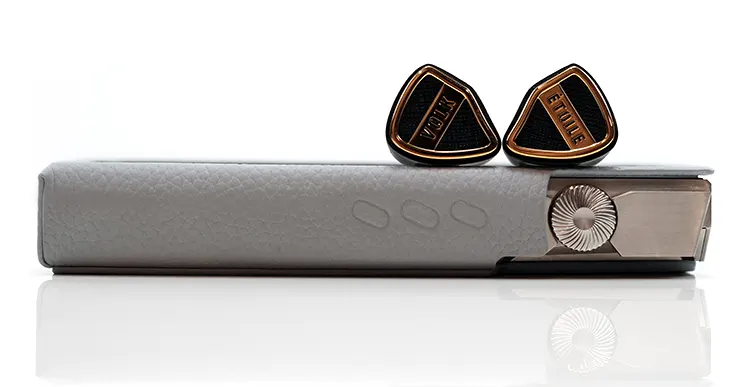
Compared to the Noble Audio Shogun, the ÉTOILE has roughly the same level of sensitivity without needing volume adjustment on a low gain setting from the iBasso DX340/AMP15 combo.
From the same setup, I found it a little more sensitive than the FIR Audio Radon 6 (red filter) and marginally less so than the Unique Melody Multiverse Mentor.
DAP & Portable Amplifier Pairings
The ÉTOILE sounded its best with an analog or smooth-sounding source that focuses on depth and power, or with a creamy vocal coloration.
For example, the Cayin N6iii R202 delivered a very smooth vocal delivery with little in the way of harmonic dissonance in the mids, much more so than the more neutral iBasso DX340/AMP15 combo and slightly superior to the HiBy R8 II.
However, it has the least bass weight of the 3 DAPs, so it’s more of a midrange specialist in R2R mode. 1-Bit mode was much too flat and uninspiring to be a worthy pairing if you want things to stay ‘joyful’.
The DX340 ÉTOILE pairing was my least favorite for vocals. There was an enhanced level of energy from the treble tuning that tended to peak natural sibilance a bit more for my tastes.
However, the staging space and clarity on the lows were the best of the DAPs. Not a huge bass line, but a very well separated one with excellent detail.
The HiBy R8 II sat between the DX340 and N6iii, producing excellent power from the ÉTOILE and a slightly softer vocal treatment, though still not as analog-sounding as the R202 performance.
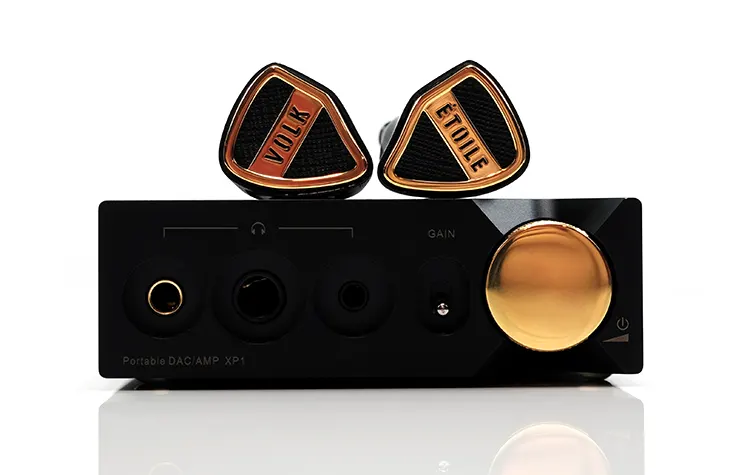
The C9ii and XP1 took the ÉTOILE to the next level. The XP1 produces incredible bass power and texture from the ÉTOILE with an intimate, rich vocal tone. It’s a little dark on the highs and not as airy as the C9ii, though.
The C9ii is the most balanced of the pairings, with much of the R202’s vocal smoothness, great bass depth in Classic Tube mode, and airier than the XP1. I would advise turning Hyper mode off as it can push the treble a little too hard.
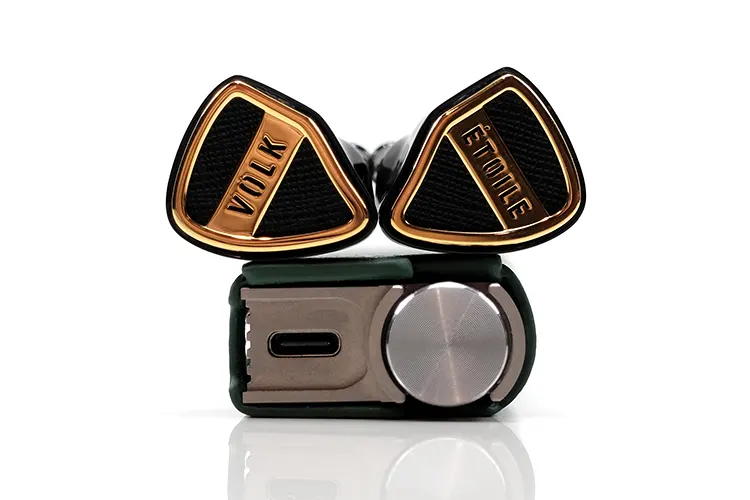
Dongle Pairings
I tested the ÉTOILE with 4 dongles, the iBasso DC-Elite, Nunchaku, Cayin’s RU7, and the HiBy FC6.
I would dismiss the FC6 right away. Not that it sounded bad, in fact, the ÉTOILE sounded great with all of the dongles. Rather, compared to the other 3, it had the rawest vocal and percussion tone with a little harshness and a less expansive soundstage.
I would probably dismiss the Nunchaku’s solid-state mode also. Like the DAP pairings, it is too flat and sterile-sounding, creating a very bland presentation from the ÉTOILE.
The DC-Elite is the most driven-sounding of the other three dongles. It has the most precision, clarity, and a slightly more upfront vocal delivery without any harshness. It’s an excellent pairing with the ÉTOILE for fast-paced EDM, modern pop, and metal.
The Nunchaku tube mode is very creamy and deep-sounding. The ÉTOILE vocals are softer than those of the DC-Elite pairing, slightly more aloof, but overall, the Nunchaku tube mode provides a very relaxing listening experience.
The RU7 sits between the two iBasso dongles, offering a slightly dipped vocal imaging experience while retaining analog smoothness and excellent bass weight.
The ÉTOILE sounds more expansive than the DC-Elite, though perhaps not as accurate or as detailed. If you feel the ÉTOILE vocal imaging is too far forward, then this is the right dongle choice for you.
