

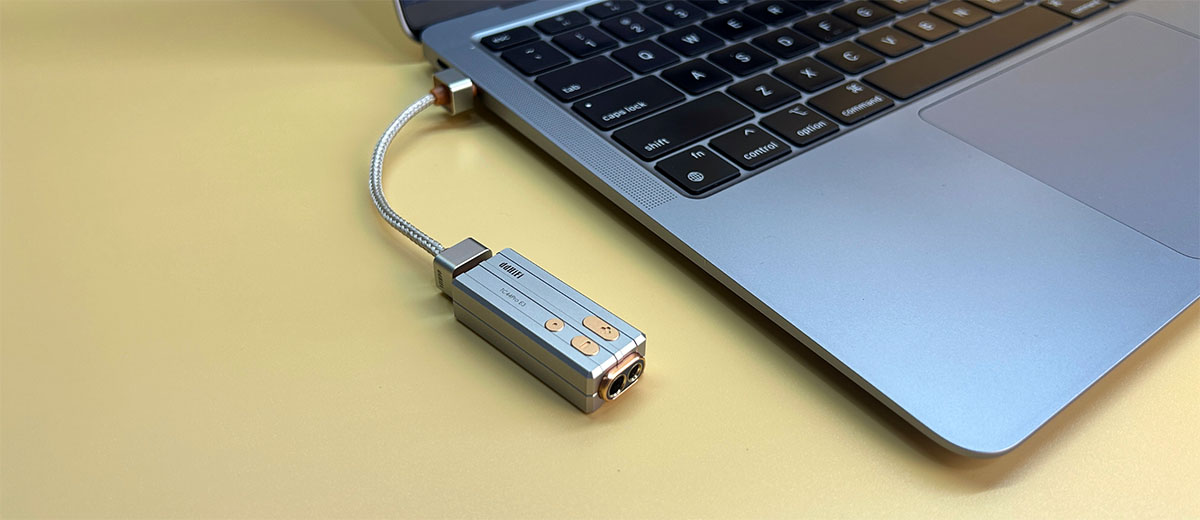
Meldrick reviews the ddHiFi TC44 Pro E3, an affordable 3rd-generation dual CS43198 dongle DAC with up to 510mW of output power. It is currently priced at $105.99.
Disclaimer: This sample was sent to me in exchange for my honest opinion. Headfonics is an independent website with no affiliate links. I thank ddHiFi for their support.
You can read about previous ddHiFi products we have previously reviewed on Headfonics here.
This article follows our latest scoring guidelines, which you can read here.
Admittedly, I’ve been a long-time fan of ddHiFi, starting with their compact TC35Pro E2 and following their steady improvements up to the recent TC44Pro M3. Today, I’ll be taking a closer look at their latest release, the TC44Pro E3.
Positioned near the top of ddHiFi’s dongle lineup at $105.99, the E3 looks impressive on paper, offering over double the output power of the TC44Pro E2 while managing to shrink into an even more compact form factor.
But the landscape has shifted. In the time since ddHiFi’s last release, strong challengers from the likes of iFi audio’s GO Link Max and others have entered the market. So, does the TC44Pro E3 still hold its own in today’s crowded dongle scene? Let’s find out.
Features
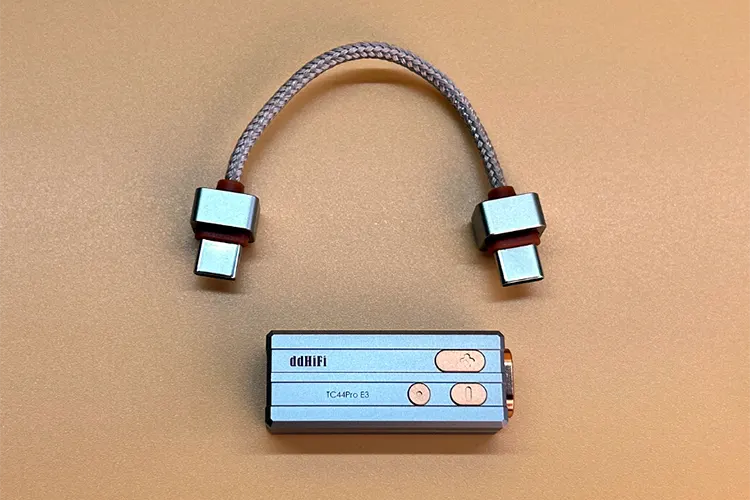
Unlike previous ddHiFi dongles, the TC44Pro E3 finally joins the likes of FiiO by introducing a detachable USB-C to USB-C cable along with onboard physical volume controls and a dedicated gain button.
This marks a big step forward in usability. Users can now adjust volume directly on the device without fumbling through software controls, while the detachable cable opens up compatibility with legacy I/O like USB-A or Lightning.
First seen on the TC44Pro M3, ddHiFi has carried over the inclusion of both 4.4mm balanced and 3.5mm single-ended outputs to the E3. For someone invested in both ecosystems, the flexibility is a welcome touch.
The 4.4mm output is ideal for unlocking the E3’s full power potential, especially when pairing with more demanding full-sized headphones, while the 3.5mm jack covers everyday portable use.
And powerful it is, the TC44Pro E3 delivers up to 510mW from its balanced output and 175mW from its single-ended output.
This represents a significant leap over both the TC44Pro E2 and the M3, positioning the E3 as one of the most power-dense dongles ddHiFi has produced to date.
Design
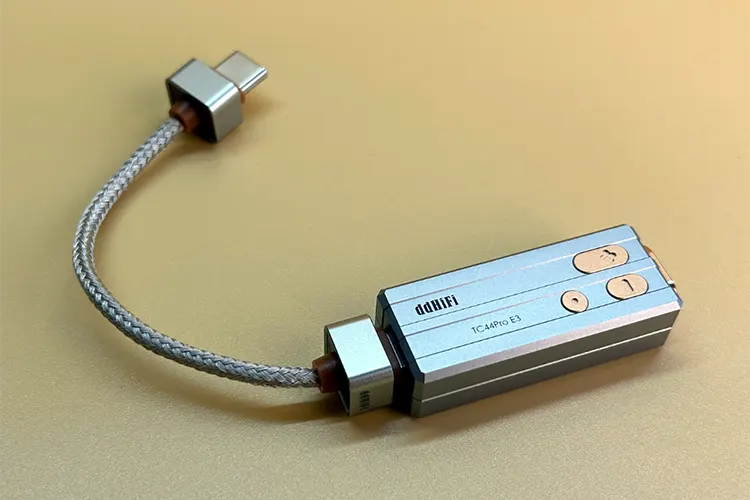
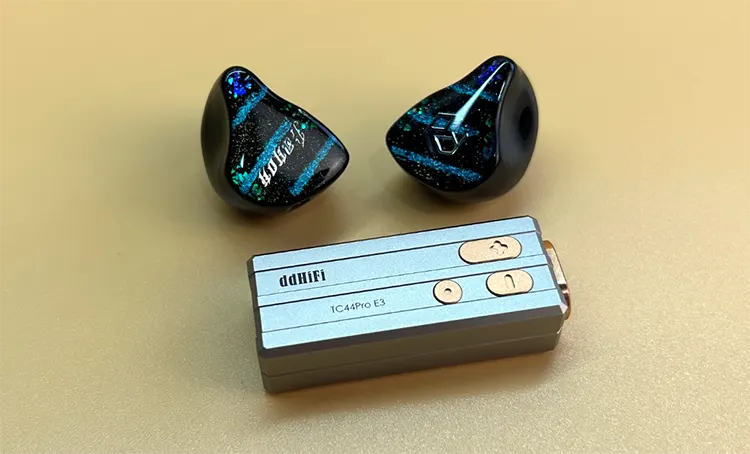
Coming as no surprise, the TC44Pro E3 continues the brand’s tradition of an all-aluminum chassis with precision-machined with a raw anodized finish that feels both solid and refined in hand.
Gold and copper accents on the buttons and output rings provide a tasteful contrast, balancing utilitarian industrial styling with just enough visual flair to stand out.
Over the course of testing, the unit proved remarkably durable, barely showing any fingerprints or micro scratches. However, I did notice that the aluminum shell starts to heat up a little during prolonged use, especially in high-gain mode.
One of the biggest improvements is the size. According to ddHiFi, the TC44Pro E3 is up to 20% smaller than its predecessor, and that reduction is immediately noticeable.
Where the TC44Pro E2 was barely pocketable, the E3 slips into jeans or pants pockets with almost no resistance or bulk, making it one of the most comfortable dongles to carry around.
The E3 also marks a shift from the TC44Pro M3 “T-stick” design toward a cable-on-dongle format.
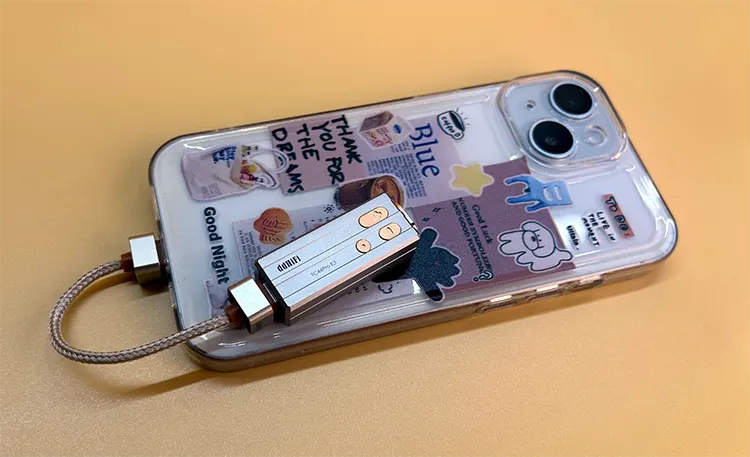
The swappable TC03SS USB-C cable not only increases flexibility with different devices and legacy adapters but also avoids the port-blocking issues of past models. On my MacBook Air, for example, the E3 no longer obstructs the adjacent USB-C slot.
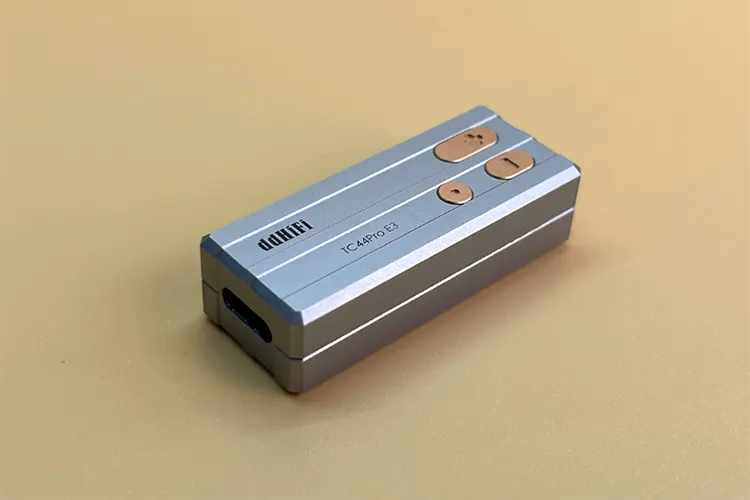
Ergonomics is just as carefully thought out. Three front-facing buttons provide tactile, blind-access volume and gain control, with the gain toggle deliberately offset to minimize accidental presses.
Discreet rear-mounted LEDs indicate PCM, DSD, and gain status, maintaining visibility without being distracting in darker environments.
Controls
The control scheme on the TC44Pro E3 is simple but thoughtfully executed, with volume down on the left and volume up on the right, each marked by engraved minus and plus symbols.
The buttons themselves offer a quiet yet tactile click that provides enough feedback to confirm each press without being distracting.
ddHiFi has implemented 60 discrete steps of volume adjustment, which allows for fine-tuned control over listening levels. The tradeoff, however, is that moving from minimum to maximum requires pressing a button 60 times, since the unit does not support long-press acceleration.
The gain button sits just above the volume down control and is engraved with a small circle for easy identification. What’s clever is that each of the three buttons has a slightly different shape, making it possible to distinguish them by feel alone
The underside of the dongle houses a small gain LED that flashes yellow when high gain is active and remains off when the unit is in low gain mode.
I appreciated that the unit also remembers its last gain setting. If the TC44Pro E3 is unplugged while on high gain, it will resume in high gain once reconnected.
Additional status feedback comes from the PCM/DSD indicator LED, which glows blue for PCM output and green for native DSD decoding.
Altogether, while the TC44Pro E3’s controls may not be the fastest in operation, they strike a good balance between usability, feedback, and discreet functionality.
I/O
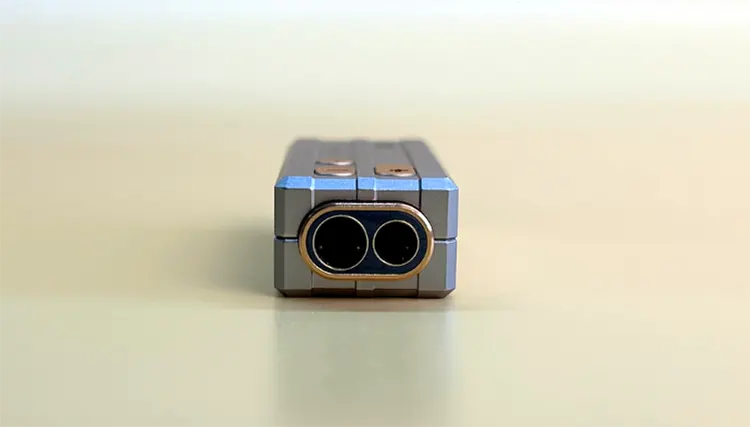
The TC44Pro E3 keeps things straightforward. Its only input is a female USB-C port, which connects to your source device through the provided detachable cable.
In my testing, the E3 had no trouble working with various adapters, including USB-A and Lightning cables I had on hand, making it easy to pair with a wide range of setups.
On the output side, the dongle provides both a 3.5mm single-ended jack and a 4.4mm balanced jack, covering the most common standards for IEMs and headphones today.
The I/O layout may be modest, but it feels carefully considered, streamlined for listeners who just want to plug in, connect their headphones, and start listening right away.
Packaging & Accessories
The TC44Pro E3 comes in a simple white box that includes the TC44Pro E3 Dongle and a ddHiFi TC03SS USB-C to USB-C cable
The TC44Pro E3 comes with the bare essentials needed for usage out of the box, and the TC03SS cable on its own already retails for around $15.99. However, I would have appreciated the inclusion of a USB-C to USB-A cable.
Sound Impressions
All sound impressions and selected comparisons were completed with the MOONDROP Blessing 3, Yanyin Canon II, the Kiwi Ears KE4, the Sennheiser HD 600, and HarmonicDyne BAROQUE.
Bass
The bass response of the TC44Pro E3 is characterized by a strong emphasis on the sub-bass region, giving it a solid sense of weight that comes through clearly on tracks that demand low-end authority.
Sub-bass notes hit with good presence and extension, adding a satisfying rumble in genres like hip hop and electronic.
Texture is decent, though not the most natural I’ve heard, especially with acoustic kick drums, where a touch more harmonics could have made the presentation feel more lifelike and dynamic.
Moving into the mid-bass, the E3 takes on a cleaner, leaner approach. It avoids excess warmth or thickness, which gives the presentation a tidy and controlled character.
Bass guitars, for instance, have good resolution and remain articulate, but they lack the rich, velvety strums that warmer sources tend to bring out.
This restraint means the E3 is less likely to overwhelm the rest of the frequency range, but it also leaves certain genres feeling less engaging than they could be.
On the right material, however, the tuning works quite well. In boom-bap hip hop, for example, the strong sub-bass delivers impact while the leaner mid-bass avoids muddying the rhythm.
However, on disco-fusion or funk tracks, the same restraint takes away some of the groove, making bass lines sound duller.
Mids
The TC44Pro E3 has a clean, neutrally-tuned mid-range that results in a presentation that leans slightly thin in the lower mids and brighter in the upper mids.
This balance gives instruments and vocals a clean sense of separation, with less blending or vagueness compared to warmer sources.
Male vocals, particularly those that sit lower in the register, don’t carry the same weight or authority that a warmer source would lend them. They articulate, but the lack of body can leave them sounding somewhat distant.
On the other hand, higher-pitched male vocals and female vocals benefit from the E3’s leaner tuning, standing out with a level of clarity and presence that helps them cut cleanly through the mix.
String instruments are a strong suit as well, displaying good resolution, dynamics, and note weight that highlight the dongle’s technical strengths.
The upper mids are energetic, giving instruments like snare drums a sharp and snappy attack. On well-recorded material, this adds excitement, but on poorly mixed tracks, that same emphasis can verge on being fatiguing.
Where the E3’s mids shine brightest is in acoustic and balladic tracks, particularly those with solo guitar, piano, or delicate female vocals.
In these settings, the dongle’s cleaner and flatter midrange presentation allows each element to emerge distinctly, creating a sense of intimacy and spaciousness.
Treble
The treble on the TC44Pro E3 is lively and engaging, giving music a nice sense of sparkle and clarity. Hi-hats and cymbals sound crisp with a natural decay. Different cymbals are easily distinguishable from each other, giving percussion a more realistic feel.
Horns and chimes also make a strong presence and dynamics, often cutting through the mix in a way that adds energy and character.
One area where the E3 really shines is with higher-pitched synths, especially in 80s tracks, which carry energy that can be felt throughout the entire mix.
Of course, the energetic tuning has its drawbacks. On poorly mastered recordings, the E3’s treble can come off a little sharp or sibilant, which might be distracting depending on the track.
This also makes it pairing dependent; when used with colder or more neutral IEMs, the treble can lean toward being fatiguing after longer listening sessions.
On the flip side, pair it with a warmer or smoother set of earphones, and the E3’s treble becomes one of its best features, adding sparkle and space without ever feeling overdone. With the right pairing, the TC44Pro E3’s top end enhances both energy and detail.
Staging and Dynamics
The TC44Pro E3 presents a relatively narrow soundstage. On balladic tracks, this closer, more intimate presentation helps highlight the emotional weight and musicality of vocals.
However, the tradeoff is that the E3 doesn’t quite capture the same grand sense of scale that some wider-sounding dongles can convey.
Where it shines, however, is in imaging. Thanks to its solid resolving power, instruments are easy to pinpoint within the mix, and the way sounds pan or fade in complex arrangements is handled with precision.
This gives the stage, while narrow, a clear and well-structured layout that feels intentional rather than cramped.
Dynamics are also strong, giving music a good sense of punch and contrast. Instruments are presented with good note weight impact.
The TC44Pro E3’s ability to articulate the volume difference between the loudest and quietest instruments in the track adds to its impressive instrument playback.
Click on page 2 below for my recommended pairings and selected comparisons.
