

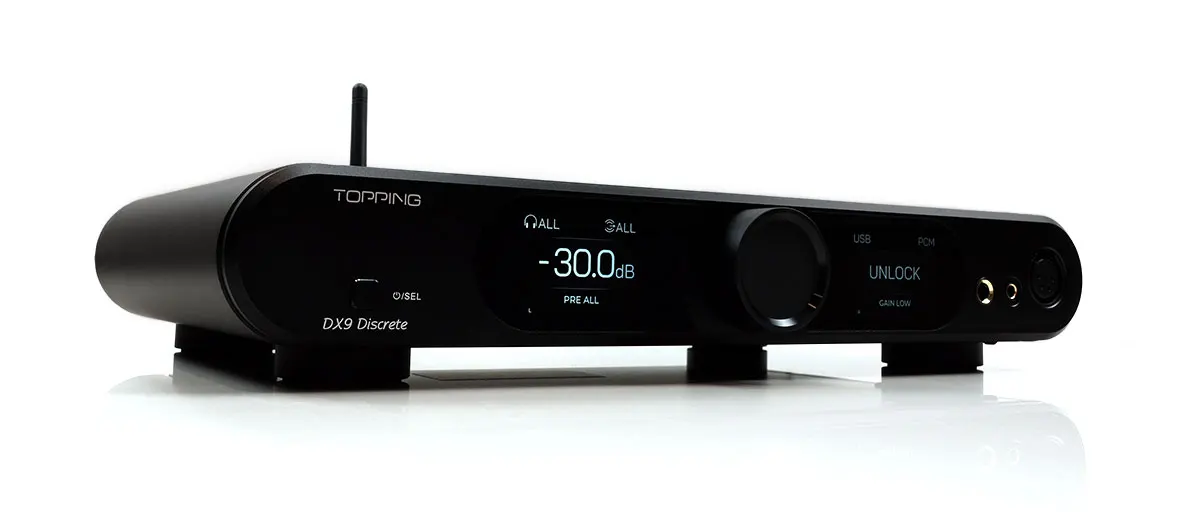
Marcus reviews the Topping DX9 Discrete, a limited-edition desktop 16-element 1-bit PSRM DAC and 10W-Capable NFCA headphone amplifier. It is currently priced at $1299.
Disclaimer: This sample unit was sent to me in exchange for my honest opinion. Headfonics is an independent website with no affiliate links or status. I thank the team at Topping for supporting us.
Click here to read more about Topping products previously reviewed on Headfonics.
This article follows our current scoring guidelines, which you can read in more detail here.
Last year, Topping released one of their most ambitious integrated DAC and desktop units, the DX9.
This system surprised me in many ways with its snappy, solid-state sound and excellent flexibility for headphones as well as traditional HiFi and streaming systems. Since the review, it has been on constant rotation in the office, for reviews and personal listening.
However, Topping has a history of launching ‘Discrete’ editions of their solid-state gear, so I am not surprised at all that this year they launched the $1299 DX9 Discrete.
Out goes the delta-sigma DAC from last year’s model, and now we have a 1-BIT discrete DAC behind a discrete design NFCA module-based amplifier, providing for a smoother sound, combined with the already existing excellent system matching capability.
The timing seems right. Organic-sounding amplifiers have been in vogue for the last 12 months, so why shouldn’t Topping grab a piece of that lucrative pie?
Is the DX9 Discrete an upgrade over the original DX9, and how does its performance compare to other analog-sounding systems, such as the HIFIMAN Serenade or quality delta-sigma competitors such as the Ferrum ERCO? I found out in my full review below.
Features
The desktop-designed Topping DX9 Discrete is an integrated balanced DAC, pre-amp, and headphone amplifier with additional wireless Bluetooth capability.
The 1-bit DAC design is a departure from the original DX9’s classic limited-run AK4499EQ delta-sigma solution. This is a 16 Element PSRM (Precision Stream Reconstruction Matrix) DAC that was first used in Topping’s D900 and D90III Discrete DAC designs.
The combination of an ultra-fast switching logic array and a precision voltage reference to process the signal in phases means Topping does not need to stuff the DX9 Discrete with 1000s of resistors to create a precise 1-bit DAC.
The DX9 Discrete XMOS XU316 and 1-bit DAC chipset supports input signals up to PCM 768kHz/32-bit and native DSD512, whilst providing similar levels on its I²S connection. This drops down to PCM 24-bit/192kHz for coaxial, optical, and 24/96kHz for LDAC Bluetooth wireless receiving.
You can connect and drive almost any headphone (or IEM) to the DX9 Discrete with provision for XLR, 4.4mm, and 6.35mm connectivity, all with an output impedance of less than 0.1Ω.
The six-channel NFCA module amplifier inside the DX9 Discrete can deliver up to 10W into a 16Ω load (7080 mW @32Ω) balanced, dropping to 3.3W into a 16Ω load (2120 mW @32Ω) single-ended.
The DX9 Discrete can operate as a central component within a dedicated HiFi system with a line-out rated at 5.25Vrms balanced and 2.5Vrms single-ended.
It also offers a dedicated pre-amp output in balanced and unbalanced formats with up to 48Vpp in high-gain balanced, dropping down to 24Vpp unbalanced.
Design
Remarkably little of the DX9 Discrete exterior has changed since the DX9 was launched.
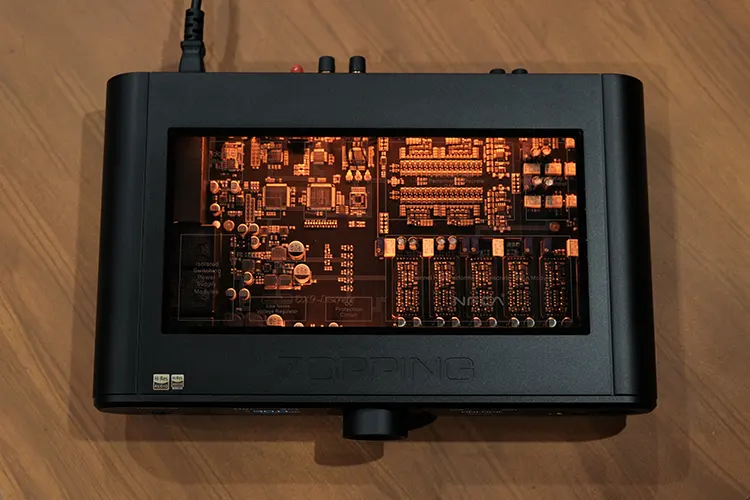
Any tweaks are more nuanced than obvious, with the standouts including the ‘DX9 Discrete’ labeling at the front and the top Plexiglass circuit design modified to account for the new 1-BIT DAC configuration.
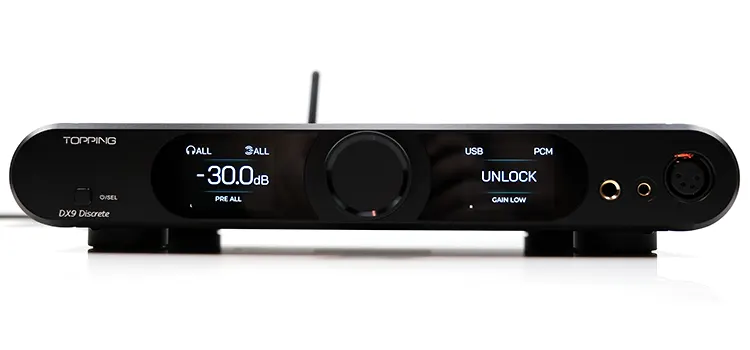
For those assessing the DX9 Discrete form factor and aesthetics for the first time, it is one of Topping’s larger desktop units, but it’s quite low-profile, being wide rather than deep and just 6cm in height.
Aesthetically, I find it quite modern-looking with excellent legibility from its dual LCD screen display and easy access to controls courtesy of a large multi-function volume dial that connects to the unit’s menu system and the internal hybrid relay-resistor network.
Like the original, the main star of the DX9 Discrete aesthetic show is the Plexiglass top panel and beautiful soft warm orange LED glow underneath when powered on.
It’s not a fixed strength illumination. If the strength of the lights bothers you, then you can adjust them in the DX9 Discrete menu settings.
From my experience of using the DX9 for the last year, this type of showroom effect demands being placed on top of any headphones component stack for maximum visibility.
However, it can become slightly warmer than the aluminum housing around it; thus, I wouldn’t advise putting anything soft on top for long periods of time during use.
I/O
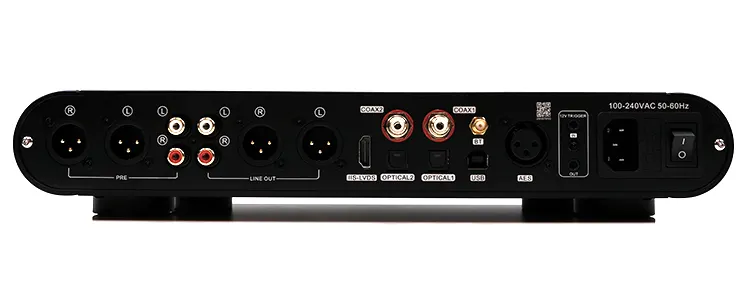
The connectivity options are unchanged from the DX9 to the DX9 Discrete. That means a well-organized single row of balanced and single-ended pre and line out options to the left and your digital input options to the right, beside a trigger control and a SMPS universal power supply.
I have always considered the DX9 to be well stocked for digital input options. Dual coaxial and optical inputs, USB-B, AES, and I²S cover all of the classic and modern source options you can think of, not to mention the connector for the BT antennae, which allows the DX9 Discrete to connect to any source wirelessly.
The one caveat for DX9 owners is the change in the I²S pin configuration for the DX9 Discrete. I believe one less pin is being used in this configuration. It might not seem much, but it renders all my Cayin source I²S components incompatible with the DX9 Discrete.
I can see my sources feeding the DX9 Discrete a signal, I can see the unit managing the correct sample rates, but there is no analog audio output when using the Cayin N7, N8ii, and the Cayin Mini-CD MKII.
That is a shame, as it was one of my big joys when using the original DX9, and I prefer its performance over USB. Coaxial comes a close second best, depending on the output source.
Controls
You can control the DX9 Discrete in a number of ways. There is a multifunction dial which, when used in combination with the Power/SEL button to the far left, gives you direct manual control over the unit’s features and setting menu navigation.
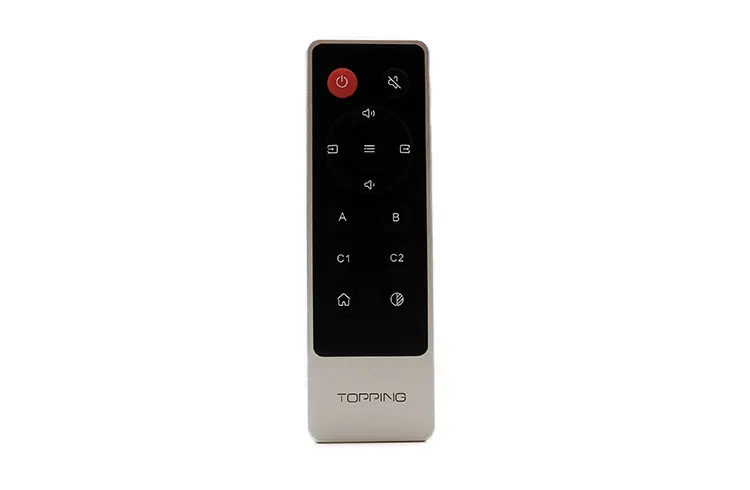
If you are sitting far away from the Dx9 Discrete, for example, a HiFi setup, then Topping provides a remote control made from CNC-machined and sandblasted aluminum.
This is one of the better remote controls out there. It is well-built, robust, and sturdy with a well-spaced-out button configuration.
This remote control does not come with a CR2032 battery. Chinese export regulations for air cargo are strict for batteries, but the cost of buying one is dirt cheap.
Software Integration
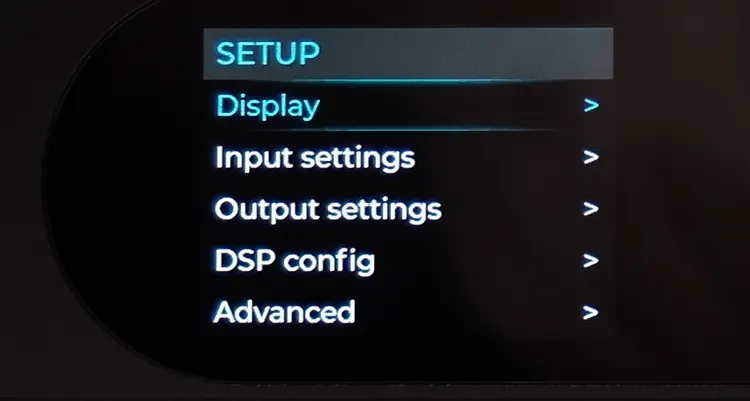
The menu system has changed from the original DX9 layout. I have some pros and cons with the new layout.
For one, the level of granular control as to what you can see or quickly select has much improved. You can omit certain inputs or outputs from the multifunction dial round-robin push-button sequence so you do not accidentally switch to lineout from pre-out, etc.
The second is the addition of onboard 5 DSP and 2 Crossfeed options that were not present when the DX9 was launched.
And finally, the wider integration of Topping Tuned, the company’s PEQ software, allows you to tweak the USB tuning from the comfort of your PC or MAC to suit your headphones’ response curve.
The main con is just how overwhelming the UI is now with these additional options. You need to spend time going through everything to make sure it is set up to your liking. Some concepts, such as “ALL” for inputs and outputs, might seem intuitive but do not produce expected results.
Packaging & Accessories
The packaging for the DX9 Discrete is unchanged from the DX9, which is a good thing because I thought it was unique for a headphone amplifier.
Most desktop amps are brown boxes or printed sleeves with white boxes and a fairly functional inner packaging layout for maximum safety during shipping.
Topping does it slightly differently, though by no means less safe. The retail box has a classy printed outer sleeve and an inner tray lined with a silky overlay, almost as if Topping was presenting this amplifier to you in a ‘regal’ manner.
It looks minimalistic, clean, and classy. All the accessories are tucked underneath to avoid a messy look, though for some reason, the power plug comes in a separate box outside the main packaging.
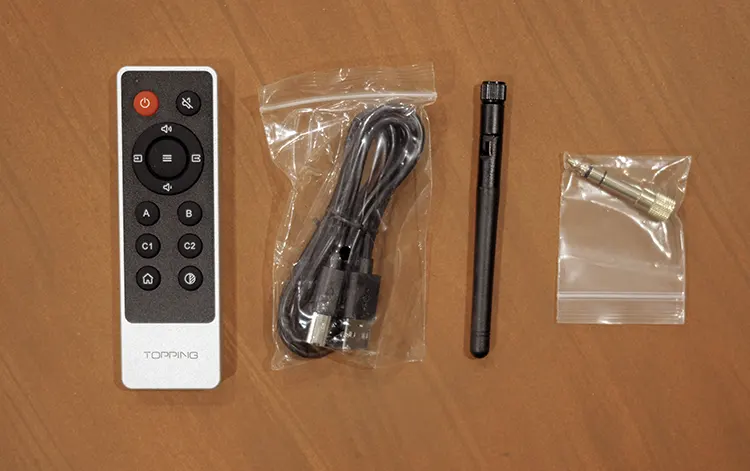
As with the original, the DX9 Discrete accessories include a USB-B to USB-A cable, the remote control, an additional 6.35mm-to-3.5 mm converter, and the screw-on Bluetooth antenna.
Click on page 2 below for my sound impressions and recommended pairings.
