

Synergy
DAP Pairings
I tested the PMG Audio Apx ME with quite a few DAPs, including the iBasso DX320 MAX Ti and DX340 with AMP17, the HiBy RS8 II, and FiiO’s M27.
What I found was a preference for a source pairing that offered midrange bloom, whether in higher contrast, a more forward vocal presence, or a sweeter, airier tone. Anything that was too reference or linear came off as slightly dull in its delivery.
For example, the RS8 II was my top pairing choice because it produced a rich, heavily textured presentation from the Apx ME mids and lower treble.
Not so much additional contrast as a light sheen and a more forward midrange presentation that beautifully balance the marauding low-end power of the Apx ME.
The DX320 MAX Ti delivered higher contrast and incredible separation in the Apx ME mids, and a snappier, more defined low-end that sounded a little more controlled than the RS8 II’s bass performance.
The DX340 with AMP17 was surprisingly good as well, though not quite as expansive as the RS8 II or DX320 MAX Ti. The dynamics on the lows were very good, the mids forceful and clean. Just the staging width fell a bit short compared to the flagship sources.
The M27 fell a bit flat for my preferences. This is the linear side of the coin with a very balanced presentation throughout the Apx ME’s FR.
Great for referencing in some respects, and very spacious, more so than the DX340. However, the mids lacked bloom, so vocals felt more subdued and comparatively flatter than in the other pairings.
Dongle Pairings
The same theory for the best DAP pairings above did not hold as well when comparing multiple high-end dongle performances.
I found that space and precision were equally important as midrange presence for the Apx ME to capture my attention properly.
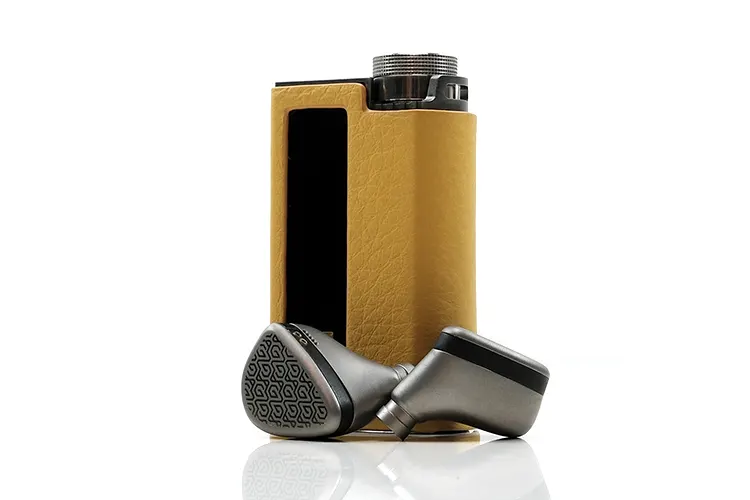
The surprise package was the Cayin RU9 Apx ME pairing. I was fully expecting the iBasso DC-Elite to be the top choice, given how clean, clear, and punchy it sounded with the Apx ME.
However, the staging space, especially the expansive width and noticeable sub-bass presence, combined with the analog vocal timbre, made it my go-to dongle for the Apx ME during and after the review.
It sounded ‘on point’ with female vocalists without needing additional contrast, while also avoiding excessive bass bloom and slower decay, which the iBasso Nunchaku suffered a bit from.
The Nunchaku is very smooth and deep-sounding with the Apx ME, but just felt a little too forward in vocal imaging and not enough space behind its mids to create the same perceived openness of the RU9 pairing.
I also brought out my old Luxury & Precision W2 dongle, one of my favored old-timers for how puncy and precise it sounds.
It’s more in the vein of the DC-Elite tonally, with higher levels of contrast in the Apx ME mids presentation. However, it lacks the dynamic range of the DC-Elite and the openness of the RU7, a quality I think the Apx ME needs to sound optimal.
Selected Comparisons
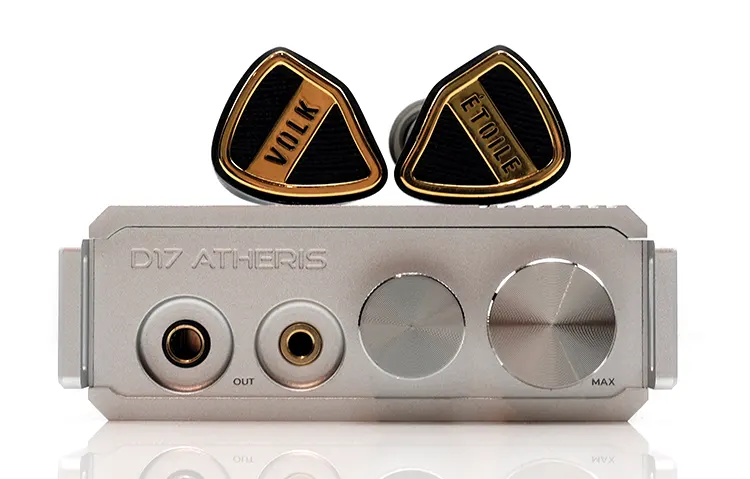
The following selected comparisons to the PMG Audio Apx ME were completed using the iBasso DX320 MAX Ti, the Cayin N6iii/R202, and the iBasso D17 Atheris. All connections were in balanced mode, with the D17 receiving a USB-C digital audio input from a smartphone.
PMG Audio Apx
The Apx was the original model, launched in 2024 and limited to a small batch run of just 20 units. It was also our co-awardee for the Top Gear 2024 Award for Best Universal IEM.
Technical
Both monitors are universal hybrid multi-driver designs, with the main differences being the additional VDC driver and changes in the type and division of BA drivers in the Apx ME.
That means 11 drivers versus 12, though at a high level, it is still a single 10mm PEEK diaphragm dynamic, 2 planar types (rectangular and round), and 8 BA using a 7-way passive crossover.
The VDC driver focuses primarily on improving the sub-bass response with a peak around 250Hz, and the BA drivers have new, higher impedance voice coils with the 6 drivers for the mids as opposed to 4+2 (highs) in the older model, better suited to the acoustics of the new titanium shell.
The switch to higher impedance does mean the new Apx ME has a slightly heavier load at 10.8Ω compared to the original’s 5.1Ω rating, though bear in mind that both driver sets are using flat impedance (FIBAE) technology. The Apx ME is also more sensitive at 117 dB/mW compared to 107 dB/mW.
The supporting technologies have also been upgraded, with the Apx ME now using a 2-gen POD+ technology, or Pressure Optimizing Design, to cover both the dynamic driver and shape the mids and GSO, enhancing the staging and imaging performance of the Apx ME.
Design
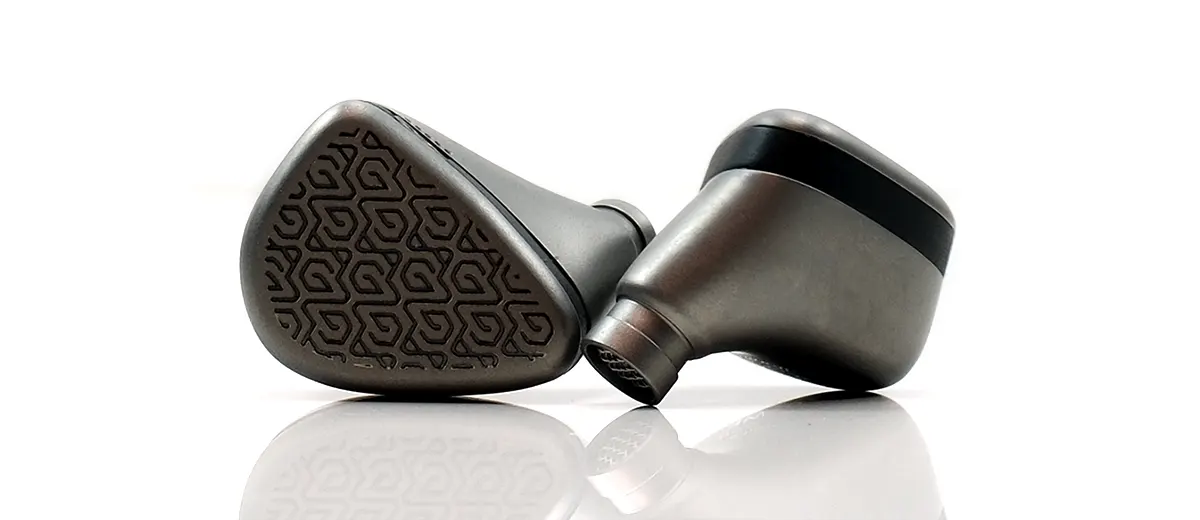
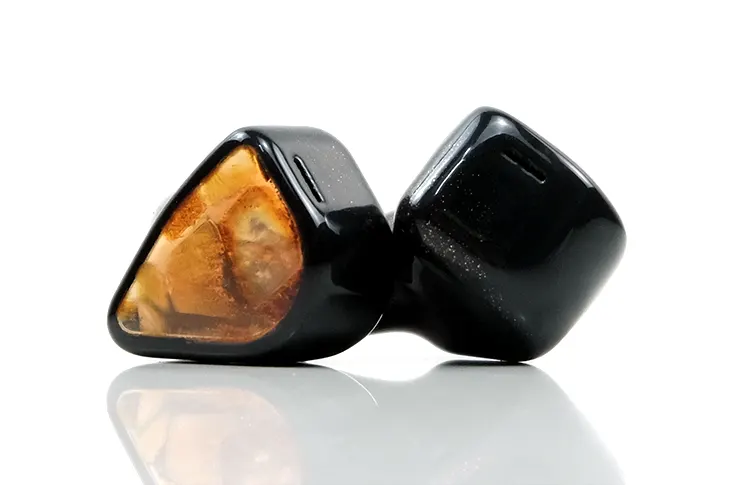
The Apx ME is clearly more premium and more durable-looking than the original Apx. The Apx ME’s CNC-machined Titanium is very robust with a slightly heavier, denser feel in the hand and ear compared to the resin shell of the Apx.
However, sometimes design is in the eye of the beholder, and preferences can vary a lot. I personally love the resin shell and striking amber plate of the original for its deeper fit and slightly lower level of tip dependency.
The Apx ME has a shorter nozzle, allowing the tips to have a more pronounced effect on isolation and performance. Thankfully, the Apx ME tip selection is superior to the original lineup, so you should be able to find something that works for your ears.
The situation is similar for the stock cable. The original Apx came with a 1.2m-long 4-wire or 4-core silver-copper alloy with a graphene core and terminated with an interchangeable plug system.
It is clearly less premium in terms of looks and wire quality than the thicker coaxial geometry of the 6N OCC pure silver wire used inside the Apx ME stock cable.
The exterior finishing is also superior, with matching titanium barrels, chin cinch, and connectors. You do, however, lose the interchangeable plug system with only one option available: a 4.4mm balanced jack.
It’s more the handling that might balance things out. The original cable is far lighter to handle and around the ear. The Apx ME cable is quite heavy and slightly stiffer due to its coaxial geometry and twisted outer jacket. Some might prefer a lighter cable.
Performance
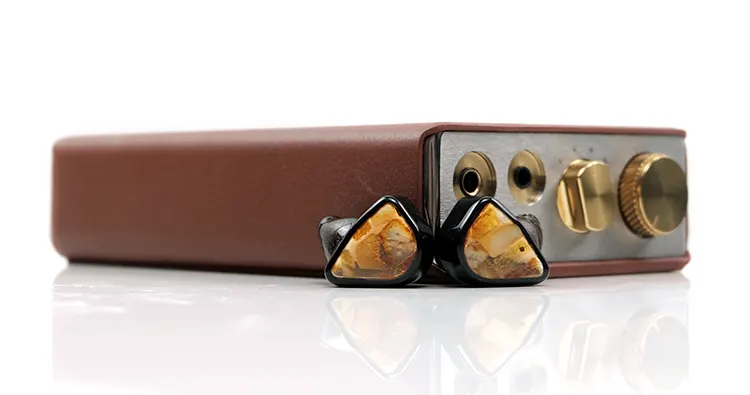
Having spent the majority of my time hauling the original Apx around as my go-to IEM, I am familiar with the critique that, for many, it is too bright in the highs, with a pointed 5-6k peak and more energy overall than the SE.
And that is true when compared to the Apx ME, which is infinitely more relaxed and richer-sounding through the same region.
If sibilance and high-energy fizz from percussion are not to your taste, or if you are pairing with a bright source, the ME is the better choice. Soulful vocals are fuller-sounding, with better texture and a calmer effect on the ear.
Both have an excellent sub-bass response, and typically, I explain to anyone who asks why I love the og Apx that it’s not just the sub-bass response but the excellent bass-to-mids separation with a dip that retains space, prevents bleed, but doesn’t suck out the lower-mids presence.
And yet, the ME sub-bass and low-end fullness is on a whole other level, sounding deeper, heavier, and yes, slightly warmer. That, in turn, imbues the mids with that generally smoother, richer character, unaffected by a weightier treble presence.
However, at times I still prefer the original for its treble brilliance and height, giving it a taller staging quality than the Apx ME, whilst accepting the caveat that I will get a sharper midrange.
Not that the ME lacks headroom; it sounds incredibly spacious, and it’s my pick for heavy-hitting EDM and mid-tempo rock tracks that need an authoritative fundamental.
Rather, the peak in my listening attention with the Apx ME is closer to the mids and bass response. The original Apx sounds sprays my attention all over; from lows to mids to highs, giving a very multi-directional experience.
PMG Audio Apx SE
The Apx SE was the follow-up to the original Apx and was released in late 2024. It had a larger limited run of 100 units and was also the co-awardee of the Top Gear 2024 Award for Best Universal IEM.
Technical
The Apx SE is technically unchanged from the original, so that means one less driver than the ME, as well as using last-gen POD and GSO technology. The key changes were more in how they were tuned than any internal physical deviation.
The Apx SE is a universal hybrid IEM with 11 drivers, including a single 10mm PEEK diaphragm dynamic, 2 planar types (rectangular and round), and 8 BA, all using a 7-way passive crossover.
What is missing is the VCD bone conduction driver inside the Apx ME. It also uses BA drivers with lower-impedance coils, as well as the 4+2 mids/highs split, a configuration better suited to the resin shell.
Like the original, the Apx SE has a low 5Ω impedance rating, though combined with FIBAE, it means it will not suffer from high-impedance output skew. Its SPL of 107dB @ 1kHz, 1 mW, is the same as the original, meaning it is less sensitive than the Apx ME.
Design
The SE uses the same resin shell design as the original, meaning most of the observations from the Apx/Apx ME comparison hold here as well.
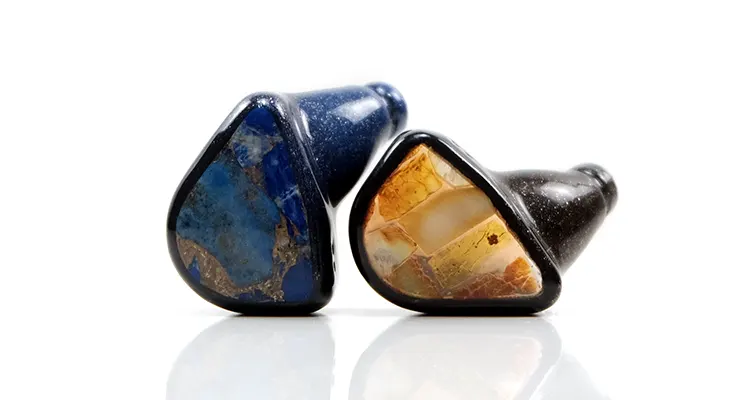
The key differences are the external aesthetics: the SE went with a strong blue ‘stone’ Lapis Lazuli-Brass hybrid design, as opposed to the black and amber of the original, or the more durable, uniform shape of the CNC-Machines titanium on the Apx ME.
As with my Apx observations, whether you prefer this look and resin material or the premium titanium materials and intricate honeycomb etchings will largely come down to personal preference.
I edge toward the resin shape and the longer nozzle, as it’s a little lighter in my ear and seals quite easily with the stock tips. The Apx ME shape is more uniform in dimensions and thus depends more on the tips for sealing and performance. Durability is in the Apx ME corner all day long.
Cables have also changed. The SE stock cable is a hybrid of gold-plated silver, silver, and silver-copper alloy, with dual shielding of silver alloy and copper. It retained the interchangeable jacks of the original but added a fairly soft but thick jacket around a twisted design.
The Apx ME’s 6N pure-silver coaxial design is lighter and slightly easier to manage than the SE cable, despite also having a similar twisted-coaxial exterior finish.
Both come with excellent accessory and case lineups. I would argue that the Apx ME packaging is a refinement of the SE, whereas the SE packaging was a major upgrade over the original Apx.
Both use the large leather zipper case, which can double as a gadget storage box. The Apx ME’s version has a nicer finish on the outside with more pliable materials on the inside for improved ‘stretch’.
Performance
If we are going to define the Apx ME as a successor to what has gone before, then the Apx SE is the one square in its sights.
Not that the SE has an inferior sound, but rather that it produces a different, smoother, fuller sound and greater flexibility than the original, matching a wider range of gear and ear tips.
However, I felt the original’s vast sense of space and immersion was more subdued on the SE, creating a less dynamic and vivid soundscape than the original.
The Apx ME now feels like a mix of the originals’ spacious soundscapes and the SE’s smoother timbral aims, but with a more coherent midrange and higher frequencies that sound more natural and richer in texture.
A lot of that perceived spatial enhancement comes from the lows of the Apx ME. They are thicker, deeper, and more dynamic-sounding. However, that VCD driver is also working its magic, delivering a more tactile and detailed experience with every impactful note.
The SE hits hard, but from 20-60Hz, it’s maybe 1-2 dB lower than the Apx ME, so its solidity is not quite as convincing. It does have a little more upper-bass amplification around 200-400hz where the bloom is noticeable, and this helps with the lower-mids even-harmonic timbre.
From 1-4k, the Apx ME offers stronger pinna gain, further amplifying the already richer vocal and midrange notes. It also helps strengthen and shape the staging quality more than the SE does, creating greater depth and improved separation.
The SE is more elevated in the 5-10k range, which adds a bit more contrast to the midrange timbre. I wouldn’t call it sharper, but it’s not quite as effortless or natural in its delivery as the Apx ME.
VOLK Audio ÉTOILE
Last year’s VOLK Audio ÉTOILE was the company’s debut high-end universal IEM and also won the Top Gear 2025 Best Universal IEM award.
Technical
Both monitors are hybrid multi-driver universal models. The Volk Audio ÉTOILE uses a 10-driver mix of dynamic, BA, EST, and magnetostatic (planar) using a 6-way custom-engineered crossover, so there is no bone conduction.
The precise configuration is a proprietary 10mm M10 subwoofer (dynamic) for the lows up to 350Hz and two dual BA driver arrays for the mids from 350Hz to 8kHz. One is a dual diaphragm for midrange body, and the second is a single diaphragm for clarity in the mids and highs
The highs and ultra-highs are composed of a quad array of EST drivers, from 8kHz onwards, with an overlapping 8mm M8 Magnetostatic tweeter featuring a planar diaphragm.
The ÉTOILE has a slightly lighter load than the Apx ME at 8Ω impedance, with reduced sensitivity at 110.6dB/mW @ 1kHz, but I found it easier to drive than the Apx ME.
Design
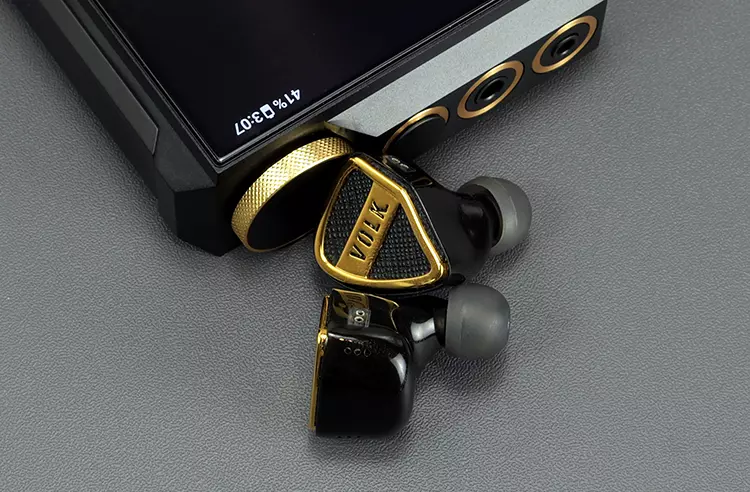
The ÉTOILE has a larger form factor but weighs less, since it is made of resin rather than CNC-machined Titanium. One could argue that PMG Audio has done extremely well packing in all those driver variants into such a compact metal shell.
I would also point out that the ÉTOILE’s resin shell might be considered a bit thin. They may require ‘babying’ in case of accidental drops. I would also recommend avoiding aggressive yanking of the cable in case the shell suffers stress fractures.
Despite using resin, the ÉTOILE’s shell contouring is slight rather than aggressive. It has more contouring than the Apx ME’s Titanium shells, but it’s gentle rather than extreme in its drips and valleys.
Aesthetically, I find the ÉTOILE’s mix of gold and black design a bit brasher and more urban than the lower-profile, nuanced honeycomb-finished plating of the Apx ME.
Both are comfortable in the ear, with the lighter ÉTOILE edging it thanks to its more forgiving resin and slightly stronger contouring, which creates a stronger seal.
Both IEMs have insertion ‘noise’ but from different sources. The ÉTOILE suffers from driver flex on initial insertion, which will not happen again unless you break the seal or reinsert.
The Apx ME has a residual noise from the VCD driver, which sounds like a low-pitched pin on insertion or a strong tap on the shells.
Both have fairly heavy-duty stock cables, with the ÉTOILE version looking and feeling closer to the Apx SE version but with superior barrel finishing.
This is a twisted solid-core offering with a hybrid mix of 5N OCC silver, 4N silver, silver-plated copper, gold-plated silver, and palladium-plated silver, terminated with a 4.4mm jack.
Performance
The key areas you will notice right away are the enhanced muscularity of the Apx ME bass response, the more intimate vocal imaging of the ETOILE, and its slightly higher level of treble presence, which ever so slightly shifts the midrange timbre with a slight treble sheen.
Stage-wise, the ETOILE feels a little dampened down, with a slightly shorter decay and a more spacious studio-room feel than the hall-like arena of the Apx ME.
The PMG Audio monitor is noticeably taller, wider, and deeper, but so also is the stronger sense of space between you, the listener, and the stage itself.
With the ETOILE, a noticeable bump around 500Hz to 1k means vocals present themselves front and center, right in front of your nose, with excellent imaging depth behind, albeit within narrower left-right confines.
Tonally, the Apx ME is the smoother-sounding of the two through the mids and highs. Treble presence is shelved down a bit more than the ETOILE, which, whilst not what I would call elevated, does offer more ‘fill’ from 5-10k.
Combined with a very sub-bass-biased low-end, it can lead to a slightly lighter, yet still what I would call a natural tone in the mids and highs when the sub-bass is not called upon.
The Apx ME delivers greater weight and a liquid-like timbre throughout. It sounds like the more powerful of the two monitors, with its longer bass shelf and a more persistent fundamental frequency in lower-register notes.
I would go with the ETOILE if you prefer your recordings to be delivered in a more intimate, delicate manner; pick the Apx ME if you need a much larger, more complex staging.
My Verdict
Honestly, I find little fault with the PMG Audio Apx ME. It’s at a world-class level, sounding smooth and detailed, and addressing much of the feedback from previous owners, making it one of the most powerful yet natural-sounding high-end IEMs on the market today.
From my own point of view, the new shells are definitely more premium-looking than the resin, but the shorter nozzle means the tips are going to play a crucial role in getting the right sound for you. Choose wisely.
This is going to be a very hard universal IEM to beat in 2026, with its biggest weakness perhaps being that, once again, there is a limited supply of units available for interested high-rolling buyers.
PMG Audio Apx ME Technical Specifications
- 12 drivers: 1x Rectangular Planar, 1x 10mm DD, 1x VCD, 8x BA, 1x Round Planar (all drivers are custom-built to PMG Audio’s spec)
- True 8-way passive crossover
- Flat Impedance technology
- Impedance: 10.8 Ohm ±1.5 Ohm
- SPL: 117dB @1kHz
- Frequency response: 2Hz-22kHz
- Titanium shell body
- Custom 6N OCC pure Silver cable 4.4mm
- Leather multi-function suitcase
- Leather portable case
- 5 pairs of PMG-selected ear tips
- Certificate of authenticity
- 3-year warranty
