

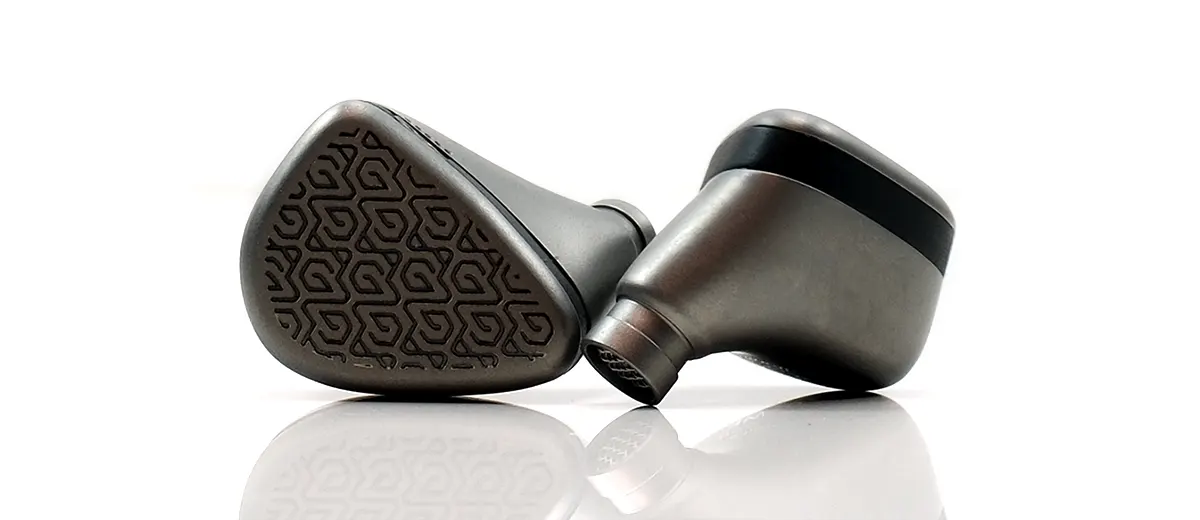
Marcus reviews the PMG Audio Apx ME, a new re-tuned titanium-shell edition of their award-winning 12-driver dynamic, BA, and planar IEM. It is currently priced at €6000.00.
Disclaimer: This sample was sent to me in exchange for my honest opinion. Headfonics is an independent website with no affiliate links or services. I thank PMG Audio for its support.
Click here to learn more about the PMG Audio products we have previously reviewed on Headfonics.
This post follows our current scoring guidelines, which you can read in more detail here.
The PMG Audio Apx ME is the 3rd iteration of the company’s limited-run summit-fi universal IEM series, which began with the original Apx in early 2024.
For those who are unaware, PMG Audio is the high-end sub-brand of Custom Art’s owner, Piotr Granicki, with a no-limits, money-is-no-object approach to earphone design, aiming to capture what he feels is ‘best in class.’
How successful that has been is somewhat tricky to gauge because each release is a very limited run: the first started with just 20 units, followed by 100 units of the 2nd version, the Apx SE, and now the Apx ME, which has a 200-unit run.
One could argue that since each wave has sold out, that yes, mission accomplished. I would support that on a personal level, given I also awarded one of the highest scores ever given to an IEM on Headfonics with both the original and the Apx SE winning awards in 2024.
If there is an IEM I grab for travel, reference work, or pure enjoyment, it is the original Apx. Something about its expansive staging and beautiful layering still wows me today.
So, how can the new €6000 Apx ME offer something different? Well, by producing the smoothest, deepest sound yet from an Apx, whilst capturing some of that beautiful height and air of the original Apx. It is also packaged in a sturdier metal shell and comes loaded with a vastly upgraded accessory package.
The most mature and audibly accessible Apx version to date? I found out in my full review and comparisons below.
Features
The PMG Audio Apx ME is now a hybrid 12-driver universal IEM with an 8-way passive crossover, compared to the Apx and SE’s 11-driver configuration.
The precise configuration has some changes from the previous edition. However, the rectangular ultra-planar subwoofer for the sub-lows and a 10mm PEEK diaphragm dynamic driver for the lows and lower-mids is unaltered.
The 8 flat impedance (FIBAE) BA are freshly recoiled higher impedance drivers in slightly different configurations from the previous version.
There are now 6 dedicated to the mids (lower mids and mids) instead of 4+2 for the mids/highs, with the upper frequency extension, as before, covered by a smaller round Ultra-Planar tweeter.
The new driver is bone-conduction (of sorts), or more precisely, a VCD driver (short for Vibration Conduction Driver), aimed at improving bass response with a peak around 250Hz and enhancing overall structural resonance in a more meaningful way than standard bone-conduction alternatives.
Previous features, such as POD (Pressure Optimizing Design) and GSO (Geometrical Sound Outlet), are still present but have been upgraded.
POD is now POD+, a 3D-printed waveguide that covers both the dynamic driver pressure and midrange response. GSO has updated the nozzle geometry to enhance the staging and imaging performance of the Apx ME.
The Apx ME is rated at 10.8Ω ±1.5Ω for impedance, with an SPL of 117 dB/mW @1kHz, so it has a bit more load than the original or SE edition, but it seems more sensitive than the older versions on paper.
Design
So, this is another huge change: switching from resin to a CNC-machined titanium shell for the Apx ME shell. It creates a totally different aesthetic, and for many, it will look more premium.
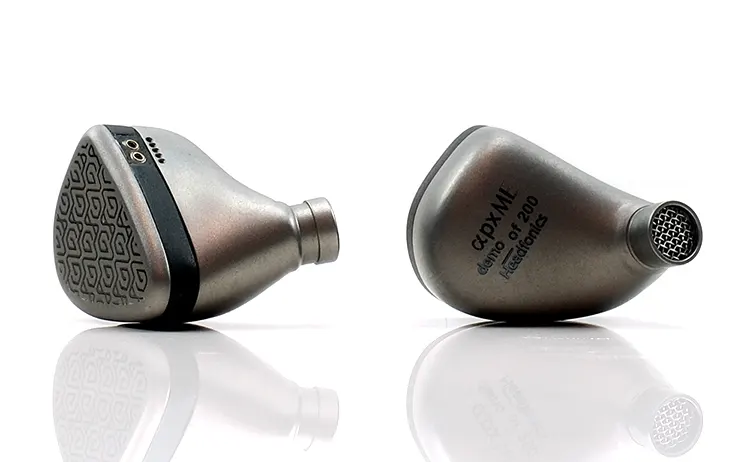
It excudes a mature monotone matte grey with black fender rings and a plate finished with a delicately etched hexagonal honeycomb pattern in matching black outlines.
Both of the Apx ME nozzles have protective meshes to prevent dust and dirt from accumulating. Also, perhaps not many will notice, but I appreciate the beautifully designed quad venting array just below the 2-pin connectors.
On the old resin models, these were recessed behind a single rectangular port, so not as obvious. Having them mounted to exit the shells directly is more attractive to me.
What I also like about this particular Apx version is the lack of weight from the titanium, something I was concerned about before trying them out.
Though not quite as light or as contoured as the resin shells of the previous iterations, they are nevertheless surprisingly light and incredibly robust-feeling in the hand.
The Apx ME nozzle is also shorter than the resin designs by a noticeable amount. This will place more emphasis on tip choice for passive isolation and will also create a more volatile environment for performance consistency.
Comfort & Isolation
As mentioned, the additional weight of the Apx ME shells is negligible in the ear. PMG Audio has kept the sizing pleasingly compact. Hence, they sit well in most ears, though by default most of the ear canal penetration comes from the tip rather than the titanium nozzle.
Because the Apx ME titanium shells have a more uniform shape and a generally less forgiving nature of metals for isolation compared to resin, you will need to choose your tips carefully.
A good fit and the correct tip choice will produce an excellent seal and an impressively comfortable fit for longer listening sessions. Given that PMG Audio has significantly enhanced tip selection, I suspect they feel the same way.
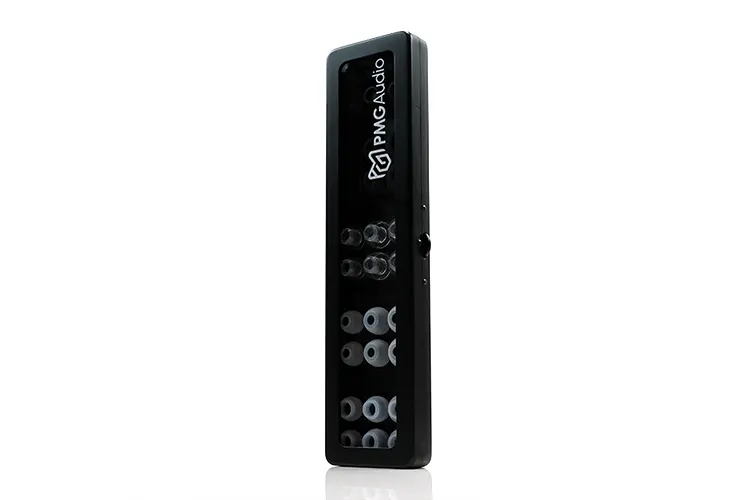
The latest tip selection comes in an impressively long black metal-and-glass panel tray with no fewer than 5 types in small, medium, and large sizes. There are no foam options; this is an all-silicone tip lineup.
Generally speaking, my go-to fitting size was medium, with large also working but with diminished performance, given that the nozzle was farther from my ear canal.
The best tip for me was the wide-bore white silicone tip, which delivers the most balanced, immersive sound signature from the APX ME.
The narrower-bore black tips would be my second choice, as they seal just as well as the white silicone tips and provide an equally immersive sound. They will, however, produce a slightly stronger bass response.
Afterward, the dual-flange produces admirable results in terms of expanse and seal, but I find it a little less comfortable during longer listening sessions.
The narrow-bore white silicone and transparent gel-type tips didn’t create an effective seal in my ear, noticeably reducing staging depth and size and allowing too much background noise to bleed in.
Stock Cable
The Apx ME comes with an entirely new stock cable, the 3rd such stock cable.
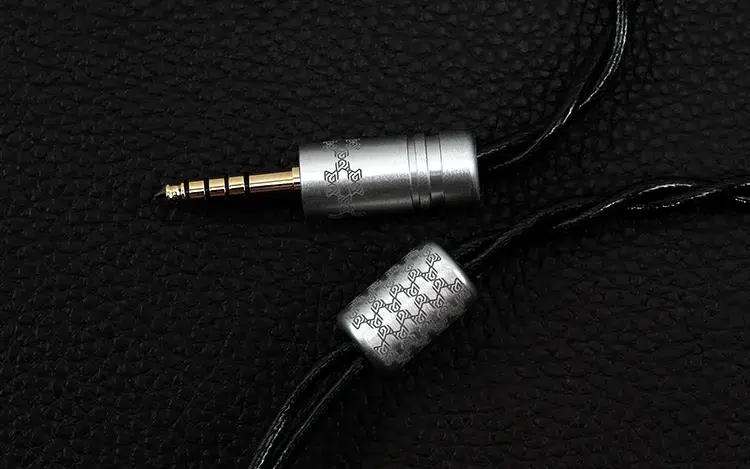
This time, the hybrid mix of metals from the SE version is replaced with a simpler, custom 6N OCC pure-silver wire in a coaxial geometry with silver shielding, inside a brown twisted PVC jacket, and terminated with matching titanium barrels and connectors. The cable is terminated with a 4.4mm jack by default.
For pliability, I would rate the new Apx ME stock cable somewhere between the lightweight OG stock cable for handling and the heavier SE alternative.
Aesthetically, it’s more in keeping with the titanium shell finish and a mature, low-profile color, but the jacket feels a little firm. I would have preferred a softer outer material for prolonged use, but given the size of the wiring (no official AWG but definitely low 20), that might not have been possible.
As with the SE cable, the Apx ME stock cable comes with an integrated IEM organizer strap, which is appreciated for its low-profile design and the likelihood of never being lost when on the go.
Microphonics or cable noise is very low, as is memory retention. This is a very well-behaved cable and unlikely to tangle up when in use.
Packaging & Accessories
With each new PMG Audio IEM release, the packaging gets more refined and premium-looking.
If there was one lasting criticism of the OG, it was that the presentation felt a bit rough around the edges. The SE improvements, including a dedicated leather zipper case and compartmentalized accessories, were very much welcomed.
If anything, the Apx ME packaging is a refined version of the SE display case, with a broader accessory lineup.
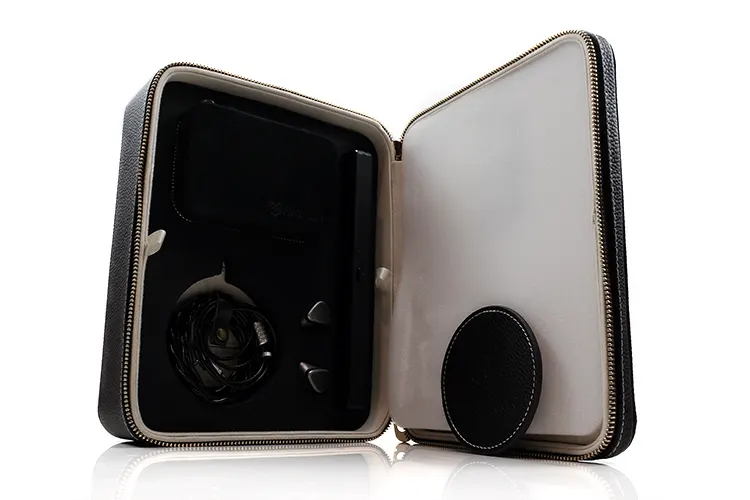
The large brown leather outer carry case is very refined yet robust, with decorative exterior finishing and a neat insert to house the accessories.
The ear tips come in their own elongated metal case with a clear panel on top, but if, like me, you have a preferred set of tips, it also comes with a tiny square-like version where you can pack your favorite tips into when on the go.
You also get a smaller zipper carry case to fit inside bags and a matching leather coaster that sits on top of the cable compartment.
One last thing. The Apx ME case contents can be emptied, with Velcro-finished dividers available to compartmentalize the base. This will allow you to neatly pack a system rig, such as a DAP, a portable amplifier, or spare cables, alongside the IEMs for a complete travel or community-meet kit.
Sound Impressions
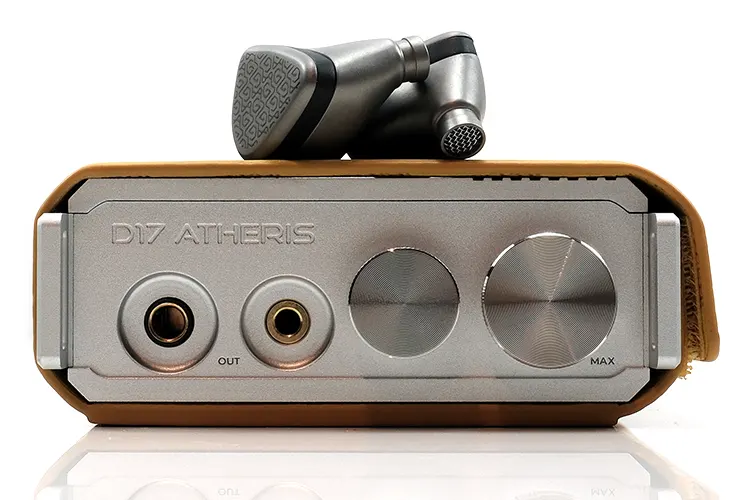
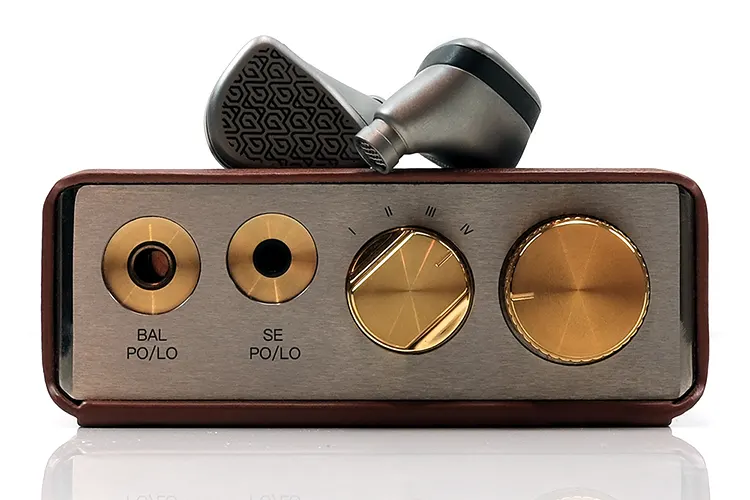
The following sound impressions were completed using the iBasso DX320 MAX Ti, the HiBy RS8 II, and the FiiO M27 with a low-gain balanced output connection.
Summary
If there is an evolutionary line in the Apx models, the Apx ME sits closer to the SE edition than to the OG. It produces an even smoother sound than the SE and substantially enhances quality and low-end power, delivering a very deep and authoritative presentation.
However, it would also be wrong of me to discount the influence of the first Apx model, because not only has the Apx ME refined the SE’s tonal balance, but it’s also stolen a trick or two from the OG’s spacious soundstage.
One could argue that it is the best of both worlds, with a richer, more natural-sounding full-bodied vocal timbre, weighty, detailed bass, and plenty of space to let the Apx ME deliver an effortless, easily enjoyed performance.
And it is not just ‘moar bass’ either. This is not a bloated driver response with a molasses-like trail left behind every note. It is far more agile than that.
The sub-bass bias is still there, and the separation and layering are excellent. Rather, it’s the ‘pointed’ slam and the textured detail from the Apx ME lows that impress me a lot more than what the SE offered.
The highs have leaned back a little from the SE, considerably more than in the original. For those who struggled with the brighter highs of the original, the Apx ME delivers a far more liquid-like treble performance with an even-harmonic bias in the midrange tuning.
Some might feel the original still has the height advantage, and to an extent, I do find the original’s immersion from its treble presence quite exceptional.
For those that did not, the Apx ME’s mids-to-treble coherence is superior to the SE, which does not quite convey the same natural, rich midrange tone.
Frequency Response
The biggest Apx ME tuning changes from the previous two models for me are primarily below 150Hz, and everything above 1k. You can make a case for 100-250Hz, given the VCD drivers peak around 250Hz, but that is more of a ‘physical feeling’ than an outright amplitude change.
As with the older models, PMG has retained that sub-bass bias, which I much prefer over elongated bass shelves.
From 80Hz down to 20Hz, I hear a little more elevation than the SE, and whilst it does feel similar in amplitude to the OG around 50Hz-20Hz, it offers a fuller sound courtesy of a perceived stronger 50-100Hz elevation. It also sounds more physical and textured courtesy of the VCD driver.
Though there isn’t a huge FR change in the upper-bass and lower-mids, the Apx ME rises a bit earlier from 1-3k and stays consistent up to 5-6k, rather than the older model’s gradual rise and peak at 5k.
The deviation from what came before feels more dramatic post-5k. The first Apx had a noticeable lift from 5-7k with a treble shelf higher than either the SE or the Apx ME.
The SE was lowered but still felt relatively lively compared to the smoother ME tuning, which drops the energy a fair bit between 5-8k.
There is a gentle lift around 10k that ensures the Apx ME does not fall into the ‘dark trap’, though. Compared to the previous 2 models, some might argue it’s the darkest-sounding treble of the three.
Personally, I like the ‘take no prisoners’ airy and tall presentation of the original’s treble tuning, but if I am picking something with the smoothest highs, then the ME beats out the SE’s slightly compromised interpretation every time.
Staging & Dynamics
Despite the relaxed treble tuning, there is no doubt that the Apx ME is a huge-sounding monitor. Perhaps with a slight bias now to depth over treble brilliance, it nevertheless sounds effortless, especially through the mids.
I hear a slight increase in dynamic range and textured detail in the Apx ME mids compared to the older models. Practically every note now has a stronger fundamental frequency, so whilst seemingly not as forward-sounding in some areas, it nevertheless sounds bigger and more confident in its delivery.
The presentation is outstanding at the macro-level. Reverb is palpable, with a cathedral-like quality that makes some of the competition sound as if it’s being delivered within the confines of a padded studio.
If there is a slight critique is more because of how wedded I am to the OG’s treble performance. I am in the minority regarding how well the top-end tuning was received.
There are times when I feel the original has a more enveloping sound than the Apx ME, due to the stronger presence of the upper-register spatial cue.
But it is vastly deeper and more holographic-sounding than the SE edition. Not as intimate in the mids, but more spacious sounding, with vocals and instruments easily commanding their own space without a hint of smear.
It’s a big sound, but not the type of big for nimble, ethereal orchestral works; more an arena-big vibe suited to muscular rock and pop gigs, if that makes sense.
Click on page 2 below for my recommended pairings and selected comparisons.
