

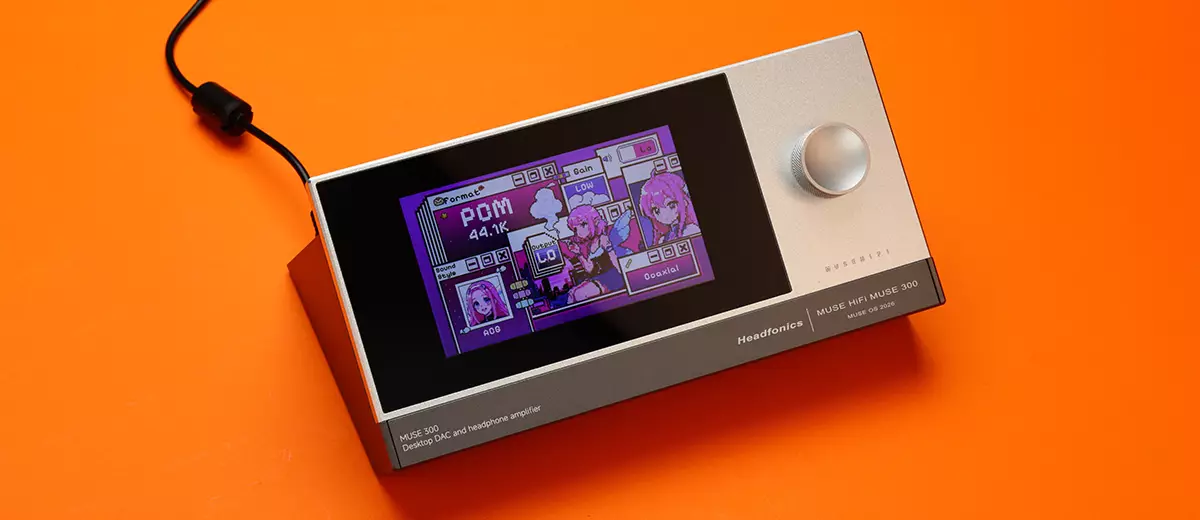
Marcelo reviews the MUSE HiFi MUSE 300, an innovative compact desktop ES9039 Ultra DAC/Amp and wireless streamer with a proprietary OS. It is currently priced at $439.99, with Kickstarter pricing starting from $349.99.
Disclaimer: This sample was sent to me in return for my honest opinion. Headfonics is an independent website that does not have any affiliate links. I thank HiFiGO and MUSE HiFi for this opportunity.
Click here to read more about other MUSE products previously reviewed on Headfonics.
This article follows our current scoring guidelines, which you can read in more detail here.
My mind gets stimulated whenever I read about something as the world’s first, and much more so upon knowing I will be reviewing one. Like the MUSE HiFi M6 Double, which I previously reviewed, the MUSE HiFi MUSE 300, selling for $399, is one of those products.
Have you ever seen a uniquely shaped desktop DAC headphone amplifier with its own dedicated operating system and a 5-inch screen? The MUSE 300 is the world’s first to have these.
Another thing that excites me is the use of real analog components to shape the sound, rather than the digital manipulation used in nearly all other desktop DAC amplifiers.
The MUSE 300 is a unique-looking desktop DAC amplifier equipped with the latest chipset and promises great sound quality. How will it compare to others, including its sibling, the MUSE HiFi M6 Double, and the xDuoo XD05 Basic 2? Let’s find out.
Features
The MUSE 300 is a feature-rich desktop DAC headphone amplifier, but what piqued my interest the most is the sound-tuning method, which uses analog components like resistors and capacitors to shape the sound in three different tuning styles.
Balanced sound tuning for neutral and accurate, perfect for classical music and monitoring, Tube Amplifier sound tuning for warm and full-bodied, ideal for pop and jazz with rich harmonics, and ACG sound tuning for transparent and lively, tailored for anime songs and game soundtracks.
This approach to sound tuning differs from that of most DAC amplifiers, which manipulate the sound in the digital domain. The MUSE 300 uses real electronic parts to achieve these effects.
What enabled the MUSE 300 to obtain the world’s first title was its use of a dedicated custom operating system, MUSE OS, to run its 32-bit Microcontroller Unit.
Unlike Android DAPs, the MUSE 300s use this hardware-and-operating-system combo to enable more optimized, precise management of complex tasks and the best possible sound quality.
For audio decoding, the MUSE 300 uses the ES9039 DAC chip from the American company ESS Saber, known for its detailed sound.
Though the MUSE HiFi never mentioned whether it is the Q2M or PRO version of that chip, I strongly suspect it’s the former based on the pricing, but I could be wrong.
Two OPA1612, two ES9603, and two TPA6120A are used as low-pass filters, I/V converters, and headphone amplifiers, respectively, to form a true balanced output.
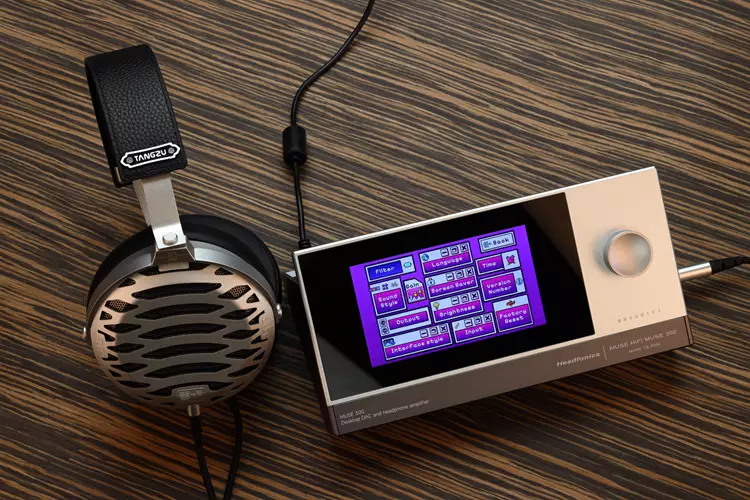
The MUSE 300 also features a large 5-inch screen with customizable UI themes and screensavers.
The power output rating lacks specificity, but the MUSE 300 is rated for a maximum output of 2,200 mW, a signal-to-noise ratio of 129 dB, and less than 0.0006% distortion.
Design
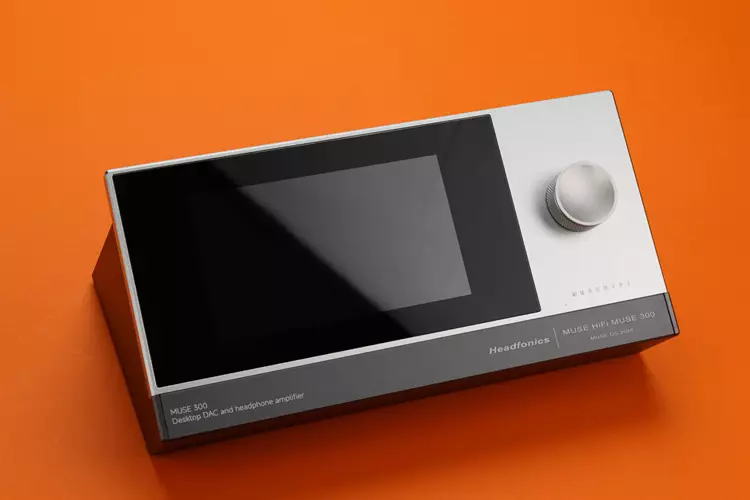
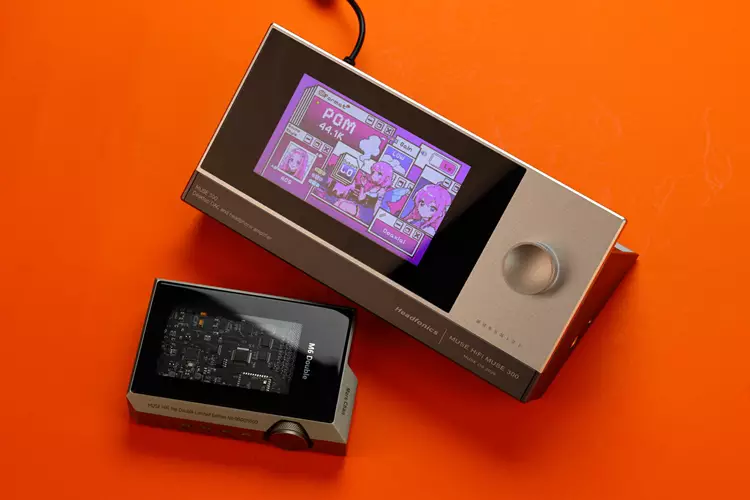
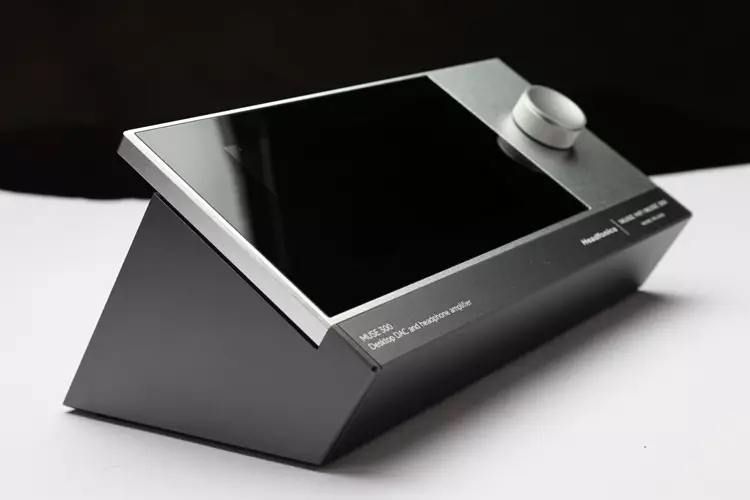
The shape of the MUSE 300 looks odd at first glance, but I quickly realized it is useful. I like that the front faces my face when seated at a desk, rather than my torso, as most desktop DAC headphone amplifiers do.
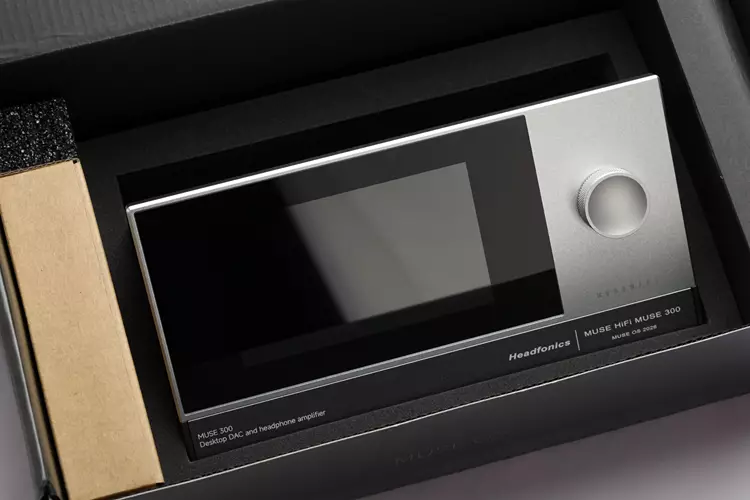
The front faceplate is made of 8-mm-thick, silver-anodized aluminum and features a glass panel for the 5-inch screen and a single metal push-button rotary knob to control the MUSE 300. The rest of the chassis is made of 3-mm-thick aluminum casting.
Overall, the MUSE 300 looks futuristic and neat, and it feels very sturdy, heavy, and solid. the MUSE 300 is 228 mm x 140 mm x 100 mm x in dimensions.
Display
The large 5-inch 480 x 854 IPS screen looks clear and high-contrast, has good viewing angles, and offers five levels of brightness. It clearly displays the user interface and the screensaver animations, which increase engagement while listening to music.
The display features three UI themes, namely Cyberpunk, which has Neon lights and high-tech vibes, perfect for gaming desktops.
Minimalist with its clean, refined looks, blending seamlessly into modern homes or offices, and the ACG Style, which features bright, playful, anime-inspired visuals. Switch freely between themes to match your décor, desktop, or daily mood.
Additionally, the screen saver can be customized by uploading your own JPEG.
As much as I like that the MUSE 300 has these features, I wish that the spectrum analyzer and VU meter were faster and more accurate. And oh, the screen cannot be turned off.
I wish there were a control to turn the screen off, like a screen timer, and a triple-press on the knob to turn it off at will.
Although these complaints aren’t a deal-breaker, I hope MUSE HiFi can address them with a firmware update. My MUSE 300 sample unit currently has the firmware version 1.0, by the way.
I/O
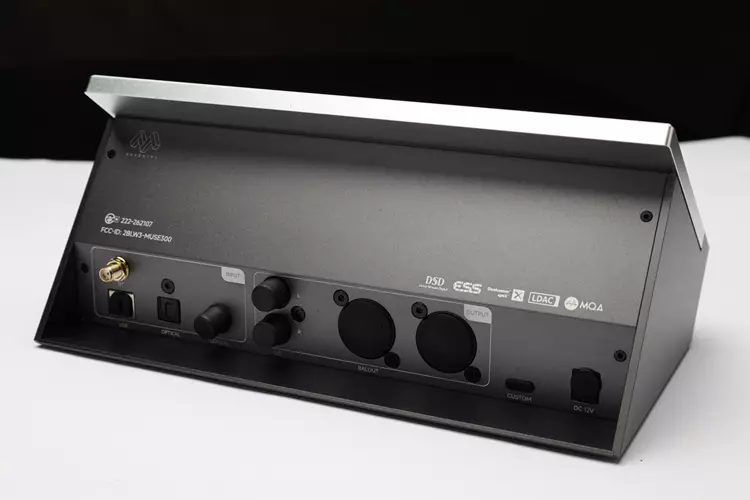
Most of the I/O is neatly located at the back. From left to right are the Bluetooth antenna jack, the USB-B, optical, and coaxial inputs, the RCA stereo, the XLR balanced stereo outputs, a USB-C port for firmware update and data only, and a barrel-type 12V power input jack.
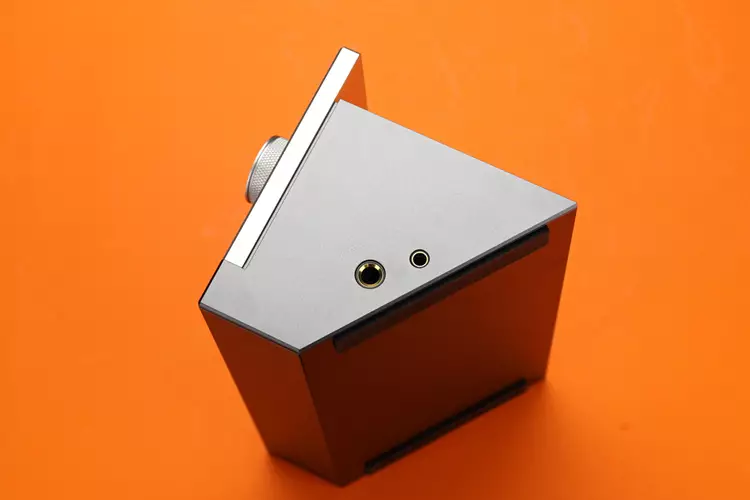
The 3.5 mm single-ended and 4.4 mm balanced headphones output jacks are located on the right side.
What surprised me, though, is that all the inputs and output jacks are covered with rubber caps, which I find to be a nice touch, especially at its price point.
Both the RCA and XLR output jacks at the back are active regardless of whether I select Line out or Phone out in the menu. However, when I chose the Line out, the 3.5 mm and 4.4 mm headphone jacks are deactivated.
When the output setting is Line Out, both the RCA and XLR outputs have a fixed output level. When Phone Out is selected, both the RCA and XLR output jacks have variable output levels controlled by the volume knob, as do the headphone outputs.
Controls & Navigation
The MUSE 300 includes only one control, a push-button rotary knob. At first, I thought it lacked some buttons, but after further use, I realized it is more than adequate for controlling the MUSE 300.
Navigating the MUSE 30’s UI is easy and intuitive; it involves only single and double presses and turning the knob. By long-pressing the knob, the MUSE 300 can be turned on or off.
Though this is not a deal-breaker, I do wish the screen were touch-sensitive to make it even easier to use.
Packaging & Accessories
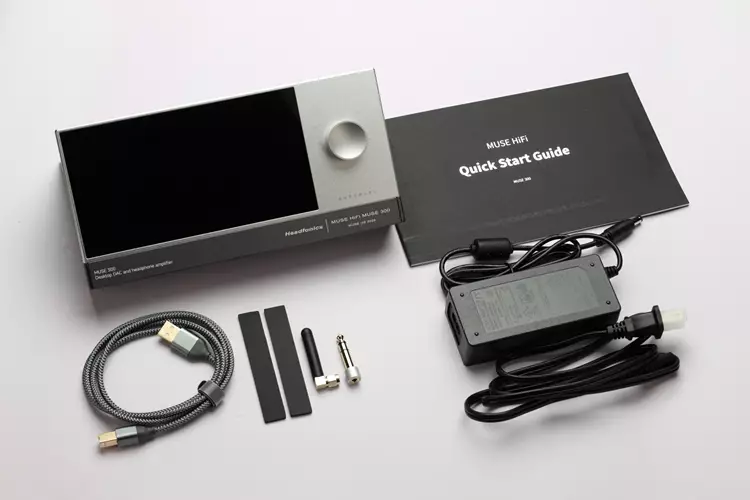
The packaging is simple and practical, using foam and cardboard to protect the MUSE 300 during shipping. It uses a hard black box with the MUSE 300 photo on the front and some text all around, measuring 343 mm x 185 mm x 110 mm.
The box contains the MUSE 300 Main Unit, Power Adapter, USB Cable, Headphone Adapter, AC Power Cord, User Manual, Bluetooth Antenna (requires installation), and an extra pair of Silicone footing Pads.
Sound Impressions
Before critical listening, I performed a 12-hour burn-in on the MUSE 300, which I do on almost all review units, regardless of purpose.
I tested the MUSE 300 on my desktop PC, MacBook Pro, and OnePlus 13 phone, but I mostly did my critical listening with my FiiO M33 R2R as the digital source, connected via USB.
I used my DUNU Falcon Ultra, Tipsy M5, and QoA Martini IEMs, as well as the TANGZU OX Demon King, FiiO’s JT3, and the Sennheiser HD 6XX headphones.
For music players, I mostly used PowerAmp, UAPP, and YouTube Music. No EQ was used, nor were any sound enhancement programs; the MUSE 300 is set to medium gain when paired with IEMs and to high gain when paired with headphones.
Sound Style & Filters
I couldn’t hear any meaningful difference among the eight digital filter settings on the MUSE 300, so I set it to the default filter, which is the Linear phase apodizing fast roll-off.
However, unlike with digital filters, there are clear, immediate differences in sound among the three sound-style modes. These sound modes use real audio components to tune the sound, such as capacitors and resistors, which I will discuss separately below.
Balanced Sound Style
In the Balanced sound style mode, the MUSE 300 sounds very analytical with a flat and accurate frequency response from the lowest bass to the highest treble.
There is no perceived response roll-off both in the subbass and the upper treble, and needless to say, there is no artificial warmth in this mode.
The bass is tight, punchy, and accurate; the midrange is very flat and accurate, with no hint of warmth; and the treble is also very flat and extended.
The instruments and microdetails are clearly presented, with no hint of veiling; it sounds so clear and transparent.
Of all the modes, this is the one I like most for its balanced presentation of bass, midrange, and treble, and its accurate, revealing, and analytical sound without sounding cold or sterile.
Tube Amplifier Sound Style
In this mode, there is a perceived subtle softening of the midrange and treble transients, and a softening and rounding off of the bass impact and presentation. I must say it emulates the sound of a tube amplifier very well.
The sub-bass has a slight roll-off; however, there is added subtle boominess or looseness in the mid-bass to compensate for it. The midrange became slightly warm with a lusher, less analytical sound presentation.
I also perceived a subtle roll-off in the upper treble and a softening of the transients, which makes the overall sound signature slightly warmer than the Balanced sound mode. It still sounds clear and transparent, though.
This is my second favorite mode. I use this to tame bright IEMs and headphones, or when I want a more relaxed sound presentation.
ACG Sound Style
ACG means animation, comics, and games. These are the kinds of music associated with animation, comics, and games, and the way MUSE HiFi tuned it, it complements those genres’ tonality rather than countering them.
This means that in this mode, the bass becomes leaner and tighter, with a distinct forwardness in the upper midrange and treble that I often hear in songs from these genres.
I know many people like this type of sound and listen to ACG music, especially the younger generation who are big fans of anime. But personally, I don’t have a use for this sound mode.
Coloration
Aside from those three sound tuning styles discussed above, which have an apparent and distinct impact on the sound. There is no unnatural coloration with the MUSE 300 to talk about.
I hear no bass bloat, no midrange nasality or muddy warmth, and no treble sharpness or congestion; the overall sound of the MUSE 300 is very natural and open.

Staging & Dynamics
No matter what sound style mode I’m in, the MUSE 300 always has an airy, open, and wide soundstage with reasonably good depth. Most of the time, I hear a wider-than-deep stage with a slightly forward, high-clarity stage presentation.
I hear a very clean sound with prolonged instrument decay and reverberation towards the dark background. However, due to its wide and slightly forward stage presentation, the stage depth isn’t as deep as the best I’ve heard.
The dynamics in the Balanced sound style mode are excellent; I hear a terrific transient response that feels very immediate. And the bass’s power delivery is very fast and tight.
In the Tube amplifier sound style mode, the dynamics are less immediate sounding with less slam in the bass and less snap in the percussive instruments, and the transient response is slightly softened. The dynamics are still good, though.
When in ACG mode, the dynamics become even more subdued due to its lean bass response. The sound is tonally lively, but in terms of sheer dynamics, it sounds kind of compressed.
Click on page 2 below for my recommended pairings and selected comparisons.
