

Select Comparisons
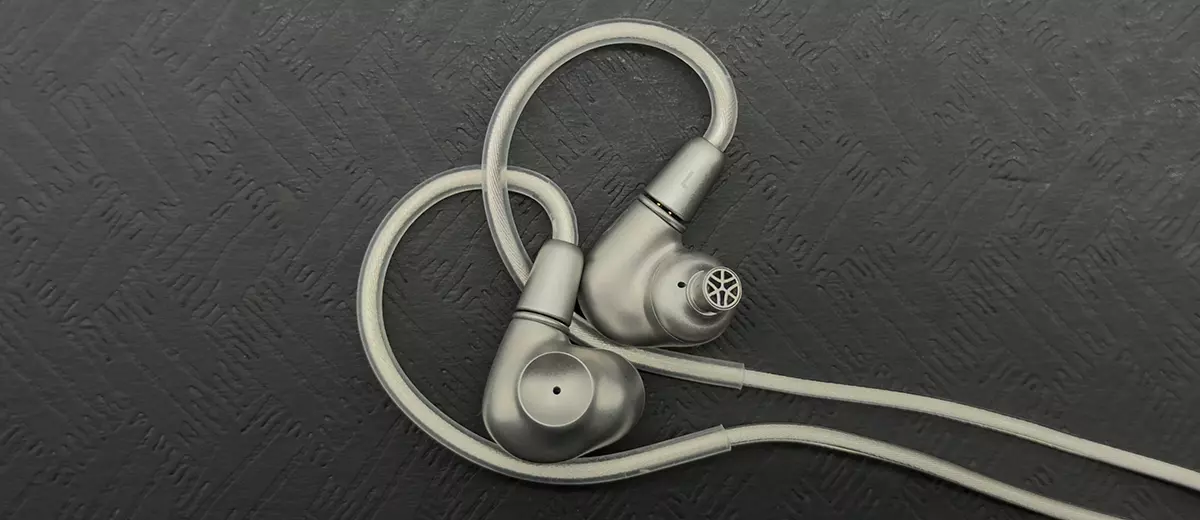
DITA Audio Mecha
Technical
At the core of the Mecha lies a single 10 mm LiMa-Carbide dynamic driver with a dual-magnet setup. The LiMa-Carbide driver consists of a 9 mm lithium-magnesium diaphragm surrounded by a 1 mm carbide diaphragm.
According to DITA, the Li-Ma diaphragm is much harder to fabricate than materials like lithium-aluminum or pure aluminum. This combination helps achieve greater extension and a clean presentation.
DITA Audio Mecha has an impedance of 32 Ω at 1 kHz and a sensitivity rating of 113 dB/Vrms. The Mecha is more efficient to drive. Even with low-power sources, Mecha can sound full.
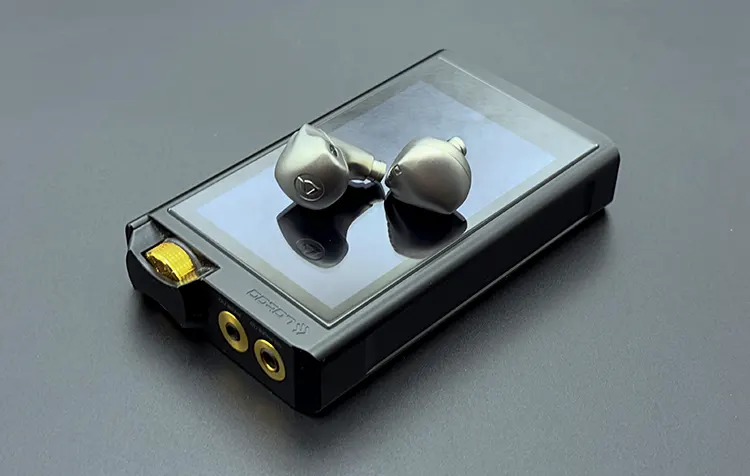
The ASTRU is better at scaling and more stable with additional power. When pairing Mecha with the Lotoo PAW Gold Touch DAP, I find myself staying under a volume level of 30 most of the time, while the ASTRU feels more comfortable at a volume level of 35.

Design
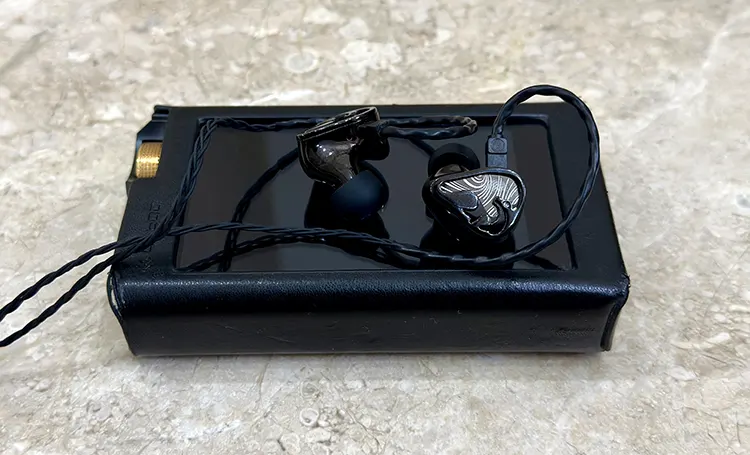
Same titanium brotherhood, but both IEMs showcase different design languages. The Mecha features a slightly matte finish and is less shiny than ASTRU. The shells are quite ergonomic, with the usual IEM-like design and no edges or bumps along the curves.
The ASTRU is very small in comparison. Mecha is comfortable for me, but ASTRU’s smaller footprint makes it disappear in the ears, so people with small ears would definitely prefer ASTRU’s fit.
Mecha includes a custom-designed Churro cable, crafted from monofilament single-crystal, high-purity copper with silver-plated conductors.
The cable is also equipped with DITA’s APV2 (Awesome Plug Version 2), giving it modular 3.5 mm single-ended, 4.4 mm balanced, and USB Type-C plugs. This makes it compatible with nearly every type of portable source.
The ASTRU’s cable is 4.4 mm balanced but also comes with a 3.5 mm connector, adding compatibility with a wider variety of sources. It is also easier to handle.
Performance
The Mecha comes across as slightly leaner of the two, though purely in terms of bass quantity, they are not far apart.
It lacks the sense of depth and foundation of ASTRU, so notes do not feel quite as grounded. ASTRU’s fuller and smoother, with a touch more detailed bass line and with a firmer low-end hold.
Frankly, these are simply two different characteristics rather than a matter of one being better than the other.
In the midrange, ASTRU comes across as the more natural and musical of the two. The lower mids sit a little higher, so notes carry a bit more body and weight. Vocals sound denser, and instruments come through fuller and richer.
The Mecha sounds a touch leaner and cleaner in the lows, with less warmth filling in the foundation. It has a slightly more forward upper midrange, and that helps with outlines. Female vocals have better presence.
Treble differences are not massive. Both have a smooth presentation. Neither is trying to be sharp or aggressive. The Mecha has a bit more air around the notes and maybe a slight extra sparkle up top. It feels just a little more open in the treble. But this is not some major shift.
The ASTRU stays close, with a similarly smooth treble balance, just without quite the same sense of shimmer and openness.
Technically, Mecha has a slight edge in raw resolution. Its imaging also comes across a bit sharper, likely helped by the more open treble, which gives it a greater sense of height and openness.
The ASTRU sounds more coherent and more balanced overall. It feels more filled in, and its stage is laid out in a more natural and organized way, and ultimately more coherent in how it presents the whole image.
Campfire Audio Alien Brain
Technical
The Alien Brain was in the first quarter of 2025. It is a hybrid IEM with five drivers. The driver configuration is a 10 mm Glass-PU Dual-Magnet Dynamic Driver and four high-performing custom balanced armature drivers.
Two of these balanced armatures handle the mid-frequency range, while the remaining two act as super-tweeters, catering to the high-frequency region.
The Alien Brain has an impedance of 7.8 Ω at 1 kHz and a sensitivity rating of 8.97 mVrms to hit 94 dB. Alien Brain is an extremely easy-to-drive IEM, like most Campfire Audio IEMs. It does not demand much power and pairs well with basic sources.
ASTRU, though easy to drive, can scale quite well and remains very stable with powerful sources. If the sources are too powerful, Alien Brain can have static noise in the background.
Design
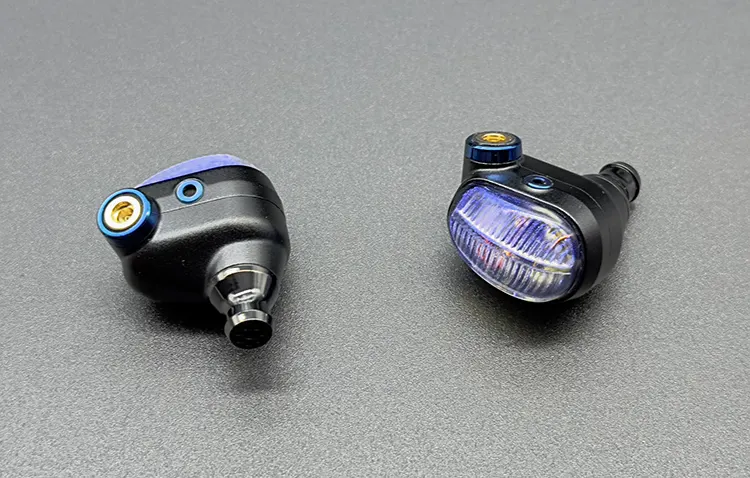
The Alien Brain has a very quirky design, featuring a sci-fi-influenced look with a futuristic aesthetic.
The shells are made from matte-finished black metal, offering a rugged yet lightweight appearance. The faceplate design features a blue-accented, semi-transparent, glass-like enclosure with a ribbed texture.
Though the shells are small, Alien Brain’s fit is more challenging and demands a good amount of ear tip rolling. After all these months, I keep changing ear tips to find that sweet spot. ASTRU’s shells are smaller in size and have an easier fit.
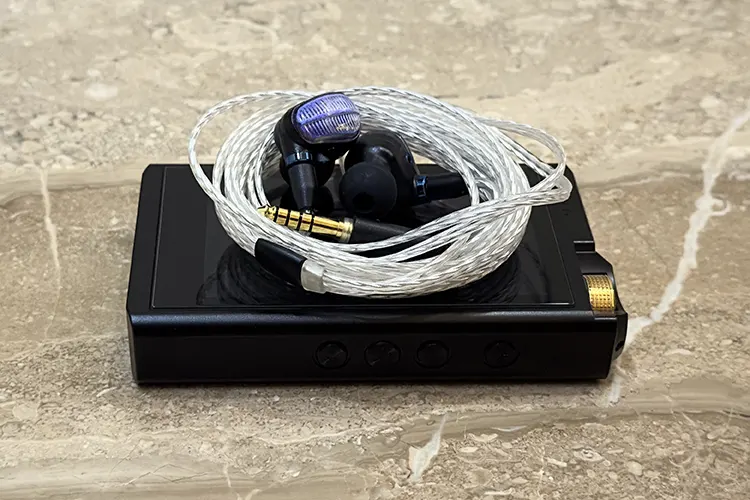
With the Alien Brain, you get a pair of IEM cables in 3.5 mm and 4.4 mm terminations, along with a USB-C portable DAC dongle.
It uses an MMCX port to connect to the cables. ASTRU’s cable is 4.4mm balanced but comes with a 3.5mm connector, so both terminations are catered to.
Performance
The ASTRU comes across with slightly more sub-bass presence. It feels a bit more grounded because of that. There is a better sense of depth underneath the music, and the low end has more of that planted feel and a more solid foundation.
Alien Brain still has a good bass response. It is detailed, textured, and gives enough quantity to stay engaging, but it does not dig quite the same way. It feels a little lighter in depth next to ASTRU.
Alien Brain has a very natural midrange in its own right, and there is definitely some emotional engagement there. But ASTRU sounds smoother to me. Also, a touch more balanced. Tonally, I also find it a bit more accurate.
ASTRU has more of a lower midrange body. Alien Brain has more energy in the upper midrange, and that gives it a slightly more vivid and sharper presentation of female vocals and instruments. With some sources, that same push can also thin things out a bit.
ASTRU is the smoother one in the treble. Alien Brain has more energy and sparkle. It sounds a little brighter and livelier in that region. Some people will like that straight away, especially if they want more bite and a bit more spice in the top end.
With poorer recordings, it is less forgiving. ASTRU is easier on the ear. It smooths things over better, but does not really kill the detail.
On ASTRU, the stage feels more solid, and more importantly, it layers better. Instruments space out more naturally. Separation is also stronger. The Alien Brain has sharper images. It outlines presence a bit more clearly, and pulls out more detail.
LETSHUOER Mystic 8
Technical
The LETSHUOER Mystic 8 has an all-balanced armature driver setup. It features eight balanced armature drivers, four each from Sonion and Knowles.
The Mystic 8 also incorporates a low-pass filter module to enhance bass performance and employs a three-way crossover circuit along with a four-way acoustic tube configuration to precisely divide frequencies among the drivers.
With a sensitivity rating of 107 dB/Vrms and an impedance of 18 Ω at 1 kHz, the Mystic 8 is an easier-to-drive IEM and does not require much power. ASTRU needs a bit more power to show its full potential.
Both IEMs are fairly stable with high power output, but ASTRU scales up a bit better. On my LPGT, Mystic 8 takes a few fewer volume clicks than ASTRU.
Design
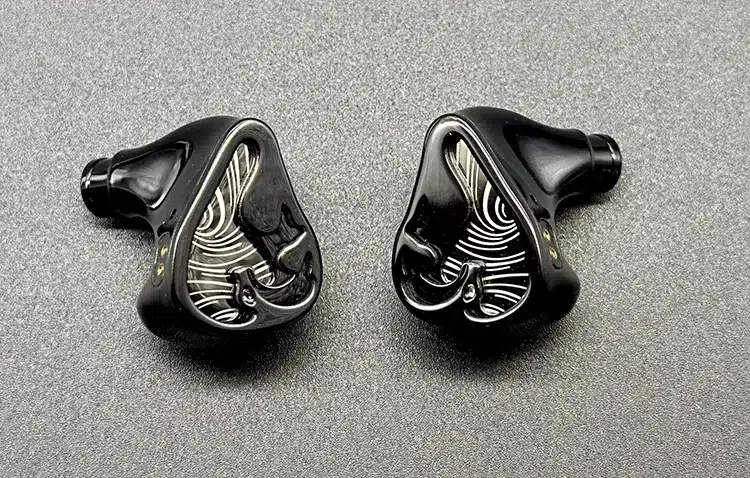
The shells of Mystic 8 are made of CNC-machined titanium alloy, which is strong and corrosion-resistant, offering excellent durability.
The design is inspired by the Phantom Cat. The faceplate of the IEMs features a cutout depicting the cat, with the cat’s eyes made of faux diamond.
ASTRU, also built in titanium, has a minimal design. It has smaller shells. However, the Mystic 8 shells are also small, so the fit is equally good on both.
For large ears, Mystic 8 may be a better fit due to its more conventional shape and design. ASTRU will favor those with very small ears.
The Mystic 8, being a premium offering from LETSHUOER, offers a very decent unboxing experience. ASTRU is presented similarly.
Both IEMs include high-quality accessories. The stock cable of Mystic 8, I feel, is too flimsy. I prefer the stock cable that comes with ASTRU.
The carry case that comes with the Mystic 8 is a round, puck-style case made of shiny aluminum with a thick black silicone cover as a lid. This one looks more premium and is more durable than the one we get with ASTRU.
Performance
The ASTRU has more about raw impact and a stronger foundation in the low end. Not too much. Not overcooked. But enough to make the music feel grounded. You get solid impact, which adds a layer of fun and excitement.
The Mystic 8 sounds leaner. Cleaner too. Bass is tighter and a bit lighter on its feet, but it lacks that sense of weight that ASTRU does. This difference sets the tuning style for both IEMs right away.
Midrange is where Mystic 8 gets very impressive. Very natural. Very engaging. There is a certain cleanliness to how it presents vocals and instruments, and that works in its favor.
At the same time, it does not have quite the same lower-mid fullness as ASTRU. So that extra body, that added richness, is a bit more obvious on ASTRU. The upper mids are where Mystic 8 has a better edge. Better extension too. Notes come through with clearer outlines.
The Mystic 8 has more air and more sparkle. Notes feel a bit more open and articulate. There is more shimmer on cymbals, and notes are more detailed.
The ASTRU is smoother and more forgiving here. More toned down. It does not throw details away, not at all, but they do not pop out in the same way. Mystic 8 makes those details easier to notice.
The ASTRU gives a more immersive stage to my ears with better instrumentation layering. Things feel more wrapped around you. More connected. More filled in.
The Mystic 8 sounds a bit more open in the way it presents space, and images come through sharper. Outlines are cleaner, and placement feels a bit more precise.
Resolution also feels a touch better on Mystic 8 with a cleaner, crisper presentation, which helps details stand out more easily.
My Verdict
A lot of Meze’s releases have been well received, and for good reason. I still remember quite a few people around me really appreciating ADVAR, though its tuning was a bit sharp.
Then ALBA came in and got plenty of love, too. Even now, it still feels like one of those fan-favorite Meze sets. The ASTRU is another that can easily land in that same good company.
A good single dynamic driver, when tuned right, can still be one of the most satisfying things in this hobby. The ASTRU is a good reminder of that. It has the looks and Meze finesse in design and presentation. More importantly, it has a tuning that feels thought through.
The price may raise a few questions for people who mostly judge an IEM by technical performance. That part is fair. But where ASTRU really makes its case is through its tonality and the kind of immersive, easy-flowing presentation it brings.
Instead of instant pyrotechnics, it settles in slowly, and the more you listen, the more that tuning begins to click.
ASTRU maintains an impressive balance and coherence. Nothing feels disconnected or overdone here. Everything flows in a very natural and convincing way. It’s not always about chasing micro-details or precise technicality.
Sometimes you want to sink into the music and let the tuning do its thing. ASTRU fits that mood very well. And that is exactly where ASTRU feels justified.
Overall, I think the Meze Audio ASTRU deserves to be mentioned alongside some of the well-known single dynamic driver sets.
It may have its own style and priorities, but it belongs in that conversation. For anyone who enjoys a smooth, rich, well-balanced tuning, ASTRU feels like an easy recommendation.
Meze Audio ASTRU Specifications
- Driver Configuration: 10mm Single Dynamic driver
- Impedance: 32 Ω @ 1 kHz
- Sensitivity: 111 dB SPL/mW at 1 kHz
- Frequency Response: 5 Hz – 35 kHz
- Cable: Silver-plated Linear Crystal Oxygen-Free Copper
