

Selected Comparisons
The following selected comparisons to the iBasso D17 Atheris were completed using a mix of IEMs and headphones, including the PMG Audio Apx, Volk Audio’s ÉTOILE, the PLUSSOUND Allegro II, and the Meze Audio POET.
For connectivity, I used the iBasso DX340/AMP15 coaxial output into both units with the DAC and amplifier gain set to low.
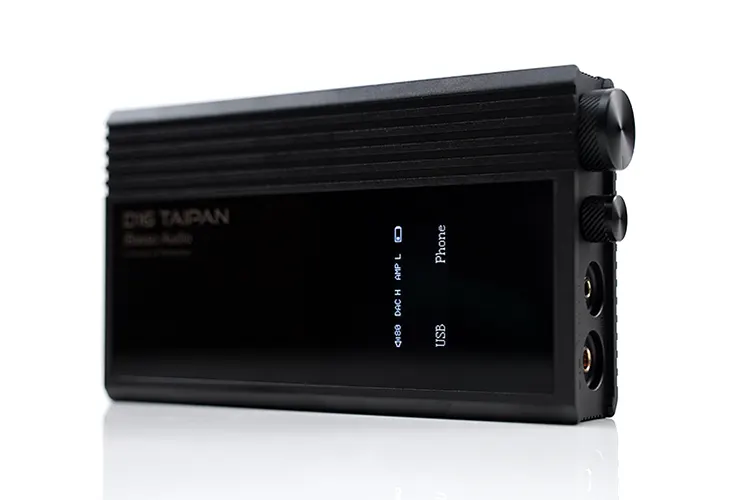
iBasso D16 Taipan
The iBasso D16 Taipan is the ‘precursor’ to the D17 Atheris and was released in 2024. It also won our Top Gear 2024 Award for Best Portable DAC/amp.
Technical
I have covered a lot of the differences in my review to date, so I will try to keep this brief.
Where there was one DAC inside the D16, you now have two (3 modes) inside the D17. Essentially, the D17 Atheris takes a slightly slimmed-down 64-resistor version of the D16’s 1-bit 128-resistor array DAC and adds a discrete-engineered 284-resistor array R2R DAC alongside it.
And for those who wanted the tube output from the PB5 Osprey instead of the 1.2W Super Class A balanced headphone amplifier inside the D16, the D17 Atheris has you covered with a similarly powered dual NuTube 6P1 amplifier.
Decoding is much the same at 32BIT/768kHz (though via WASAPI, it can drop to 386kHz) with a native decoding ceiling of DSD512. Both support coaxial and optical input at PCM 768kHz/DoP256 and PCM 192kHz/24BIT, respectively.
However, the D17’s digital input management differs from the D16, and that affects the amount of power you can expect to receive from the tube output.
Given the D17 Atheris has two architectures, you now have a choice of mode (OS, NOS, and SD). However, only R2R will provide 1.2W balanced maximum. Once you switch to the 1-Bit option, it drops down to 340mW balanced.
One could argue that the D16 Taipan 1-bit mode output is thus more advantageous for headphone use, though remember, it’s a solid-state output. If you want tube output, you have to pair it with the PB5 or PB6, whereas for less demanding gear, the D17 Atheris is all you need.
Design
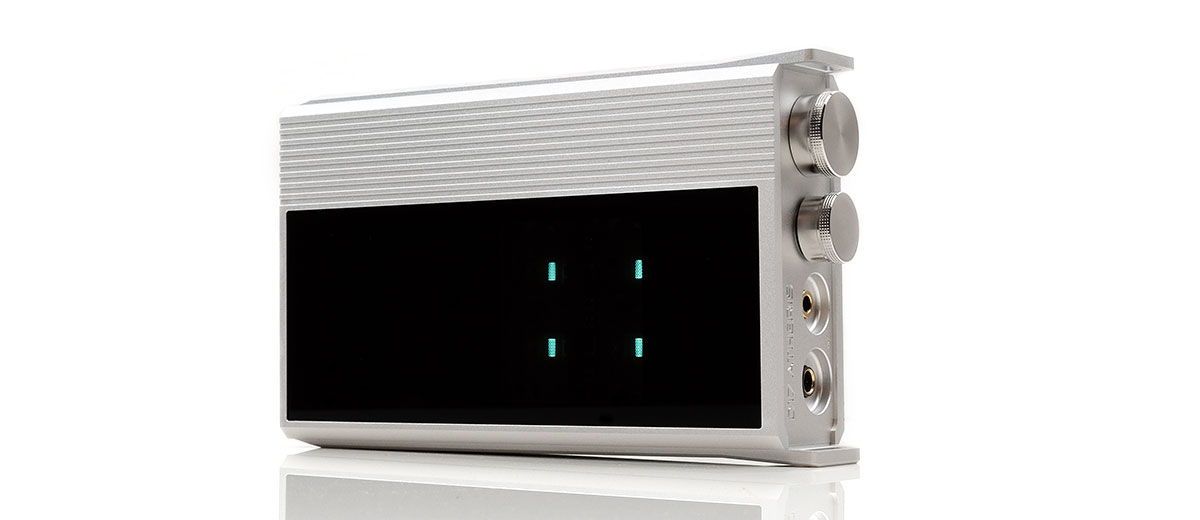
The D17 Atheris is slightly bigger and heavier than the D16 Taipan. However, I think the aesthetics have improved, benefiting from good feedback from D16 owners, and then integrated into the changes.
Features such as the front panel knob guardrails, a bigger digital multifunction dial, stronger heatsink (ribbed) finishing, and enhanced legibility from switching to a silver aluminum chassis with black labeling make the D17 Atheris a more user-friendly device.
Despite the slightly toned-down OLED lighting, the addition of the NuTube green glow on the top glass panel is a nice variation. I don’t have an issue with the softer display lighting, but that’s a personal perspective. YMMV.
Some of the menu settings have changed, particularly the decoding mode, with the new DAC options now reflected in the scrollable list.
Many of the core features remain from the D16, including the 24-stepped attenuator, dual PO/LO 3.5mm/4.4mm output, and separate USB-C charging/data transfer plus coaxial/optical input on the rear panel.
Performance
Since the D17 Atheris has more DAC modes, it’s probably best to focus on the SD mode differences between it and the D16 Taipan in 1-Bit mode.
Both units deliver an analog sound signature with the PMG Audio Apx; nothing sounds digital or overly polished in the output. However, it’s more the amplifier flavoring that creates the biggest differences in their 1-bit performances.
The D17 Atheris NuTube output has 1-2 dB more bass emphasis and a very slight dB reduction in treble presence relative to the heavier mids and highs bloom of the D16 Super Class A output.
The FPGA algorithm could have been tweaked because, with lineout, i.e., without the NuTubes in the line, the D17 Atheris 1-Bit treble is a little more attenuated, creating a smoother tuning in general.
Combined with the fuller D17 Atheris bass output, the tubes offer a richer and slightly more relaxed flavor to the Apx midrange timbre. The D16 output has shorter decay and a more urgent but etched note delivery with stronger treble contrast.
In the D16’s favor is power; the dynamic range on demanding headphones is more impressive, which is not surprising when the D17 Atheris SD mode drops down to 340mW max. Also, it has a slightly blacker background with sensitive gear, which I expected given the D17 Atheris’s tube output.
NOS and OS modes accentuate the above differences more and match the D16 for power. In NOS, vocal presence is a bit more noticeable over OS, with both modes offering enhanced depth and a slightly more relaxed delivery than the D16.
Here, the D17 Atheris sounds a lot more even-harmonic, not as neutral or as etched, with a little off the highs, and a more planted, stronger fundamental frequency in lower-register notes.
Onix Mystic XP1
The ONIX Mystic XP1 was released in late 2023, with our review coming out in early 2024. This is perhaps one of my most widely used DAC/Amps in review testing over the last year.
Technical
Although bought are technically portable DAC/Amps, the direction and target market feel somewhat different.
The XP1 is a feature beast, much more so than the D17 Atheris with BT wireless and local playback capability, with an integrated multiplatform app to manage media from an SD card.
However, the DAC is a simpler delta-sigma dual AKM AK499EQ+AK4191EQ DAC solution. Although a flagship choice, it’s an easier implementation than the discrete-engineered dual R2R and 1-bit DAC design inside the D17 Atheris.
The iBasso money has clearly been spent on the discrete-engineered dual 1-bit and R2R DAC implementation. It is pitched to the purist audiophile, rather than a modern tech lover. There is no wireless or local playback, but it delivers a more natural, analog sound signature from its Nutube amplification.
Decoding is similar at PCM 32BIT/768kHz and native DSD512 via USB and coaxial inputs. Both units can also provide a traditional 24-BIT/192kHz decoding rate via optical.
The ONIX amplification is stronger on paper at up to 2360mW from its balanced output compared to 1.2W from the D17 Atheris.
However, like the D17 Atheris, this is not a straightforward rating, since the XP1 power is split between battery- and DC-powered, meaning the top-level output is via desktop mode.
Without the DC input, the XP1 maximum output is weaker at 812mW into a 32Ω load, though once you switch the D17 Atheris into 1-bit mode, it becomes the weaker amplifier at just 340mW.
Design
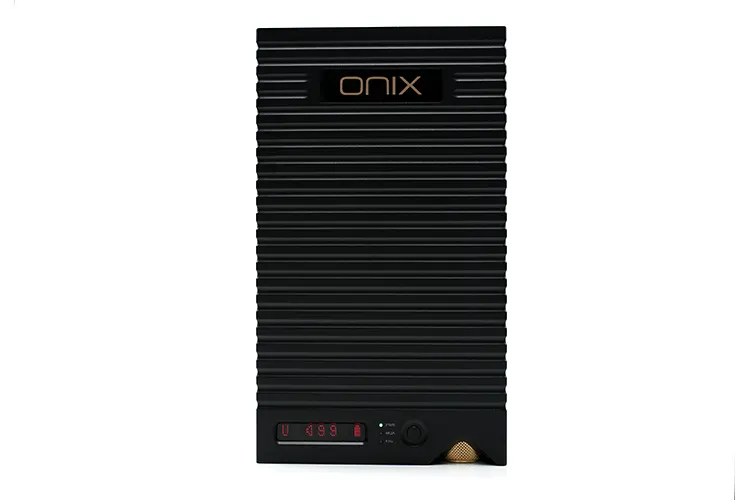
Because the XP1 comes stacked with so many features, it’s no surprise that it’s housed in a bigger and heavier enclosure than the D17 Atheris.
However, the XP1 shell is a little more refined with smoother cornering and slightly better chamfering. The dial guard is cut from the main housing rather than extended beyond, so it feels more integrated.
What it lacks is a sizeable display screen that can convey enough information compared to the bigger version on the D17 Atheris.
It is not the worst in the world, and it has some retro charm, but the viewable space is limited, and the menu is quite linear in navigation, which is ironic given the depth of features the XP1 has.
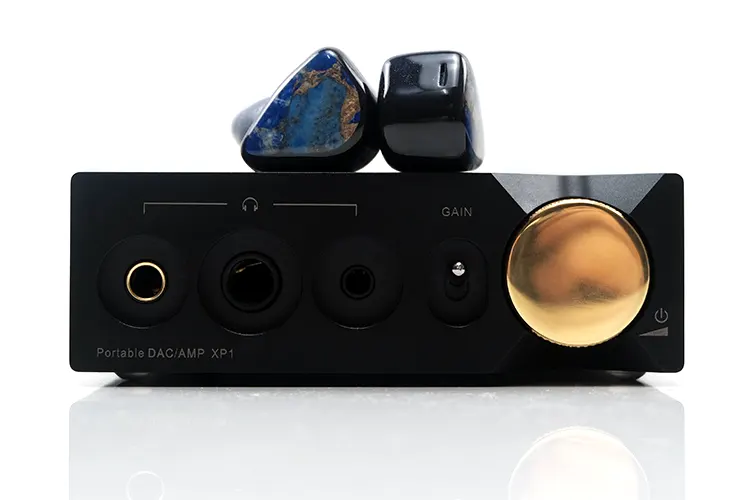
Both have multi-function dials, but unlike the D17 Atheris, the XP1 does not separate the digital from the analog, so it’s just one rather attractive gold laminated dial with plenty of knurling to keep it grippy.
I do like the smaller top panel button on the XP1 for rotating through the input options. On the D17 Atheris, you have to dig into the settings menu to access the same options, which can take a bit longer.
Both devices have 3.5mm/4.4mm PO on the front panel, with the XP1 also offering an additional 6.35mm PO for SE jacks. It also has a mechanical gain lever on the front panel, an option that is accessible via the GUI on the D17 Atheris.
LO options are on the rear panel of the XP1, but only a 4.4mm line out and no SE. It will, however, take a 3.5mm AUX input and, like the D17 Atheris, it separates DAC from charging duties via separate USB-C inputs. Since there is local playback, the XP1 has a microSD card slot near its AC connector.
Performance
Even though the XP1 only has one DAC, the inputs have variable performance, with the local playback sounding the most dynamic. On that basis, I chose to compare the XP1’s battery-powered local playback with the best the D17 Atheris has to offer, the NOS mode (R2R).
With the PLUSSOUND Allegro II, there are a few differences I expected and one I did not. The ‘not’ was the weight and extension on the low-end.
I have always considered the XP1 to be one of the beefiest-sounding portable amps I have in my collection. Ranged against the NOS balanced output of the D17 Atheris, it actually felt somewhat diminished in its sub-bass response. It’s not as rounded or fulsome-sounding as the D17 Atheris equivalent.
Everything else I expected. The solid-state energy and tone from the XP1 are a marked contrast with the smoother, more even-harmonic delivery of the D17 Atheris. The XP1 has more contrast throughout with shorter decay and a slightly more intimate or forward-sounding staging quality.
With the Allegro II, I also heard a slightly reduced level of dynamic range, particularly in the lows and mids. Both amps attenuate slightly on the highs, so neither is bright-sounding.
The XP1 is more towards the darker end of the scale, but can deliver more upper-order harmonic dissonance or a slight sharpness in the upper-mids note quality of the Allegro II compared to the more liquid-like delivery of the D17 Atheris.
Overall, the XP1 is driven, fast-sounding, very solid-state in its tonal quality, with some slight rawness in the upper-mids. The D17 Atheris is slightly more languid, but smoother, deeper, and more refined in the mids and highs.
Chord Electronics Hugo 2
The timeless Chord Electronics Hugo 2 has been on the market since 2017. Chord has seen no reason to update it just yet, such is its legendary future-proof status. It also won our Top Gear 2017 Award for Best Portable DAC/Amp.
Technical
Both devices use discreet-engineered in-house solutions for decoding. The Hugo 2 uses an in-house ‘tap-based FPGA Xilinx Artix 7 chipset with a 10-element Pulse Array design capable of up to PCM 32BIT/768kHz and DSD512 from its coaxial/USB inputs and 24-bit/96kHz from its optical input.
That’s a little bit behind the 32-bit/768kHz and DSD512 decoding performance of the D17 Atheris, but bear in mind the Hugo 2 was launched in 2017 when such rates were very rare.
I have not included the aptX BT capability of the Hugo 2, but it’s there if you want it. For a true wireless experience, its modular compatibility with 2go is preferable, albeit more costly.
They differ a lot in amplification, with the D17 Atheris using dual Korg NuTubes and a Texas Instruments BUF634A buffer amp setup compared to the Hugo 2’s solid-state pure Class A single-ended design.
Neither are massively powerful amplifiers, but in R2R mode, the D17 Atheris has an edge at 1.2W balanced high gain compared to the Hugo 2’s ceiling of 740mW. Bear in mind, the Hugo 2 is single-ended by design, so on a like-for-like it has more power.
One thing to mention on their lineout capability. The Hugo 2 has pre-amp capability with a proper set of dual RCA outputs on the rear panel and variable volume control.
You can go with the LO from the D17 Atheris with up to 7Vrms (balanced), which is a lot livelier than the Hugo 2’s 3Vrms equivalent (single-ended only).
Design
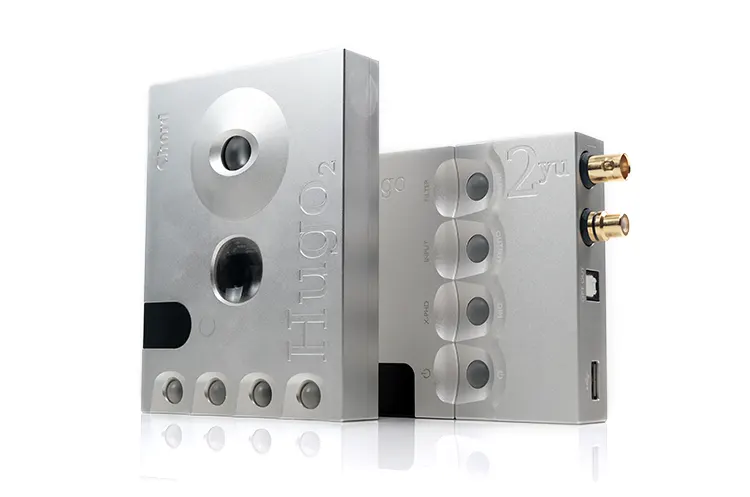
Vastly different design philosophies with the futuristic niche design of the Hugo 2 in stark contrast to the more traditional box and display design of the D17 Atheris.
Both are robust, but the Hugo 2’s refined CNC-machined aluminum body is ‘next level’. There isn’t a sharp corner to be found anywhere, and all orbs rotate very smoothly.
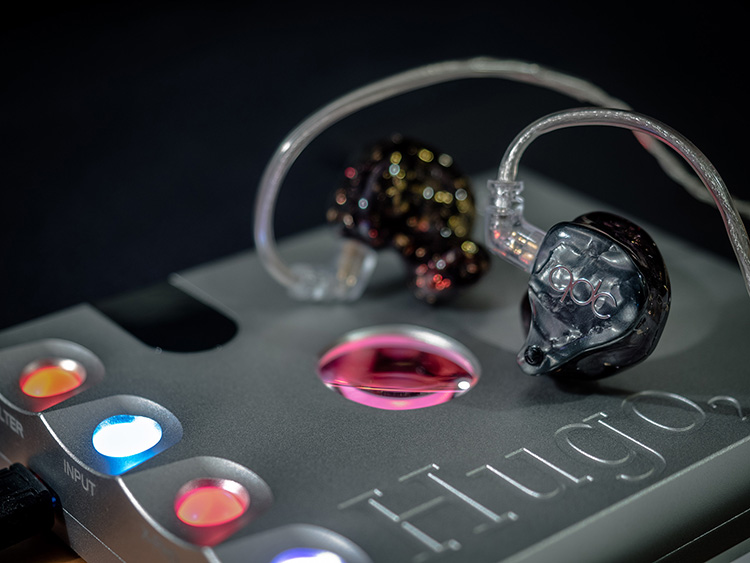
Everyone has their opinion on the Hugo 2 orb control system, but on the Hugo 2, I find it relatively easy to use and remember. It is not as complex as the Hugo M Scaler or the EQ system on the Mojo 2.
However, most will take to the D17 Atheris multi-dial volume and OLED settings menu system quickly. It’s more intuitive for visual confirmation.
I also find the D17 Atheris I/O layout more desktop-friendly. The Hugo 2 orbs are on the cable side, and the headphone outputs are on the reverse side, meaning you connect headphones to the rear panel if you want the controls facing you.
I much prefer the standard controls and PO/LO to the front of the D17 Atheris and the connections to the rear; it just seems more logical.
Chord do SE on principal, so balanced is omitted on purpose. That means no 4.4mm output with dual 3.5mm and a single 6.35mm PO, the order of the day. For modern portable audiophiles, the D17 Atheris’s 4.4mm options are more attractive.
Hi-Fi users will prefer the Hugo 2’s dual RCA and standard TOSLINK connector port on the rear panel. It’s plug-and-go for most component system owners.
Charging the Hugo 2 battery is old-school with Micro USB and an 8-hour charge cycle with a 2A wall charger. You also get about 6-7 hours of playback time on heavy loads compared to 11-14 hours on the D17 Atheris.
Performance
For this comparison, I picked the last of the 3 D17 Atheris DAC modes, the OS mode, and switched to a single-ended output using the Volk Audio ÉTOILE to match the Hugo 2’s 3.5mm PO.
The difference between these two portable DAC/amps is stark rather than nuanced. The Hugo 2 is more linear and reference-like in its presentation, with a very resolving, articulate performance with excellent micro-detail.
The D17 Atheris is far more analog-sounding, richer, and more powerful in the low end, with smoother, more natural mids and a relaxing set of highs.
Of the two, the D17 would get my pick if you need a stronger fundamental. The ÉTOILE has excellent bass from its dynamic driver lows, but it’s not an ‘always on’ experience, so when it is called upon, you need it to hit hard, or the tuning sounds incomplete.
With the Hugo 2, it struggles to deliver that necessary body and sub-bass response that I find enjoyable, something the D17 Atheris delivers with ease.
On the flip side, the Hugo 2 is somewhat wider and airier in the highs, with a slightly stronger vocal presence backed by a punchier, faster mid-bass response. If you have a fast-reference-like BA IEM, it will reveal more of the recording but may not necessarily connect with you on an emotional level.
Again, the OS mode of the D17 Atheris will give you that. It’s a more relaxed macro performer with notes that offer better fundamental frequency levels and a more even-harmonic, richer sound. If you need power and body, the D17 Atheris is the better choice.
My Verdict
The iBasso D17 Atheris is probably the most complete portable DAC and amplifier the company has made to date. Its ‘triple flavor’ DAC modes and tube amplifier sound have an unmistakable smooth analog overtone, with plenty of gorgeous vocal bloom or rich and deep bass performances when required.
iBasso has been crafty by taking some of the best aspects of the D16 Taipan and the PB5 Osprey, then improving, refining, and adding one or two additional excellent ideas into one compact and tidy unit.
The price might have gone up, but the desire to stack and add to the D17 Atheris might have decreased, especially with IEM and tube lovers.
There are some quirks; nothing is perfect. For demanding headphone users, there still might be a need to stack the D17 with a more powerful amplifier, especially if you are switching to the weaker 1-bit DAC mode. The tamer glow of the OLED panel might also polarize some D16 fans.
Overall, the D17 Atheris is a complete listening experience for IEM and for many headphone users, and a solid choice for those who want that old-school resistor sound in a modern package.
iBasso D17 Atheris Technical Specifications
- DAC Design: Dual Discrete DAC (R2R + 1-bit)
- R2R DAC: 284 high-precision film resistors (0.01% tolerance, 25 ppm), fully balanced 4-channel
- 1-bit DAC: 64 PWM DAC units (8 sets of 8E, 4 channels)
- PCM: up to 32bit/768kHz
- DSD : Native DSD64, DSD128, DSD256, DSD512
- Coaxial Input: Up to 32bit/768kHz / DoP256
- Optical Input: Up to 24bit/192kHz / DoP128
4.4mm Balanced PO (R2R Mode)
- Output Power: 1200mW + 1200mW @ 32Ω (THD <1%)
- Output Level: 7Vrms (AMP H Gain + DAC H Gain)
- THD+N: -76dB (tube amplification)
- Dynamic Range: 116dB (AES17-20K A-wt)
- SNR: 116dB (AES17-20K A-wt)
- Crosstalk: -129dB
- Frequency Response: 15Hz–22kHz (-1dB), 15Hz–40kHz (-2.5dB)
- Output Impedance: 1.9Ω
3.5mm Single-Ended PO (R2R Mode)
- Output Level: 2.4Vrms (DAC Low Gain), 4Vrms (DAC High Gain)
- THD+N: -104dB
- Dynamic Range: 126dB (AES17-20K A-wt)
- SNR: 126dB (AES17-20K A-wt)
- Crosstalk: -120dB
- Frequency Response: 15Hz–22kHz (-1dB), 15Hz–40kHz (-2.5dB)
4.4mm Balanced LO (R2R Mode)
- Output Level: 2.4Vrms (DAC Low Gain), 4Vrms (DAC High Gain)
- THD+N: -104dB
- Dynamic Range: 126dB (AES17-20K A-wt)
- SNR: 126dB (AES17-20K A-wt)
- Crosstalk: -120dB
- Frequency Response: 15Hz–22kHz (-1dB), 15Hz–40kHz (-2.5dB)
3.5mm Single-Ended LO (R2R Mode)
- Output Level: 2Vrms (DAC Low Gain), 2.4Vrms (DAC High Gain)
- THD+N: -103dB
- Dynamic Range: 120dB (AES17-20K A-wt)
- SNR: 120dB (AES17-20K A-wt)
- Crosstalk: -100dB
- Frequency Response: 15Hz–22kHz (-1dB), 15Hz–40kHz (-2.5dB)
4.4mm Balanced PO (1-bit Mode)
- Output Power: 340mW + 340mW @ 32Ω (THD <0.5%)
- Output Level: 3.5Vrms (AMP H Gain + DAC H Gain)
- THD+N: -76dB (tube amplification)
- Dynamic Range: 109dB (AES17-20K A-wt)
- SNR: 109dB (AES17-20K A-wt)
- Crosstalk: -123dB
- Frequency Response: 15Hz–22kHz (-1dB), 15Hz–40kHz (-2.5dB)
- Output Impedance: 1.9Ω
3.5mm Single-Ended PO (1-bit Mode)
- Output Power: 87mW + 87mW @ 32Ω (THD <1%)
- Output Level: 1.7Vrms (AMP H Gain + DAC H Gain)
- THD+N: -70dB (tube amplification)
- Dynamic Range: 104dB (AES17-20K A-wt)
- SNR: 104dB (AES17-20K A-wt)
- Crosstalk: -118dB
- Frequency Response: 15Hz–22kHz (-1dB), 15Hz–40kHz (-2.5dB)
- Output Impedance: 1Ω
4.4mm Balanced LO (1-bit Mode)
- Output Level: 2Vrms (DAC Low Gain), 2.4Vrms (DAC High Gain)
- THD+N: -114dB
- Dynamic Range: 118dB (AES17-20K A-wt)
- SNR: 118dB (AES17-20K A-wt)
- Crosstalk: -120dB
- Frequency Response: 15Hz–22kHz (-1dB), 15Hz–40kHz (-2.5dB)
3.5mm Single-Ended LO (1-bit Mode)
- Output Level: 1Vrms (DAC Low Gain), 1.2Vrms (DAC High Gain)
- THD+N: -110dB
- Dynamic Range: 114dB (AES17-20K A-wt)
- SNR: 114dB (AES17-20K A-wt)
- Crosstalk: -100dB
- Frequency Response: 15Hz–22kHz (-1dB), 15Hz–40kHz (-2.5dB)
Input Interface
- USB-C (Data): PCM 768kHz/32bit, DSD512;
- Coaxial: PCM 768kHz/DoP256;
- Optical: PCM 192kHz/DoP128
Output Interface
- 4.4mm balanced PO/LO, 3.5mm single-ended PO/LO
Charging Interface
- USB-C (Charge): 5V/3A, QC3.0 support
- Charging Time: 3 hours Battery Life: 15 hours
Other Parameters
- Size: 145mm x 86.3mm x 31.6mm
- Weight: 470g
