

Synergy
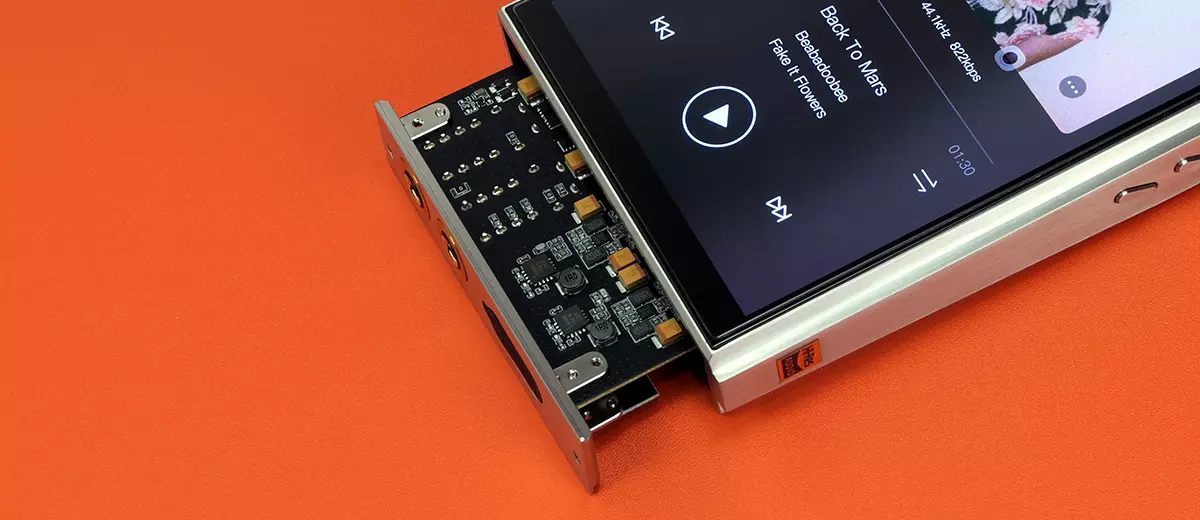
The iBasso AMP17 is specifically designed for gear that works best with high-current and sub-ohm impedance.
Typical target gear should include low-impedance IEMs, but given the headline rates of 1080 mW (battery) and 1900 mW (Dc input) into 32 Ω loads, it should also make AMP17 a good choice for modern planar headphone owners.
IEM Pairings
Because of the fairly neutral tonal quality from AMP17, I did not find any horrible mismatches with my paired IEMs. IEMs included the Noble Audio Shogun, PMG Audio’s Apx, Volk Audio’s ÉTOILE, the Vision Ears VE10, and the custom-made VE PRO.
In all instances, the tonal accuracy of these monitors’ core tuning was retained with nothing sounding overly peaky, lean, or pervasively bright.
What you do get in all of these performances, at least when compared to AMP16 and AMP15, is more vibrancy and aggression in the delivery, particularly for the enhanced response from any dynamic driver covering the lows.
IEMs such as the Apx and ETOILE sounded really authoritative with the AMP17/DX340 pairing, as did the VE PRO; 3 IEMs with solid but well-controlled dynamic driver bass shelves.
I was half expecting Apx to sound a little hard-edged, given the V1 of this IEM has some strong treble, but that did not seem to be the case. What I heard was a deep soundstage, clean highs, and a vibrant midrange presentation.
If you are pairing with the DX340, be mindful of your gain levels. I prefer keeping the DAC gain mode on high, which boosts the bass and vocal presence and typically adds a little more sparkle in the upper-mids and highs.
With the Noble Audio Shogun’s high bass-shelf, I felt high gain overcooked the bass response, dominating the vocal presence, and sounding a shade too aggressive. I would turn off the DAC gain option to produce a smoother sound for longer listening periods.
Headphone Pairings
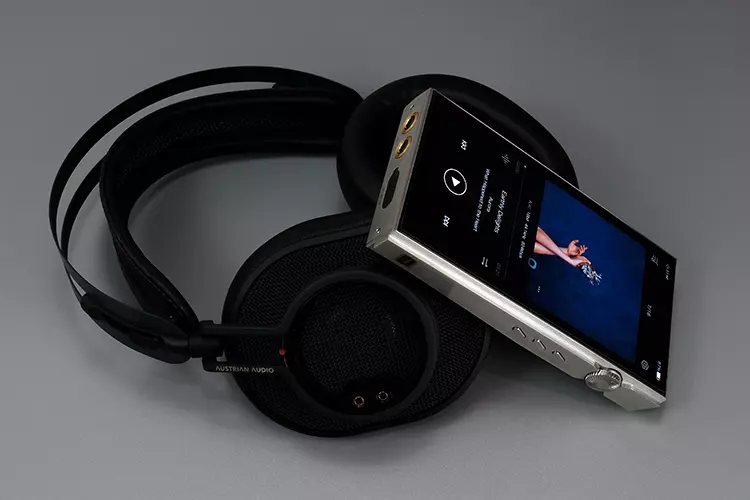
With headphones, you will have to play around with the DX340 (and DX300/DX320) DAC and amplifier gain levels a bit more to get the desired outcome.
With my tested pairings, I found the power and impact very satisfying, and not once did I get a sense I was being shortchanged for dynamic range. Only if you are planning to pair with a Susvara something equally as inefficient would I advise against it.
Desktop amplifiers can perform better, but that has more to do with scaling potential rather than poor performance from AMP17.
With low-impedance dynamic driver headphones such as the Austrian Audio Composer, you do not even need to go into high-gain for the DAC or the amplifier. AMP17 delivers a fulsome low-end that I tend to look for when pairing this headphone with an amplifier.
My only caution is the gain settings. I would keep them off as the forceful, cooler nature of AMP17’s sound can inject a lot of energy into the upper-mids. Keeping both gain options turned off with an H2 harmonic filter (natural sound) provided the best balance between power and tonal balance.
Going planar, however, I would keep both gain levels on high. The Audeze LCD-4z and Dan Clark Audio’s NOIRE XO sounded excellent with AMP17/DX340. In particular, the more relaxed mids of the LCD-4z get an ice lift from AMP17’s DAC high-gain setting, helping to tease out some satisfying vocal presence.
Camerton’s Binom-ER sounded horrible with standard rock and thrash metal with AMP17/DX340. The bass overwhelms the lower-mids and Hetfield’s vocals way too much. However, with pop and dance and upper-register vocals, it cleans its act up beautifully with a nice bass/upper-mids balance.

Selected Comparisons
The following comparisons to the iBasso AMP17 were completed using the DX340 and a mix of the PMG Audio Apx and the Vision Ears VE10.
iBasso AMP15
The iBasso AMP15 is the stock amplification card of the DX340, so both were launched at the same time last year. The DX340 also won our 2025 Top Gear Award for Best DAP.
Technical
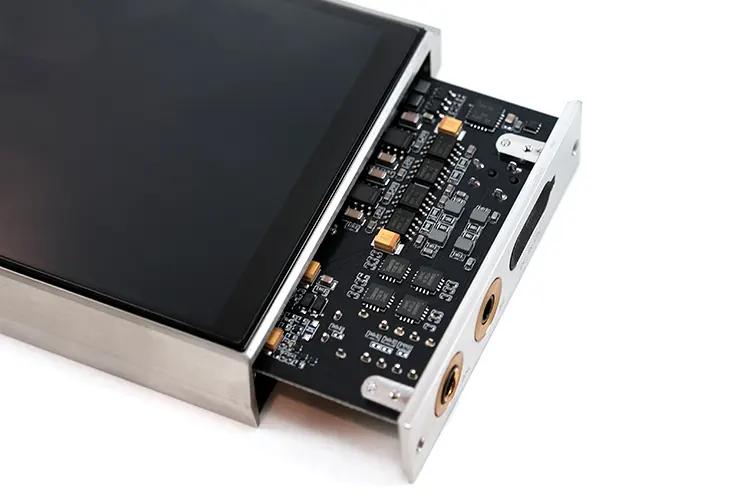
AMP15 is a balanced amplification card, but unlike AMP17, it can output single-ended with a dual LO/PO 3.5mmoutput. Unlike AMP17, AMP15 has no dedicated 4.4mm balanced line-out. Its 4.4mm socket is also dual-functional for PO and LO.
Inside the AMP15 are 8 TI BUF634 op-amps, delivering up to 1200 mW balanced and 312 mW single-ended into a 32 Ω load, using the DX340’s dedicated amplification battery power supply. Like the AMP17 card, AMP15 has a DC 12V input socket that will increase the voltage headroom.
AMP15 has a little more headroom than AMP17, with a maximum output power rating of 2150mW balanced on a 32Ω load compared to AMP17’s 1030 mW (battery) and 1900 mW (DC-powered) on the same 32Ω load.
Performance
AMP17 is the more aggressive performer of the two cards, especially at lower volume levels with sensitive gear. Using the Apx and VE10, there was at least a 4-5 dB gap in volume matching with AMP15 sounding the quieter or more ‘tranquil’ of the two cards.
When I mention aggressive, I mean vibrant and dynamic, with a more immersive staging quality and a significantly more noticeable fundamental frequency presence in lower-register notes compared to AMP15.
AMP17 thus hits with authority on the lows, vocals have enhanced gravitas and perceived body, and the surrounding instruments benefit from improved layering with a hint of aggression in note attacks.
I hear AMP15 as the gentler of the two cards with a more linear, neutral tuning with the same two IEMs. I find it spacious and ethereal with a nice weight and punch to the lows, but it’s missing the body and power of AMP17’s sub-bass performance when recordings need it.
Instruments have excellent levels of micro-detail from AMP15, but they do not leap out in quite the same manner or display the same level of dynamic range as the AMP17 pairings. For want of a better word, AMP15 lacks AMP17’s explosive performance.

iBasso AMP16
The iBasso AMP16 was launched in early 2025, not long after the AMP15 and the DX340 were released.
Technical
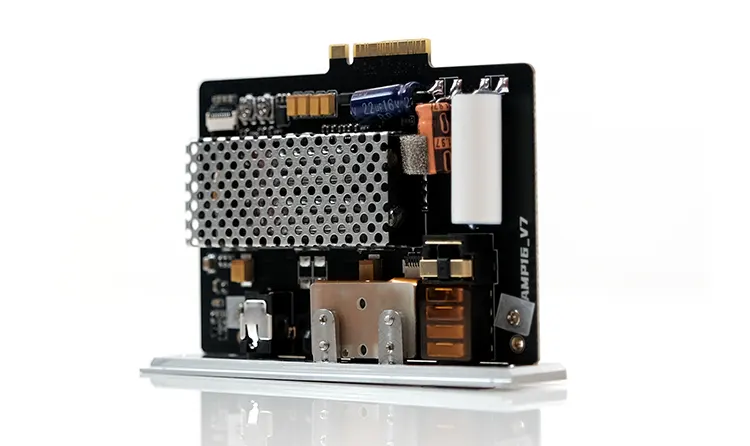
AMP16 is a balanced, engineered hybrid tube-and-transistor amplifier card. It consists of a dual Raytheon JAN6418 tube with a 22.5V anode power supply on the tube side, 4 TI dual opamps, and 4 BUF634A on the transistor side.
The hybrid setup also means the user can choose between two modes via the DX340’s GUI: Tube and Class AB (transistor). It also offers 4.4mm balanced and 3.5mm single-ended output.
Each mode will deliver a different output power level, with Tube mode capable of up to 660mW balanced on a 32Ω load from the DX340’s battery. Class AB mode will provide up to 1W at the same load and battery, which is closer to AMP17’s balanced output when powered by the DX340’s battery.
AMP16 has the same DC12V input as AMP17, enhancing the voltage performance and output headroom from 1W to 2W in Class AB mode, but Tube mode via DC is lower than AMP17’s balanced output at 1.5W.
Performance
There are more definite tonal differences between AMP16 and AMP17 than with the AMP15 comparison.
AMP17 is cooler in tone, though still quite vibrant and exciting-sounding. I would not describe AMP17 as reference-like neutral, but it’s not as smooth and sweet-sounding as AMP16 in tube mode.
AMP16 in Class AB mode is closer in tone, but it lacks the low-end presence and power of AMP17 as well as the dynamic range level on more explosive tracks.
Thus, both cards are precise-sounding, quick in pace, and clean in tone, but it’s the additional body and vibrancy that make the difference between AMP16 Class AB and AMP17.
Tube Mode is why anyone would buy AMP16 in the first place, and to that end, it is the logical complementary card to AMP17.
I do not consider it to be expansive in its presentation or quite as finely layered as AMP17. However, its smooth, analog coloration, airier staging over AB, and improved vocal body over AMP15 make it different enough from AMP17 to sit happily beside it.
I would go with AMP17 if I wanted more low-end definition, more crunch in my rhythm guitars, a better sense of speed, and a more immersive soundstage.
Some might find the result more fatiguing with brighter IEMs compared to AMP16’s smoother tube mode, but AMP17 can be just as musical in its own way and more revealing to boot.
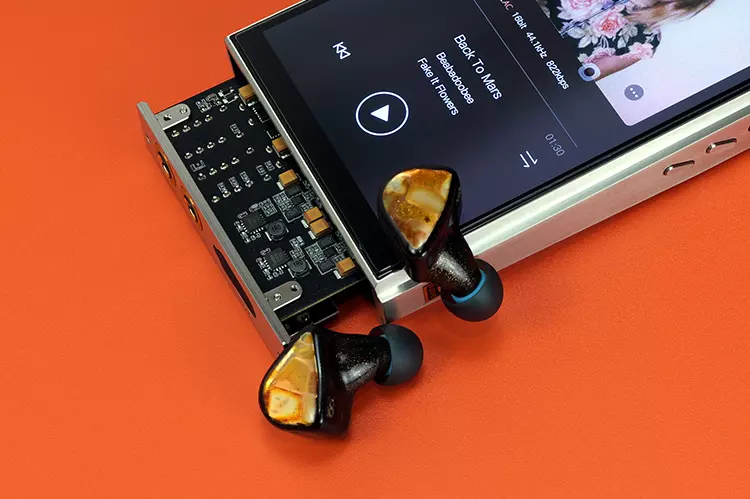
My Verdict
Crudely speaking, the iBasso AMP17 is kind of like AMP15 on steroids. It retains the technical prowess and clean tonal quality of the stock DX340 amplification card but replaces the balanced presentation with more aggression, slam, and impact. It’s a lively, immersive performer.
You could argue it’s a more ‘musical’ performance, or at least make previously forgettable recordings sound more interesting with a degree of vitality and gravitas I didn’t hear from AMP15 or AMP16.
Just watch your gain levels with L-shaped or darker-sounding gear, as it can overwhelm your bass-heavy gear. This is not a ‘get out of jail card’ for every pairing out there unless you open up the DX340 PEQ.
Moving forward, I am finally swapping AMP15 for AMP17 inside the DX340. iBasso has always excelled at delivering clean, resolving, solid-state sound, but the additional depth and power from AMP17 seals it for me.
iBasso AMP17 Technical Specifications
4.4mm Balanced PO Output
- THD+N 116dB (No load) -110dB (600 ohms load)
- Dynamic Range: 120dB
- SNR: 122dB
- Crosstalk: -117dB
- Frequency Response: 10Hz-40kHz (+/- 0.5dB)
- Output Impedance: 1.1 ohms
- Output Power: 1030mW + 1030mW@32 ohms (Battery powered)
- Output Power: 1900mW + 1900mW@32 ohms (12V DC Power supply)
4.4mm Balanced LO Output
- THD+N: -116 (No load)
- Dynamic Range: 126dB
- SNR: 123dB
- Crosstalk: -97dB
- Output Level
- 1.6Vrms (Low gain)
- 2.6Vrms (Mid gain)
- 3Vrms (High gain)
