


Marcelo reviews the Hidizs x Linsoul AP80 PRO MAX, a new compact and affordable digital audio player developed in partnership with Linsoul. It is priced from $139.00 on Kickstarter.
Disclaimer: This sample was sent to me in exchange for my honest opinion. Headfonics is an independent website with no affiliate links or status. I thank Hidizs and Linsoul for their support.
Click here to read more about Hidizs products we have previously reviewed on Headfonics
Please note that this article follows our current scoring guidelines, which you can read in more detail here.

Hidizs became one of my favorite audio brands after I listened to and owned the lovely-sounding planar IEM, the MP145. It was then followed by the Hidizs S9 Pro Plus Martha dongle DAC amplifier, which boasts an open and transparent sound.
Ever since then, I’ve also been mesmerized by the looks of Hidizs DAPs, including the Hidizs AP80, AP80 Pro-X, and especially the AP80 Pro-X Red Copper Edition.
However, I never got around to buying one, as I was always looking for an Android-based DAP so that I could install my favorite audio player.
The AP80 PRO MAX is a collaboration between HIDIZS and Linsoul. Linsoul is one of the largest online audio stores, selling IEMs, headphone amplifiers, and a wide range of other products.
I got excited when I knew I was going to review the Hidizs AP80 PRO MAX, as I like the asymmetrical and faceted design, especially with the leather case.
However, looks and sound are two different things, and based on the disappointment I felt with the sound quality on several sub-$300 DAPs that I’ve heard, I was anxious that the AP80 PRO MAX could also be a disappointment.
Will the AP80 PRO MAX disappoint me in terms of sound quality as a sub-$300 DAP? Or how will it compare to other DAPs such as the Shanling M3 Plus and the HiBy R3Pro II? Find out in my review below.

Features
The AP80 PRO MAX is a feature-rich DAP for its small size. It uses a Linux-based Hiby operating system, Hiby OS, which is one of the best operating systems that I have tried in non-Android-based DAPs.
It features a full-metal chassis and utilizes Ingenic 1600E SOC processors, which are fast when used in a DAP. The DAC chip used is the ESS SABRE ES9219C x 2, which I heard on other devices and liked the sound of.
It also supports up to 2TB of MicroSD card capacity, allowing for direct music playback from local files. Additionally, it can stream music over a 2.4GHz WiFi connection via Tidal and Qobuz.
The AP80 PRO MAX can also be configured as a digital source for an external DAC amplifier and as a DAC amplifier for digital sources, such as phones, laptops, and PCs, via the USB-C connection.
AP80 PRO MAX is highly versatile in its use, as it can also function as a Bluetooth 5.1 audio transmitter or receiver. It can be connected to a DLNA and AirPlay WiFi network, and also allows wireless music transfers via the WiFi connection.
The 3.5mm output is 75mW at 32Ω, and the 4.4mm output is 125mW at 32Ω. The Dimensions are 82.8*51*15.5mm, and it weighs 81g.
Designs
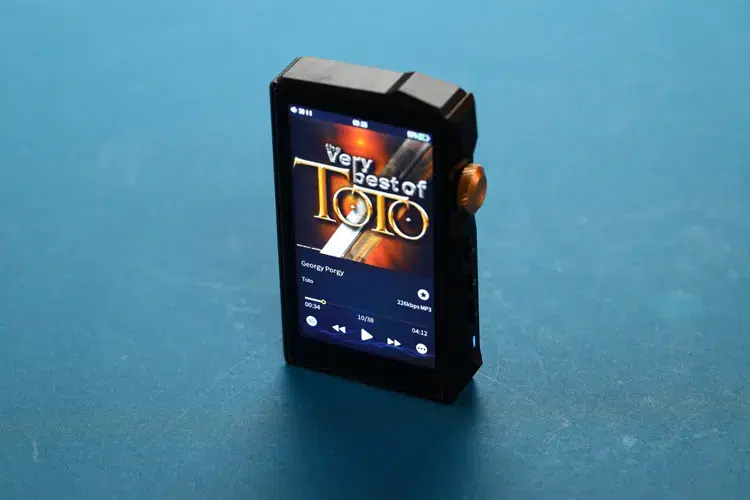
The AP80 PRO MAX appears smaller in real life than it does in photos. I especially like its tempered glass and screen, sandwiched within a full-metal chassis with an asymmetrical, faceted industrial and sci-fi-looking design, as well as the gold knob on the right side.
My review sample came in color black; however, AP80 PRO MAX is also available in silver and blue.
The left side and back are plane, but the top and right side feature a faceted design, as do the knob and three control buttons. The bottom is where the USB-C, 3.5mm, and 4.4mm output jacks are located.
It’s a mini-sized DAP with a dimension of 82.8*51*15.5mm and a weight of 81g. It is very pocketable and nice for daily use; it feels very nice in the hands.
The 2.95 (360×640) IPS HD Touchscreen is one of the best-looking screens I’ve used for a small DAP, as it has above-average contrast, viewing angle, color, and brightness. The screen looks crisp, and the touch control is smooth and responsive.

I/O
All the I/Os are located at the bottom of the AP80 PRO MAX, consisting of a USB-C port, a 3.5mm output jack, and a 4.4mm output jack.
The USB-C port serves as both an input and output data port, as well as a charging port. There is no support for UAC 1.0 USB mode; therefore, the AP80 PRO MAX is not compatible with gaming consoles and old devices.
The 3.5mm output jack can switch between headphone output and line-level output for use with other headphone amplifiers, while the 4.4mm output serves as the balanced output.

Controls
All the AP80 PRO MAX controls are located on the right side. I especially like the inclusion of the gold knob, which serves as the volume control and the power switch.
There are three buttons below the know, which are the skip/fast forward, play/pause, and the skip/fast backward buttons.
All buttons work with both the local music player and the Hiby music player app, as well as the PowerAmp music player app, when connected via Bluetooth.
With the Bluetooth connection, the forward and backward buttons function only as skip buttons, rather than as fast forward and backward buttons.
With the local music player, those buttons also function as a play/pause and fast-forward button; however, when I long-press the back button to make the music play faster backward, to repeat a portion of a song, the music plays forward instead of backward.
I hope a firmware update can resolve this issue. I’m currently using firmware version 1.0.
Battery Life
I can vouch for Hidizs’ claim of 8 to 10 hours and 10 -12 hours of battery life for the AP80 PRO MAX, as I have observed similar times during the course of the burn-in period.
However, the actual charging times from zero to 100 percent battery are about one and a half hours, instead of the 1-hour claim by Hidizs.
I’m using a 60W Supre Vooc and PD charger as well as a 20W PD phone charger. The temperature while charging is only mildly warm.

Packaging & Accessories
The packaging features a small, grey hard box with a photo of the AP80 PRO MAX on top and text all around.
It includes the DAP with screen protectors already installed on the front and back, user manuals, a greeting card, two screen protectors, a 10cm USB-C to USB-C cable, and a 1-meter-long USB-A to USB-C cable.
The leather protective case arrived in a separate box and is available separately. The design looks good when used with the AP80 PRO MAX and does not interfere with its normal use, as it does not cover any of the buttons.
The green leather case is not included with the AP80 PRO MAX; it arrived in a separate package and is available for purchase separately. This is one of those DAPs that look nicer with its protective case on than off.

Software Impressions
The AP80 PRO MAX does not have an open Android operating system, which means we are limited to the default music players and streaming services.
However, the HiBy OS with the new UI works well with the X1600E processor, resulting in boot-up times of less than 9 seconds, which is significantly faster than those of an Android-based system, which usually takes about 30 seconds to boot up.
My review sample arrived with a firmware version 1.0 and the new user interface. It includes the HiBy proprietary sound adjustment feature called MSEB, a graphic equalizer, gain control, filter selection, and soundfield control feature, among others.
However, only two filters are available: the fast and apodizing fast roll-off filters, with no inclusion of a Non-oversampling filter.
Overall, it is a well-designed and featured operating system, and I never experienced any unusual lag or freezing.
Navigation
Navigating through the HiBy OS is intuitive and easy. There are not many pages to go around.
The AP80 PRO MAX is responsive to operate; it lags slightly in response when scanning in music mixes that are an hour long, but for normal-length music, it is fast. I also like the customizable drop-down shortcut menu.

Third-Party Music Players
The AP80 PRO MAX utilizes a proprietary operating system, which means that installing a third-party music player app is unfortunately not possible. This is the main downside of non-Android DAPs.
Streaming Apps
Tidal and Qobuz streaming apps are built in. Unfortunately, neither is available in my country, the Philippines. Due to its non-open Android operating system, I am unable to add my favorite music streaming apps, such as YouTube Music and Spotify, among others.

Sound Impressions
I spent more than 30 hours letting the AP80 PRO MAX play to burn in and test the battery life and charging time before conducting a serious listening session with it using my Hidizs MK10, QoA Martini, Tipsy M5, and Kiwi Ears Astral IEMs, as well as the Sennheiser HD 6xx and MOONDROP Horizon headphones.
I didn’t use EQ, MSEB, sound field, or any other features that enhance the sound.
Summary
There is always something I wish were improved regarding the sound of sub-$300 DAPs, mostly the perceived lack of resolution, transparency, and warm or cold coloration, as well as the occasional veil in the treble and lack of bass impact.
I’m pleased to report that the Hidizs AP80 PRO MAX does not introduce an obvious warmth to the sound, and the treble remains clear.
When I listen to the AP80 PRO MAX, I’m greeted with a neutral tonality characterized by a flat perceived frequency response and a transparent sound without obvious colorations, with an above-average soundstage size.
The bass is neutral with a small amount of added boominess in the sound; it goes deep and rumbly without losing too much control. There are acceptable details and articulation in the sound.
Lower midrange is clear and tight; there is no artificial warmth or bloom. It sounds colorless yet not clinical, as the overall sound is never thin or light in note weight; the vocals never lack body.
The Upper midrange is flat and neutral as well; there is no extra energy or accentuation, and it’s very transparent, with good vocal and instrument presence.
The treble is clear and transparent, allowing the micro details to be heard. There is a nice sparkle and shimmer in the sound, as well as air, due to the extended upper treble.
Timbre
The AP80 PRO MAX is one of the least colored-sounding digital sources I’ve heard, yet it doesn’t sound clinical or cold; it has a natural, neutral tonality and timbre, with fast transients and clean decay. There is no hardness or sharpness in the sound; it sounds transparent.
However, if I were held at gunpoint about what I can criticize in the sound, it is that the bass slightly lacks tightness and grip, which makes it somewhat boomy-sounding.
I wish there were more control over the bass and that it sounded tighter, but it remains neutral, nonetheless.

Staging & Dynamics
The AP80 PRO MAX’s soundstage is large, although not as expansive as those of DAPs costing multiple thousands of dollars.
However, among its peers in the price range, it is above average. This is due to its flat perceived frequency response and transparent sound presentation, which I associate with a well-implemented ESS Sabre DAC chip.
There is a sense of spaciousness and air, making the sound seem wide open with a broad spread of instrument placement from the extreme left to the extreme right.
Due to the AP80 PRO MAX’s clean sound, there is also good perceived depth in the sound, as well as front-to-back instrument placement.
There is also a good height in the soundstage, making me feel like I’m in front of a big event. The AP80 PRO MAX’s sound staging performance is good.
Imaging is good as well. Images have defined and stable extreme lateral panning and separation, as well as front-to-back instrument and vocal layering. Depending on the IEMs or Headphones being used, I experience a nicely holographic sound.
The AP80 PRO MAX offers a reasonably energetic sound presentation, from the lowest bass to the highest treble, despite its moderate power output rating. It sounds lively and musically engaging, with no dullness in the sound.
Click on page 2 below for my recommended pairings, wireless performance, and comparisons.
