

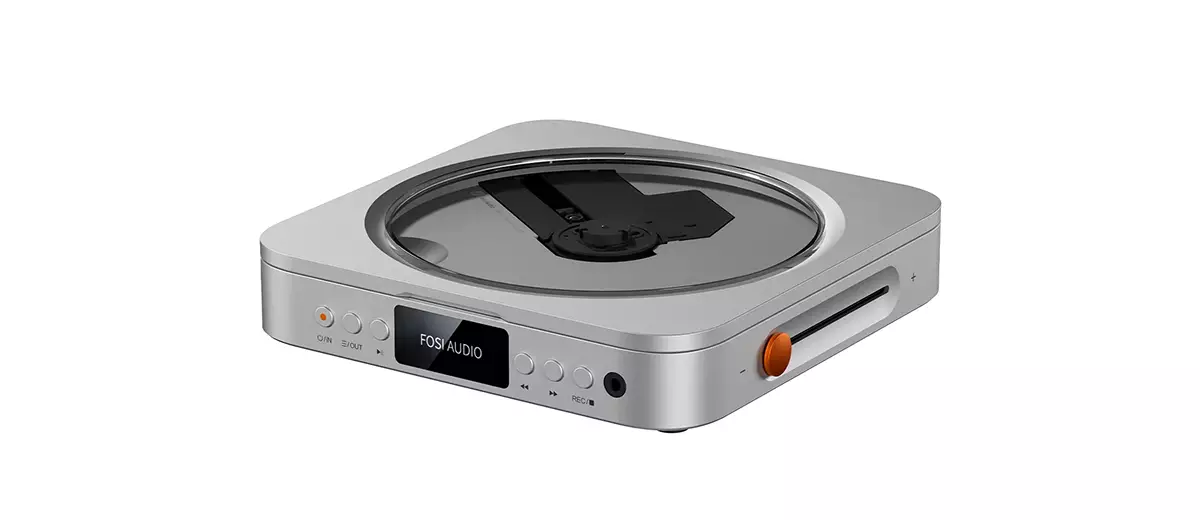
Wired Connectivity
Optical
Bypassing the internal DAC, the optical connection is pure digital. Having a powered speaker such as the Edifier M90 proved its worth as my favored setup. You must provide your own optical cable, though.
Line-Out
Volume is again maximized when using the line-out, and the internal DAC is bypassed. Connecting to powered speakers such as the FiiO SP5, though, makes it a seamless interaction.
You can also go from line-out to a dual RCA, such as on the Fosi Audio BT20A MAX, or a complete desktop amplifier (or two-channel amp).
Just know that this will most likely limit the audio quality versus straight line-out, especially when using multiple two-channel components such as a power amplifier and pre-amplifier.
3.5mm Headphone Port
Providing up to 210mW provides adequate power for most IEMs and headphones, but will not present the best listening options, to me. I did enjoy the Grell OAE2 headphones in this manner, along with some older Sony MDR-Z7 1st generation.
Both were powered adequately, and I did appreciate the inclusion of a headphone port. But I lamented the lack of a 4.4mm Pentaconn balanced option.
Synergy
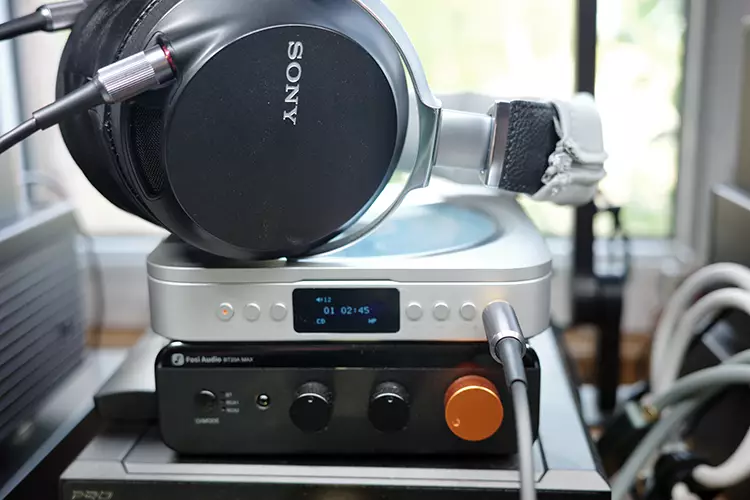
The versatility of the Merak allowed headphones, a desktop amplifier, and powered speakers to function smoothly, and often be hooked up at the same time. I cannot really say I had a favorite, but I did have a preferred setup, which saw the majority of listening time.
The Edifier M90 powered speakers include an optical input, which quickly became my go-to desktop option, along with running the line-out into the Fosi Audio BT20A MAX for use with the KEF Q150 speakers.
Having the ability to switch paid dividends, providing a different sound quickly across both options.
Switching to headphones proved the versatility yet again of the Merak, with the ability to drive headphones comfortably up to 300Ω.
The Grell OAE2 and Sony’s MDR-Z7 1st generation headphones provided a good look into both the open-back and closed-back headphone world.
The Grell sounded a bit thin, but their sound signature leans towards clarity-driven analytics. Combined with the “typical” CD sound signature, the duo worked well for genres oriented towards accuracy and detail.
The Sony headphones, on the other hand, lent a warm, richer tonality to the equation while providing a more personal listening experience due to the closed-back nature.
The Merak’s clear and crisp signature presented excellent clarity, offsetting the somewhat bloated upper bass/lower midrange frequencies of the MDR-Z7.
Selected Comparisons
SMSL PL100PRO
Features
The PL100PRO uses 32-bit dual Cirrus Logic CS43131 DAC chips, with 110dB SNR for better channel separation. The Fosi Audio Merak uses the same Cirrus Logic CS43131 and Texas Instruments TPA6120 amplifier.
The PL100PRO also comes equipped with an automotive-grade suction-type motor mechanism. It features a slot-loading CD drive that purportedly offers stable, reliable, and consistent CD reading and playback. The Merak uses a top-loading magnetically led lid.
Due to the automotive-grade motor mechanism, the SMSL PL100PRO can be placed in either horizontal or vertical positioning and can be added to a car stereo audio system, too. The Merak is a true desktop CD player, albeit one with a minimal footprint.
The SMSL PL100PRO features balanced audio circuitry with a 4.4mm balanced headphone output and XLR balanced line-out ports. The Merak utilizes a 3.5mm single-ended headphone port and a line-out port, among others.
The balanced headphone output has a rated output power of up to 200mW per channel, for use with most IEMs and headphones that do not need much juice to run. This is also more powerful than Merak, but it was never lacking in power for either headphone use.
The XLR balanced line-out allows for easy pairing with high-end amplifiers, such as the SMSL PA-X Gallium Nitride I previously reviewed. The Merak melded seamlessly with the Fosi Audio BT20A MAX desktop amplifier.
Coaxial and optical output ports can act as a source for other high-end DACs you may add to the chain. Using the Merak in such a situation can be done with either the line-out or the optical out.
Both have individual volume control for use with headphones.
Design
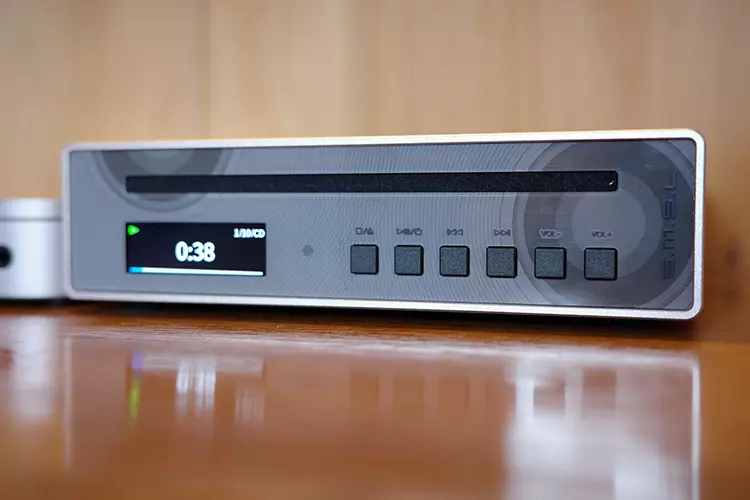
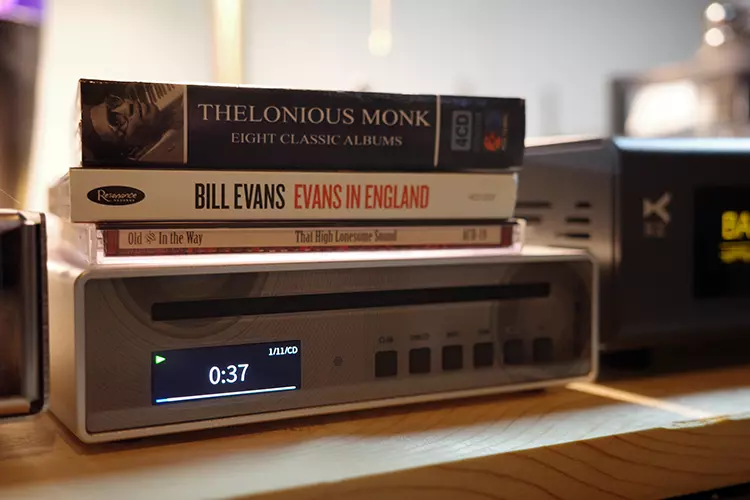
Similar in size to what you might have found in an early-90s car CD player, the SMSL PL100PRO can be placed either in horizontal or vertical mode as space limitations require. The looks could easily make for insertion into an old PC tower, too.
The SMSL PL100PRO comes in either a black or silver aluminum shell, and the same glass IPS LCD screen and accenting.
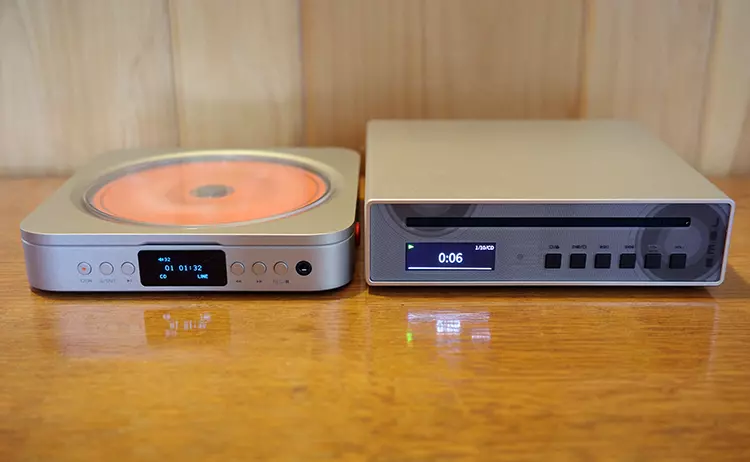
The fairly diminutive size (160 x 44.5 x 160mm (W x H x D)) adds to the versatility, as does the weight of just under 2.5lbs. The Merak has not only a smaller footprint, but is lighter, too. It also has a more modern look to me.
The front is dominated by the slot ingress/egress on the top of the screen, while the LCD screen and control switches cover the bottom. Even in desktop mode, the black lettering of the controls is very hard to see. The remote is a must-use tool.
Both have “screens” that are nearly impossible to use unless you are in a desktop situation. But, if we recall the days gone by of the Sony Walkman, it really is not a big deal.
The rounded corners are a nice break from the traditional box, but the large “targets” have drawn polarizing responses. The Merak is slim-line in looks and feel, making for as much of a minimalistic style as the SMSL.
The back gives plenty of space for all the potential input and output connections, but the lettering is also hard to see. Those connections are easily differentiated, though.
Also, with headphone ports on the back, the use of headphones is less than ideal. The Merak is easier to read on the back but also has fewer options.
Performance
When I used the PL100PRO through its internal DAC with the Grell Audio OAE2, the PL100PRO delivered a fairly clean, neutral, and well-balanced sound signature.
The tonal presentation leaned toward accuracy rather than coloration, but there was no hiding the almost artificial neutrality to it. The Merak, on the other hand, promoted accuracy with a richness to it that shied away from the artificiality of the SMSL.
The bass, when present, accommodated whatever the source music was. The “typical” CD sound of clean articulation certainly came through along with tight, controlled bass. The Merak presented a bit more grunt down low.
The attack is quick and sharp, while the slight delay of decay gives a solid amount of bass weight, if unspectacular. The timbre of the Merak comes across with a more natural sound, flowing with a somewhat vinyl touch, but with plenty of detail retrieval.
Sometimes CDs can artificially add to the top end, becoming grating or harsh. The SMSL balances the line of expressing the extension without too much thinning of notes or becoming shrill.
The soundstage matches what one might expect from a CD player, that is, to promote good three-dimensionality without enhancing any of the three. The soundstage depth on the Merak is the only dimension lacking over the SMSL.
The biggest difference to me, other than the differing sound signatures, is that the Merak supports gapless playback, while the SMSL does not. That is a dealbreaker.
My Verdict
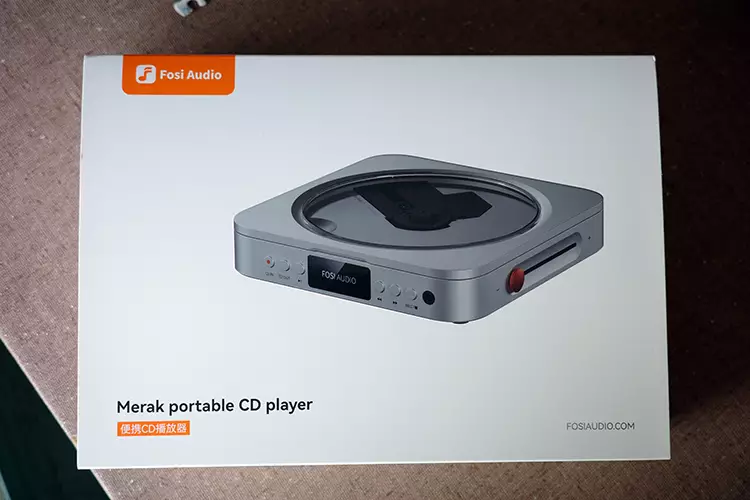
The Fosi Audio Merak is a thoroughly competent CD player for either desktop use or with headphones.
In fact, the Merak has all but replaced another unit that I use as my “affordable” model; it is that good. And, on another note, I recommended it to a well-known vinyl-loving friend, who is thoroughly satisfied with it for his office desktop system.
Such are the qualities of the Merak that it could very well be the unit to beat in this segment. Gapless playback, quality sound that promotes enough of the typical CD sound while also rendering a smooth, organic, natural sound without losing clarity, makes for a complete package.
If I had to nitpick, it would be, yet again, the small screen, which is only usable in desktop situations. And some complain about the magnetic grip of the lid. I do not, though.
The Fosi Audio Merak is easy to use, comes with optical that can feed into a desktop amplifier if equipped or powered speakers without issue, and presents a rich, accurate sound without the artificiality normally associated with “affordable” CD players.
Add in gapless playback, and the only thing lacking might be XLR outputs. But due to the diminutive size, that is not really missed, keeping the aesthetics as they are.
Fosi Audio Merak Technical Specifications
- Chipsets: SC6137D / CS43131 / TPA6120.
- Max Sampling Rate: CD: PCM 16-bit 96kHz / USB: PCM 16-bit 96kHz.
- Headphone impedance: 16 – 300Ω
- Inputs: USB-A flash drives and CD.
- Outputs: 3.5mm headphone jack, Line-out, Optical, 12V trigger.
- CD formats: CDDA, CD-R / CD-RW (partially readable). Original pressed discs recommended.
- CD-R formats: FLAC / WAV / WMA / AAC / MP3
- SACD playback: Only SACDs with a CD layer are supported.
- Formats for USB drive playback: MP3 / WAV / FLAC / AAC / APE / WMA.
- IR remote control: Up to 7 meters.
