

Sound Impressions
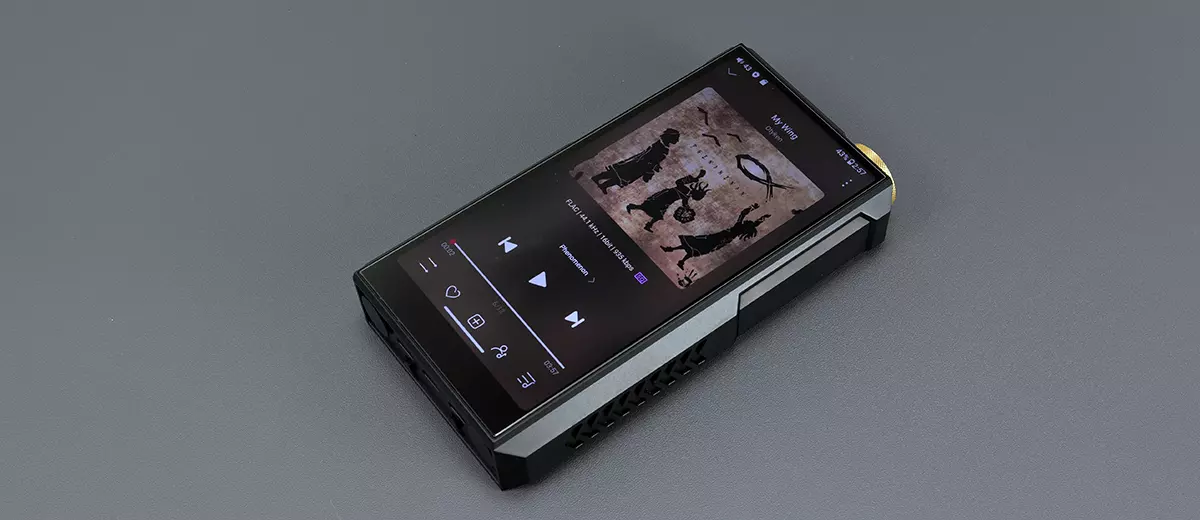
The following sound impressions of the FiiO M27 were completed using a mix of the PMG Audio Apx, the Vision Ears VE10, Volk Audio ÉTOILE, and the Austrian Audio The Composer.
Summary
The M27 sounds far more open and holographic compared to the M17, more reference-like in pairing performances, with improved note definition and a shade more contrast.
That combination of balance, space, and clarity makes micro-detail so much easier to pick up in recordings with quality gear that have an exacting presentation, such as the Apx and The Composer.
Not that the M17 sounds compressed when compared to the M27. Rather, it sounds slightly less balanced and softer, especially through the mids and highs, which struggle more to be heard above the low-end response on bass-heavy recordings.
I find the M17 staging dimensions can often emphasize the mid-bass and lower-mids. I heard more bloom, with narrower mids and tapered highs compared to the M27’s tighter, more linear bass control, wider mids, and airier highs. It just sounds more balanced across the entire frequency response.
More so with the “All-to-DSD” response, which I will get into more detail below. If you want the M27 to soar in terms of staging expanse and holography, the higher upsampling rates are the way to go.
This is still quite a clean, reference-like sound signature. FiiO had not suddenly gone all romantic with the M27 tuning.
However, it’s not a dry sound, with plenty of energy and drive, and a nice harmonic balance keeping the mids and highs from sounding too stark or hard-edged.
The only time I felt the M27 came up short was the synergy between the HIFIMAN Susvara OG, where the upper-mids felt a little peaky relative to some warmer, richer amps I like to normally pair it with.
Otherwise, the combination of power, dynamic range, and clarity are excellent for darker gear such as the ABYSS JOAL and the Audeze LCD-4z, headphones that I normally keep away from DAPs.
Improved All-To-DSD
If you do not mind draining the M27’s battery a little faster, All-To-DSD can similarly enhance recordings as the M17’s version. However, this time, you have additional layers or granular control from DSD64 (the M17 limit) to DSD128 and DSD256.
Each stage will flavor the sound with DSD64, perhaps sounding the densest and smoothest of the three options with my PMG Audio Apx test IEM, but not the most expansive. It’s a good choice if you want to retain a fairly natural, almost analog overtone in your recording.
It’s not as expansive or holographic as the other DSD sample rates, but it’s more forgiving in the upper-mids and highs of brighter gear compared with All-To-DSD turned off.
The DSD256 sample rate has an even more treble extension and air, with an almost ethereal ambiance to its presentation. It’s far more holographic than DSD64 or the stock sound, pushing out spatial cues wide and deep.
DSD128 is my preferred setting out of the three options. I can use this with richer IEMs such as the VE10 to retain space between the mids and bass response, but still get a nice kick out of the lows, which sounds more vibrant to my ear than the stock sound.
Its staging is more expansive than DSD64, giving it a very natural, spacious sound with excellent depth and power, and slightly less battery drain than DSD256.
Synergy
Digital Output Performance
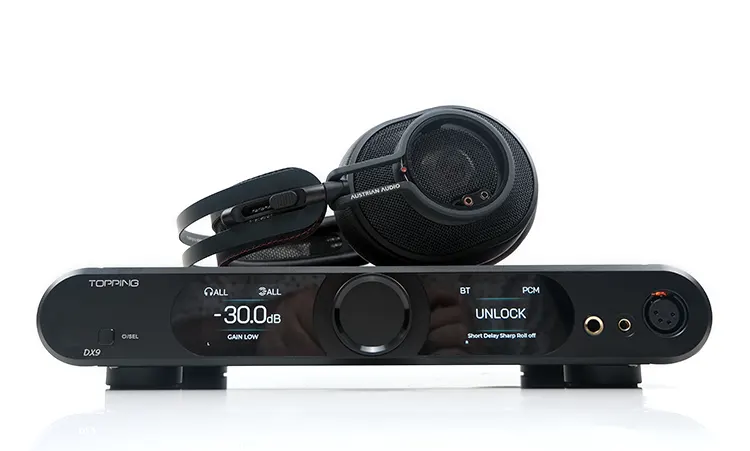
I tested the coaxial, optical, and USB output on the M27 via the Topping DX9 Discrete and came away with some distinct preferences.
The first is that I prefer the coaxial output the most out of the three connections. It provides the most reference, or linear performance, with an excellent harmonic balance throughout.
However, it’s not as vibrant as the USB output, which is more dynamic-sounding and possibly more resolving in its imaging and placement performance.
My reasoning for not placing the USB output above the coaxial is the harmonic balance. I felt it sounded slightly sharper on some higher-register notes, such as female vocal sibilance and some percussion attacks.
The coaxial performance sounded calmer with headphones that can put a spotlight on harmonic dissonance, such as the DCA NOIRE XO and the Austrian Audio Composer.
The optical performance was very smooth but also very relaxed in its delivery. However, the soundstage was reduced in terms of immersion compared to USB and coaxial, moving from a holographic presentation to a more frontal presentation akin to a nearfield 2-channel speaker setup.
It sounds pleasing tonally and great for brighter gear, but its technical capability is not on par with coaxial or USB.
One final, small observation. USB connections take priority over coaxial and optical. You need to disconnect the USB first before using the coaxial and optical outputs to a DAC.
Analog Output Performance
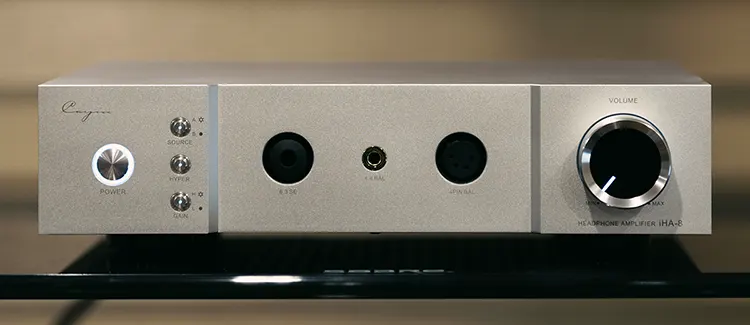
For this section, I wanted to compare the performance of the M27 lineout and the M17’s equivalent using the Cayin iHA-8 as the test amplifier. In each instance, I tested the iHA-8 output via a 4.4mm balanced PO connection using the Austrian Audio Composer.
I thought the difference between the M27’s balanced lineout and the M17’s version was quite noticeable. There is a certain softness in note definition with flatter dynamics from the M17 compared to the more vibrant delivery of the M27.
The M17 had a vocal forward performance, but the staging presence behind felt somewhat dimmed and narrower. Whereas the M27 sounded taller and wider with improved upper-order harmonic presence and a more holographic presentation.
It’s a similar scenario, switching to the single-ended lineout performance comparisons. The M17 presentation sounds somewhat rolled off at both ends of the spectrum and, as a result, comes off a little bit more mid-centric with background instrumental separation softer and less precise in its placement.
The M27 SE output is once again taller-sounding with more air and sparkle, creating a more spacious and complex performance. Though not mid-centric, vocals have more impact and detail than the fuzzier M17’s equivalent.
IEM Pairings
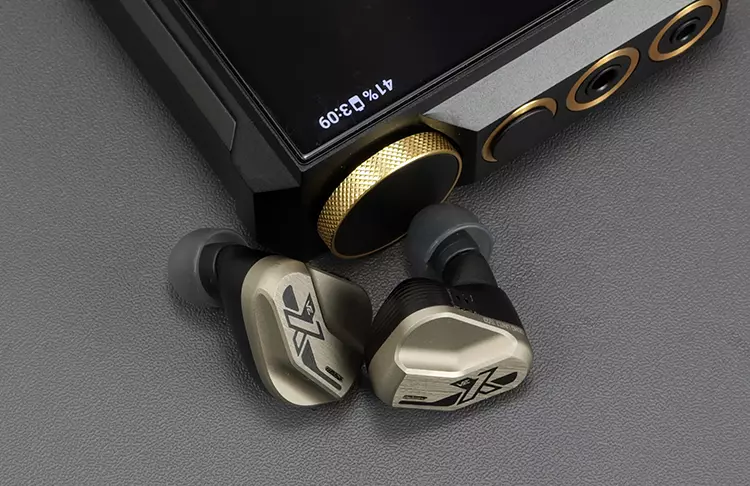
I tested 5 IEMs with the M27 in low-gain mode via its balanced 4.4mm output. These included the PMG Audio Apx, the Vision Ears VE10, Volk Audio ÉTOILE, the Noble Audio Shogun, and JH Audio’s Jolene (custom IEM format).
This was one of those occasions where I preferred the SE output over the balanced alternative for some, but not all of the tested IEMs.
For example, PMG Audio’s Apx sounded wonderful in balanced mode because it has the space to allow everything to breathe.
It needs to sound dynamic to convince, and that was very much the case with the M27 pairing. Vocals were vibrant, staging was airy and tall-sounding, and there was plenty of refined ‘fizz’ in the upper-mids.
The JH Audio Jolene performance was perhaps the best I ever heard from a DAP. Typically, it can sound dark when you push the Bass Boost module to max. Not the case here.
The balanced output kept the upper-mids and vocal range clear of the lows, whilst creating excellent definition and a short enough decay from the bass response to sound clear and powerful.
Conversely, the M27 SE output with the Jolene sounded soft with the vocals in the dreaded recessed position, lacking presence and power.
Single-ended suited my preference more with the VE10, ÉTOILE, and, to some extent, the Shogun. With the ÉTOILE in balanced mode, it sounded a little edgy and sharp in its prominent upper-mids, compared to the more coherent and smoother SE output.
It’s more about the weight of the lows and how vibrant they were relative to the vocal presence for the VE10 and the Shogun. If you are a basshead, you will love it, but for quieter moments, the M27 SE output is more coherent and smoother-sounding.
Headphone Pairings
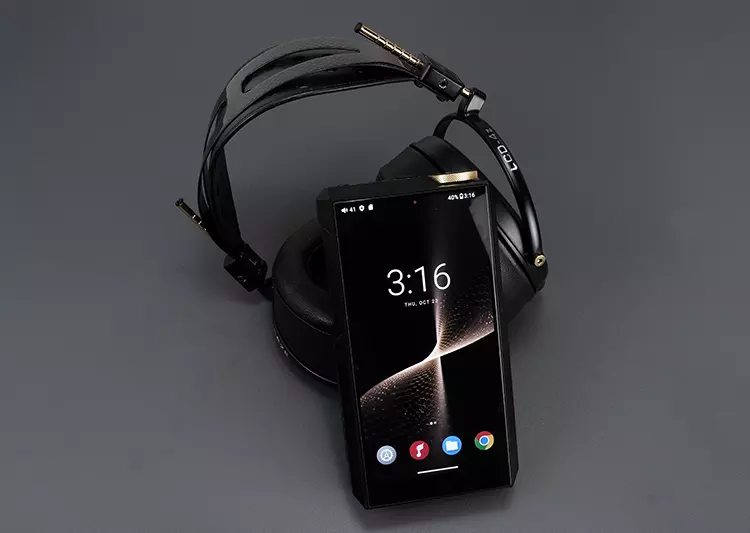
I tested 4 headphones ranging from the easy-to-drive Austrian Audio Composer up to the HIFIMAN Susvara Unveiled and the original Susvara.
The observations are about what the M27’s Ultra High Gain brings to the table for demanding gear. The good news is that, yes, in this mode, the M27 can drive both Susvara models, albeit with listening volume levels around 90.
The question is, do you like what you are hearing, and broadly speaking, I preferred the Unveiled performance over the original Susvara with the M27. Also, you will find the newer model a bit easier to drive than the original.
As a benchmark, I compared it to the Feliks Audio Envy, which has a maximum output of 6W, and found the modern Tube sound of the Envy provided more headroom and a smoother, fuller sound than the M27 presentation.
What I found pleasing about the M27 performance was its staging width, sounding slightly wider than the Envy. What I found less pleasing was the slight edge to the upper-mids of both models, around 4-5k on the OG and 6k on the Unveiled.
The M27 seemed to emphasize that a bit more prominently than the smoother Envy delivery. I would PEQ those regions, bringing them down a notch or just above it to reduce the upper-harmonic influence or enhance the second-harmonic regulation level.
The Audeze LCD-4z and the Composer sounded much more composed, with the cleaner highs of the M27 nicely suited to teasing out the relaxed LCD-4z’s mids.
The Composer can run just fine from low or medium gain, no issues, though I increased the second-harmonic regulation strength to gently soften the influence of the upper-mids and highs.
